

If you've ever searched for natural ways to calm your anxiety or soothe your digestion, you've likely run into fragmented advice that addresses one symptom at a time. Understanding what is holistic wellness framework changes that experience entirely. Rather than chasing individual fixes, a holistic wellness framework coordinates your physical health, mental and emotional state, social connections, and environment into one coherent plan. For beginners navigating conditions like anxiety and IBS, this whole-person approach is often the missing piece that makes gentle practices like Qigong feel genuinely transformative.
Table of Contents
- Understanding the holistic wellness framework: What it means and why it matters
- Core domains of whole-person health: biological, behavioral, social, and environmental
- Integrative practices within a holistic framework: How gentle movement like Qigong fits in
- Practical framework for beginners: Personalizing your holistic wellness plan
- Common beginner challenges and how to stay on track with holistic wellness
- Why holistic wellness frameworks must balance comprehensiveness with simplicity
- Explore Stella Qigong's courses to support your holistic wellness journey
- Frequently asked questions
Key Takeaways
| Point | Details |
|---|---|
| Whole-person approach | Holistic wellness frameworks address physical, mental, social, and environmental factors together for better health outcomes. |
| Four key domains | The biological, behavioral, social, and environmental domains interact bidirectionally to shape your well-being. |
| Integrative practices | Gentle methods like Qigong complement standard care as part of a coordinated, evidence-based wellness plan. |
| Start simple | Beginners should focus on a few changes per domain and build routines gradually to maintain consistency and track progress. |
| Balance breadth and depth | Effective frameworks are comprehensive yet practical, avoiding overwhelm for sustainable holistic health improvements. |
Understanding the holistic wellness framework: What it means and why it matters
Most people hear "holistic wellness" and picture a spa menu or a shelf full of supplements. That's a narrow picture. A holistic wellness framework means planning your wellness around the whole person, addressing interconnected dimensions such as physical health, mental and emotional wellbeing, social belonging, and environmental factors. It's a structured way of seeing how everything in your life talks to everything else.
This matters because symptoms like stress and digestive distress rarely have one root cause. Anxiety tightens your gut. Poor sleep inflames your nervous system. Social isolation amplifies both. A holistic health framework recognizes these loops and works with them rather than against them.
A few principles anchor every well-designed holistic wellness framework:
- Whole-person focus: No single dimension exists in isolation. Physical, mental, social, and environmental factors all shape your health simultaneously.
- Evidence-informed practices: Holistic doesn't mean unproven. Good frameworks draw on research and complement standard medical care.
- Coordination, not replacement: This approach works alongside your doctor's guidance, not instead of it.
- Personalization: One plan doesn't fit all. Your framework evolves based on your own patterns and responses.
This is what separates understanding holistic wellness from simply trying random wellness trends. When you explore integrative health practices through this lens, you stop collecting isolated techniques and start building something coherent.
Core domains of whole-person health: biological, behavioral, social, and environmental
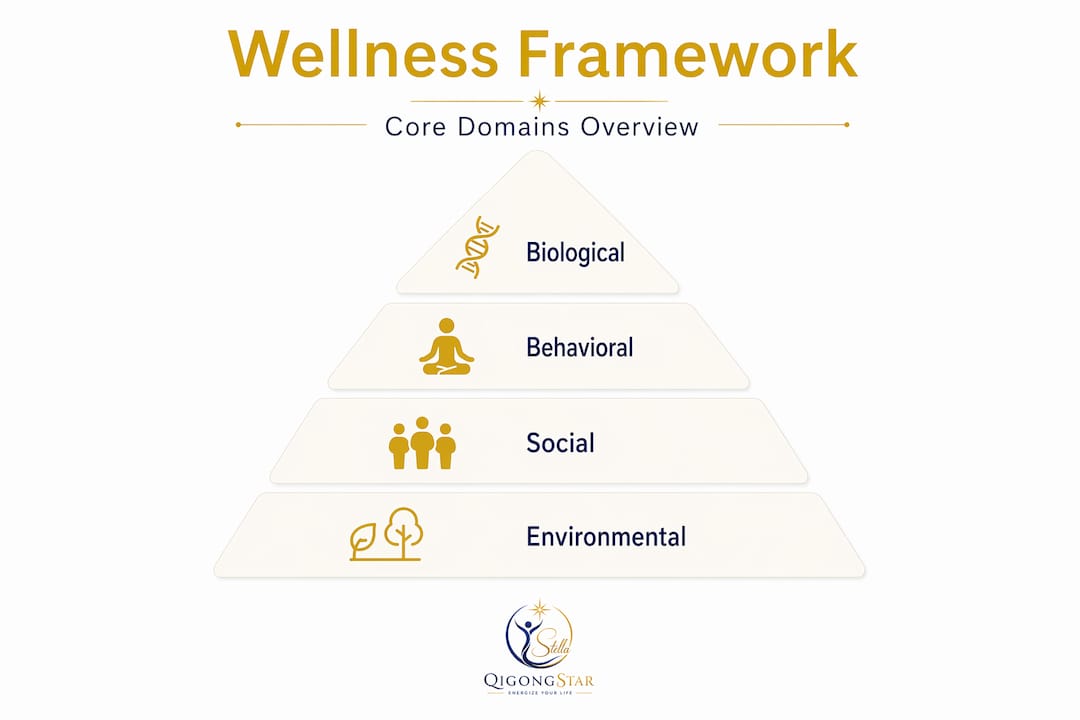
Whole-person health frameworks organize the determinants of health into four domains, biological, behavioral, social, and environmental, to understand their bidirectional interaction with health and disease. Think of these domains as four overlapping circles. When one shifts, the others feel it.
Here's how each domain shows up in real life, especially for someone dealing with anxiety or IBS:
- Biological domain: This is your body's baseline. Digestive function, nervous system tone, inflammation levels, and sleep quality all live here. For someone with IBS, the state of the gut microbiome and vagus nerve activity are biological levers worth knowing about.
- Behavioral domain: What you do each day. Movement, eating patterns, stress management practices, and sleep hygiene belong here. A daily Qigong practice is a behavioral change with biological ripple effects.
- Social domain: The quality of your relationships, sense of community, and access to support networks. Loneliness increases cortisol. A warm conversation can literally lower heart rate. Social health is physical health in disguise.
- Environmental domain: Your surroundings matter more than most people realize. A cluttered, noisy workspace can keep your nervous system in a low-level stress state all day. Natural light, calming spaces, and reduced screen time are environmental inputs.
The table below illustrates how these domains interact for someone managing anxiety and IBS:
| Domain | Example factor | Impact on anxiety and IBS |
|---|---|---|
| Biological | Gut microbiome balance | Disrupted microbiome worsens IBS symptoms and mood |
| Behavioral | Daily Qigong practice | Calms nervous system, reduces cortisol and gut tension |
| Social | Regular connection with friends | Lowers stress hormones, supports emotional regulation |
| Environmental | Natural light and calm workspace | Reduces low-grade stress activation throughout the day |
Building holistic wellness routines becomes far more powerful once you see your symptoms through all four of these lenses at once.
Integrative practices within a holistic framework: How gentle movement like Qigong fits in
Integrative medicine uses evidence-based complementary methods like meditation, yoga, acupuncture, and massage alongside standard care to relieve symptoms and improve wellbeing. Qigong sits naturally within this definition. It's gentle, accessible, and backed by a growing body of research supporting its role in stress reduction and nervous system regulation.

What makes Qigong particularly valuable within a holistic health framework is how it touches multiple domains at once. A single 20-minute Qigong session can calm the biological stress response, reinforce a positive behavioral habit, and create a quiet environmental ritual that anchors your day. That's unusual efficiency for a practice anyone can start at home.
Here's how to integrate Qigong thoughtfully into your wellness plan:
- Pair it with sleep hygiene: A short evening Qigong flow can signal your nervous system that the day is winding down, supporting better sleep quality.
- Combine with mindful nutrition: Practicing Qigong before meals activates the parasympathetic nervous system, the "rest and digest" state, which can meaningfully ease IBS symptoms.
- Stay connected to your healthcare provider: If you're managing diagnosed anxiety or IBS, Qigong as a modality works best within a coordinated care plan rather than as a standalone solution.
- Build social rituals around it: Joining a live online Qigong class creates community and accountability, feeding the social domain of your framework at the same time.
Pro Tip: Start with just 10 minutes of Qigong three times a week before you layer in other practices. Consistency with one gentle habit builds the foundation that makes everything else stick.
Exploring the Qigong benefits for wellness beyond stress relief, including its effects on gut motility and immune tone, can help you see why it deserves a real place in your plan.
Practical framework for beginners: Personalizing your holistic wellness plan
Knowing the principles of holistic wellness is one thing. Applying them without feeling overwhelmed is another. The good news is that beginners benefit most from selecting one or two levers per domain first, then expanding gradually to avoid overwhelm and improve adherence.
Here's a practical starting sequence you can follow:
- Assess your current state across all four domains. Write one honest sentence about your biological health, your daily behaviors, your social connections, and your environment. This alone creates clarity most people have never had.
- Choose one change per domain. Not four. Not eight. One per domain. For example: a 10-minute Qigong routine (behavioral), a short evening walk outside (environmental), a weekly check-in call with a friend (social), and speaking to your doctor about your gut symptoms (biological).
- Build a minimal daily anchor. One practice that ties your domains together. A morning Qigong session, followed by a mindful breakfast and five minutes of journaling, works beautifully as this anchor.
- Track for three weeks before adjusting. Note your energy, sleep, stress level, and gut comfort daily. Patterns will emerge faster than you expect.
- Expand from evidence, not enthusiasm. Only add a new practice when your current ones feel settled and natural.
A practical beginner framework starts by assessing multiple life drivers and planning coordinated routine changes, rather than focusing only on symptoms. That reframing alone relieves a lot of pressure.
| Domain | Beginner starter activity | Benefit for anxiety and IBS |
|---|---|---|
| Biological | Track sleep and gut symptoms | Identifies patterns and triggers |
| Behavioral | 10-min daily Qigong | Calms nervous system, improves digestion |
| Social | Weekly wellness check-in with a friend | Reduces isolation, lowers cortisol |
| Environmental | 5-min morning outdoor light exposure | Supports circadian rhythm and mood |
Pro Tip: Pair your personalized wellness routines with a simple tracking note on your phone. Even three words a day, such as "calm, tight gut, tired," builds a feedback loop that guides smarter adjustments over time. You can also explore practicing mind-body medicine at home for more structured guidance on getting started.
Common beginner challenges and how to stay on track with holistic wellness
How to implement holistic wellness successfully often comes down to avoiding a handful of predictable traps. Knowing them in advance keeps your energy focused and your momentum steady.
The most common challenges beginners face include:
- Doing too much at once. Implementing a whole framework all at once often leads to failure and poor adherence. A focused, incremental approach consistently outperforms ambitious overhauls.
- Confusing integrative with alternative medicine. Integrative wellness adds gentle practices to your existing care. Alternative medicine replaces standard treatment entirely. These are not the same thing, and the distinction genuinely matters for your safety.
- Skipping progress tracking. Without tracking, you lose the feedback that tells you what's actually working. Changes that feel insignificant on day one may show clear patterns by week three.
- Ignoring red flags. If your anxiety or IBS symptoms worsen significantly, that's a signal to consult your healthcare provider, not to double down on wellness practices alone.
"Integrative therapies should complement standard care, not replace it, to avoid harm and maximize benefits."
Staying on track also means being honest with yourself about what feels sustainable. If a new practice feels like a chore after two weeks, it's worth examining whether it fits your actual life. For deeper guidance on navigating common beginner challenges, especially when dealing with chronic discomfort alongside stress, gentle and informed support makes all the difference.
Why holistic wellness frameworks must balance comprehensiveness with simplicity
Here's something most wellness content won't tell you: the benefits of holistic wellness are only available to the people who actually follow through. And most beginners don't follow through because they're given frameworks that are too elaborate to sustain.
There's a tempting logic that says more modalities equal better results. Add Qigong, then acupuncture, then a strict elimination diet, then cold therapy, then breathwork, and surely something will work. But building a whole-person health framework isn't about adding more variables. It must be concise yet thorough enough to be genuinely usable. The frameworks that transform health are elegant, not exhausting.
For someone with anxiety and IBS, this matters acutely. Your nervous system is already sensitized. Piling on complex protocols can actually increase the stress load, worsening the very symptoms you're trying to release. The most effective approach is identifying the two or three upstream drivers that have the most influence over your symptoms, and nurturing those consistently.
Pro Tip: Ask yourself one honest question each week: "Is my wellness plan calming me or stressing me out?" Your answer tells you more than any symptom tracker.
This is also where evidence-informed practice becomes your anchor. Not every gentle therapy carries equal research support. Prioritizing practices with real clinical backing, like Qigong for stress and gut health, gives you something solid to return to when wellness culture gets noisy and overwhelming. A good framework doesn't just tell you what to add. It tells you what to trust.
Explore Stella Qigong's courses to support your holistic wellness journey
If you're ready to put the principles of holistic wellness into gentle, daily motion, Stella Qigong's online courses offer a warm, structured place to begin. Designed for beginners navigating stress, anxiety, and digestive concerns, these courses weave Qigong movement, breath regulation, and mindful awareness into accessible routines you can practice from home at your own pace.
The 5 Animal Qigong course draws on traditional Chinese Medicine to awaken your energy and release deep-held tension in ways that directly support nervous system balance and gut health. Whether you prefer on-demand flexibility or live community sessions, the full range of online Qigong courses lets you build consistency without pressure. For those specifically dealing with stress and IBS, the dedicated stress relief and digestion course is a natural next step.
Frequently asked questions
What is a holistic wellness framework?
A holistic wellness framework is a whole-person health approach that addresses physical, mental, social, and environmental factors together to plan wellness comprehensively and safely, rather than treating symptoms in isolation.
How does Qigong fit into a holistic wellness framework?
Qigong is a gentle movement practice that supports nervous system regulation and stress relief as part of a coordinated, evidence-informed wellness plan. It functions as one supportive modality within a broader framework that also includes sleep, nutrition, and social connection.
Can I use holistic wellness frameworks instead of medical treatment?
No. Integrative holistic approaches are designed to complement standard medical care, not replace it. Replacing evidence-based treatments with alternatives can increase health risks and delay necessary care.
How do I start creating my own holistic wellness framework?
Begin by honestly assessing your habits across biological, behavioral, social, and environmental areas, then select one to two changes per domain. Build coordinated routines gradually, track your results, and consult a healthcare professional if symptoms are severe or worsening.