
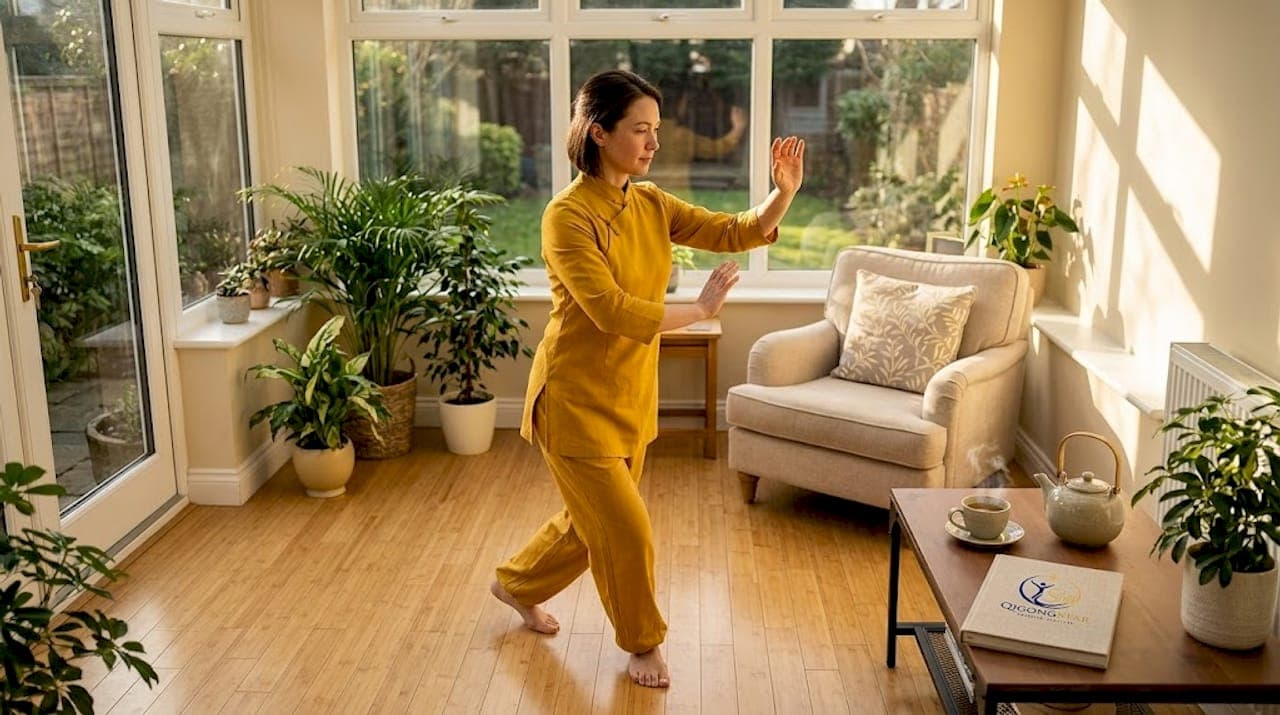
Stress, anxiety, and digestive troubles rarely travel alone. If you have ever noticed your stomach tightening on a hard day or felt completely drained after a rushed meal, you already understand something that TCM principles for everyday wellness have explained for centuries: your body and mind are one connected system. Traditional Chinese Medicine (TCM) sees stress, digestion, and energy as deeply linked, and it offers gentle, practical tools to restore that balance. Qigong and Tai Chi sit at the heart of those tools, giving you a way to calm your nervous system, soothe your gut, and awaken your energy without a single piece of equipment.
Table of Contents
- Understanding TCM principles for everyday wellness
- Preparing your body and mind: starting gentle Qigong and Tai Chi routines
- Executing daily Qigong and Tai Chi practices to relieve stress and digestive discomfort
- Supporting digestion and spleen qi through TCM lifestyle and movement
- Why tailored TCM practices may outperform generic wellness routines
- Explore Stella Qigong's courses to start your TCM wellness journey
- Frequently asked questions
Key Takeaways
| Point | Details |
|---|---|
| Mind-body harmony | TCM principles emphasize balancing Qi and supporting organ systems like the spleen for overall wellness. |
| Gentle movement efficacy | Qigong and Tai Chi use low-intensity movements to reduce stress, anxiety, and improve digestion effectively. |
| Tailored practice matters | Choosing Qigong or Tai Chi based on your specific mental health patterns improves results and adherence. |
| Lifestyle synergy | Supportive habits like warm cooked foods, regular meals, and post-meal walks enhance digestive health in TCM. |
| Accessible for all | These practices require minimal equipment and can be adapted for any fitness level, making them practical everyday tools. |
Understanding TCM principles for everyday wellness
At the foundation of TCM is the concept of Qi (pronounced "chee"), your body's vital energy. Qi flows through channels called meridians, much like rivers running through a landscape. When that flow is smooth and balanced, you feel well. When it stagnates or weakens, physical and emotional symptoms appear.
Yin and Yang are two complementary forces that must stay in balance for health. Yin represents rest, cooling, and inward movement. Yang represents activity, warmth, and outward movement. Modern life, with its constant stimulation, late nights, and irregular meals, tends to drain Yin and overactivate Yang, leaving you wired, anxious, and exhausted all at once.
One of the most important organs in TCM for stress and digestion is the Spleen. Not to be confused with its Western anatomical counterpart, the TCM Spleen governs the transformation and transportation of nutrients from food into Qi and Blood. The Spleen in TCM links digestion, energy production, and your stress response, with symptoms like bloating and fatigue after meals as common signs of Spleen Qi deficiency.
Common signs that your Spleen Qi may need support include:
- Bloating, especially after meals
- Fatigue or brain fog in the early afternoon
- Loose stools or irregular digestion
- Craving sweets as a false energy fix
- Feeling heavy, sluggish, or unmotivated
- Anxiety that flares when you skip meals
Chronic stress is particularly damaging to Spleen Qi because the Liver energy (which governs emotional flow) easily "attacks" the Spleen when stress is unresolved. Sleep disruption compounds this further, since your body restores digestive energy during deep sleep hours. Understanding these TCM approaches for stress and digestion gives you a clear map of why gentle, consistent movement practices work so well for everyday wellbeing.
Preparing your body and mind: starting gentle Qigong and Tai Chi routines
Now that you understand the foundational TCM principles, let's look at practical preparations to ensure your Qigong or Tai Chi practice supports your wellness journey effectively.
The beauty of these practices is their simplicity. You do not need a gym, special footwear, or expensive equipment. Comfortable, loose-fitting clothing and a space roughly the size of a yoga mat are genuinely all that is required.
Qigong is gentle breathing with movement, accessible for people not in top shape, and entirely suitable for stressed or fatigued adults. Harvard Health notes it can be practiced standing, sitting, or even lying down, making it one of the most inclusive wellness practices available.

| Setting | What it supports | Why it matters |
|---|---|---|
| Outdoors in nature | Grounding, fresh Qi absorption | Natural environment amplifies calming effect |
| Quiet indoor space | Focus, breath awareness | Reduces sensory overload during practice |
| Seated or lying down | Physical accessibility | Suitable for fatigue, injury, or frail adults |
| Morning practice | Yang energy activation | Aligns with natural body rhythm |
| Evening practice | Yin nourishment, wind-down | Supports sleep and nervous system recovery |
Before you begin, a simple warm-up makes a real difference. Roll your ankles and wrists gently, rotate your neck slowly, and take three full belly breaths. This signals your nervous system to shift from reactive mode into receptive mode. It is not just ritual, it is physiology.
Key preparation tips to carry with you:
- Set a clear intention. Even one word, like "calm" or "release," focuses the mind before movement begins.
- Breathe through your nose. Nasal breathing activates the parasympathetic nervous system more effectively than mouth breathing.
- Start with just 10 minutes. Consistency matters far more than duration in the early weeks.
- Remove distractions. A silenced phone changes the quality of your practice more than any technique.
Exploring basic Qigong routines or gentle Qigong styles is an excellent way to find the approach that feels right for your body and lifestyle.
Pro Tip: If you feel scattered or anxious before practice, place one hand on your belly and breathe slowly until you feel it rise and fall three times. This simple act re-anchors your awareness in your body before you even begin moving.
Executing daily Qigong and Tai Chi practices to relieve stress and digestive discomfort
With your preparations complete, here is how to implement gentle daily practices that align perfectly with your wellness goals.
Research is now specific enough to guide which practice suits which need. Qigong shows stronger effects for depression, while Tai Chi is more consistent for anxiety, with noticeable anxiety improvements seen within 6 to 8 weeks of practicing 4 or more sessions per week. That is a meaningful distinction if you are navigating both.
Here is a simple framework for building your daily practice:
- Open with standing stillness (2 minutes). Stand with feet shoulder-width apart, knees soft, eyes half-closed. Feel the ground beneath your feet. This is called "Zhan Zhuang" in Chinese medicine and it alone begins to regulate the nervous system.
- Practice slow weight shifting (3 to 5 minutes). Shift your weight gently from foot to foot in a slow, rhythmic pattern. This activates the vagus nerve, your body's main calming pathway, through sensory input from the feet and legs.
- Add breath-coordinated arm movements (5 to 10 minutes). Inhale as arms rise, exhale as arms lower. Keep movement slow and continuous, never strained. This is the core of most Qigong forms.
- Include a spinal wave or gentle rotation (3 minutes). A slow, mindful twist from the waist with exhale massages the internal organs and supports digestive Qi flow directly.
- Close with stillness and gratitude (2 minutes). Return to standing, hands over your belly, and take three deep breaths. This seals the practice and helps your body integrate the calm.
| Practice | Best for | Recommended frequency | Typical results timeline |
|---|---|---|---|
| Qigong | Depression, digestive support, fatigue | 3 or more sessions per week | 9 to 12 weeks |
| Tai Chi | Anxiety, balance, sustained calm | 4 or more sessions per week | 6 to 8 weeks |
| Combined practice | Both mood and digestion | 4 to 5 sessions per week | 6 to 10 weeks |
One of the most compelling pieces of recent evidence: a 2023 trial found that just 12 minutes of Qigong breathwork combined with grounding movement daily for 4 weeks reduced generalized anxiety scores by 42%. That is not a small effect for something you can do in your living room before breakfast.
The mechanism behind this is the mind-body connection through the vagus nerve, a long nerve that runs from your brainstem to your gut. Slow, rhythmic movement and deep diaphragmatic breathing directly stimulate vagal tone, reducing the stress hormones that disrupt both mood and digestion. Explore the broader Qigong benefits guide for deeper context on how these mechanisms translate to lasting change.
Pro Tip: If Tai Chi feels complex to learn alone, start with single-form repetition. Practicing just one Tai Chi movement for 10 minutes, repeatedly and mindfully, delivers measurable nervous system benefits without needing to memorize a full sequence.
Supporting digestion and spleen qi through TCM lifestyle and movement
In addition to movement, lifestyle and diet rooted in TCM enhance your digestive wellness and support Spleen Qi effectively.
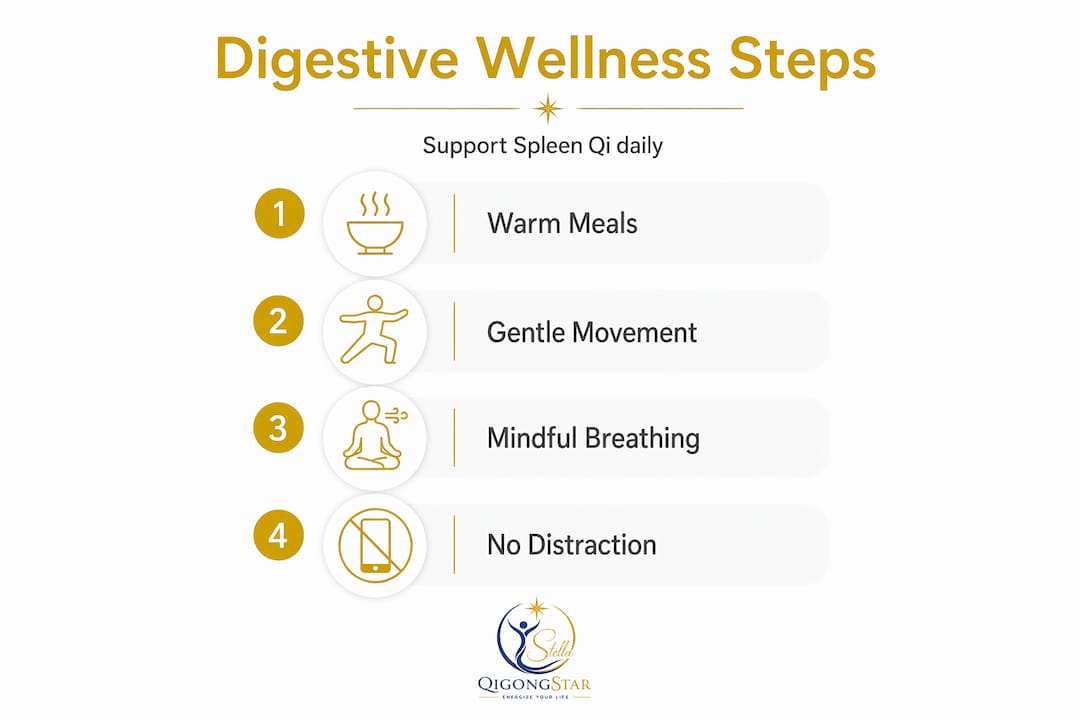
TCM dietary principles are not about calorie counting. They are about the nature of what you eat and how you eat it. Warm, cooked foods and gentle post-meal movement support Spleen Qi and digestion directly, helping to reduce bloating and the fatigue that often follows meals.
Foods and habits that nurture Spleen Qi:
- Warm soups and stews. Easy to digest, nourishing, and naturally warming.
- Ginger and cinnamon. Both awaken digestive fire and support the Spleen's transforming function.
- Lightly cooked vegetables. Steamed or sauteed rather than raw, which taxes a weakened Spleen.
- Congee (rice porridge). A classic TCM digestive tonic, particularly good during illness or high stress.
- Regular meal times. Eating at consistent times anchors your digestive rhythm and reduces Spleen stress.
What weakens Spleen Qi deserves equal attention. Cold and raw foods, excessive sweet or processed foods, eating while distracted, and irregular sleep all drain this system quietly over time.
Practitioners advise gentle post-meal movement instead of lying down after eating, especially in winter when digestion naturally slows. A calm 10-minute walk or a few gentle Qigong circles with your hands over your abdomen helps Qi descend through the digestive tract rather than stagnate. Read more about Qigong for digestive health to see how specific movements can target gut function directly.
Pro Tip: After your largest meal of the day, rest your palms over your lower abdomen and breathe slowly for 3 minutes before standing. This simple act encourages your body to stay in "rest and digest" mode rather than switching back into stress activation.
Why tailored TCM practices may outperform generic wellness routines
Most generic wellness advice tells you to "exercise more, stress less, eat better." You already know that. The reason it rarely sticks is that it does not account for your specific pattern of imbalance.
TCM has always understood that one person's anxiety is not the same as another's. Someone with Liver Qi stagnation needs movement and emotional release. Someone with Spleen Qi deficiency needs nourishment and gentleness. Prescribing the same vigorous yoga class or high-intensity walking routine to both often makes one of them worse. Matching the practice to the need demonstrably improves both adherence and effectiveness, as the differentiated benefits of Qigong versus Tai Chi for depression and anxiety clearly show.
This is the practical wisdom that sets a Chinese medicine lifestyle apart from trend-driven wellness culture. When you understand whether your stress is showing up as fatigue and foggy thinking (Spleen and Blood deficiency) or as tension and irritability (Liver Qi stagnation), you can choose the practice that genuinely restores rather than one that simply tires you out in a more wholesome way.
The other underappreciated advantage of Qigong and Tai Chi is the barrier to entry. No equipment, no gym membership, no special fitness level required. This makes consistency genuinely possible in a way that more demanding practices often do not. And in wellness through TCM, consistency is everything. A 10-minute daily practice practiced for 3 months will transform your nervous system more reliably than a 90-minute class attended twice a month.
We have seen this pattern repeatedly at QigongStar: students who approach Qigong as a daily ritual rather than an occasional workout consistently report deeper, more lasting shifts in both stress and digestion. The body responds to rhythm. TCM was built on that understanding thousands of years before modern neuroscience confirmed it. Trust the gentleness. It is not a lesser version of wellness. It may well be the most effective one, especially for those of you who are already depleted.
Explore Stella Qigong's courses to start your TCM wellness journey
To support you on this journey, consider guided courses that bring the principles and practices discussed here to life, making your wellness routine easy and effective.
At QigongStar, the Qigong online courses are designed specifically for people navigating stress, anxiety, and digestive challenges. No equipment, no prior experience, and no need to leave your home. Each course weaves TCM dietary principles, breath awareness, and gentle movement into a flowing, accessible routine you can adapt to your schedule. The 5 Animal Qigong program is a wonderful starting point, drawing on the five animal archetypes of classical Chinese medicine to nurture your physical vitality, calm your mind, and support your gut. You will walk away with an empowering daily practice that genuinely fits your life.
Frequently asked questions
What is the difference between Qigong and Tai Chi for mental health?
Qigong tends to be more effective for relieving depression symptoms due to its simple, breath-focused movements, while Tai Chi more consistently improves anxiety by training sustained attention and embodied awareness.
How often should I practice Qigong or Tai Chi for noticeable benefits?
Practicing Qigong about 3 times per week benefits depression, while Tai Chi for anxiety works best with 4 or more sessions weekly. Anxiety improvements appear within 6 to 8 weeks, and depression typically responds within 9 to 12 weeks.
Can gentle Qigong help reduce digestive problems?
Yes. Qigong combined with warm, cooked foods and gentle post-meal movements supports Spleen Qi, which helps improve digestion, reduce bloating, and sustain daily energy according to TCM principles.
Is Tai Chi or Qigong suitable for beginners and frail adults?
Absolutely. Both practices are gentle, low-impact, and adaptable. Qigong and Tai Chi are accessible for people not in top physical shape and can be practiced standing, sitting, or lying down.