

Your body doesn't just get sick. It sends signals. Tension behind your eyes before a stressful meeting. Bloating that flares when you're anxious. Fatigue that deepens every winter. Western medicine often treats these as separate problems, but the traditional Chinese medicine five elements framework sees them as one interconnected conversation. Known as Wu Xing, this Five Elements Theory maps five dynamic forces, Wood, Fire, Earth, Metal, and Water, onto your organs, emotions, and even the seasons. Once you understand this map, the path to calmer nerves and a happier gut becomes much clearer.
Table of Contents
- What are the Five Elements in traditional Chinese medicine?
- How the Five Elements shape health: cycles and interactions
- Applying the Five Elements: stress relief and digestive health
- Five Elements diagnosis and restoration: methods in practice
- Five Elements and Western science: symbol or reality?
- Why balancing the Five Elements is more than a wellness trend
- Take your next step with Five Elements-inspired practice
- Frequently asked questions
Key Takeaways
| Point | Details |
|---|---|
| Five Elements basics | Wood, Fire, Earth, Metal, and Water each relate to specific organs, emotions, and aspects of health in TCM. |
| Holistic cycles matter | Balance among the Five Elements promotes optimal health, while disruption can cause stress or digestive issues. |
| Stress and digestion links | TCM connects stress to Wood/Liver imbalances and digestive problems to Earth/Spleen or Stomach dysfunction. |
| Diagnosis and remedies | TCM diagnosis considers emotional, physical, and seasonal signs; interventions may include acupuncture, diet, and Qigong. |
| Integrate with Western care | Combining TCM and Western habits can maximize your holistic wellness journey. |
What are the Five Elements in traditional Chinese medicine?
To understand how these principles affect your well-being, let's break down the core framework. The five elements in TCM are not symbols on a page. They are living, breathing patterns that describe how energy moves through your body, your mind, and the world around you.
Each element pairs with specific organs, an emotion, a season, and even a taste. Think of them less like categories and more like personalities, each with its own strengths and vulnerabilities.
| Element | Organs | Emotion | Season | Taste |
|---|---|---|---|---|
| Wood | Liver, Gallbladder | Anger, frustration | Spring | Sour |
| Fire | Heart, Small Intestine | Joy, anxiety | Summer | Bitter |
| Earth | Spleen, Stomach | Worry, overthinking | Late summer | Sweet |
| Metal | Lungs, Large Intestine | Grief, sadness | Autumn | Pungent |
| Water | Kidneys, Bladder | Fear, willpower | Winter | Salty |
The five elements are Wood, Fire, Earth, Metal, and Water, each corresponding to specific organ pairs that govern both physical and emotional health. What makes this framework so powerful is that it treats your emotions as diagnostic data, not inconveniences to suppress.
Here is a quick snapshot of what each element governs in your body and mind:
- Wood: Governs planning, vision, and the smooth flow of Qi (life energy). When balanced, you feel motivated and decisive. When stressed, anger and physical tension build.
- Fire: Rules the heart and governs joy, connection, and mental clarity. Imbalance shows up as anxiety, insomnia, or a racing mind.
- Earth: Manages digestion and nourishment. Worry and overthinking are its emotional signatures. Bloating and fatigue often signal Earth imbalance.
- Metal: Linked to the lungs and letting go. Grief or prolonged sadness can weaken this element, affecting breathing and immunity.
- Water: The foundation of vitality and willpower. Fear and chronic exhaustion often point to a depleted Water element.
"The Five Elements are not static labels. They are dynamic, interrelated forces that constantly influence one another, creating health when in balance and dis-ease when disrupted."
This is the heart of traditional Chinese healing. Your liver is not just a detox organ. It is the seat of your emotional resilience and physical flexibility. Your spleen is not just digestive machinery. It is how you process both food and worry.
How the Five Elements shape health: cycles and interactions
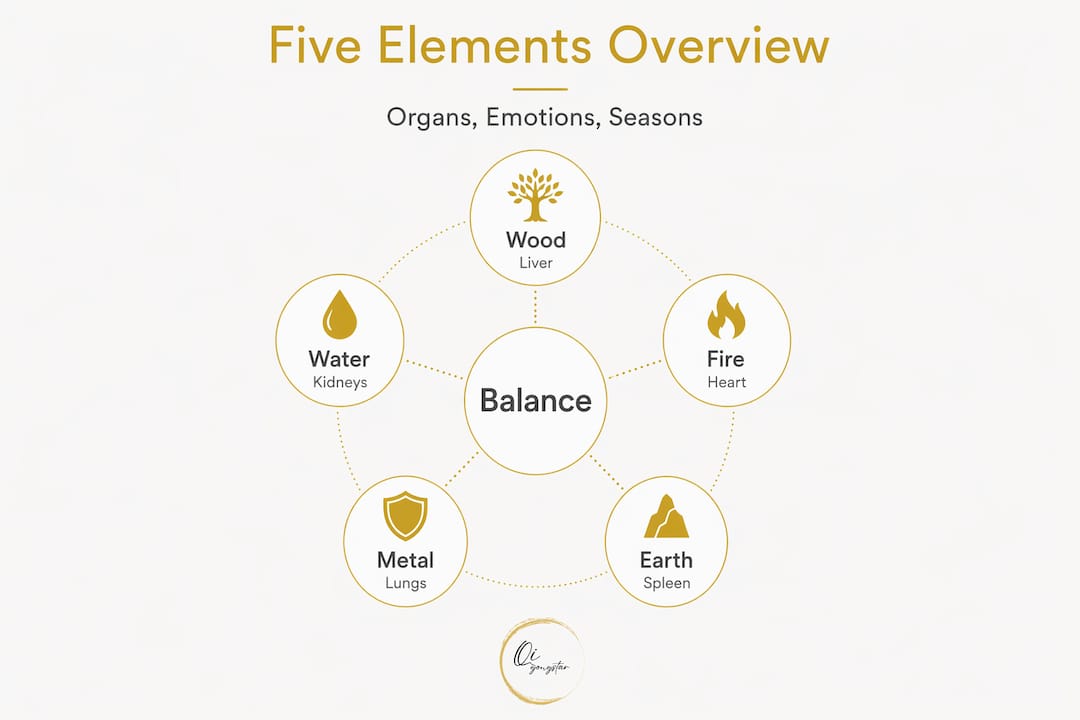
Now that you know what each element represents, let's look at how their relationships impact your daily health. The elements don't operate in isolation. They move through two key cycles that either nourish or regulate one another.
The two core cycles:
- The generating cycle (Sheng cycle): Each element feeds and supports the next. Water nourishes Wood. Wood fuels Fire. Fire creates Earth (ash). Earth produces Metal. Metal enriches Water. This is the nurturing, mother-to-child flow of energy.
- The controlling cycle (Ke cycle): Each element also keeps another in check. Wood controls Earth. Earth controls Water. Water controls Fire. Fire controls Metal. Metal controls Wood. This is the regulating relationship that prevents any one element from dominating.
When these cycles flow freely, you feel balanced and well. When they are disrupted, imbalance sets in.
| Cycle state | What it looks like | Common experience |
|---|---|---|
| Healthy generating | Smooth energy transfer between organs | Consistent energy, stable mood |
| Healthy controlling | Natural regulation and checks | Calm digestion, clear thinking |
| Overacting (excess control) | One element over-suppresses another | Stress causing digestive upset |
| Counteracting (rebellion) | Weaker element pushes back on stronger | Chronic fatigue resisting treatment |
Overacting and counteracting cycles are the root of many common complaints. A classic example: when Wood (Liver) is overcharged by chronic stress, it overcontrols Earth (Spleen/Stomach), causing bloating, loose stools, or poor appetite. This is not metaphor. This is a pattern TCM practitioners observe daily.
Pro Tip: If your digestion consistently worsens during stressful periods, your Wood element may be invading your Earth. Soothing the Liver through gentle movement and sour foods like lemon water can help ease that pressure before it settles into your gut.
The elements also respond to seasons. Spring is Wood's time, which is why many people feel restless or irritable in March and April. Winter belongs to Water, which is why fatigue and fear tend to surface more deeply in the coldest months. Working with these seasonal rhythms, rather than against them, is one of the most practical gifts the five elements theory offers.

Applying the Five Elements: stress relief and digestive health
Understanding the theory is powerful, but how do you use it for the issues you care about, like stress or digestion?
Stress and the Wood element
When you are under chronic stress, your Liver Qi stagnates. The Wood/Liver imbalance shows up as irritability, tension headaches, tight shoulders, PMS, and difficulty winding down. The Liver needs to move freely, like a tree bending in the wind. When it can't, that energy gets stuck.
To calm Wood and restore flow:
- Practice stress reduction exercises like Qigong or gentle stretching to release stagnant Liver Qi
- Add sour foods (lemon, apple cider vinegar, fermented vegetables) to support the Liver
- Prioritize sleep before midnight, when the Liver does its deepest repair work
- Support the Water element (Kidney), which is Wood's mother, to nourish and calm an overactive Liver
Digestive health and the Earth element
The Earth element governs the Spleen and Stomach, the central digestive hub in TCM. When Earth is weak, you experience bloating, fatigue after meals, poor appetite, loose stools, and a tendency to overthink or ruminate. Worry is Earth's emotion, and it is a two-way street: worry weakens digestion, and weak digestion amplifies anxiety.
To nurture Earth and soothe your gut:
- Eat warm, cooked foods rather than cold or raw, which tax the Spleen
- Reduce excessive sweet foods, which temporarily stimulate Earth but ultimately deplete it
- Practice Qigong for IBS relief, which gently activates the digestive meridians
- Limit worry time by setting boundaries around rumination, a surprisingly direct way to protect your Spleen Qi
- Explore our Qi Blog insights for practical TCM-inspired wellness tips
Pro Tip: Support the mother element to restore a depleted child. Earth's mother is Fire (Heart). When digestion is chronically weak, warming heart-centered practices like breathwork, gratitude journaling, or gentle movement can kindle the digestive fire from above.
Five Elements diagnosis and restoration: methods in practice
Let's see how these principles play out in real-life assessments and therapy sessions.
How a TCM practitioner diagnoses elemental imbalance:
- Emotional signature: Which emotions do you cycle through most? Persistent anger points to Wood. Chronic worry signals Earth. Ongoing grief suggests Metal.
- Seasonal sensitivity: Do your symptoms worsen in a particular season? That season's element is often the weakest link.
- Pulse diagnosis: A trained practitioner reads 12 distinct pulse positions on your wrists, each corresponding to a specific organ and element.
- Tongue observation: The color, coating, and shape of your tongue reveal the state of your internal organs with surprising specificity.
- Physical symptoms: Recurring headaches (Wood), heart palpitations (Fire), bloating (Earth), dry cough (Metal), lower back pain (Water) all carry elemental signatures.
Once an imbalance is identified, TCM treatments restore balance through acupuncture on specific meridians, herbal formulas matched to the element's taste and temperature, dietary adjustments, and movement practices like Qigong.
Therapies matched to each element:
- Wood: Acupuncture on Liver/Gallbladder meridians, sour herbs like milk thistle, lateral stretching movements
- Fire: Heart-calming herbs like hawthorn berry, meditation, breathwork
- Earth: Warming foods, moxibustion (heat therapy on acupuncture points), 5 Animal Qigong practices that stimulate the digestive center
- Metal: Lung-opening breathing exercises, pungent herbs like astragalus, grief processing
- Water: Restorative rest, kidney-nourishing foods like black beans and walnuts, gentle Water Qigong flows
Pro Tip: At-home balancing works beautifully for mild, early-stage imbalances. If your symptoms are chronic, painful, or significantly affecting your quality of life, a qualified TCM practitioner can provide a precise diagnosis and a treatment plan tailored to your unique elemental pattern.
Five Elements and Western science: symbol or reality?
While TCM's approach is deeply experiential, many readers wonder how it stands up scientifically.
The honest answer is nuanced. Western science currently lacks empirical tools to measure Qi or verify the Five Elements as a biological model. There is no blood test for Wood deficiency. No scan that shows a depleted Water element. From a strictly materialist perspective, the framework is symbolic.
"TCM sees the Five Elements as dynamic processes that guide holistic diagnosis and treatment. Western science, without a measurable equivalent to Qi, treats them as a symbolic system rather than a verifiable physiological model."
But here is where it gets interesting. The limitations and the experiential strengths of the five elements in health exist side by side:
- Limitations: No randomized controlled trials validate the Five Elements as a standalone diagnostic system. Results vary between practitioners. The framework is not designed for acute emergencies or structural pathology.
- Strengths: Thousands of years of clinical observation. Patterns that correlate with modern psychosomatic research (stress causing gut issues, grief weakening immunity). A framework that treats the whole person, not just isolated symptoms. Practical tools that people find genuinely useful for self-awareness and prevention.
The most grounded approach is to hold both perspectives. Use Western medicine for diagnosis, acute care, and anything structural. Use the Five Elements as a lens for understanding patterns, preventing imbalance, and nurturing the emotional and energetic dimensions of your health that lab results simply don't capture.
Why balancing the Five Elements is more than a wellness trend
Here is something most articles on this topic won't tell you: the Five Elements framework is not primarily a treatment system. It is a pattern recognition system. And that distinction matters enormously.
Most wellness trends offer you a fix. Take this supplement. Follow this protocol. Do this detox. The Five Elements offer something more valuable: a way of reading yourself over time. When you understand that your annual winter fatigue is a Water element pattern, not a personal failing, you stop fighting it and start working with it. You rest more deeply in January. You eat warming foods. You protect your Kidneys. And by spring, your Wood element rises with genuine energy rather than dragging itself into the new season on caffeine and willpower.
We have seen this shift happen repeatedly in our Qigong community. Someone comes in frustrated by digestive issues that no elimination diet has solved. They learn about Earth element patterns. They realize their gut flares every time they spiral into worry. They start a gentle Qigong practice that calms the nervous system and activates the digestive meridians. Within weeks, not months, their relationship with their gut changes. Not because they found the perfect probiotic, but because they addressed the root.
The White Tiger Qigong tradition we teach is built on exactly this understanding. Movement is not just exercise. Each form corresponds to specific elements, organs, and meridians. When you practice with that awareness, you are not just stretching. You are actively participating in your own elemental balance.
That is the enduring power of this ancient framework. It gives you agency. And in a world full of passive treatments and quick fixes, that agency is genuinely transformative.
Take your next step with Five Elements-inspired practice
Inspired to put these principles into practice? Here's how you can start your own Five Elements journey.
The most direct way to experience elemental balance is through movement. Our 5 Animal Qigong practices are rooted in the Five Elements framework, with each animal form designed to awaken and balance a specific element's energy in your body. Whether you are working to calm a stressed Liver, soothe an anxious digestive system, or simply build deeper vitality, these gentle, flowing movements meet you exactly where you are.
You don't need prior experience or a deep knowledge of TCM to begin. Our beginner-friendly programs guide you step by step, with live classes and on-demand options that fit your schedule. Explore our full course catalog and find the practice that resonates with your body's needs right now. Your energy is waiting to flow.
Frequently asked questions
How do I know which of my Five Elements is out of balance?
TCM experts use recurring emotional patterns, seasonal symptom flares, and physical signs like pulse and tongue quality to identify which element needs support. Diagnostic methods include reading 12 pulse positions and observing tongue color, shape, and coating for organ-specific clues.
Can I balance my elements at home, or do I need a professional?
Lifestyle changes, warm nourishing foods, gentle Qigong, and stress management work well for mild imbalances you can feel but that aren't yet chronic. For persistent or complex patterns, a qualified TCM practitioner offers precise element-based diagnosis that goes well beyond what self-care alone can address.
What's the difference between TCM and Western medicine in treating stress?
TCM addresses stress by identifying which element is disrupted, often Wood or Fire, and restoring balance through movement, diet, and acupuncture. Western medicine typically focuses on symptom management, while TCM's holistic model treats the emotional and physical dimensions together.
Is there scientific proof for the Five Elements theory?
Western science currently views the Five Elements as a symbolic diagnostic framework rather than an empirically measurable biological system, largely because there is no Western equivalent to Qi. That said, many of the patterns it describes align closely with what modern psychosomatic research continues to uncover.