

The whole person health model is an integrative framework that treats physical, behavioral, spiritual, and social well-being as a single, interconnected system rather than a collection of separate conditions. The NIH defines whole-person health as considering the whole person and multiple factors that promote health across physical, metabolic, and musculoskeletal domains. This approach moves beyond managing symptoms and asks a deeper question: what does this person need to genuinely thrive? Programs like the VA Whole Health initiative and research tools from the National Center for Complementary and Integrative Health (NCCIH) are already putting this model into practice, with measurable results for real people.
What is the whole person health model and its core components?
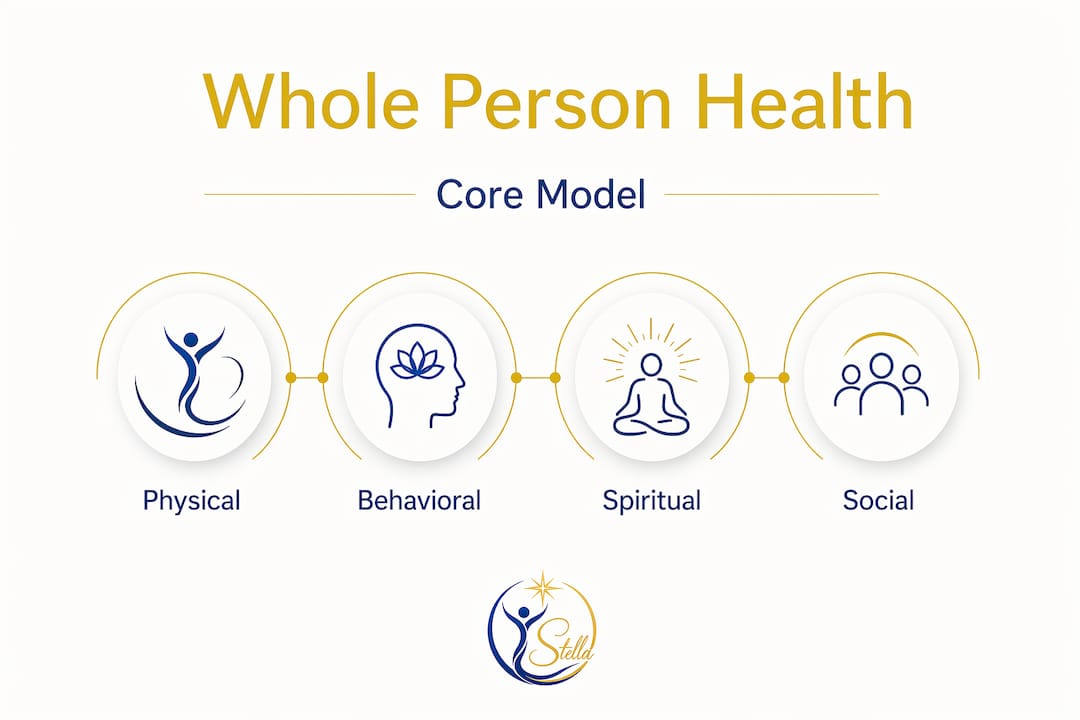
The whole person health model is built on four interconnected dimensions: physical well-being, behavioral health, spiritual meaning, and socioeconomic circumstances. No single dimension operates in isolation. When your sleep suffers, your mood shifts. When your sense of purpose fades, your immune resilience often follows. The model recognizes these links as the foundation of genuine wellness.
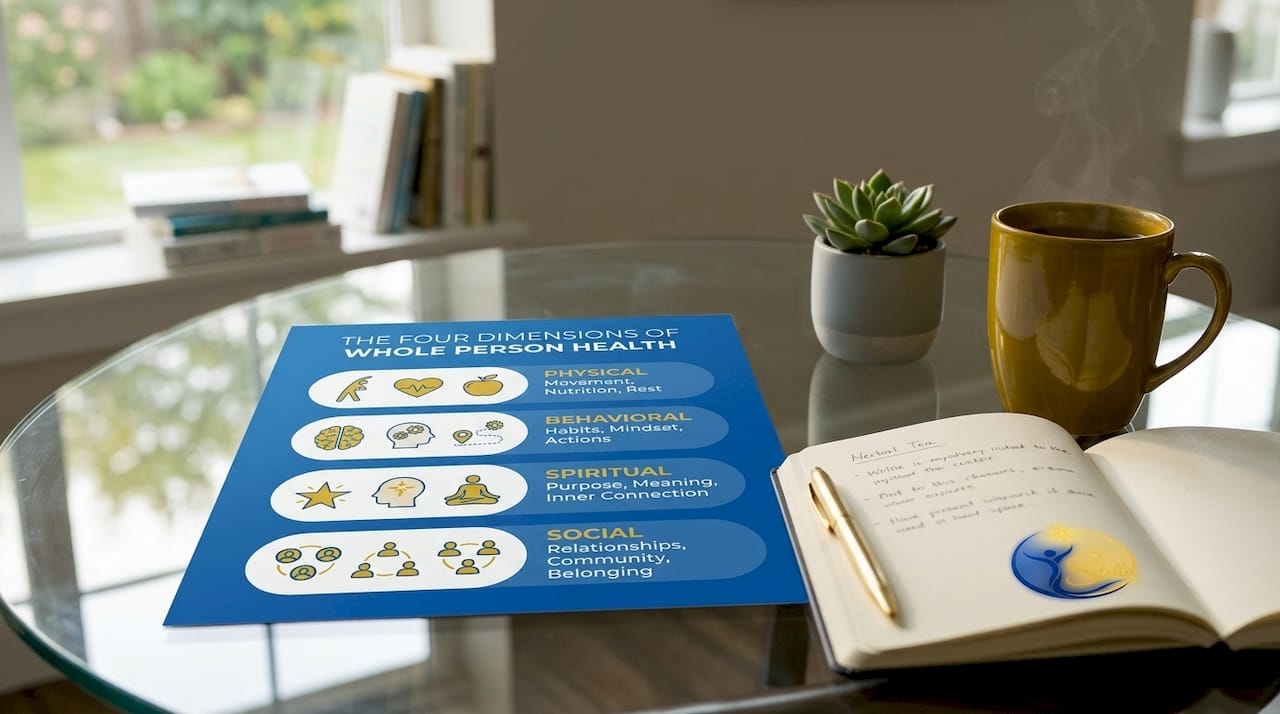
Primary care whole health includes physical, behavioral, spiritual, and socioeconomic well-being as defined by patients themselves, delivered through interprofessional, team-based care over sustained relationships. That last phrase matters. Sustained relationships mean your care team knows your story, not just your chart.
Here is how the core dimensions break down in practice:
- Physical health: Nutrition, movement, sleep quality, and chronic disease management
- Behavioral health: Stress responses, mental health, substance use, and emotional regulation
- Spiritual well-being: Sense of purpose, meaning, values, and connection to something larger than yourself
- Socioeconomic factors: Housing stability, employment, community ties, and access to care
| Dimension | Key Influences | Example Practices |
|---|---|---|
| Physical | Diet, exercise, sleep | Qigong, walking, whole-food nutrition |
| Behavioral | Stress, mood, habits | Breathwork, therapy, mindfulness |
| Spiritual | Purpose, values, meaning | Meditation, community, ritual |
| Socioeconomic | Housing, income, support | Community programs, peer networks |
Pro Tip: Start your whole person health assessment by rating each dimension from one to ten. The lowest score reveals where your energy needs to flow first.
How does this model differ from traditional biomedical approaches?
Traditional biomedical research focuses largely on specific organs and diseases, treating the body as a collection of parts rather than an integrated system. A cardiologist addresses your heart. A gastroenterologist addresses your gut. Each specialist is skilled, but the conversation between your heart and your gut rarely makes it into the treatment plan.
The whole person health approach targets health as an integrated physiological process affecting multiple domains at once. This is not a soft or philosophical distinction. It changes which questions get asked, which treatments get offered, and which outcomes get measured.
Family physicians integrating lifestyle medicine, behavioral health, and social determinants into primary care represent the clearest clinical expression of this shift. Even so, system incentives and training in conventional medicine still lag behind the model's demands.
| Feature | Biomedical Model | Whole Person Health Model |
|---|---|---|
| Focus | Organ or disease-specific | Integrated, multi-domain |
| Goal | Symptom reduction | Long-term resilience and wellness |
| Care team | Single specialist | Interprofessional team |
| Patient role | Passive recipient | Active co-creator of care |
| Success measure | Lab values, diagnoses | Self-assessed well-being and function |
The practical implication is significant. When you visit a practitioner trained in whole person thinking, the first question is not "What is wrong with you?" It is "What matters to you?" That reframe changes everything about the care that follows.
What practical tools and programs support whole person health?
Two programs stand out as the most developed real-world applications of this model: the VA Whole Health Program and the NCCIH's Whole Person Health Index.
The VA Whole Health approach centers care on what matters to the individual. Veterans create personalized plans reflecting their mission and purpose, using tools like the Personal Health Inventory to map their values, strengths, and health goals. Telehealth integration makes this accessible regardless of geography, a critical feature for rural veterans and anyone with mobility limitations.
The NCCIH's Whole Person Health Index (WPHI) is a nine-question, free self-report survey that measures integrated health components across multiple domains. It tracks changes in self-assessed health over time, giving both individuals and clinicians a versatile, low-barrier tool for monitoring progress. You can use it to measure wellness progress across mind-body practices without needing a clinical appointment.
Here is a practical sequence for applying whole person health principles in your daily life:
- Complete a self-assessment. Use the WPHI or a simple journaling practice to rate your physical, emotional, social, and spiritual well-being honestly.
- Identify your anchor dimension. Choose the one area where improvement would create the most positive ripple effect across the others.
- Set one behavioral intention. Not a goal with a deadline, but a daily practice. Fifteen minutes of gentle movement, five minutes of breathwork, or one nourishing meal.
- Build your support network. Whole person health does not happen in isolation. Identify one person, community, or practitioner who can support your chosen dimension.
- Track and adjust monthly. Revisit your self-assessment every four weeks. Notice what has shifted and recalibrate your focus accordingly.
Pro Tip: The WPHI is free and takes under three minutes to complete. Doing it monthly creates a personal health timeline that reveals patterns no single doctor's visit can capture.
What are the main benefits of adopting a whole person health approach?
The benefits of whole person health extend well beyond feeling better on a given day. This model builds the kind of resilience that holds when life gets genuinely hard.
Whole person health supports resilience, disease prevention, and health restoration in ways that symptom-focused care cannot replicate. When you address the root causes of stress, poor sleep, or social isolation, you reduce the conditions that allow chronic disease to take hold in the first place.
- Prevention over reaction: Addressing lifestyle factors like diet, movement, and stress before they become diagnoses saves both suffering and cost.
- Alignment with personal values: Care that reflects what you actually want from life produces better adherence and deeper motivation than externally imposed protocols.
- Social determinants addressed: Employment, housing, and social connections are treated as health factors, not background noise. This matters enormously for long-term outcomes.
- Improved quality of life: Self-assessed well-being, energy, and purpose all improve when care addresses the full person rather than isolated symptoms.
- Stronger patient-provider relationships: Sustained, trust-based relationships with care teams produce better communication and more personalized treatment decisions.
Exploring a holistic wellness framework gives you a structured way to begin applying these benefits in your own life, starting with the dimensions that feel most out of balance right now.
What challenges exist in adopting whole person health broadly?
Whole person health is not the default in most healthcare systems, and the reasons are structural, not accidental. Balancing standardization with customization is one of the central tensions. Standardized protocols are efficient and measurable. Personalized, culturally responsive care is neither, at least not by conventional metrics.
Healthcare culture's traditional prioritization of expert knowledge over patient lived experience is another barrier. When a clinician's training centers on diagnosis and prescription, integrating a patient's spiritual values or housing situation into a care plan can feel outside the scope of practice. Changing that belief system requires more than adding a new service line. It requires organizational culture shifts, updated training curricula, and payment models that reward relationship-based care.
Successful whole person health models require financial incentives, community engagement, and infrastructure investments to achieve system-wide transformation. Without policy leadership, even the most committed practitioners hit institutional walls.
For individuals navigating this on their own, the path forward is clearer. You do not need a reformed healthcare system to begin practicing whole person principles today. Gentle movement practices like qigong, breathwork, and mindful nutrition are all within reach. Learning how to practice mind-body medicine at home is one of the most direct ways to reclaim agency over your own integrated health.
Pro Tip: If your current healthcare provider does not ask about your stress levels, sleep, or sense of purpose, bring it up yourself. You are the expert on your own lived experience. Advocate for the full picture.
Key takeaways
The whole person health model is the most effective framework for long-term wellness because it treats physical, behavioral, spiritual, and social health as one integrated system rather than separate problems.
| Point | Details |
|---|---|
| Core definition | Whole person health integrates physical, behavioral, spiritual, and social dimensions into one care framework. |
| Key distinction | Unlike biomedical models, this approach focuses on root causes and long-term resilience, not symptom management alone. |
| Practical tools | The NCCIH's WPHI and VA Personal Health Inventory offer free, accessible ways to assess and track whole person health. |
| Primary benefits | Prevention, value-aligned care, and addressing social determinants all improve long-term health outcomes. |
| Main barrier | Systemic culture and payment models still favor disease-focused care, making individual self-care practices a vital complement. |
Why I think most people are applying this model backwards
Most people I speak with discover whole person health after a crisis. A burnout. A diagnosis. A season of anxiety that finally becomes impossible to ignore. They arrive at this model looking for a fix, which is understandable. But the model is not a repair kit. It is a way of living before things break.
What I have found, both in my own practice and in working with students through Qigongstar, is that the spiritual and social dimensions get treated as optional extras. People commit to the physical work first, which makes sense. Movement is tangible. Breathwork is measurable. But the sense of purpose, the quality of your relationships, the feeling that your life has meaning — these are not soft additions. They are load-bearing walls.
The other thing most articles will not tell you: tracking matters more than intensity. A gentle qigong practice done consistently three times a week will outperform an intense wellness overhaul that lasts ten days. The WPHI exists precisely because self-assessed health over time reveals patterns that no single snapshot can. Use it. Return to it. Let your data tell you where to place your attention next.
The whole person health model is not a destination. It is a practice of returning, again and again, to the full picture of who you are and what you need to flourish.
— Stella
Start your whole person health practice with Qigongstar
Qigongstar offers online qigong courses designed around the same principles that define whole person health: gentle movement, breath regulation, and mindful attention to your body's signals. Whether you are managing stress, supporting your digestive health, or simply looking to awaken your energy and build lasting vitality, the courses meet you where you are. White Tiger Qigong and Five Animal Qigong both integrate physical, energetic, and spiritual dimensions into every session. Explore the full range of online qigong classes and find the practice that fits your life. Beginners are warmly welcome.
FAQ
What is the whole person health model in simple terms?
The whole person health model is an approach to wellness that considers your physical, mental, behavioral, spiritual, and social health together as one system. Rather than treating individual symptoms, it addresses the root causes and conditions that shape your overall well-being.
How is whole person health different from holistic health?
Whole person health and holistic health share the same philosophy, but whole person health is the more formal, research-backed term used by institutions like the NIH, NCCIH, and the VA. Holistic health is a broader cultural concept, while whole person health refers to a specific, structured care model with defined dimensions and measurable tools.
What is the Whole Person Health Index?
The NCCIH's WPHI is a free, nine-question self-report survey that measures integrated health across multiple domains. It is designed for both personal tracking and clinical research.
Can I apply the whole person health model without a doctor?
Yes. Self-care practices like qigong, breathwork, mindful nutrition, and community connection all align with whole person health principles and require no clinical setting. Tools like the WPHI let you assess and track your own progress independently.
What role does spirituality play in whole person health?
Spirituality in this model refers to your sense of purpose, meaning, and values, not necessarily religious practice. Research from the American Academy of Family Physicians identifies spiritual well-being as a core health dimension alongside physical and behavioral health.