

Body wisdom is defined as the innate, non-cognitive intelligence of the physical self that communicates through sensation, rhythm, and feeling to guide you toward balance and stress reduction. Unlike analytical thinking, this intelligence operates below conscious awareness, sending signals through tightness in the chest, a sudden drop in energy, or a quiet sense of ease. Understanding the body wisdom concept means recognizing that your body holds knowledge your mind has not yet processed. Somatic awareness, the recognized clinical term for this capacity, forms the foundation of many mind-body healing traditions, including White Tiger Qigong and Five Animal Qigong as taught by Qigongstar.
What does body wisdom feel like and how does it communicate?
Body wisdom speaks in a language of sensation, not words. You might notice a knot in your stomach before a difficult conversation, a lightness in your chest when you make a decision that feels right, or a wave of fatigue that arrives precisely when you have been ignoring your need for rest. These are not random physical events. They are early body signals that serve as protective guidance and promote self-care before a problem becomes a crisis.
The key difference between body wisdom signals and overthinking is direction. Overthinking loops back on itself, generating more questions and more anxiety. Body wisdom moves forward. A sensation arises, delivers its message, and invites a response. Somatic therapists describe this as the difference between a "whole-body yes" and a "whole-body no." Expansion sensations signal yes, while contractions signal no, offering a decision-making tool that works beyond pure cognition.
Common body wisdom signals include:
- Tightness or constriction in the throat, chest, or belly, often signaling resistance or fear
- Warmth or openness across the chest, indicating alignment or genuine enthusiasm
- Sudden fatigue or heaviness, pointing to depletion or a need to withdraw
- Restlessness or agitation, suggesting unmet needs or suppressed emotion
- A quiet sense of stillness, which often accompanies clarity and right action
Pro Tip: Start with one check-in per day. Before a meal or after waking, place one hand on your belly and simply ask: "What am I noticing right now?" You do not need to interpret the sensation. Just notice it. This small act trains your nervous system to stay in conversation with your body.
What psychological and physiological mechanisms underpin body wisdom?
Body wisdom is not mystical. It rests on well-documented physiological systems that researchers and clinicians study under the umbrella of somatic awareness.
Interoception, proprioception, and exteroception are the three core components of body awareness. Interoception is your ability to sense internal states: heartbeat, hunger, breath, and emotional feeling. Proprioception tracks your body's position and movement in space. Exteroception processes stimuli from the external environment, such as temperature and touch. Together, these systems create a continuous, real-time map of your physical and emotional state.
| Mechanism | What it senses | Role in body wisdom |
|---|---|---|
| Interoception | Internal states: heartbeat, breath, hunger, emotion | Detects early signs of stress, imbalance, or alignment |
| Proprioception | Body position, movement, and spatial orientation | Grounds awareness in the present physical moment |
| Exteroception | External stimuli: temperature, touch, sound | Connects the body to its environment and relationships |
| Somatic awareness | Breathing, posture, tension, and emotional response | Integrates all signals into conscious embodied presence |
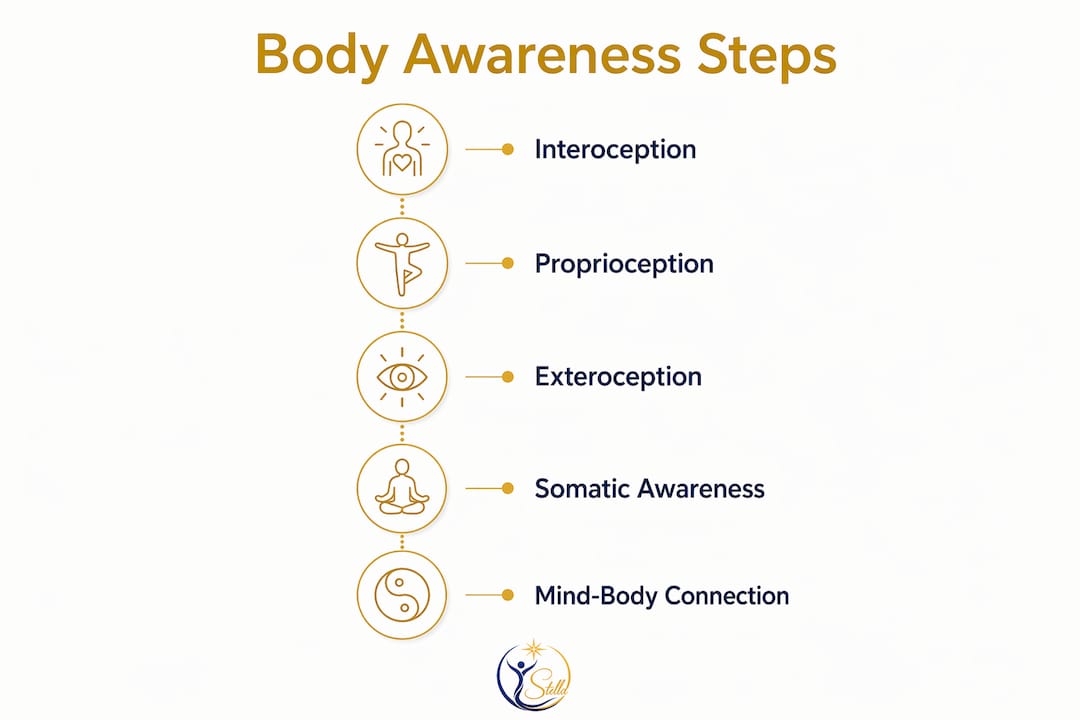
Somatic awareness involves paying attention to breathing, movement, posture, tension, and emotional responses as they arise. Body psychotherapy identifies this capacity as foundational for both embodiment and psychological well-being. The nervous system acts as the communication highway, translating cellular and organ-level information into the felt sensations you experience as body wisdom.
The mind-body connection deepens this further. When you practice mindful movement and breath regulation, you train the nervous system to stay receptive rather than reactive. Research links stronger body awareness to better emotional regulation, lower stress reactivity, and improved physical health outcomes. The body is not a passive vehicle. It is an active, intelligent partner in your well-being.

How can you develop and deepen your connection to body wisdom?
The single most important shift in developing body wisdom is moving from a fix-it mindset to a curiosity mindset. Viewing the body as a conscious system working on your behalf, rather than an obstacle to manage, changes everything. You stop trying to silence discomfort and start listening to what it is telling you.
Here is a practical sequence for building this capacity:
- Begin with a daily body scan. Lie down or sit comfortably. Move your attention slowly from the top of your head to the soles of your feet. Notice areas of tension, warmth, numbness, or ease without trying to change them. Five minutes is enough to start.
- Practice breath awareness. Sit quietly and observe your natural breath for two minutes. Notice whether it is shallow or deep, fast or slow. The breath is the most direct bridge between your conscious mind and your autonomic nervous system.
- Add mindful movement. Gentle practices like qigong, slow walking, or restorative yoga bring proprioception online. Movement helps you feel your body from the inside rather than observing it from the outside.
- Journal your sensations. After a significant event, write down what you noticed in your body. Over time, patterns emerge. You begin to recognize your personal body wisdom vocabulary.
- Pause before decisions. Before saying yes or no to something, take three slow breaths and scan your body. Notice whether you feel expansion or contraction. Let that information sit alongside your logical reasoning.
Modern lifestyles cause disconnection from the body, making relearning body wisdom a lifelong process that requires consistent, attentive noticing. Wellness practitioners describe this as "wise effort," a gentle, sustained commitment rather than a forced sprint.
A common challenge is numbness. Many people, when they first try to tune in, feel nothing at all. Initial numbness is normal. Breakthrough comes through patient, non-judgmental attention rather than forcing sensations. Treat numbness as information, not failure. It often signals a nervous system that has learned to protect itself by going quiet.
Pro Tip: Integrate body check-ins into existing habits. Before you open your email, before you eat, before you sleep. Repetition builds the neural pathways that make body awareness feel natural rather than effortful. Consistency matters far more than duration.
How does body wisdom improve stress relief and well-being?
Body wisdom functions as an early detection system for imbalance. Long before your mind registers that something is wrong, your body has already been sending signals. A tight jaw during a meeting, a shallow breath when you read a certain message, a heaviness that settles in after a particular conversation. These are not coincidences. They are early indicators of interpersonal and environmental impacts that body wisdom surfaces before stress becomes chronic.
Living in integrity aligns your bodily signals with your deepest values, naturally relaxing the body. Dissonance, living or acting against what you truly value, creates tension that shows up as a persistent, unpleasant physical feeling. This is body wisdom at its most practical. It tells you when your choices are costing you more than you realize.
The benefits of practicing body awareness include:
- Reduced stress reactivity by catching tension early and responding rather than reacting
- Clearer decision-making through somatic signals that complement logical analysis
- Improved emotional resilience as you learn to feel and release emotions rather than suppress them
- Better sleep and digestion when the nervous system shifts from fight-or-flight to rest-and-digest
- Deeper self-trust as your body's signals prove reliable over time
Living primarily from cognitive analysis disconnects you from the deeper truths held in the body. Body wisdom reveals these subtleties through sensation and rhythm in ways that pure reasoning cannot access. People who integrate somatic awareness into daily life report feeling more grounded, more present, and more capable of navigating difficulty without being swept away by it.
Body literacy is a learnable skill rooted in curiosity and openness. It deepens embodied self-knowledge and improves emotional regulation over time. The body does not ask for perfection. It asks for attention.
Key Takeaways
Body wisdom is the body's innate intelligence, communicated through sensation, and developing it through somatic awareness practices like qigong directly supports stress relief, emotional resilience, and aligned decision-making.
| Point | Details |
|---|---|
| Body wisdom defined | It is the non-cognitive intelligence of the body, communicated through sensation, rhythm, and feeling. |
| Core mechanisms | Interoception, proprioception, and somatic awareness form the physiological foundation of body wisdom. |
| Curiosity over fixing | Shifting from a fix-it mindset to curiosity is the most important step in developing body awareness. |
| Early stress detection | Body wisdom surfaces signs of imbalance before the conscious mind registers stress. |
| Consistent practice | Daily check-ins, breath awareness, and mindful movement build body literacy over time. |
What I have learned from listening to my own body
When I first started paying attention to my body's signals, I expected clarity. What I got instead was silence. Weeks of sitting quietly, scanning, and feeling almost nothing. That numbness was humbling. I had spent years living from my head, analyzing, planning, and solving, and my body had simply learned to wait quietly in the background.
The shift came when I stopped trying to get something from my body and started being with it. Non-judgmental curiosity is not a technique. It is a relationship. The moment I stopped treating my sensations as data to decode and started treating them as a conversation, something softened. A tightness I had carried in my upper back for years began to speak. It was not injury. It was unexpressed grief I had been too busy to feel.
What body wisdom has given me is not a perfect inner compass. It is a more honest relationship with myself. I trust my body's signals now, not because they are always comfortable, but because they are always true. If you are starting this practice, be patient with the silence. Your body has been waiting a long time to be heard. Practices like Five Animal Qigong have been particularly powerful for me in awakening that felt sense of inner aliveness.
— Stella
Qigongstar courses to deepen your body awareness practice
Body wisdom grows fastest when you give it a structured, supportive container. Qigongstar offers online qigong classes designed specifically to cultivate somatic awareness through gentle movement, breath regulation, and mindful presence.
The Five Animal Qigong and White Tiger Qigong courses on Qigongstar weave body awareness into every session. Each movement sequence invites you to feel from the inside out, releasing deep-held tension and awakening your energy in a way that purely cognitive practices cannot reach. These courses are beginner-friendly, on-demand, and grounded in Chinese Medicine traditions that have supported embodied well-being for centuries. Whether you are managing stress, soothing digestive discomfort, or simply wanting to feel more at home in your body, Qigongstar's holistic wellness routines offer a clear, gentle path forward.
FAQ
What is the body wisdom concept in simple terms?
Body wisdom is the natural intelligence of your physical body, communicated through sensations like tightness, ease, warmth, or fatigue, that guides you toward balance before your conscious mind catches up.
How is body wisdom different from intuition?
Body wisdom is the physical dimension of intuition. Intuition is the broader felt sense of knowing, while body wisdom specifically refers to the somatic, bodily signals that carry that knowing.
What is somatic awareness and how does it relate to body wisdom?
Somatic awareness is the clinical term for the practice of paying attention to breathing, posture, movement, tension, and emotional responses as they arise. It is the skill that makes body wisdom accessible and readable.
Can body wisdom help with stress relief?
Body wisdom acts as an early warning system for stress, surfacing tension and imbalance before they become chronic. Practices that build body awareness, such as qigong and body scans, train the nervous system to respond rather than react.
How long does it take to develop body wisdom?
Body wisdom is a lifelong practice, not a destination. Most people notice meaningful shifts in body awareness within a few weeks of consistent daily check-ins, breath awareness, and mindful movement practice.