
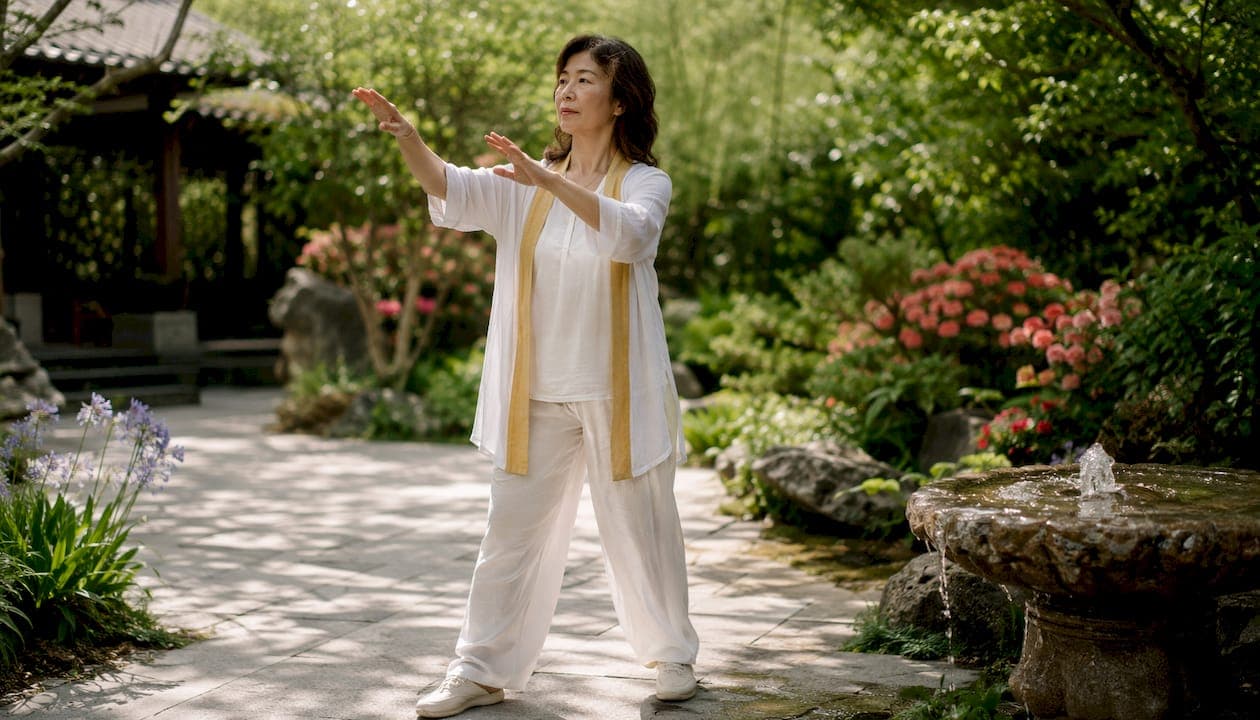
Somatic healing is a body-centered approach that uses sensation, breath, and movement to process stored stress and restore nervous-system balance, according to Harvard Health. Rather than talking through problems alone, it invites you to notice what your body is already holding. Three benefits stand out for anyone drawn to qigong-based wellness:
- Faster nervous-system downshift: Gentle movement and breath cues shift you out of fight-or-flight more quickly than cognitive reflection alone.
- Deeper body awareness: Tuning into sensation builds the interoceptive skill that makes qigong practice richer and more effective.
- Complementary support: Somatic work pairs well with clinical care, though Harvard's Dr. Amanda Baker notes it is still less researched than CBT.
TL;DR: If you want movement-based stress relief that works with your body rather than around it, somatic healing is worth exploring. Scroll to the 6–8 minute qigong practice below to feel the difference right away.
Table of Contents
- What is somatic healing and how does it work in your body?
- Common somatic techniques and how qigong fits in
- How does somatic healing compare to talk therapy?
- What does a somatic healing session actually look like?
- Safety, contraindications, and when to seek specialist care
- Try this 6–8 minute somatic qigong practice at home
- How to find a qualified somatic therapist or qigong instructor
- Key Takeaways
- Why qigong is one of the most natural somatic tools available
- Guided somatic qigong with Stella QigongStar
- Useful sources for further reading
What is somatic healing and how does it work in your body?
Somatic healing works by helping your body complete unfinished stress responses so your nervous system can return to balance. When you experience stress or threat, your body mobilizes energy for fight, flight, or freeze. If that cycle never fully completes, the energy stays locked in muscle tension, shallow breathing, or a persistent sense of dread.
Anxiety often shows up as chronic tightness in the jaw, neck, and shoulders, and somatic approaches explicitly target those physical holding patterns. Two key methods keep the process safe. Titration means working with small doses of sensation rather than flooding yourself with intensity. Pendulation means moving your attention back and forth between a difficult sensation and a calm, resourced feeling, so you never stay overwhelmed for long.
Qigong maps naturally onto both principles. A slow arm sweep paired with a long exhale is titration in motion. Returning to a grounded stance between movements is pendulation in practice. Self-regulation is the primary goal: learning to shift yourself out of fight/flight/freeze and back to calm, on your own. Building that skill reliably can take weeks or months of consistent short practice, so patience matters as much as technique.
Common somatic techniques and how qigong fits in
Somatic therapy draws on a range of body-focused methods. Here is how the core techniques work and where qigong naturally overlaps:
- Body scanning: Slowly moving attention through the body to notice tension, warmth, or numbness without judgment. White Tiger Qigong's standing meditation uses exactly this awareness.
- Breathwork: Lengthening the exhale slows sympathetic arousal and signals safety to the nervous system. Five Animal Qigong integrates breath cues into every movement sequence.
- Grounding: Feeling the weight and contact of your feet on the floor anchors attention in the present moment, interrupting anxious thought loops.
- Pendulation and titration: Alternating between noticing a tense area and returning to a comfortable sensation keeps the process gentle and prevents overwhelm.
- Gentle movement impulses: Small, slow movements, such as rolling the shoulders or swaying the spine, help complete the stress cycle the body started but never finished.
- Somatic experiencing exercises: Guided awareness of physical sensations, often combined with talk, to process stored emotional material.
For qigong practitioners, the White Tiger Qigong breath-and-shoulder-release sequence is a direct somatic tool: the slow inhale lifts and opens the chest, and the exhale melts tension from the upper back. Five Animal Qigong's gentle spinal rolling mimics the small movement impulses somatic practitioners encourage. You can explore somatic stress release examples that show how these principles translate into everyday movement.
Pro Tip: Start with just one technique for two to three minutes. If sensation feels intense, pause and return to your feet on the floor before continuing.

How does somatic healing compare to talk therapy?
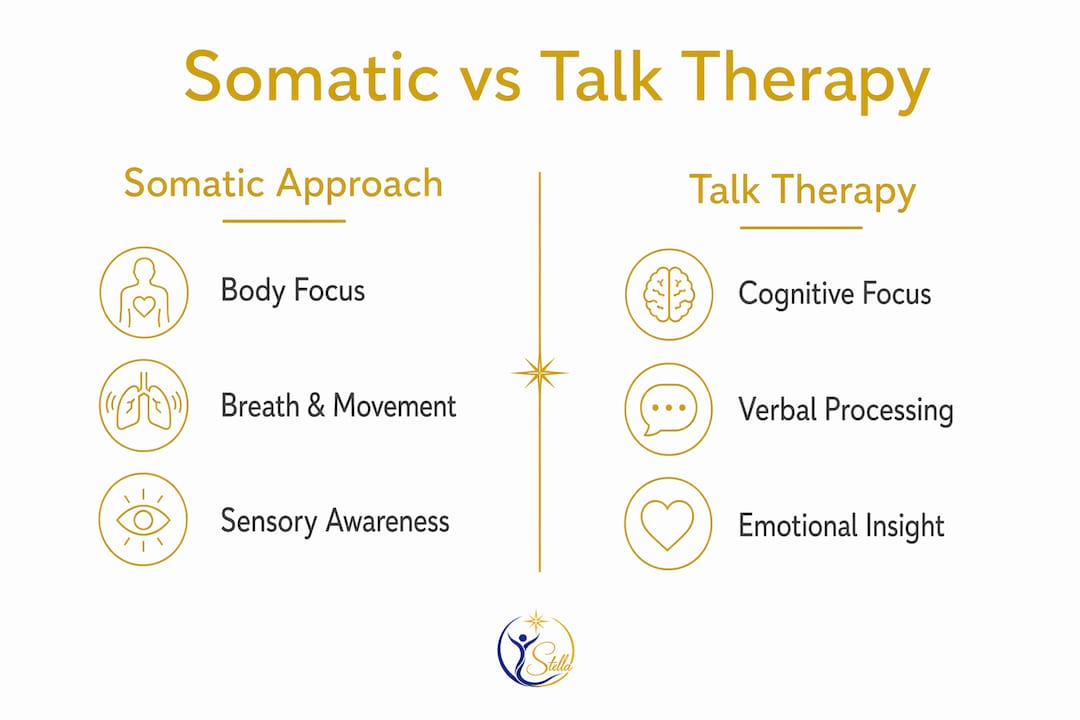
Somatic healing centers the body as the starting point; talk therapy centers cognitive processing. Both can be useful, and they often work best together.
| Dimension | Somatic approach | Talk-based approach |
|---|---|---|
| Starting point | Physical sensation and body awareness | Thoughts, beliefs, and narrative |
| Core techniques | Breathwork, movement, body scan, grounding | Verbal processing, cognitive restructuring |
| Primary goal | Nervous-system regulation and stress-cycle completion | Insight, belief change, behavioral shifts |
| Session experience | Quieter, more inward; less verbal | Conversational and reflective |
That distinction matters practically. If you are managing active trauma, PTSD, or a diagnosed anxiety disorder, somatic work is most safely done alongside, not instead of, evidence-based clinical care. When stress is the primary concern rather than a clinical diagnosis, somatic and mind-body approaches can stand on their own as a wellness practice. Online hypnotherapy is another complementary option worth considering; hypnotherapy for anxiety addresses the cognitive and nervous-system layers that somatic work also targets.
What does a somatic healing session actually look like?
Sessions vary, but most follow a recognizable rhythm. A typical individual session runs 50–60 minutes and blends centering, body-focused work, and grounding.
- Opening (5–10 min): Centering and resourcing. You settle into the space, notice your breath, and identify a felt sense of calm or safety to return to if needed.
- Core work (20–30 min): Body-focused awareness, gentle movement, or guided breathwork. The practitioner may invite you to notice where you feel tension and what happens when you breathe into it.
- Closing (5–10 min): Grounding and brief verbal processing. You return to a stable, present-moment awareness before leaving.
Session formats range from individual in-person appointments to online video sessions and group classes, the latter of which is where qigong fits especially well. Costs vary widely across the United States; individual somatic therapy sessions with a licensed therapist typically run more than a standard talk-therapy appointment, while group qigong classes and online courses are considerably more accessible. Many practitioners offer sliding-scale fees.
Pro Tip: Ask in your first call whether the practitioner has trauma-aware training, what their safety protocols are, and whether they accept insurance or offer sliding scale. These three questions tell you most of what you need to know.
Safety, contraindications, and when to seek specialist care
Somatic work is generally gentle, but it can surface strong reactions. Somatic approaches prioritize client agency: you always have permission to pause, slow down, or stop entirely. That said, some situations call for extra care.
Seek a trauma-specialist or mental health professional before beginning somatic work if you experience intense flashbacks, dissociation, suicidal ideation, or active psychosis. These are not contraindications to somatic healing forever, but they require clinical support first. People managing uncontrolled medical conditions, active substance misuse, or certain medications that affect body awareness should coordinate with their medical provider before starting.
For most people exploring qigong-based somatic practices, the risk is low. Keep movements small, stay within a comfortable range of sensation, and treat any practice as exploratory rather than therapeutic. Somatic tools support regulation; they are not a substitute for trauma-focused psychotherapy when that level of care is indicated. For a broader view of how somatic work fits into integrative care, the integrative medicine approach offers useful context.
Try this 6–8 minute somatic qigong practice at home
This short sequence supports nervous-system downshift and builds the body awareness that makes qigong practice more effective. Move slowly and stay curious rather than goal-oriented.
- Center and resource (1–2 min): Stand or sit comfortably. Feel your feet or sit bones making contact with the ground. Bring to mind a place or memory that feels genuinely calm. Let that feeling settle in your chest for a few breaths.
- Three breath cycles with shoulder release (2 min): Inhale slowly through the nose, letting the shoulders rise gently. Exhale through the mouth, allowing the shoulders to drop and soften. Repeat three times, pausing at the bottom of each exhale to notice any shift in tension.
- Two slow qigong arm movements (2 min): Inspired by White Tiger Qigong, raise both arms forward and up on a long inhale, then lower them in a wide arc on the exhale, as if gently pressing water downward. Move at half the speed you think is slow enough.
- Standing ground and body scan (1–2 min): Return to stillness. Scan from the crown of your head to your feet, noticing warmth, heaviness, tingling, or ease without trying to change anything.
- Grounding breath (30 sec): Three natural breaths. Feel your feet. Open your eyes fully.
- Keep every movement small and unhurried.
- If sensation spikes, return to step one and resource before continuing.
- Seated variations work just as well: rest hands on thighs and use gentle head nods instead of arm sweeps.
Pro Tip: For guided instruction that builds on this sequence, Qigongstar's online qigong classes offer structured, beginner-friendly sessions you can follow from home.
How to find a qualified somatic therapist or qigong instructor
Prioritize trauma-aware training, a clear scope of practice, and open communication about methods and safety. A practitioner who cannot explain their approach in plain language is a red flag before you even begin.
Credentials to look for:
- Somatic Experiencing (SE) training or certification for clinical somatic therapists
- White Tiger Qigong School or Yoga Alliance certification for qigong instructors
- Additional trauma-informed training (such as EMDR or trauma-sensitive yoga background)
Questions to ask in a first call:
- How do you handle it if I feel overwhelmed during a session?
- What is your experience working with stress and anxiety specifically?
- Do you coordinate with other healthcare providers when needed?
Red flags: Practitioners who pressure you to relive traumatic memories in detail, lack clear safety protocols, or make clinical claims beyond their scope of practice.
Search professional directories, local bodywork studios, and integrative health clinics. For online qigong instruction with certified instructors, Qigongstar's course pages are a practical starting point.
Key Takeaways
Somatic healing works by using body sensation, breath, and gentle movement to complete unfinished stress responses and restore nervous-system regulation, making it a natural fit for qigong-based wellness practice.
| Point | Details |
|---|---|
| Core definition | Somatic healing uses sensation, breath, and movement to process stored stress and rebalance the nervous system. |
| Evidence level | Promising but less researched than CBT; best used as a complement to clinical care, per Dr. Amanda Baker. |
| Safety first | Strong reactions can occur; seek a trauma-aware practitioner if you have a history of severe trauma or mental health conditions. |
| Skill-building timeline | Reliable body awareness takes weeks to months of consistent short practice, such as grounding or body scanning. |
| Qigongstar next step | Try the 6–8 minute practice above or enroll in a beginner class at Qigongstar for guided somatic qigong. |
Why qigong is one of the most natural somatic tools available
Most people expect somatic healing to look like lying on a table while a therapist guides them through breathwork. That version exists, and it can be genuinely helpful. But qigong offers something the clinical model rarely does: a daily, self-directed practice that builds nervous-system regulation over time rather than in isolated sessions.
What strikes me most, watching students move through White Tiger Qigong and Five Animal Qigong sequences, is how quickly the body begins to soften. Neck and shoulder tension that students have carried for years starts to release within a few weeks of consistent practice. Sleep tends to improve. Digestion settles. These are practitioner observations, not clinical data, but they align with what somatic theory predicts: slow, embodied movement teaches the nervous system new patterns.
The deeper point is this. Somatic healing is not a technique you apply to yourself once and move on. It is a relationship you build with your own body, one breath and one movement at a time. Qigong, rooted in Traditional Chinese Medicine and refined over centuries, is structured precisely for that kind of patient, attentive practice. The two belong together.
Guided somatic qigong with Stella QigongStar
If the short practice above resonated, structured guidance makes the difference between occasional relief and lasting change.
Qigongstar offers live and on-demand courses designed specifically for stress relief and nervous-system wellness, taught by Stella, a certified instructor through the White Tiger Qigong School and Yoga Alliance. Three courses suit readers exploring somatic movement:
- Online Qigong Classes: Live and on-demand sessions for all levels, with breath-led sequences that mirror the somatic techniques covered here. A strong starting point for anyone new to body-centered movement.
- Five Animal Qigong: Gentle, flowing forms drawn from Traditional Chinese Medicine that encourage natural movement impulses, ideal for readers who want a somatic-style practice with deep roots.
- White Tiger Qigong: Breath-and-movement sequences that target the neck, shoulders, and spine, the exact areas where chronic stress tends to settle.
Start with the beginner-friendly online classes and build from there. Choose a trauma-aware teacher, move at your own pace, and let your body guide the process.
Useful sources for further reading
- What Is Somatic Therapy? — Harvard Health: Clinical overview with Dr. Amanda Baker's perspective on evidence limits and complementary use.
- A Complete Guide to Somatic Therapy — Healthline: Practical breakdown of techniques, conditions addressed, and what to expect in sessions.
- What Is Somatic Therapy? — National Geographic: Focuses on self-regulation as the primary goal and realistic timelines for building body awareness.
- Somatic Therapy — Psychology Today: Describes session formats (individual and group) and the range of mind-body techniques used.
- What Is Somatic Therapy? Benefits, Types and Efficacy — Forbes: Covers the "emotions stored in the body" framework and how somatic techniques address physiological stress cues.
- Somatic Therapy — Verywell Mind: Accessible introduction to somatic experiencing, including how it differs from CBT and who it suits.
This article is general wellness information, not medical or psychological advice. If you are managing trauma, a mental health condition, or a medical concern, please consult a qualified professional before beginning any new somatic or movement practice.