

Your thoughts, your physical health, and your sense of meaning are not separate systems running in parallel. The mind-body-spirit connection is a holistic wellness framework in which thoughts and emotions, physical health, and your inner sense of purpose function as one integrated system, where a shift in any one dimension ripples through the others.
Two everyday examples make this concrete:
- Stress causing headaches: A looming work deadline triggers a cascade of cortisol and muscle tension that lands as a throbbing headache. The mind initiated it; the body absorbed it.
- Meditation calming digestion: A ten-minute breath practice before meals quiets the autonomic nervous system, and many people notice their gut cramps ease within days.
The short version you can carry with you: tend to your thoughts, your body, and your sense of purpose together, and each one heals faster than it would alone.
Table of Contents
- What is the mind-body-spirit connection, and how does it actually work?
- How do you recognize when the connection is in balance or out of it?
- Why does tending to all three dimensions improve your wellbeing?
- Practical practices to strengthen the connection: a 2-week starter plan
- What does research actually say about the mind-body-spirit model?
- How Qigong brings the mind-body-spirit model to life
- How to begin integrating mind-body-spirit care: your first 30 days
- When integrated self-care helps and when to see a professional
- Key Takeaways
- Why the spirit dimension is the most underestimated part of this model
- Qigongstar's online classes: a gentle way to put this into practice
- Useful sources and further reading
What is the mind-body-spirit connection, and how does it actually work?
The relationship runs in both directions simultaneously. Your mind influences your body through neuroendocrine signals, your body feeds information back to your mind through interoception and the gut-brain axis, and your spirit, meaning your values, purpose, and felt sense of meaning, acts as a motivational regulator that shapes how you interpret and respond to both.
Four key mechanisms drive this loop:
- Neuroendocrine responses: Perceived stress activates the hypothalamic-pituitary-adrenal axis, releasing cortisol and shifting the autonomic nervous system toward sympathetic dominance. Sustained activation disrupts sleep, digestion, and immune function. The Merck Manual describes this as a two-way feedback loop: stress hormones alter digestion and immune signaling, while chronic inflammation and pain can reduce cognitive clarity and worsen mood.
- Immune-inflammatory pathways: Chronic psychological stress elevates pro-inflammatory cytokines, which in turn affect brain chemistry. Depression and anxiety are now understood partly as inflammatory conditions, not purely psychological ones.
- Gut-brain signaling: The vagus nerve carries signals in both directions between the gut and the brain. Dysbiosis or gut inflammation can impair mood and cognition, while mental states like anxiety can trigger IBS-like symptoms. This is why mind-body practices can ease gut symptoms that seem purely physical.
- Meaning and purpose as regulators: Your spirit, framed clinically as your inner world of values rather than only religious belief, shapes how you appraise threats and challenges. A person with a clear sense of purpose tends to recover from illness faster and sustain health behaviors longer.
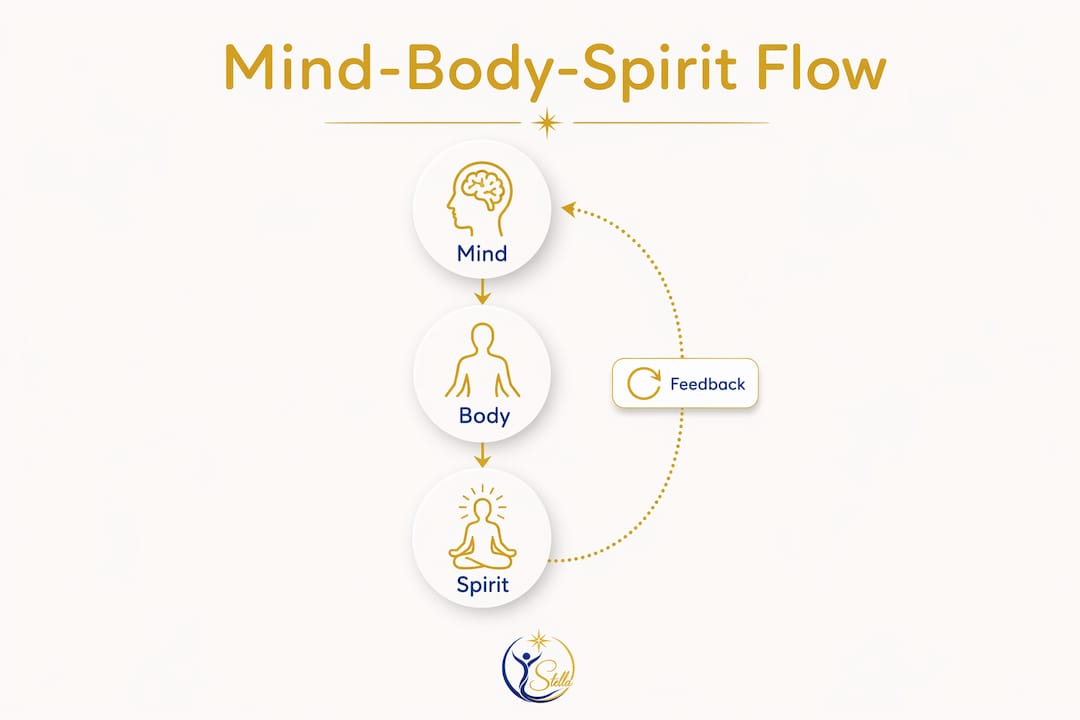
A simple flow: Mind (thought/emotion) → Body (neuroendocrine/immune response) → Spirit (meaning shifts) → feedback back to Mind. Understanding these pathways matters because it tells you where to intervene. Breathwork targets the autonomic nervous system directly. Journaling shifts appraisal. Gentle movement addresses both physiology and felt meaning at once.

How do you recognize when the connection is in balance or out of it?
The system announces itself through symptoms you may have been treating in isolation.
Work stress and the body: You push through a brutal project deadline for three weeks. By week two, you notice jaw tension, shallow breathing, and a persistent low-grade headache. Your body is not malfunctioning; it is accurately reporting what your mind has been holding.
Chronic gut symptoms and meaning: Someone living with IBS often finds that flares cluster around emotionally charged periods, job changes, relationship strain, or grief. The gut-brain axis is not a metaphor; it is a measurable signaling pathway. Treating the gut alone, without addressing the emotional load, often yields only partial relief.
Grief and physical depletion: Bereavement research consistently shows that acute grief suppresses immune function and disrupts sleep architecture. The spirit dimension, the loss of meaning and connection, translates directly into physical vulnerability.
Recovery after exercise: Conversely, a 30-minute walk in a green space does more than burn calories. It lowers cortisol, lifts mood through endorphin and serotonin activity, and, for many people, creates a brief but genuine sense of renewal. Body action feeds spirit.
Signs of healthy integration:
- Consistent, restorative sleep
- Emotional resilience after setbacks
- Digestion that feels calm and regular
- A sense that your daily actions align with what you value
- Energy that feels steady rather than borrowed
Signs of imbalance:
- Chronic pain or tension with no clear structural cause
- Persistent low mood, anxiety, or a sense of meaninglessness
- Dysregulated appetite or digestion
- Difficulty recovering from ordinary stress
- Feeling disconnected from your own body
When several of these signs cluster together, integrated practices are not a luxury. They are often the missing layer of care.
Why does tending to all three dimensions improve your wellbeing?
Caring for mind, body, and spirit together produces outcomes that single-focus approaches often miss. When care is integrated, stress management improves, symptoms resolve more fully, and resilience builds in a way that holds under pressure.
Key benefits supported by research and clinical experience:
- Reduced anxiety and stress reactivity through breath and movement practices that directly lower cortisol
- Better sleep quality as the nervous system learns to shift out of sympathetic overdrive
- Lower systemic inflammation, which underlies conditions from cardiovascular disease to depression
- Improved digestion, particularly for stress-related gut disorders like IBS
- Higher life satisfaction and sense of purpose, which research links to longer healthspan
- Faster recovery from illness, partly because meaning and social connection modulate immune function
A translational approach that integrates mind, brain, and body research across levels, from basic science to clinical interventions, increases the chance of developing targeted, effective health strategies. In plain terms: treating the whole person is not just philosophically appealing. It produces better-targeted results than siloed care.
Clinicians who integrate a patient's values and sense of purpose into treatment, rather than focusing only on symptoms, tend to see improved outcomes and a stronger patient experience. The spirit dimension is not soft. It is a clinical variable.
Practical practices to strengthen the connection: a 2-week starter plan
These practices strengthen the bidirectional pathways between mind, body, and spirit quickly and safely, even in small daily doses. You do not need an hour a day. You need consistency.
2-week starter plan:
- Days 1–2: Begin with five minutes of slow diaphragmatic breathing each morning. Inhale for four counts, hold for two, exhale for six. This directly activates the parasympathetic nervous system.
- Days 3–4: Add a ten-minute slow walk outdoors, without your phone. Notice three physical sensations: the ground under your feet, the temperature of the air, the rhythm of your breath.
- Days 5–7: Introduce a short body scan at bedtime. Lie down, close your eyes, and move attention slowly from feet to crown, releasing tension as you go. Deep breathing and body scans strengthen self-regulation and reduce autonomic arousal.
- Days 8–10: Add five minutes of journaling after your morning breath practice. Write one thing you are grateful for and one value you want to act on today. This engages the spirit dimension.
- Days 11–14: Introduce a short, gentle movement session, ten to fifteen minutes of Qigong, yoga, or slow stretching. Focus on breath coordination with movement rather than effort or range.
Daily practices to layer in over time:
- Breathwork (diaphragmatic or box breathing, 5–10 minutes)
- Mindful movement such as Qigong, tai chi, or gentle yoga
- Slow outdoor walks for nervous system regulation
- Sleep hygiene: consistent bedtime, no screens 30 minutes before sleep
- Nutrition basics: reduce ultra-processed foods and increase fiber for gut-brain health
- Journaling for values clarification and gratitude
- Community or service activities that feed a sense of purpose
Pro Tip: Habit stack your practice onto something you already do. Breathwork after brushing your teeth, a body scan while the coffee brews, a five-minute walk at lunch. Five-minute anchors attached to existing habits are far more durable than ambitious standalone routines.
A note on contraindications: if you are recovering from major surgery, a cardiac event, or a serious mental health episode, start with breath and rest practices only, and introduce movement gently with your clinician's guidance. Adapt intensity to your current capacity, not an ideal version of it.
What does research actually say about the mind-body-spirit model?
Strong evidence supports mind-body techniques for stress reduction, anxiety, and certain chronic conditions. The science on the spirit dimension, specifically meaning and purpose as health variables, is newer but growing.
Moving away from reductionist care toward integrated mental, physical, and spiritual approaches is recommended by contemporary translational and integrative health advocates. And reductionist models can slow recovery when systems-level factors like purpose and social context alter the biological mechanisms that interventions target.
| Category | Examples | Evidence Status |
|---|---|---|
| Evidence-based interventions | Mindfulness-based stress reduction (MBSR), diaphragmatic breathing, cognitive behavioral therapy (CBT), structured exercise | Strong: multiple RCTs and meta-analyses |
| Practice-based interventions | Qigong, yoga, tai chi, acupuncture, meditation | Moderate to strong: growing RCT base, especially for anxiety and pain |
| Promising / early-stage | Meaning-centered therapy, spiritual care integration in oncology, psychedelic-assisted therapy | Emerging: early trials positive, more replication needed |
A few important distinctions:
- Where the science is strong: Breath-based and movement-based practices reliably reduce self-reported stress and measurable cortisol. MBSR has a robust evidence base for anxiety and chronic pain.
- Where it is still emerging: The precise mechanisms by which meaning and purpose affect immune function are being mapped, but the clinical signal is consistent enough that the AMA Journal of Ethics recommends incorporating spiritual inquiry into medical history-taking.
- Where to be cautious: Claims that any single practice cures disease, or that spiritual alignment alone resolves a medical condition, go beyond what the evidence supports. Integrated care means alongside conventional medicine, not instead of it.
For a deeper look at how these modalities compare, the mind-body healing modalities guide offers a practical overview.
How Qigong brings the mind-body-spirit model to life
Qigong is one of the clearest practical illustrations of the three-pillar model: gentle movement addresses the body, coordinated breath and focused attention engage the mind, and the ritual structure and intention behind each practice nourish the spirit. It is not a metaphor. Each element targets a specific physiological or psychological pathway.
Movement-based practices like Qigong can change mental states through breath, attention, and gentle movement, and are commonly used to bridge mind and body in practice. For a detailed look at the physical mechanisms, the how Qigong heals the body guide traces these pathways clearly.
What a beginner remote session looks like with Qigongstar:
- Duration: 45–60 minutes, live or on-demand
- Opening: Two to three minutes of standing breath awareness to settle the nervous system
- Movement sequences: Slow, flowing postures from White Tiger Qigong or Five Animal Qigong, coordinated with inhale and exhale cues
- Breath focus: Diaphragmatic breathing throughout, with specific patterns for energy cultivation or release
- Closing: A short stillness or body scan to integrate the session
- Expected effects after a few sessions: Reduced muscle tension, calmer digestion, improved sleep onset, and a growing sense of groundedness
Trust signals: Qigongstar instructors are certified by the White Tiger Qigong School and Yoga Alliance, two recognized credentialing bodies in the field. Courses are available both live and on-demand, making them accessible regardless of schedule or time zone.
Qigong works because it does not ask you to separate your breath from your body or your intention from your movement. Every posture is simultaneously a physical act, a breath practice, and a moment of deliberate attention. That integration is precisely what makes it an efficient entry point into whole-person wellness.
How to begin integrating mind-body-spirit care: your first 30 days
Within 30 days of consistent practice, most people notice modest but real shifts: slightly better sleep, a calmer gut response to stress, and small but measurable mood gains. These are not dramatic. They are the early signals that the system is beginning to regulate.
30-day checklist by week:
- Week 1 (Days 1–7): Establish your breath anchor. Five minutes of diaphragmatic breathing each morning. Track sleep hours and a simple mood rating (1–10) each evening.
- Week 2 (Days 8–14): Add ten minutes of gentle movement daily, Qigong, yoga, or a slow walk. Note energy levels and any gut changes in a brief journal entry.
- Week 3 (Days 15–21): Introduce a values or gratitude journaling practice (five minutes). Begin a consistent sleep schedule: same bedtime and wake time, even on weekends.
- Week 4 (Days 22–30): Combine all three: morning breath, midday or evening movement, and a short evening journal. Review your four tracked metrics (sleep, mood, energy, ritual minutes) and notice any trends.
Simple tracking suggestions:
- Sleep hours logged each morning
- Mood rating (1–10) before bed
- Energy level mid-afternoon (1–10)
- Minutes of intentional practice per day
Customizing for your starting point: If you are new to any movement practice, keep sessions under 15 minutes and prioritize breath over range of motion. If you have more experience, you can extend movement sessions and add more structured breathwork patterns. The goal in month one is consistency, not intensity. For a structured beginner pathway, the beginner's guide to starting a mind-body practice offers a clear onboarding sequence.
When integrated self-care helps and when to see a professional
Integrated practices complement medical and psychiatric care. For certain conditions, they do not replace it. Knowing the difference protects you.
Red flags that require professional attention before or alongside any self-care practice:
- Suicidal or self-harm ideation
- Rapidly worsening depression, anxiety, or psychosis
- Unexplained weight loss, new neurological symptoms, or chest pain
- Symptoms that have persisted for more than two weeks without improvement
- Any chronic condition that has not been medically evaluated
Practical referral guidance: When you want to integrate mind-body practices into an existing treatment plan, bring a simple written summary to your clinician: what practices you are doing, how often, and what you have noticed. Ask specifically whether any contraindications apply to your condition or medications. Most clinicians welcome this conversation. The AMA Journal of Ethics notes that asking about a patient's values and practices can be incorporated into standard medical history-taking and improves patient-centered care.
Stress, for example, can manifest physically in ways that extend well beyond tension headaches. Research on stress-related physical symptoms shows how mental load creates downstream effects across multiple body systems, reinforcing why professional guidance matters when symptoms are persistent or severe.
This article is general health information, not medical or psychiatric advice. Consult a qualified clinician for your specific situation.
Key Takeaways
The mind-body-spirit connection is a bidirectional, integrated system: tending to thoughts, physical health, and sense of purpose together produces better outcomes than treating any one dimension alone.
| Point | Details |
|---|---|
| The system is bidirectional | Stress affects the body through cortisol and immune pathways; physical symptoms feed back to mood and cognition. |
| Spirit means purpose, not only religion | Clinically, "spirit" refers to values and meaning, which regulate how you respond to stress and illness. |
| Small daily practices create real change | Five-minute breath anchors, gentle movement, and journaling build integration faster than occasional long sessions. |
| Know when to seek professional help | Red flags like suicidal ideation, rapid symptom worsening, or unexplained physical changes require clinical care. |
| Qigongstar offers a structured entry point | Beginner-friendly live and on-demand Qigong courses from Qigongstar integrate movement, breath, and intention in one practice. |
Why the spirit dimension is the most underestimated part of this model
Most people who discover the mind-body connection focus on the physical mechanics: cortisol, the vagus nerve, inflammation. That knowledge is genuinely useful. But the spirit dimension, your sense of meaning, your values, and your felt connection to something larger than daily tasks, tends to get treated as optional or vague. Clinical evidence suggests it is neither.
The research on purpose and health outcomes is consistent enough that the AMA Journal of Ethics recommends incorporating spiritual inquiry into standard medical history-taking. Not because every patient is religious, but because a person's inner world of values shapes how they interpret illness, sustain health behaviors, and recover from setbacks. Ignoring it in care is not neutral. It leaves a lever unpulled.
The practical implication is this: if your breath practice and movement routine are not producing the results you hoped for, ask whether the spirit layer is being addressed. Are your daily actions aligned with what you actually value? Do you have a sense of purpose that extends beyond managing symptoms? These are not soft questions. They are often the ones that unlock the rest.
Qigongstar's online classes: a gentle way to put this into practice
If you have been reading about the mind-body-spirit connection and wondering where to actually start, guided Qigong is one of the most accessible entry points available. It addresses all three dimensions in a single session: gentle movement for the body, coordinated breath and focused attention for the mind, and intentional practice for the spirit.
Qigongstar offers structured online Qigong courses and classes designed for beginners and wellness-focused adults who want a real practice, not just information.
- Live and on-demand formats so you can practice on your schedule
- Beginner-friendly sequences in White Tiger Qigong and Five Animal Qigong, both rooted in Chinese medicine
- Specialized routines targeting stress relief, anxiety, burnout, and gut health
- Certified instruction from instructors credentialed by the White Tiger Qigong School and Yoga Alliance
These courses are not a substitute for medical care. If you are managing a serious condition, continue working with your clinician and bring your practice plan to that conversation. For those ready to add a structured, evidence-aligned movement and breath practice to their daily life, explore the available classes and find the format that fits where you are right now.
Useful sources and further reading
The sources below offer authoritative depth on the mechanisms, clinical applications, and evidence base behind the mind-body-spirit connection.
| Source | Focus | Why it matters |
|---|---|---|
| Merck Manual: Mind-Body Interactions | Physiological feedback loops between mental states and body systems | Authoritative clinical reference explaining cortisol, autonomic balance, and bidirectional signaling |
| AMA Journal of Ethics: Mind/Body/Spirit in Medical Care | Clinical integration of spiritual and psychological factors in treatment | Peer-reviewed ethics guidance on incorporating values and purpose into patient care |
| PMC: Translational Mind-Brain-Body Research | Integrating basic science with clinical interventions across levels | Supports the case for whole-person, systems-level approaches to health |
| MDPI: Integration Challenges in Clinical Care | Limits of reductionist models in chronic condition management | Explains why siloed care can slow recovery and what integrated models offer |
| Positive Psychology: Body-Mind Integration | Attention training, breath practices, and self-regulation | Practical psychological literature supporting breathwork and body scan techniques |
| Taking Charge, UMN: What Is the Mind-Body Connection | Movement-based practices and mental state change | Accessible clinical overview of how breath, attention, and movement interact |