
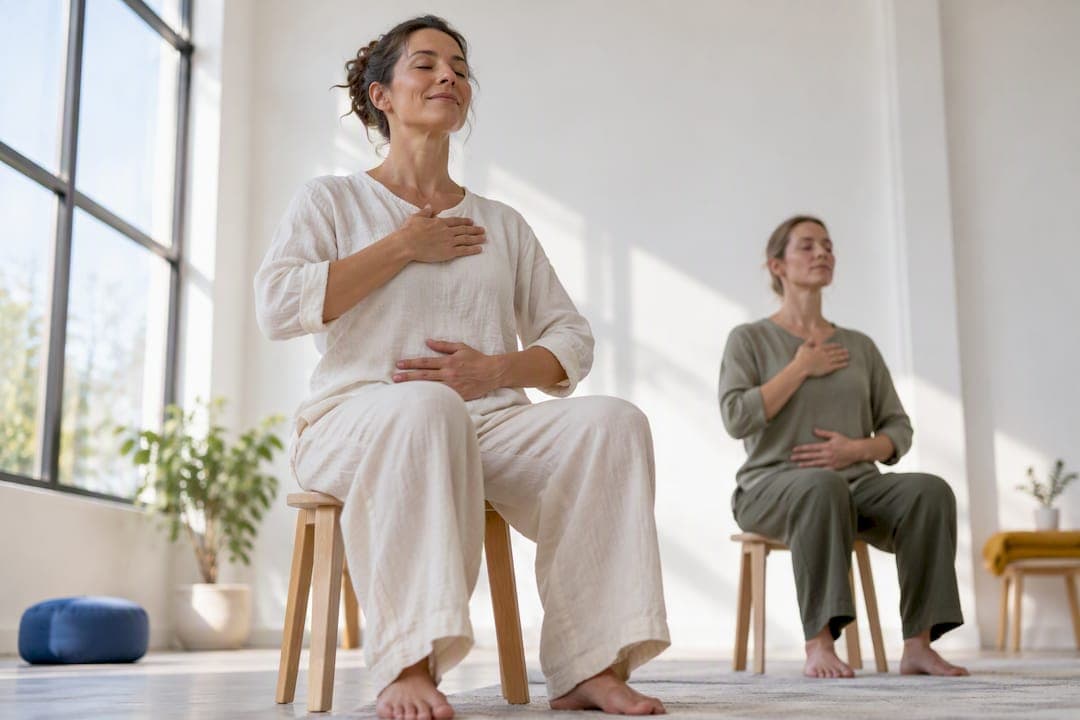
Breath-first Qigong works: slow diaphragmatic breathing with long, soft exhales, paired with gentle movement, activates the vagus nerve and shows up in meta-analyses as measurable improvements in heart rate variability and lower perceived stress. The practical takeaway is simple. Try the seven-minute reset below, and repeat it two to three times a week or as a daily micro-practice, because consistency, not intensity, is what moves the needle over time.
TL;DR:
- Regular practice of slow diaphragmatic breathing with extended exhalation can gradually improve heart rate variability and reduce perceived stress over several weeks.
- The effectiveness of Qigong relies on consistent, moderate sessions of 30 to 60 minutes, two to three times weekly, with noticeable benefits appearing after 8 to 12 weeks.
- Gentle movements like shaking, facial softening, humming, and mindful touch enhance vagus nerve activation by reinforcing safety signals and stimulating autonomic balance.
- Beginners, older adults, and those with health concerns should start with seated exercises, shorter routines, and modify moves to avoid dizziness or discomfort, especially around digestion or balance issues.
- Combining breath, movement, facial relaxation, and optional humming creates a layered approach that amplifies vagus nerve stimulation more effectively than any single technique alone.
Table of Contents
- What the Vagus Nerve Does and How Qigong Reaches It
- What the Research Actually Shows About Qigong and Stress
- Qigong Moves That Target the Vagus Nerve, Step by Step
- The Seven-Minute Vagus Reset You Can Do Today
- Safety, Contraindications, and When to Check With Your Doctor
- Meet the Teaching Behind This Guide
- Beyond Breathing: The Neural Pathways Qigong Also Engages
- How Qigong Compares to Other Vagus Nerve Stimulation Methods
- Tracking Whether Your Vagal Tone Is Actually Improving
- Adapting Qigong for Different Bodies and Nervous Systems
- What I Tell Every New Student About Finding the Shift
- How QigongStar Helps You Build a Consistent Practice
- Sources
- FAQ
What the Vagus Nerve Does and How Qigong Reaches It
The vagus nerve is the longest cranial nerve in your body, running from the brainstem down through the neck, chest, and abdomen. It carries the parasympathetic signals that slow your heart rate, deepen digestion, and tell your lungs to relax. Think of it as your body's off switch for the fight-or-flight response, wired into your heart, lungs, and gut in ways that most people never learn about until something goes wrong.
Researchers measure how well that off switch is working through heart rate variability, or HRV, which tracks the tiny fluctuations between heartbeats. Two markers matter most here. SDNN reflects overall variability across a longer window, and RMSSD zooms in on beat-to-beat changes that are closely tied to vagal activity. Higher numbers on both generally mean your nervous system shifts more easily between alert and calm states, which is exactly what you want.
Here's the part that connects Qigong to all of this: slow breathing with an extended exhale creates what researchers call respiratory vagal stimulation, or rVNS. When your exhale runs longer than your inhale, vagal activity rises, heart rate drops slightly, and blood pressure often follows. That's not incidental to Qigong. It's the mechanism underneath nearly every slow, breath-led movement in the practice.
Diaphragmatic breathing is the tool that makes this reliable. Guy's and St Thomas' NHS Foundation Trust offers cues worth memorizing:
- Place one hand on your chest and one on your belly.
- Inhale through the nose and let the belly hand rise while the chest hand stays still.
- Exhale slowly, letting the belly fall, and extend the exhale longer than the inhale.
- Repeat for several breaths, keeping the shoulders soft and unhurried.
Statistic to note: A meta-analysis on Qigong and Tai Chi found moderate improvements in SDNN (Hedges' g = 0.47) and significant increases in RMSSD (Hedges' g = 0.60) after regular practice, which puts these breath-led movement styles solidly on the map as a legitimate way to shift your autonomic balance.
What the Research Actually Shows About Qigong and Stress
The evidence for qigong vagus nerve effects is stronger than most casual wellness content suggests, but it comes with real boundaries worth understanding before you set expectations.
Start with the numbers. The same systematic review cited above pooled data from hundreds of participants and found the RMSSD effect (Hedges' g = 0.60) based on 212 participants, while the SDNN effect (Hedges' g = 0.47) drew on 543 participants across multiple trials. In plain terms, that's a small-to-moderate effect on SDNN and a moderate-to-large effect on RMSSD, which in HRV research is a genuinely encouraging signal, especially for a low-risk, no-equipment practice.
On the psychological side, pooled results from several randomized trials found stress reductions with an effect size around SMD -0.88 and anxiety reductions around -0.75 after one to three months of regular practice. Those are large effects by conventional research standards, roughly comparable to what's reported for structured relaxation training in clinical settings.

What did the studies actually ask people to do? A review on Qigong for stress recovery found that trials generally used sessions of 30 to 60 minutes, two to three times weekly, sustained over 8 to 16 weeks to produce these effects. That's a useful benchmark if you're wondering how much practice actually counts.
A few caveats matter here:
- Baseline autonomic function varies. People who start with lower HRV or higher resting stress sometimes see bigger relative gains, while others plateau faster.
- Study styles differ widely. Meta-analyses lump together Qigong, Tai Chi, and related mind-body movement, so not every finding applies equally to every style.
- Consistency outperforms complexity. Research on moderators suggests that showing up regularly predicts benefit better than adding more advanced sequences.
- Sample sizes in some trials remain modest, which is typical for movement-based research but means individual results can vary more than a single average suggests.
None of this undercuts the core finding. It just means Qigong for vagus nerve support behaves like most gentle interventions: real, replicable at the group level, and dependent on you actually doing it.
Qigong Moves That Target the Vagus Nerve, Step by Step
These seven moves form the backbone of vagus nerve qigong practice. Each one is breath-led first, movement-second, so resist the urge to rush the shapes before you've settled the breath.
1. Diaphragmatic Seated Breathing Sit tall, hand on chest, hand on belly. Inhale through the nose for a count of four, exhale slowly for a count of six to eight. Let the belly lead the movement, not the chest. This is your foundation, and if you only have ninety seconds, do this alone.
2. Shake the Tree Stand with soft knees and let your whole body gently shake, starting at the ankles and letting it ripple upward. Keep your jaw loose and your breath unforced. This move discharges nervous tension before you settle into slower work, and it's a favorite warm-up in White Tiger Qigong sequences.
3. Palm-Heart Massage Rub your palms together until warm, then rest one palm gently over your heart center. Breathe slowly under your own hand for six to eight breaths. The warmth and gentle pressure send a tactile signal of safety that pairs well with the breath.
4. Swimming Dragon A flowing spinal wave that moves through the torso, with the neck following gently rather than leading. Keep rotations small and controlled. Skip any strong neck traction if you have cervical issues, and keep the range of motion modest until your body tells you it wants more.
5. Soft Humming Exhale with a low hum in the back of the throat for five to twenty seconds. Humming vibrates tissue in the neck near the vagus nerve's pathway and gives you an audible cue that your exhale is long enough. Stop and switch to plain breathing if you feel light-headed.
6. Slow Standing Sway With Open-Hand Exhale Shift your weight gently side to side, and open your palms outward on each exhale as though releasing something. This pairs whole-body movement with the same extended exhale that drives respiratory vagal stimulation.
7. Micro-Yawn and Soft Face Massage Let your jaw drop into a small yawn, then use your fingertips to softly massage your temples and jaw hinge. Facial softening is one of the more overlooked signals your nervous system reads as safe, and it costs you fifteen seconds.
Pro Tip: If a move ever makes you feel dizzy or unusually breathless, shorten your exhale count and return to plain seated breathing. The goal is a gentle nervous system shift, never a strain.
For readers managing tighter chests or shallow breathing patterns, our guide on relaxation techniques without therapy walks through active relaxation cues that pair naturally with these seven moves.
The Seven-Minute Vagus Reset You Can Do Today
This sequence takes the moves above and compresses them into a tight, repeatable routine you can use on a stressful morning or before bed.
- Minute 1: Seated diaphragmatic breathing. Inhale for four counts, exhale for six to eight.
- Minutes 2 to 3: Shake the Tree, gentle and continuous, breath unforced.
- Minute 4: Palm-Heart Massage, six to eight slow breaths under your own hand.
- Minute 5: Swimming Dragon, small controlled range, neck soft.
- Minute 6: Soft humming on every exhale, five to ten seconds per hum.
- Minute 7: Micro-yawn, face massage, and three closing breaths with eyes softly closed.
To extend this into a fifteen to thirty-minute session, simply double the time on each movement phase and add a closing few minutes of stillness. Our daily Qigong routine guide has a longer structure if you want to build toward that.
| Progress Marker | What to Watch | Realistic Timeline |
|---|---|---|
| Resting heart rate | Small downward drift, tracked over weeks | 2 to 4 weeks |
| Subjective stress | Easier to settle after triggering events | 1 to 3 weeks |
| Sleep quality | Falling asleep faster, fewer night wakings | 3 to 6 weeks |
| HRV (if tracked) | Gradual SDNN/RMSSD improvement | 6 to 12 weeks |
Aim for daily micro-resets on busy days and two to three fuller sessions weekly, mirroring the dosing used in the trials that produced the effect sizes discussed earlier.
Safety, Contraindications, and When to Check With Your Doctor
Vagus nerve exercises are gentle by design, but gentle doesn't mean risk-free for everyone.
- Get medical clearance first if you have unstable cardiac conditions, severe uncontrolled hypertension, or recent neck or spine surgery.
- Pregnant readers with complications should check with their care team before adding new breath or movement practices.
- Stop and modify if you feel dizziness, faintness, sharp neck pain, or unusually strong heart palpitations during practice.
- Start seated rather than standing if balance or lightheadedness is a concern.
- Shorten your exhale counts if extended breath holds feel uncomfortable rather than calming.
- Ease off humming immediately if it triggers any dizziness, and return to plain diaphragmatic breathing.
If you're unsure whether a specific health condition affects your practice, our detailed page on Qigong contraindications covers modifications for a wider range of conditions than we can list here, and it's worth a read before you begin.
Meet the Teaching Behind This Guide
This guide draws on Stella's ongoing work teaching White Tiger Qigong and Five Animal Qigong, two curricula built specifically around breath regulation, gentle movement, and nervous system recovery. Instructors teaching through QigongStar hold certification from the White Tiger Qigong School and Yoga Alliance, which grounds the practice in a recognized lineage rather than a loosely assembled routine.
Classes at QigongStar are built breath-first, exactly as described above, with particular attention to stress relief and gut-related issues like IBS, since digestive symptoms and vagal tone are closely linked. Whether you're joining a live group class or working through an on-demand course, the sequencing always starts with the breath before it asks anything of your body.
Beyond Breathing: The Neural Pathways Qigong Also Engages
Breath drives most of Qigong's vagal effect, but it isn't the only lever at work. Slow, repetitive movement itself feeds proprioceptive signals into the brainstem regions that regulate autonomic tone, reinforcing the calming input the breath is already generating.
Facial and jaw softening matters more than most practitioners realize. The vagus nerve shares close anatomical and functional ties with the muscles of the face and throat through what's sometimes called the social engagement system. Deliberately relaxing the jaw, softening the eyes, and easing facial tension send the brainstem a signal of safety that can accelerate the shift into a parasympathetic state, sometimes faster than movement alone.
Humming adds a third pathway. The vibration from a sustained hum travels through tissue near the neck and throat, where branches of the vagus nerve run close to the surface. This mechanical stimulation, paired with the long exhale a hum requires, gives you two vagal levers operating at once rather than one.
None of these mechanisms work in isolation from the breath. Movement and facial cues amplify the effect that slow exhalation initiates, which is why Qigong sequences layer breath, motion, and subtle facial release together rather than treating them as separate techniques. That layering is likely part of why practice-based approaches show effects across both cardiac markers and self-reported stress, not just one or the other.

How Qigong Compares to Other Vagus Nerve Stimulation Methods
Qigong sits in a distinct category among vagus nerve healing techniques, occupying the space between passive relaxation and active medical intervention.
Electrical vagus nerve stimulation, delivered through implanted or transcutaneous devices, works directly on nerve fibers and is used clinically for conditions like treatment-resistant epilepsy and depression. It's precise and measurable, but it requires a device, a prescription, and ongoing medical oversight. It's not a tool most healthy adults reach for to manage everyday stress.
Meditation and mindfulness practices activate the vagus nerve largely through the same breath-slowing mechanism Qigong relies on, since most seated meditation styles naturally lengthen the exhale over time. The difference is movement. Meditation asks you to sit with stillness, which some people find difficult when anxious energy is high, while Qigong gives that same nervous energy somewhere to go through gentle shaking, swaying, or flowing motion before settling into stillness.
Cold exposure and other physical vagal stimulation methods, like cold water on the face, work through a different reflex entirely, triggering a sharp parasympathetic surge rather than a gradual one. They're fast but intense, and not everyone finds a sudden cold shock pleasant or sustainable as a daily habit.
Qigong's advantage is accessibility. It needs no device, no extreme sensation, and no clinical referral, and it gives restless energy a productive outlet before asking the nervous system to fully settle. For most healthy adults managing everyday stress rather than a diagnosed condition, that combination is hard to beat.
Tracking Whether Your Vagal Tone Is Actually Improving
You don't need a lab to notice change, but a few tracking methods make progress harder to talk yourself out of.
Consumer HRV devices, including chest straps and some wrist wearables, give you a rough proxy for the SDNN and RMSSD markers discussed earlier in this guide. Look for a gradual upward trend across weeks rather than day-to-day swings, since HRV is naturally noisy and reacts to sleep, alcohol, and stress independent of your Qigong practice.
Resting heart rate is a simpler, no-equipment option. Check it first thing in the morning before you get out of bed, and track it weekly rather than daily. A slow downward drift over a month or two is a reasonable sign that your baseline parasympathetic activity is strengthening.
Subjective markers matter just as much as numbers, and they're often the first thing to shift. Notice how quickly you recover after a stressful email, a tense conversation, or a bad night's sleep. Faster emotional recovery, even before HRV numbers move, is a genuine early signal that your vagal tone is responding to practice.
Sleep quality tends to shift next. Falling asleep faster and waking less during the night both correlate with improved autonomic regulation, and they're easy to notice without any device at all. Give any of these markers at least three to six weeks before drawing conclusions, since HRV and heart rate respond to consistent practice, not single sessions.
Adapting Qigong for Different Bodies and Nervous Systems
Vagus nerve qigong is genuinely adaptable, but it does need adjusting for different populations rather than a one-size-fits-all approach.
For older adults, balance and joint comfort come first. Seated versions of every move in this guide work just as well as standing ones, and Shake the Tree can be done from a chair with feet planted and hands resting on the thighs. Slower transitions between positions reduce fall risk without diluting the breath work that drives most of the benefit.
For people managing anxiety disorders, starting standing or with big movements can sometimes backfire, since heightened body awareness during anxiety can make gentle shaking or swaying feel overwhelming rather than calming. Begin instead with seated diaphragmatic breathing alone for several sessions before introducing movement, and keep humming brief and optional rather than a fixed requirement. Anxious nervous systems often respond better to predictability, so a shorter, repeatable sequence beats a longer, novel one.
For anyone managing digestive issues like IBS, timing practice around meals matters. Gentle Qigong done thirty to sixty minutes after eating, rather than immediately before or during digestion, tends to feel more comfortable and may support the same vagal pathways that regulate gut motility.
For beginners of any age, the seven-minute reset above is intentionally short precisely because a five-minute daily habit beats a fifty-minute session done once and abandoned.
What I Tell Every New Student About Finding the Shift
Three cues do more work than any fancy sequence: soften your jaw, let the exhale run longer than the inhale, and add a small hum if it feels right. Students who focus on those three things find the vagal shift faster than students chasing perfect form.
If you arrive anxious or tense, skip standing movement at first. Sit down, breathe, and let the body catch up before you ask it to move. That order, breath before motion, is the whole method in miniature.
— Stella
How QigongStar Helps You Build a Consistent Practice
Reading about breath-first Qigong is one thing. Having someone guide your exhale count, correct your posture, and catch the moments when you're holding tension without realizing it is another. That's the gap QigongStar's online classes are built to close.
If you want a structured entry point, the Qigong for Stress Relief and Digestive Wellness course guides you through breath-led sequences aimed at nervous system regulation and gut health. If you'd rather start smaller, the 30-Minute Clarity Session offers one-on-one time to get personalized feedback on your breath cues and movement before committing further. For those who want deeper, guided work, there are 60-minute online and face-to-face Qigong sessions available to cover more ground in a single sitting. Group classes are also offered, with pricing available directly on the booking page.
Whichever entry point fits your schedule and budget, the next step is simple: book a Clarity Session or browse the course options and pick the format that matches how much guidance you want right now.
Sources
- Systematic review and meta-analysis on Qigong/Tai Chi effects on HRV (PubMed entry)
- Respiratory vagal nerve stimulation model and contemplative activities (PMC)
- Abdominal (diaphragmatic) breathing - Guy's and St Thomas' NHS Foundation Trust
FAQ
What Is the Quickest Way to Reset Your Vagus Nerve?
The fastest reliable method is slow diaphragmatic breathing with an exhale longer than your inhale, sustained for one to two minutes. Adding a soft hum or facial softening can speed the shift, but breath alone is the quickest lever available anywhere, anytime.
What Is the Seven-Minute Vagus Nerve Reset?
It's a short sequence combining seated breathing, gentle whole-body shaking, palm-heart massage, a flowing spinal movement, soft humming, and a closing facial release, detailed step by step earlier in this guide. Each phase runs roughly one minute and builds directly on the previous one.
How Long Should I Hum to Stimulate My Vagus Nerve?
Five to twenty seconds per hum is a reasonable range, repeated across several exhales during a session. Stop humming immediately and return to plain breathing if you feel lightheaded, since the goal is gentle stimulation, not strain.
What Are the Symptoms of a Tight Vagus Nerve?
Common signs include a persistently elevated resting heart rate, digestive sluggishness or bloating, shallow chest breathing, and a sense of being stuck in low-grade alertness even when nothing stressful is happening. These symptoms often improve gradually with consistent breath-led practice like the routines in QigongStar's stress relief course, though persistent or severe symptoms deserve a conversation with a doctor.