
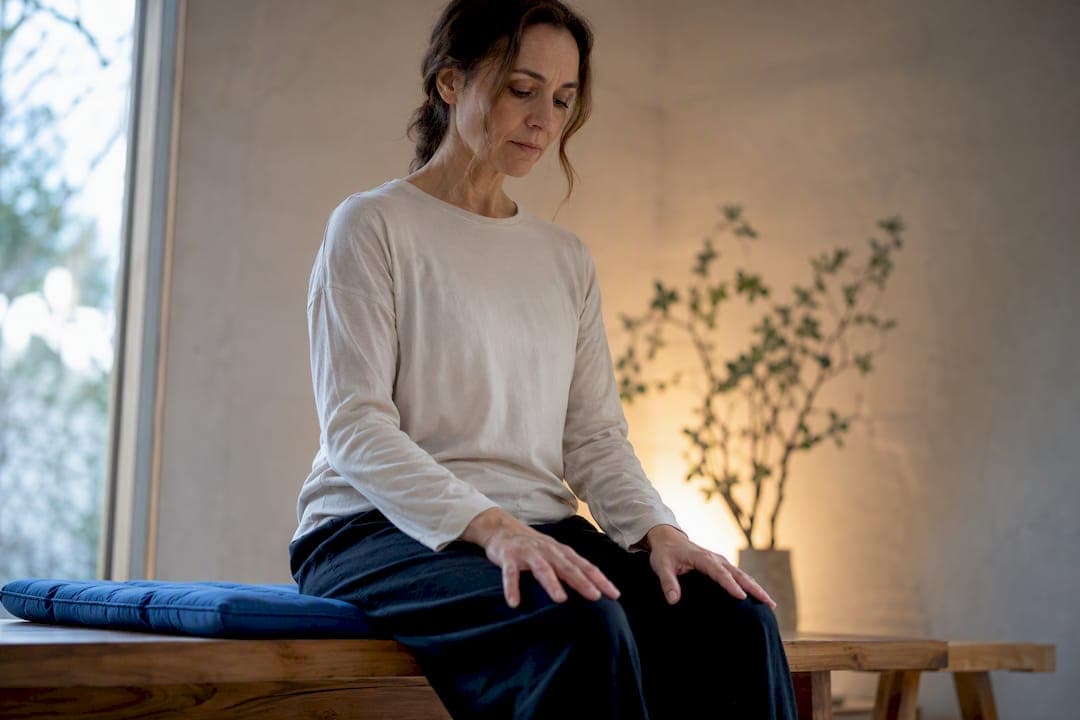
Bone breathing qigong is a mindful breath-and-visualization practice that guides subtle breath into the skeleton to support circulation, ease tension, and cultivate a felt sense of calm. Traditional teachings link it to "marrow washing" and stronger bones, though clinical evidence for those specific claims remains thin. If you're generally healthy, it's a gentle, low-risk practice worth trying. If you have bone disease, recent fractures, or another significant health condition, talk with your doctor before you begin.
TL;DR:
- The main physical benefits of bone breathing are deep relaxation, warmth, and improved focus, but there is no strong evidence linking it to increased bone density.
- Beginners should practice for 10 to 20 minutes weekly, starting with fingertip and toe visualization, gradually expanding to full skeleton awareness over months.
- Warning signs such as sharp pain, dizziness, or fainting require stopping practice and consulting a healthcare professional, especially for those with bone conditions or recent fractures.
- Using proper visualization techniques, especially focusing on the periosteum and marrow, enhances sensitivity and more reliably produces sensations like warmth or heaviness.
- Guided instruction and slow progression are essential for beginners to develop genuine sensation and avoid habits like rushing or forcing feelings during practice.
Table of Contents
- How to Practice Bone Breathing: A Beginner's Starter Routine
- What Bone Breathing Is Said to Do for Your Body and Mind
- Who Should Modify or Avoid Bone Breathing
- How to Progress From Fingertips to Whole-Skeleton Breathing
- Refining Your Technique: Visualization and Feeling
- What Research Actually Says About Breath-Focused Practices
- Who's Guiding You Matters
- The Roots of Bone Marrow Practice in Chinese Medicine
- A Teacher's Note on Starting Slowly
- Continue Learning With Guided Qigong Instruction
- Sources
How to Practice Bone Breathing: A Beginner's Starter Routine
You don't need a mat, a studio, or years of qigong under your belt to begin. You need a quiet ten minutes and a willingness to slow down.
Start seated in a supported chair with your feet flat on the floor, hands resting on your thighs, spine long but not stiff. Prefer standing? Take a relaxed stance, knees soft, shoulders dropping away from your ears. Either posture works. What matters is that your body feels held, not braced.
Here is the sequence traditional teachers use to build sensation gradually, moving from small, easy-to-feel areas toward the whole skeleton:
- Fingertip breathing. Rest your attention on one fingertip. Inhale slowly through your nose, imagining breath drawing in through the skin toward that fingertip. Exhale gently, letting warmth settle in.
- Hands and arms. Once you notice warmth or a subtle heaviness, expand the visualization up through your hand, wrist, and forearm to the shoulder.
- Feet and legs. Shift attention downward. Breathe into your toes, then let the sensation travel up through your ankles, shins, and thighs.
- Whole skeleton. Combine both directions. Inhale and imagine breath entering through every bone surface at once, then exhale and gently "pack" that breath deeper into the bone, as if settling it in place.
Keep each inhale slow and low in the abdomen, not high in the chest. This diaphragmatic pattern supports parasympathetic activation, the body's rest-and-recover response. Bookend your session with a two-minute warm-up of easy shoulder rolls and a two-minute cooldown of stillness before standing up. A 10 to 20 minute session is plenty for a beginner.
If you feel lightheaded, stop and breathe normally. If you find yourself clenching muscles or forcing the breath, that tension defeats the subtle-breath effect qigong teachers describe. Ease off, soften your jaw and hands, and let the visualization happen rather than pushing it.
Pro Tip: Warmth or heaviness in a fingertip is often the first sign your attention has "landed." Don't chase bigger sensations too fast. Let each area teach you what focused, relaxed breath actually feels like before moving on.
For a wider foundation in breath control before layering on bone-specific work, Qigongstar's guide to qigong breathing exercises for beginners walks through the basics without rushing the process.
What Bone Breathing Is Said to Do for Your Body and Mind
Traditional Chinese medicine describes bone breathing as a way to "wash" the marrow, meaning it's thought to refresh Qi and blood circulation deep in the skeleton and, over years of practice, support bone strength. These are lineage claims passed down through practices like Bone Marrow Nei Gong, not laboratory findings.
What practitioners more commonly report, session to session, includes:
- A settling sense of calm that builds as the mind narrows to one small area of the body
- Warmth or heaviness sensations in the hands, feet, or wherever attention rests
- Sharper focus once the initial restlessness of sitting still fades
- A feeling of being more "in" the body rather than caught in mental chatter
Here's the honest caveat: no high-quality clinical trial has directly linked bone-focused qigong to increased bone mineral density. The subjective benefits, calm, warmth, focus, are well within what breath-focused attention practices reliably produce. The skeletal-strengthening claim is traditional wisdom, not proven physiology, at least not yet.
Who Should Modify or Avoid Bone Breathing
Bone breathing is gentle by design, but "gentle" doesn't mean "appropriate for everyone, every time." A few situations call for a pause and a conversation with your doctor first:
- Recent fractures or unstable osteoporosis, where added focus on bone areas may not be the priority right now
- Recent surgery, especially anywhere near the spine, hips, or ribs
- Uncontrolled cardiovascular conditions, where breath-holding patterns could add unwanted strain
While practicing, treat these as red flags to stop immediately: fainting or near-fainting, sharp bone pain (different from mild warmth), or acute dizziness. None of these belong in a calm breathing session, full stop.
If you're cleared to practice but want to be cautious, shorten your sessions, keep your posture fully supported in a chair, and skip any breath retention unless a clinician has specifically approved it. Qigongstar's full breakdown of qigong contraindications covers additional conditions worth discussing with a healthcare provider before you start.
How to Progress From Fingertips to Whole-Skeleton Breathing
Rushing bone breathing is a common beginner mistake. Sensitivity builds in stages, and skipping ahead usually means you're visualizing rather than actually feeling anything.
- Weeks 1 to 2: Practice fingertip and toe breathing only, 10 minutes a day. Your goal is simply to notice warmth or heaviness reliably.
- Weeks 3 to 6: Expand to full hands, feet, and lower limbs. Sessions can stretch to 15 to 20 minutes.
- Weeks 6 to 12: Move into whole-skeleton breathing, combining upper and lower body in one flowing cycle. Intermediate practitioners often work up to sessions of 30 to 60 minutes at this stage.
- Beyond three months: If you want to explore advanced compression or "packing" techniques, do this with an experienced teacher. These lineage-specific methods aren't designed for solo learning.
You're ready to expand each stage when sensation becomes consistent, not occasional. If you're still guessing whether you feel anything, stay put a little longer.
Refining Your Technique: Visualization and Feeling
The real skill in bone breathing isn't the breath pattern. It's cultivating what traditional teachers call yi, focused, relaxed feeling, without forcing it.
A useful visualization sequence moves in layers: first the skin, then the periosteum (the fibrous sheath wrapping each bone), then the marrow itself. Many beginners find that pausing at the periosteum layer turns an abstract idea into an actual tactile sensation, since it sits close enough to the skin to register clearly.
- Picture breath entering through the skin first, like mist settling on a surface
- Let that "mist" sink to the periosteum before imagining it reaching marrow
- Keep hands and jaw soft. Tension anywhere blocks the subtle sensation you're after
- Practice noticing before practicing controlling
This subtle skin-level breath is distinct from ordinary lung breathing. Your lungs still do the physical work of respiration. The visualization simply directs attention elsewhere while that happens.
Pro Tip: Try this five-minute sensitivity drill before a full session: rest your hands, pick one fingertip, and imagine drawing breath into it. Repeat daily until warmth shows up reliably, then move that same focus to an adjacent finger or toe.
What Research Actually Says About Breath-Focused Practices
Breath-focused mindfulness has real research behind it, just not for the specific claim of increasing bone density. Guided mindful breathing protocols practiced for 5 to 20 minutes a day show measurable benefits for stress reduction and attention, and short daily scripts can lower anxiety and support parasympathetic activation within minutes.
Reduced stress and improved circulation are plausible supporting factors for skeletal health over time, since chronic stress is linked to hormonal patterns that affect bone remodeling. That's a reasonable mechanism, not a proven outcome.
Here's where the evidence runs out: no randomized controlled trial in the current research record demonstrates that bone breathing itself raises bone mineral density. The autonomic and attention benefits of breathwork are well documented. The leap from "calmer, better circulation" to "denser bones" hasn't been tested directly, and honest teachers say so.
Who's Guiding You Matters
Stella, instructor and practitioner behind Qigongstar, teaches bone breathing as part of a broader foundation in breath regulation and internal work rooted in Chinese medicine. Qigongstar offers this instruction through on-demand courses and live virtual classes, including White Tiger Qigong and Five Animal Qigong programs.
A qualified instructor should be able to explain why a technique works, not just demonstrate it, and should flag when a method (like bone compression) requires supervised, in-person guidance. That distinction matters most once you move past beginner drills into anything more advanced.
The Roots of Bone Marrow Practice in Chinese Medicine
Bone breathing traces back to a broader tradition known as Bone Marrow Nei Gong, or Xǐ Suǐ Gōng, sometimes translated as "marrow washing." Historically, these methods sat within internal alchemy traditions that treated the skeleton not as inert structure but as living tissue capable of absorbing and circulating Qi, much the way traditional Chinese medicine views blood and breath as interconnected systems rather than separate mechanical processes.
Lineage accounts describe monks and martial artists using bone breathing to build resilience for physical training, later folding it into longevity and health practices meant for a wider audience. The modern teacher most associated with popularizing these methods outside China is Mantak Chia, whose writings on Bone Marrow Nei Gong brought fingertip-to-whole-skeleton progression and marrow visualization into contemporary qigong instruction.
What's worth understanding is that bone breathing was never meant to stand alone. It developed as one layer within a larger system that included physical conditioning, meditation, and, in advanced stages, methods like bone tapping or compression, practices explicitly reserved for students working directly with a teacher. The modern beginner-friendly version you're likely to encounter strips away those advanced layers and keeps the accessible core: slow breath, quiet attention, and a visualization that treats your skeleton as something alive and reachable, not fixed and forgotten.
A Teacher's Note on Starting Slowly
Go slower than you think you need to. The first weeks of bone breathing are about noticing, not achieving. And treat this as one piece of bone health, not the whole picture. Pair it with strength training and whatever calcium or vitamin D guidance your doctor recommends for your own bones.
— Stella
Continue Learning With Guided Qigong Instruction
Bone breathing rewards patience, and patience is easier to sustain with feedback from someone who can see your posture and hear how you describe your sensations. That's the real gap between reading a routine and learning it in a class: a teacher can tell you whether that "warmth" you're feeling is genuine sensitivity or wishful thinking.
Qualified instructors offer this kind of guided progression through on-demand courses, live virtual classes, and private sessions, so you can choose the pace and format that fits your schedule. Beginners typically gain the most from supervised classes early on: correction on form, confirmation that you're feeling the right things, and a structured path that doesn't leave you guessing what comes after fingertip breathing. If you're ready to build a fuller foundation in breath and internal work, White Tiger Qigong offers lineage-rooted training that includes this kind of subtle-breath cultivation, while the Five Animal Qigong program pairs movement with breath for a more active complement to seated practice. Browse Qigongstar's live and on-demand classes to find a starting point that matches where you are right now.
This article is general information, not a substitute for advice from a qualified doctor. Consult a qualified healthcare professional about your own circumstances before acting on anything here.
Sources
- Mindful Breathing | Greater Good in Action
- Breathing mindfulness — University of Pennsylvania psychiatry materials
- Mindfulness and health-related research (PMCID: PMC3085832)
- Bone Marrow Nei Gong (Xǐ Suǐ Gōng) — Qigong practice guide