
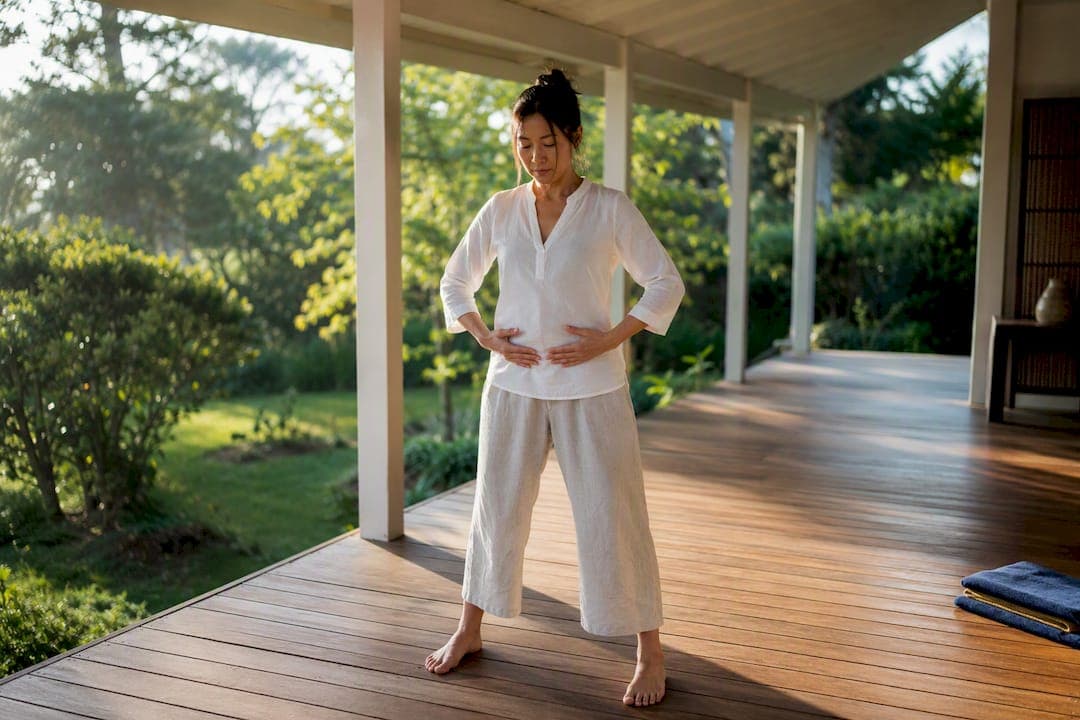
Yes, specific gentle qigong moves coordinated with breath can stimulate and help balance the stomach meridian, easing gut-related tension and supporting digestion when you practice regularly. Short-term, most people notice a softer, calmer belly within a session or two. Longer-term, consistent practice helps regulate digestion, energy, and sleep. Below, you'll find the guided moves and a simple daily routine to get you there.
TL;DR:
- Regular practice of stomach meridian qigong can help regulate digestion, energy, and sleep over time by physically stimulating the digestive organs and calming the nervous system.
- Gentle movements like waist circling and abdominal stretching are most effective when performed slowly and with attention to breath, ideally for 5 to 10 minutes daily.
- Using longer exhalations and focusing attention below the navel enhances the practice's calming effects and supports parasympathetic nervous system activation.
- People with acute abdominal pain, pregnancy, hernias, or severe digestive conditions should modify or avoid certain moves and consult healthcare providers before practicing.
- Certified instruction can improve form and safety, especially when managing chronic issues such as IBS, and traditional Chinese medicine links the stomach meridian to emotional health issues like worry and overthinking.
Table of Contents
- Stomach Meridian Qigong Moves for Beginners
- A Simple 5 to 10 Minute Daily Stomach Qigong Routine
- How Breath and Attention Make These Moves Work
- Safety, Contraindications, and Modifications
- What the Research Actually Shows
- Why Learn From a Certified Instructor
- How the Stomach Meridian Connects to Other Meridians
- Where Stomach Meridian Qigong Comes From
- Beyond Digestion: Other Benefits of Stomach Meridian Work
- How to Feel the Stomach Meridian as a Beginner
- What the Research Gets Right (and What It Doesn't Promise)
- Learn Stomach Meridian Qigong With Guided, Certified Instruction
- Sources
- FAQ
Stomach Meridian Qigong Moves for Beginners
The stomach meridian runs from just below your eyes, down through your torso, and along the front of your legs to your second toe, according to traditional Chinese medicine practitioner sources. Movements that gently rotate, stretch, or compress the abdomen work directly along this pathway, which is why the moves below focus so heavily on the waist and belly.
These six moves form the foundation of stomach meridian qigong practice. Move through them slowly, breathing with intention rather than rushing to finish.
- Waist Circling (Abdominal Rotation). Stand with feet shoulder width apart, knees soft, hands resting on your lower belly. Circle your hips and torso slowly in one direction, then reverse. This is the core movement highlighted in a qigong method shown to improve fatigue and gut health, where practitioners use gentle waist turns to encourage digestive movement. Do 8 to 10 slow circles each way.
- One Bend, One Stretch. Inhale as you reach both arms overhead and gently arch back, opening the chest and stretching the front of your torso along the stomach channel. Exhale as you fold forward with a soft spine, letting your arms drop. A Chinese medicine practitioner recommends this exact sequence to regulate stomach qi and improve digestion and sleep. Repeat 6 to 8 times.
- Belly Breathing Press. Sit or stand tall. Place both palms over your navel. Inhale, letting your belly expand against your hands. Exhale slowly, gently pressing inward as your abdomen contracts. This move builds the breath awareness you'll need for everything else. Hold each cycle for about 6 seconds on the exhale, for 1 to 2 minutes total.
- Torso Wave. Standing with knees bent, initiate a soft wave motion starting at the pelvis and rolling up through the chest, then reverse it moving down. This loosens the fascia along the stomach meridian's vertical path. Move slowly for 1 minute.
- Zusanli Tap (Point ST36). Sitting or standing, tap gently below your kneecap on the outer shinbone, a point commonly referenced in self-care practices for the stomach meridian to relieve bloating and cramping. Tap for 30 to 60 seconds per leg.
- Standing Meridian Trace. Run your palms lightly from just under your eyes, down your chest, over your belly, and down the front of your thighs, following the meridian's path. This isn't a stretch so much as a mindful acknowledgment of the channel. Trace slowly 3 to 5 times.
Keep your knees soft throughout, never locked. If any move pulls at your lower back or pelvic floor, shrink the range of motion rather than pushing through it.
Pro Tip: If your belly feels tight or defensive at first, that's normal. Start with smaller circles and shallower bends, and let the range grow over several sessions rather than forcing it on day one.
A Simple 5 to 10 Minute Daily Stomach Qigong Routine
You don't need a studio or an hour to feel a difference. This sequence takes 5 to 10 minutes and works well first thing in the morning or an hour after eating.
- Warm-up (1 to 2 minutes). Stand with feet hip width apart, knees soft. Sway gently side to side, letting your arms swing loosely, to settle your nervous system before you begin.
- Belly Breathing Press (1 to 2 minutes). Move into slow, deep belly breaths, hands over your navel, to establish the breath rhythm you'll carry through the rest of the routine.
- Waist Circling (2 minutes). Ten slow circles in each direction, staying loose through the hips and shoulders.
- One Bend, One Stretch (2 minutes). Six to eight rounds, moving with your breath rather than against it.
- Cool-down (1 minute). Stand still, hands on your belly, and take three long, slow breaths, noticing any warmth or looseness in your abdomen.
Practice this once daily, ideally on a lightly full or empty stomach rather than right after a heavy meal. Many practitioners and teachers recommend starting with 5 to 10 minutes daily of targeted abdominal movement paired with breath for measurable digestive benefits over a few weeks. As it gets easier, extend each move by a minute or two rather than adding new ones.
How Breath and Attention Make These Moves Work
The breath pattern matters as much as the movement itself. Inhale for a count of about 4, then exhale for a count of 6 to 8. That longer exhale is deliberate: extending the outbreath shifts your nervous system toward the parasympathetic, rest and digest state that your gut needs to actually move things along.
Keep your attention low, roughly two inches below your navel, in the area many qigong traditions call the lower dantian. Rather than watching the clock or your form in a mirror, simply feel your belly rise and fall. That's the whole instruction. Overthinking it defeats the purpose.
Two mistakes show up constantly with beginners. First, holding the breath during a stretch or rotation, which tenses the exact muscles you're trying to soften. Second, rushing through repetitions to "get to the end," which turns a calming practice into another item on the to-do list. Slow down. A waist circle that takes 5 seconds does more for your stomach meridian than one that takes 2.
Safety, Contraindications, and Modifications
Stomach meridian qigong is gentle by design, but a few situations call for extra care.
- Seek medical attention rather than practicing through acute, unexplained abdominal pain, blood in your stool, or symptoms that are rapidly worsening.
- If you're pregnant or have a hernia, skip strong abdominal compressions and deep forward folds; stick with gentle meridian tracing and small, easy rotations instead.
- Never hold your breath during a movement, and keep your knees soft rather than locked at any point.
- Move only within a comfortable range. A little gentle stretch is fine; sharp pain is not.
- If you have a diagnosed digestive condition like severe IBS, treat qigong as a complement to your existing care plan, not a replacement for it, and check the IBS-focused gut health resource for tailored guidance.
What the Research Actually Shows
A randomized controlled trial testing the Prolong Life With Nine Turn (PLWNT) qigong method found statistically significant improvements in gastrointestinal symptoms and fatigue after an 8-week program.
The trial followed 96 patients with chronic fatigue syndrome and measured changes using the MFI-20 fatigue scale and GSRS gastrointestinal symptom scores, alongside shifts in gut microbiota, according to the randomized controlled trial published via PubMed.
That's a meaningful signal, though it's worth being precise about its scope: the study focused on people with chronic fatigue syndrome, not a general digestive-health population, and 8 weeks is a defined window, not a lifetime guarantee. The practical takeaway still holds for a broader audience, since the mechanisms involved aren't unique to chronic fatigue.
Those mechanisms are fairly well understood even outside this one trial. Abdominal rotation physically massages the digestive organs, encouraging peristalsis, the wave-like muscle contractions that move food through your gut. Slow, extended exhalation calms the sympathetic nervous system, which otherwise diverts blood flow away from digestion during stress. Practitioner summaries of the PLWNT trial point to coordinated breathing and gentle torso movement as the likely driver behind both the fatigue and gut symptom improvements, tying directly into what's often called the gut brain axis.
None of this makes qigong a cure. It's a genuinely useful adjunct, backed by an actual clinical trial, that works alongside medical care rather than instead of it, especially for anyone with a diagnosed digestive disorder.
Why Learn From a Certified Instructor
Stomach meridian qigong is low-risk, but form and pacing still matter, especially if you're managing an existing digestive issue. Certified instruction means someone trained to recognize when a modification is needed rather than a generic video demonstrating moves at the wrong pace for your body.
Stella, the instructor behind Qigongstar, holds White Tiger Qigong School certification and Yoga Alliance accreditation. Her courses run across live online classes and on-demand sessions, so beginners can start with a guided group format while anyone managing a health condition can opt for a private session with closer attention to individual needs.
How the Stomach Meridian Connects to Other Meridians
The stomach meridian doesn't work alone. In traditional Chinese medicine, it's paired with the spleen meridian, and together they govern how your body extracts and distributes energy from food. When teachers talk about the stomach meridian, they're almost always talking about this partnership by extension.
The stomach meridian also has a close working relationship with the large intestine and small intestine meridians, since all three sit along the digestive process from intake to elimination. This is part of why a stomach-focused qigong routine tends to produce broader digestive benefits rather than a narrowly targeted effect. When you rotate your waist or stretch your torso, you're rarely stimulating just one channel.
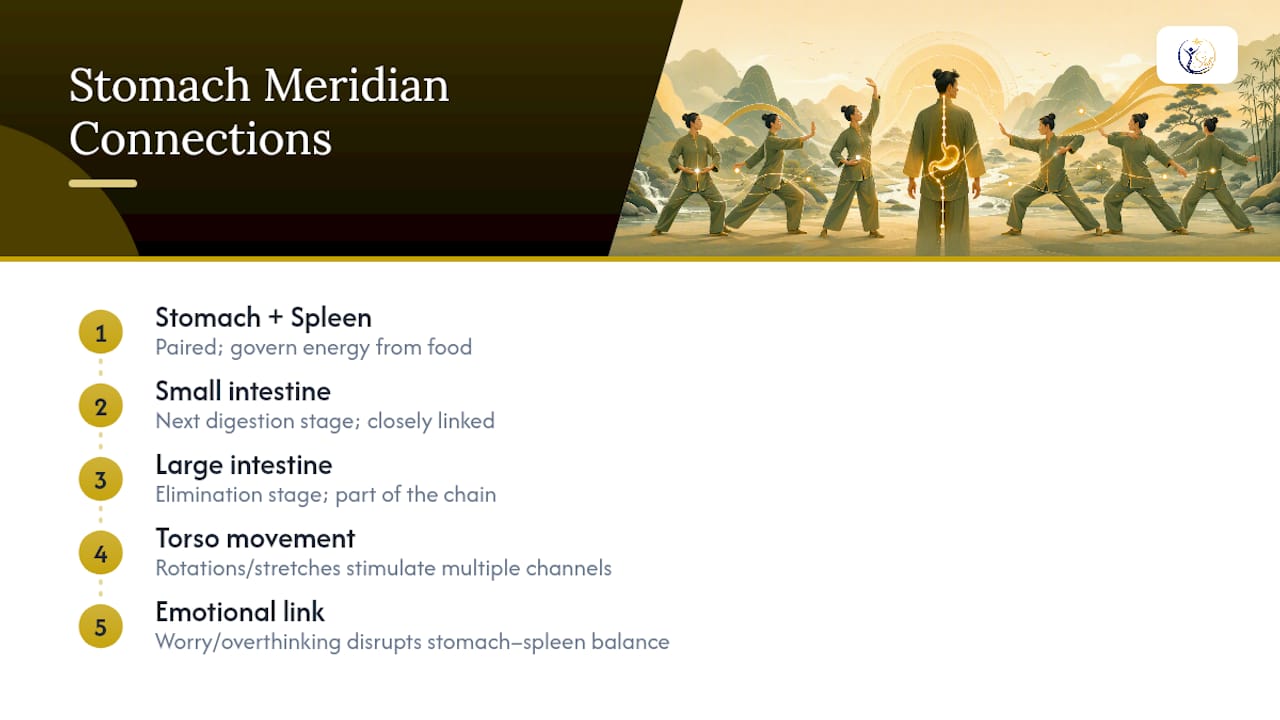
There's an emotional dimension worth knowing too. TCM associates the stomach and spleen meridians with worry and overthinking. That's not a metaphor practitioners take lightly. Chronic stress and rumination are frequently cited in TCM literature as contributors to stomach meridian imbalance, which lines up with modern research on how psychological stress disrupts gut function through the gut brain axis. Practicing stomach meridian qigong, then, is as much about calming an overactive mind as it is about physically moving your belly.
Where Stomach Meridian Qigong Comes From
Meridian theory traces back thousands of years within Chinese medicine, forming part of the same framework that underpins acupuncture and acupressure. The stomach channel, known as Zu Yang Ming in classical texts, has long been mapped as one of the twelve primary meridians, each linked to a specific organ system and set of functions.
Qigong itself developed as a movement-based complement to these acupuncture and herbal traditions. Rather than inserting needles or prescribing herbs, qigong practitioners use posture, breath, and intention to influence the same channels. Specific forms like the Prolong Life With Nine Turn method, the basis of the clinical trial mentioned earlier, were designed centuries ago around exactly this idea: that structured abdominal movement could support internal organ function without any external intervention.
Modern qigong lineages, including White Tiger Qigong and Five Animal Qigong, both draw on this same root system while adapting the movements for contemporary bodies and lifestyles. Five Animal Qigong in particular mimics the movement patterns of animals like the tiger, deer, and bear, each associated with different organ systems and energetic qualities. The digestive focus within these traditions isn't a modern wellness trend grafted onto an old practice. It's one of the original applications the system was built for.
Beyond Digestion: Other Benefits of Stomach Meridian Work
Digestive relief tends to get the headline, but stimulating the stomach meridian touches several other areas of daily function. Sleep quality shows up repeatedly in practitioner accounts, since the abdominal stretching and breath work involved in moves like One Bend, One Stretch are specifically noted for improving sleep alongside digestion.
Energy levels are another common report. The PLWNT trial's improvement in fatigue scores wasn't a side note. It was one of the two primary outcomes measured, alongside gastrointestinal symptoms, which suggests the connection between gut function and overall vitality runs deeper than most people assume.
Skin clarity gets mentioned often in TCM circles too, since stomach meridian imbalance is traditionally linked to breakouts along the jawline and cheeks, the areas the meridian passes through on the face. Whether or not you buy the full traditional framework, the practical overlap between gut health and skin health is well documented in general wellness literature.
Mood and mental clarity round out the list. A calmer nervous system, achieved through the same slow breathing that supports digestion, tends to reduce the low-grade anxiety and mental fog that chronic gut tension can produce. It's a full-body practice wearing a digestive-health label.
How to Feel the Stomach Meridian as a Beginner
Most beginners expect a dramatic sensation and get frustrated when they don't feel one right away. Start by lowering that expectation. What you're looking for is subtle: warmth, a gentle pulling sensation, or a sense of looseness along the meridian's path as you move.
Try this simple test before your first full session. Place both palms on your belly and take five slow breaths, doing nothing else. Notice whether your belly rises more than your chest. If your chest is doing most of the work, that's a sign you're breathing shallow, and it's worth spending a few extra sessions just on belly breathing before adding movement.

During the moves themselves, pay attention to temperature and tension rather than any dramatic energetic sensation. A slight warming across your abdomen during waist circling, or a mild stretch sensation running down your torso during One Bend, One Stretch, are both signs the meridian is responding. If you feel nothing at all for the first several sessions, that's still normal. Sensitivity to this kind of subtle body awareness builds with repetition, not instantly.
Pro Tip: Practice in front of a mirror for your first week, not to correct your form obsessively, but to notice whether your movement is symmetrical. Uneven rotation often hides tension you didn't know you were carrying on one side.
What the Research Gets Right (and What It Doesn't Promise)
The clinical case for qigong's digestive benefits is stronger than most wellness trends get to claim, but it's not unlimited. The PLWNT trial is a real, registered randomized controlled trial with measurable outcomes, and that's worth taking seriously. It's also a single study on a specific population, and one 8-week trial doesn't settle every question about long-term outcomes across different digestive conditions.
Where conventional advice on this topic tends to go wrong is treating gentle movement practices as either miracle cures or empty relaxation exercises with no real physiological effect. Neither framing holds up. The honest middle ground is that structured, breath-coordinated abdominal movement produces a real, measurable effect on gut symptoms and fatigue for at least some people, through mechanisms (abdominal massage, nervous system regulation, gut brain axis influence) that are physiologically plausible and partially demonstrated.
What should you actually prioritize first? Consistency over intensity. A 5 minute daily practice done imperfectly for a month will do more for your stomach meridian than a single perfect 30 minute session followed by two weeks of nothing. Start small, breathe slowly, and give it real time before judging whether it's working.
— Stella
Learn Stomach Meridian Qigong With Guided, Certified Instruction
Practicing the moves in this article on your own is a solid start, but personalized instruction can help adjust your form and pacing to your actual body. Qigongstar's Qigong for Stress Relief and Digestive Wellness course runs at £116 one off and builds directly on the abdominal rotation and breath work covered above, with structured progression rather than a single video to rewatch on repeat.
If you want more focused, one-on-one attention, a 30 minute clarity session at £85 gives you space to ask questions about your specific digestive concerns, while a 60 minute deep dive online session at £145 works well if you're managing a chronic issue like IBS and want a slower, more thorough walkthrough. For anyone local enough to meet in person, a 60 minute face-to-face session is available at £165. All instruction comes from Stella, who holds White Tiger Qigong Level 3 certification and Yoga Alliance accreditation, so you're learning the moves with someone trained to catch the small form issues a self-taught routine tends to miss. Start with the online classes page to see current beginner session dates.
This article is general information, not a substitute for advice from a qualified doctor. Consult a qualified healthcare professional about your own circumstances before acting on anything here.
Sources
- Effect of Prolong Life With Nine Turn Method on chronic fatigue syndrome clinical symptoms and roles of gut microbiota: A exploratory randomized controlled trial — PubMed
- A Qigong Method That Improves Fatigue and Gut Health - American Tai Chi & Qigong Association
- Chinese medicine practitioner shares stretching move to improve digestion and sleep — The Standard
FAQ
What emotion is associated with the stomach meridian?
In traditional Chinese medicine, the stomach meridian and its paired spleen meridian are linked to worry and overthinking. Chronic rumination is often cited as a contributor to stomach meridian imbalance, which is one reason breath-focused qigong practice targets both the mind and the gut at once.
Can qigong help with stomach problems?
Yes. A randomized controlled trial found that an 8-week qigong program produced statistically significant improvements in gastrointestinal symptoms and fatigue in the participants studied. Gentle moves like waist circling and abdominal breathing appear to support digestion through mechanisms like abdominal massage and nervous system regulation, though it works best as a complement to medical care rather than a replacement.
What does the stomach meridian do?
The stomach meridian governs digestion and fluid transport in traditional Chinese medicine, running from below the eyes down through the torso and legs. When it's imbalanced, practitioners commonly associate it with bloating, poor sleep, skin breakouts, and low energy.
What are the symptoms of a blocked stomach meridian?
Common symptoms practitioners describe include bloating, sluggish digestion, fatigue, disrupted sleep, and skin issues along the jaw and cheeks where the meridian passes on the face. If you notice acute or worsening abdominal pain rather than these milder signs, that calls for medical evaluation rather than a movement practice.