
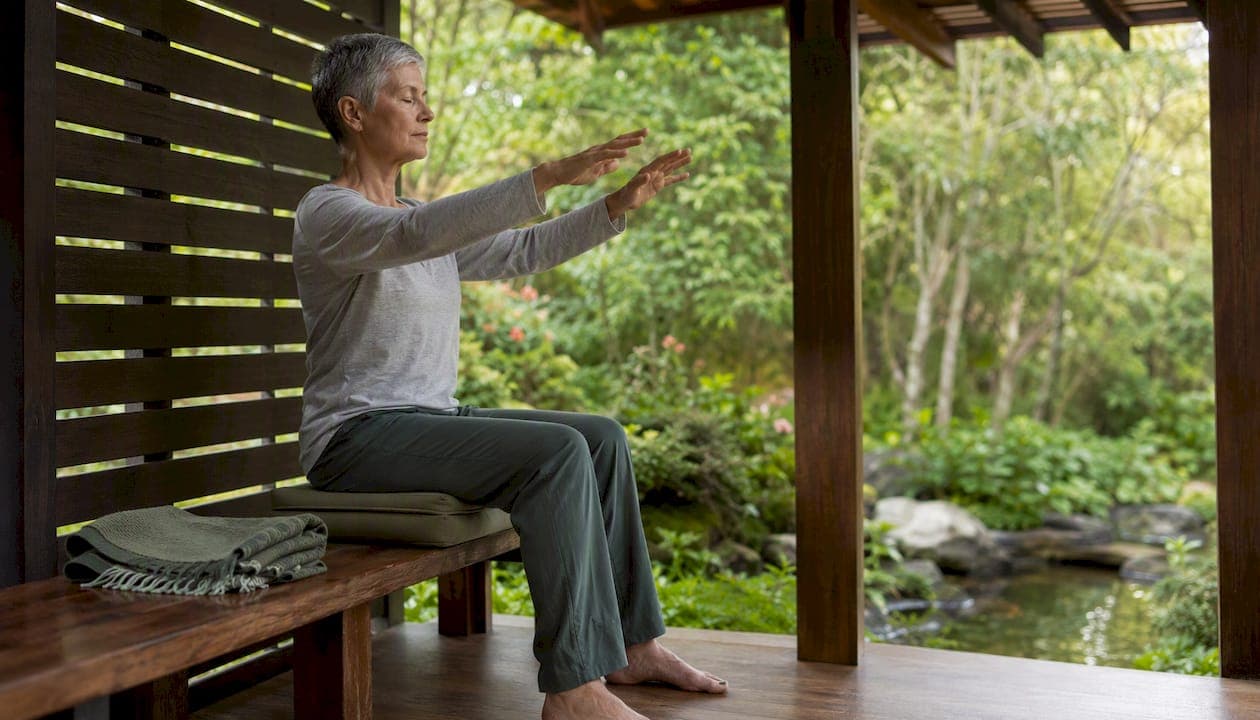
You can complete a full seated qigong routine in as little as seven minutes, and you don't need a yoga mat, special equipment, or any prior experience. This guide gives you a ready-to-follow sequence of core seated qigong exercises, clear movement cues, and a simple progression plan so you can start today and build from there. The routine draws on principles from White Tiger Qigong, a certified tradition taught by Qigongstar instructor Stella, and is suitable for most adults including older adults and those with limited mobility. A 12-week medical Qigong study found statistically significant improvements in balance and gait with no adverse events reported, which gives you a solid evidence base to work from. If you have a recent fracture, uncontrolled vertigo, or an unstable cardiac condition, check with your GP before starting.
Key Takeaways
A consistent seated Qigong practice, starting with just seven minutes daily, builds measurable improvements in balance, calm, and mobility over weeks, not months.
| Point | Details |
|---|---|
| Start with 7 minutes | A five-movement seated routine takes 7 minutes and requires only a firm chair. |
| Three golden rules | Keep breath comfortable, stay pain-free, and maintain a stable seated base at all times. |
| Evidence-backed gains | A 12-week Qigong program showed CBMS balance scores improve by +11.9 points overall. |
| Daily consistency wins | Practice daily or at least three times per week; consistency matters more than session length. |
| Qigongstar guided classes | Stella's live and on-demand courses offer certified instruction for UK beginners and beyond. |
Table of Contents
- Your 7-minute seated qigong routine, step by step
- What each movement actually does, and how to do it well
- How to set up your chair, posture, and space
- Who should take care, and how to modify safely
- How often to practice and how to build over time
- What does the research actually show about Qigong's benefits?
- Common mistakes and how to fix them quickly
- Why seated Qigong belongs in everyday life, not just rehabilitation
- Guided seated Qigong classes with Qigongstar
- Sources
Your 7-minute seated qigong routine, step by step
This sequence flows through five gentle movements. Read through it once, then follow along. Each step includes a breath count and an inline modification so you never have to pause and search for an easier option.
Session length options: 7 minutes (one round, as written) or 15 minutes (two rounds with a one-minute rest between them).
-
Centering breath (1 minute). Sit tall with both feet flat on the floor. Rest your hands on your thighs, palms up. Inhale through your nose for 3 counts, hold gently for 1, exhale through your mouth for 4. Repeat 6 times. Modification: shorten to a 2-count inhale and 3-count exhale if you feel any strain.
-
Spinal cord breathing (1.5 minutes). On each inhale, gently lengthen your spine upward, as if a thread is pulling the crown of your head toward the ceiling. On each exhale, soften and let the shoulders drop. Add a small forward tilt at the hips on the inhale and return to neutral on the exhale. Do 8 slow repetitions. Modification: keep the movement tiny, just a breath-led lengthening with no forward tilt, if you have lower back sensitivity.
-
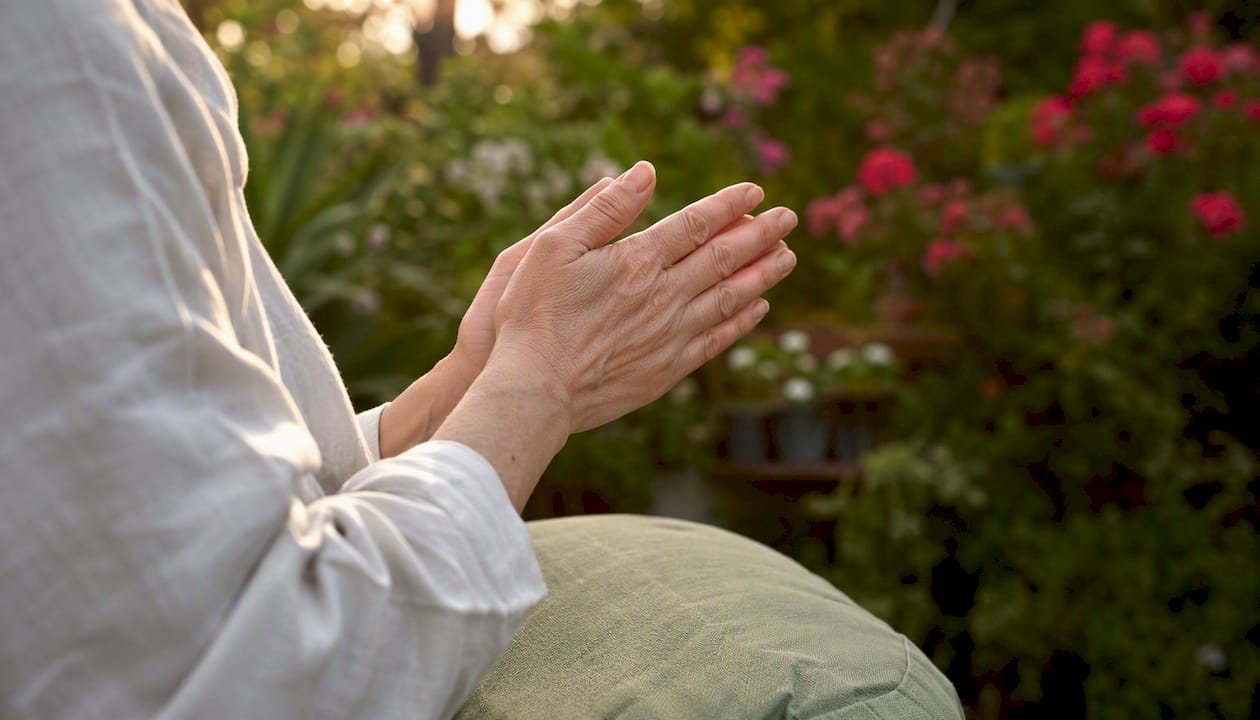
Qi self-massage (1 minute). Rub your palms together briskly for 5 seconds to build warmth. Place both hands over your lower abdomen (the lower dantian). Breathe naturally and let the warmth soothe the belly for 30 seconds. Then move your hands to your lower back and hold for another 30 seconds. This movement settles the nervous system and is often the first one students say they feel immediately.
-
Pulling down the heavens, seated (2 minutes). Inhale and float both arms out to the sides and up overhead, palms facing each other. Pause at the top for one count. Exhale and press the palms slowly downward in front of your body, as if drawing calm energy down through your center. Repeat 8 times. Modification: if shoulder range is limited, lift only to shoulder height and press down from there. Keep elbows soft throughout.
-
Gentle seated twist (1.5 minutes). Place your right hand on your left knee and your left hand behind you on the chair seat. Inhale to lengthen, then exhale and rotate gently to the left. Hold for 2 counts, inhale back to center, and repeat on the other side. Do 4 repetitions per side. Modification: reduce the rotation to just a few degrees if you have a hip replacement or spinal fusion.
Closing (30 seconds). Return to the centering breath from step 1. Two slow cycles. Let your hands rest on your thighs and sit quietly for a moment before standing.
For a beginner 10-minute daily routine that pairs well with this sequence, Qigongstar's blog offers a clear follow-along guide with additional breathing variations.
What each movement actually does, and how to do it well
Spinal cord breathing
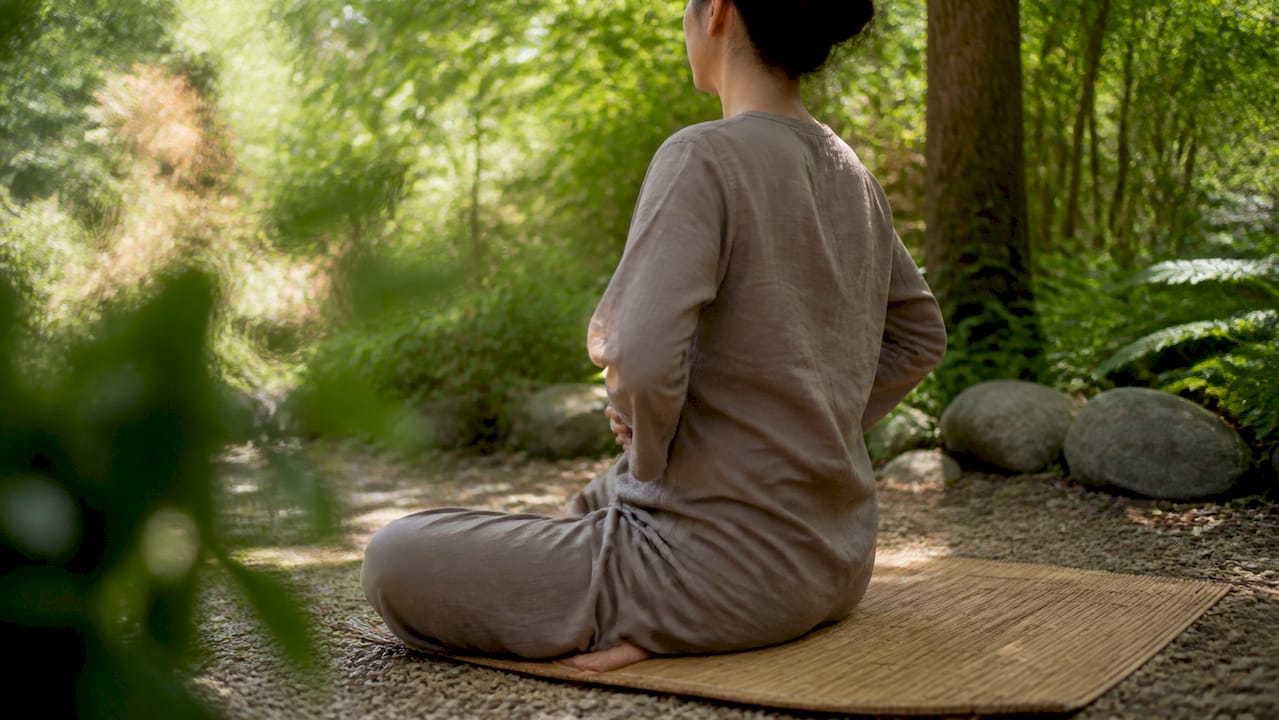
The goal is a breath-led wave through the spine, not a crunch or a stretch. You know you're doing it correctly when your lower ribs expand on the inhale and your belly softens on the exhale. If your shoulders are creeping up toward your ears, that's the most common signal to slow down and reduce the range.
Qi self-massage
Warming the palms before placing them on the body is a classic Qigong technique for directing attention and warmth inward. The body cue to watch for: a sense of gentle heat or tingling under your hands within 20–30 seconds. If you feel nothing at first, rub your palms a little longer before placing them.
Centering and the lower dantian
The lower dantian, roughly two finger-widths below the navel, is the energetic center in Qigong tradition. Placing your hands there during the centering breath anchors your attention and slows the breath naturally. You don't need to believe in any particular philosophy for this to work; the physical warmth and focused attention are enough.
Pulling down the heavens
This arm-lift movement opens the chest, gently mobilizes the shoulders, and coordinates breath with large movement, which is why it tends to feel the most satisfying in a short routine. The key is keeping the exhale longer than the inhale as the arms descend. If the arms feel heavy or shaky, reduce the height of the lift until your shoulders are comfortable.
Gentle seated twist
Spinal rotation stimulates circulation along the back and gently massages the abdominal organs. Move only as far as feels easy. Pain is always a signal to stop, not to push through.
Pro Tip: The single most common mistake in seated twists is leading with the chin rather than the chest. Keep your gaze level and let the rotation come from the mid-back, not the neck.
| Movement | Standard version | Limited mobility option | Pain-free alternative |
|---|---|---|---|
| Spinal cord breathing | Full forward tilt at hips | Breath-led lengthening only | Seated upright, breath awareness only |
| Pulling down the heavens | Arms overhead, full arc | Arms to shoulder height only | Hands rest on thighs, visualize the movement |
| Gentle seated twist | Full comfortable rotation | 5–10 degree rotation only | Hand on knee, no rotation, breathe into the side |
| Qi self-massage | Hands on abdomen and lower back | One hand only if needed | Hands on thighs, gentle breath focus |
How to set up your chair, posture, and space
Getting the setup right takes two minutes and makes every movement more comfortable and effective.
Posture checklist
- Seat depth: Sit toward the front half of the chair so your back isn't resting against the backrest. This keeps the spine free to move.
- Foot position: Both feet flat on the floor, hip-width apart. If your feet don't reach the floor, place a folded blanket or a firm cushion underneath them.
- Spine: Lengthen upward without rigidity. Think of stacking your vertebrae gently, one on top of the next.
- Head: Chin level, not jutting forward. The back of the neck stays long.
- Hands: Resting on thighs between movements, palms up to encourage openness or palms down for grounding.
Chair and props
A dining chair or a firm, armless chair works well. Avoid deep sofas or chairs that tilt you backward. A small cushion under the sitting bones can help if you find it hard to maintain an upright spine. A folded blanket on the lap is useful in cooler rooms and adds a sense of comfort during the qi self-massage step.
Seated Qigong movements require no special equipment and can be adapted for seated or lying practice, making them genuinely accessible for most ability levels.
Timing, clothing, and environment
- Best times: Morning practice tends to feel energizing; evening practice tends to feel calming. Both are valid. Pick the time you can keep consistently.
- Clothing: Loose, comfortable layers. Nothing that restricts the waist or shoulders.
- Space: A quiet corner with enough room to extend your arms to the sides without hitting anything. Dim the lights slightly or draw curtains if you find it easier to focus inward.
- Distractions: Silence your phone. Even a seven-minute window deserves your full attention.
Who should take care, and how to modify safely
Seated Qigong is gentle by design, but a few situations call for extra caution.
Pause and speak with your GP first if you have:
- A recent fracture (within the last 12 weeks), especially of the spine, hip, or wrist
- Uncontrolled vertigo or balance disorders
- An unstable cardiac condition or very high blood pressure not yet managed by medication
- Acute disc herniation with radiating pain
- A recent surgical procedure affecting the spine, hips, or shoulders
Three golden rules for safe practice:
- Breath comfort first. If you can't breathe comfortably during a movement, the movement is too large or too fast.
- Pain-free motion only. Mild stretch is fine; any sharp or joint pain means stop and reduce the range.
- Keep your base stable. Both feet stay on the floor throughout. Never reach so far that you feel unsteady in the chair.
Specific adaptations
Osteoporosis: Avoid deep forward bends and strong twisting. The breath-led spinal lengthening and arm lifts are well-suited; keep rotations minimal.
Hip or knee replacement: Avoid crossing the legs or rotating the hip beyond a comfortable neutral. The seated twist modification (5–10 degrees only) is appropriate.
Limited shoulder mobility: Use the shoulder-height arm lift throughout. Never force the arms overhead. The qi self-massage and centering breath movements are fully accessible regardless of shoulder range.
Pro Tip: Keep exertion below roughly 70% of your maximum effort at all times. If a movement feels like hard work, it's too intense for this practice.
How often to practice and how to build over time
Consistency matters more than perfect form, especially in the first few weeks. A short daily session builds the habit and the body's familiarity with the movements far more effectively than one long weekly session.
Recommended starting frequency: 10 minutes daily, or at minimum three times per week.
A simple 4-week progression plan
- Week 1: The 7-minute routine once daily. Focus on breath counts and posture only. Don't worry about the depth of any movement.
- Week 2: Add one extra round of pulling down the heavens (4 additional repetitions). Notice how your breath and shoulders feel compared to week 1.
- Week 3: Try the 15-minute version (two full rounds with a one-minute seated rest between them) on two days per week. Keep the 7-minute version on other days.
- Week 4: Practice the 15-minute version three times per week. On the remaining days, use the 7-minute version as a morning or evening reset.
Signs you're ready to progress
- You can complete the full sequence without losing the breath count.
- The movements feel familiar and you're not having to think about each step.
- You feel noticeably calmer or more energized after the session.
Combining seated and standing practice
Once the seated routine feels natural, you can add 5 minutes of walking Qigong before or after your seated session. Walking Qigong uses the same slow, breath-led movement principles and gently extends the balance and circulation benefits of your seated work into full-body movement.
What does the research actually show about Qigong's benefits?
The evidence base for Qigong is growing, and the results for older adults are particularly encouraging.
A 12-week manualized medical Qigong program involving 10 forms produced statistically and clinically significant improvements in balance and gait among community-dwelling older adults. The combined sites showed a Community Balance and Mobility Scale (CBMS) improvement of +11.9 points overall, with larger gains in participants in their 60s (+12.9 points) and 70s (+14.3 points). The program reported high acceptability and zero adverse events. Participants also described improved calm, relaxation, and flexibility.
Key finding: CBMS scores improved by +11.9 points overall after 12 weeks of structured Qigong practice, with the strongest gains in adults aged 60–79.
It's worth being clear about what this means for a short seated routine. The study used a structured 12-week program, not a single seven-minute session. Short daily sessions are the entry point; sustained practice over weeks and months is where the larger functional gains appear. Think of the 7-minute routine as the door, not the destination.
Systematic reviews of Qigong and Tai Chi in older adult populations consistently point to improvements in balance, sleep quality, and self-reported wellbeing. The mechanisms most often cited include breath regulation calming the autonomic nervous system, slow coordinated movement improving proprioception, and the meditative focus reducing cortisol. For a plain-language overview of how these mechanisms work in the body, Qigongstar's guide on how Qigong heals the body is a useful next read.
Common mistakes and how to fix them quickly
Even a gentle practice has a few pitfalls. These are the ones that come up most often with beginners.
Holding the breath during movement. The breath should lead every movement, not follow it. If you notice you've been holding, pause, exhale fully, and restart the breath count before continuing.
Moving too fast. Speed reduces the effectiveness of Qigong and increases the risk of strain. A useful check: if you can't maintain your breath count at the pace you're moving, slow down until you can.
Letting the chin jut forward. This compresses the neck and disrupts the spinal alignment that makes the movements work. Check your head position at the start of each new movement.
Gripping the chair. Hands should rest lightly on the thighs or float through the arm movements. White-knuckling the chair seat is a sign of tension, not support.
- Practice in front of a mirror occasionally to catch postural habits you can't feel.
- Set a gentle timer rather than watching a clock, so your attention stays inward.
- If your mind wanders, return to the breath count. That's the practice, not a failure.
Pro Tip: When looking for a guided class, check that the instructor holds a recognized credential such as White Tiger Qigong School certification or a Yoga Alliance registration. Well-structured beginner sessions typically run 7–30 minutes, giving you a clear sense of what to expect before committing to a longer course.
Why seated Qigong belongs in everyday life, not just rehabilitation
Most people discover seated Qigong through a physiotherapist's recommendation or a search for something gentle after an injury. That's a fine entry point. But treating it purely as a therapeutic tool undersells what it actually is: a daily practice for anyone who wants to feel calmer, move more freely, and carry less tension through the day.
The research on balance and gait is compelling, but the benefit most students notice first is subtler. After two or three sessions, the breath count starts to feel natural. The shoulders drop a little more easily. The nervous system learns, through repetition, that this is a signal to soften. That's not rehabilitation. That's a skill, and it compounds over time.
What makes seated practice particularly valuable is that it removes every barrier except willingness. No floor work, no special clothing, no warm-up required. You can do it at your desk, in your living room, or in a hospital waiting room. The chair is the only prop. That accessibility is not a compromise; it's the point.
Stella's approach through Qigongstar draws on White Tiger Qigong and Five Animal Qigong traditions, both of which are rooted in Chinese medicine and adapted for modern learners. The seated sequences in these programs are not simplified versions of the standing forms. They are complete practices in their own right, designed to work with the body you have today, not the body you think you should have.
Guided seated Qigong classes with Qigongstar
Ready to practice with a certified instructor guiding every breath and movement? Qigongstar offers live and on-demand online Qigong classes designed for stress relief, digestive wellness, and gentle mobility, all accessible from the UK. Whether you want a short daily session or a structured course, you'll find beginner-friendly options that meet you exactly where you are.
Stella's curriculum includes Five Animal Qigong and White Tiger Qigong, both taught with clear modifications for seated and limited-mobility practice. Classes run from short sessions to full progressive courses, and Stella holds certification from the White Tiger Qigong School and Yoga Alliance, so you're learning from a qualified, experienced instructor. Browse the class schedule or start an on-demand course today at Qigongstar's classes page.
Sources
This article is general information, not a substitute for advice from a qualified doctor. Consult a qualified healthcare professional about your own circumstances before acting on anything here.