
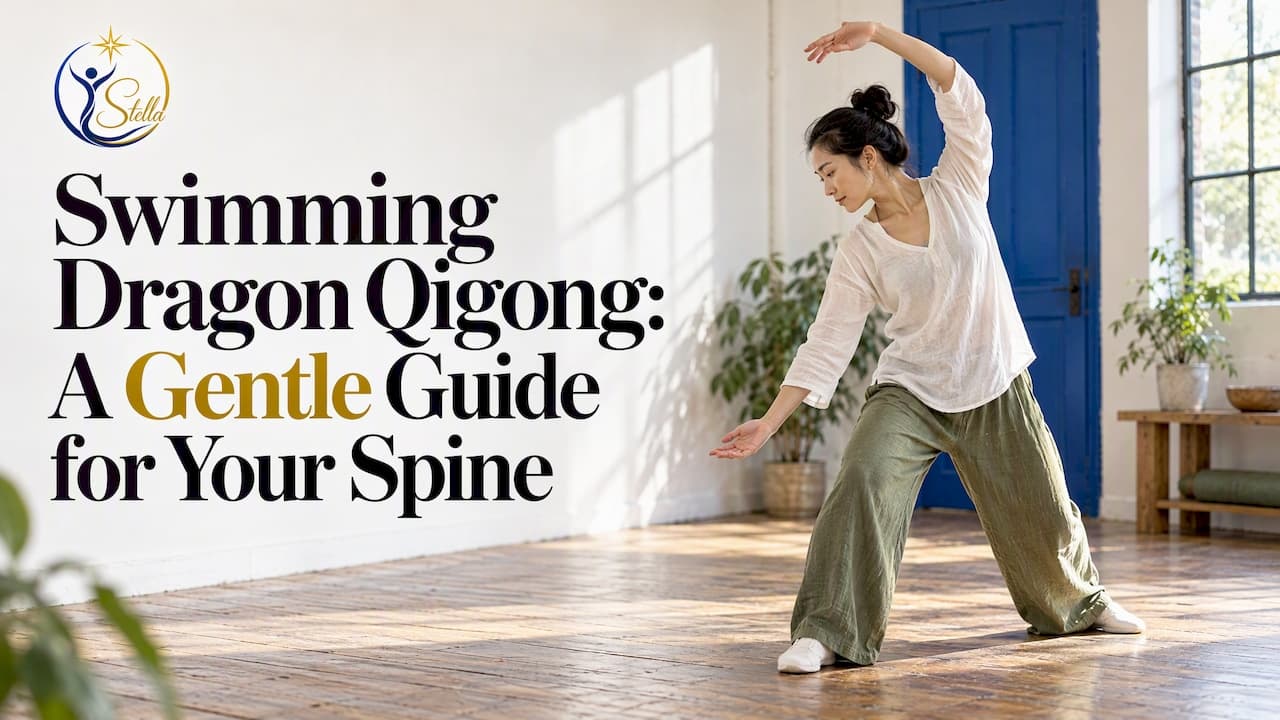
Swimming Dragon is a flowing qigong exercise in which your spine moves in soft waves, from the tailbone to the crown of the head, while your arms and legs follow the movement. It is gentle, takes 15 to 25 minutes, and suits most beginners. This guide explains where it comes from, how to practise it, what to expect, who should check with a doctor first, and how to learn it with a teacher if you want to be sure you are doing it well.
Key takeaways
- Swimming Dragon is a sequence of serpentine movements that mobilise the whole spine, usually practised in about 15 to 25 minutes.
- The skill is effortlessness. If you are forcing the movement, slow down and let momentum and the natural elasticity of your body do the work.
- The fold at the groin (the kua) is what lets your waist turn without twisting your spine, so learn it first.
- It is low risk for healthy adults, but see your doctor first if you have severe joint instability, uncontrolled high blood pressure or an acute injury.
- A teacher watching you can correct in minutes what takes months to notice alone.
Table of Contents
- What Swimming Dragon qigong is
- How the movement works
- Swimming Dragon step by step
- What to expect from regular practice
- Who should take care before starting
- Our perspective
- Learning with guidance
- How to make it a habit
- FAQ
- Sources
What Swimming Dragon qigong is
Swimming Dragon (游龍功, Yóu Lóng Gōng) is a qigong form built around undulation. Imagine a dragon moving through water: nothing is rigid, nothing is sudden, and the movement travels along the body in one continuous line. In practice, your pelvis, ribs, shoulders and head take turns leading, and the wave passes through your spine like a ripple.
People are drawn to it for a few simple reasons:
- It is easy to begin. There are no complicated stances or memorised sequences of dozens of postures.
- It is kind to stiff backs and necks, because the movement is small, slow and rhythmic.
- It is calming. The rolling rhythm gives the mind something simple to follow, which is why many people find it settles busy thoughts.
One practitioner describes the three-phase practice as helping to create an open, flexible spine, and that is a fair summary of what most teachers aim for.
A short history
The history is less settled than you might expect. According to one lineage account, the form is at most 150 to 170 years old and came to prominence later, in the early twentieth century. Another set of teaching notes describes a version of the exercises as developed by Liu Hsi-heng and taught within the tai chi world. Other guides place it within older Daoist internal cultivation traditions. Different schools teach it a little differently, so do not be surprised if two teachers show you slightly different versions. The principles stay the same: soft joints, a relaxed centre, and a spine that moves like a wave.
How the movement works
Before you try the sequence, it helps to understand three ideas. They matter more than the shape of your arms.
Effortlessness comes first
Teachers often say that when you feel yourself trying to force the movement, you have stopped doing qigong and started doing exercise. Swimming Dragon is not about muscular effort. You allow momentum, gravity and the elasticity of your body to carry you. A useful test: if your shoulders are lifting towards your ears or your jaw is tight, you are working too hard. Soften, slow down and begin again.
The kua, your hidden hinge
The kua is the fold at the groin, where the thigh meets the pelvis. Many beginners are surprised by how much attention it gets. When the kua is soft and mobile, you can turn your waist without twisting your spine and knees. It also lets your legs move together, rather like twin popsicle sticks, instead of breaking apart as you shift your weight.
Try this now. Stand with your feet hip-width apart and your knees unlocked. Place your hands on the creases at the top of your thighs. Let your weight sink slightly, as if you were about to sit on a high stool, and feel those creases fold. That small folding is your kua. Now rotate your pelvis a little to the left and right without moving your feet. The movement should come from the hips and not from the knees.

Hands connected to your centre
Your hands do not wave around independently. They stay connected to your lower abdomen, the centre your body moves from. Teachers say this connection is what separates a graceful, effective session from merely moving limbs in the air. When your centre moves, your hands follow, as if they were loosely tied to it by threads.
Swimming Dragon step by step
There are many versions, so treat this as a simple practice outline, not a replacement for a teacher. Standard routines are often taught in three half-rounds, each building on the one before, and the outline below follows that pattern. Wear loose clothing, practise on a non-slip floor, and leave a little space around you.
Preparing
- Stand with your feet about hip-width apart, knees soft, arms hanging.
- Let your tongue rest gently on the roof of your mouth and breathe through your nose.
- Shake out your hands, shoulders and legs for about 30 seconds.
- Feel your weight evenly across both feet, then soften your kua slightly.
Phase one: the pelvis leads
- Shift your weight into your right foot, letting your pelvis follow slowly.
- Allow the movement to travel up your spine so your ribs and shoulders respond a moment later.
- Let your arms swing loosely as the wave arrives, like seaweed in a current.
- Return to the centre and repeat on the left.
- Continue for about two minutes, keeping your breathing slow and unforced.
Phase two: the wave deepens
- Add a gentle forward and backward rhythm. As your pelvis tucks slightly under, your spine rounds; as it releases, your chest softly opens.
- Combine this with the side-to-side motion until a figure-eight or S-shaped wave starts to appear.
- Let your head be the last part to move, like the tip of a tail.
- Keep your knees soft and your feet connected to the floor.
Phase three: the whole body swims
- Let your hands travel in wide, slow arcs that follow your spine, with the palms leading as if they were pressing through water.
- Feel your whole body ripple from the soles of your feet to the crown of your head.
- Gradually make the movements smaller and slower.
- Finish by standing still, hands resting on your lower abdomen, for a minute or two. Notice what has changed in your breathing and in your shoulders.
Common beginner mistakes
- Twisting from the knees. If your knees ache, your kua is not folding. Reduce the range and bend your knees a little more.
- Moving too fast. A faster wave is not a better one. Aim for a pace where you can feel each vertebra join in.
- Holding your breath. Let your breath follow the movement. If you notice yourself holding it, pause and take two slow breaths.
- Stiff arms. Arms that stay stiff and separate from the body are the clearest sign that the hands are not connected to your centre.
- Going on too long at first. Start with five to ten minutes. Increase gradually as you feel steadier.
What to expect from regular practice
A basic session lasts about 15 to 25 minutes, and therapeutic effects are often reported after consistent daily practice over at least two weeks. That is a guide, not a promise. Some people feel looser and calmer after the first session; others need weeks to notice anything. Qigong is not a quick fix, and the best results tend to come from short, regular practice rather than occasional long sessions.
The movement is also a gentle form of mindful practice. Following the wave keeps your attention in the body, which many people find a relief if their days are spent in front of a screen. If stress is your main reason for starting, there is encouraging research: a 2024 systematic review of randomised controlled trials of qigong for stress management looked at the evidence for this use. Keep in mind that qigong research varies in quality, and qigong should sit alongside, not instead of, proper care for any health condition.
If you are short on time, our guides to a 10-minute beginner qigong sequence and to fitting qigong into your daily routine show how to build a habit around a form like this one. If your day is desk-bound, qigong for posture pairs well with Swimming Dragon.
Who should take care before starting
Qigong is generally low impact and can be adapted for different ages and fitness levels, but it is not a substitute for medical care. Guidance from a hospital group is that people with severe joint instability, uncontrolled high blood pressure or an acute injury should talk to their doctor before beginning. Persistent pain or unexplained neurological symptoms need a proper assessment from your GP, not self-experimentation with exercises.
Because Swimming Dragon mobilises the spine, a few situations deserve extra thought:
- Osteoporosis or osteopenia. Gentle, balance-focused movement can be useful, but ask your GP or a specialist what is safe for your spine. This piece on tai chi and osteoporosis, where falls benefits are clearer than bone gains sets out what gentle movement can and cannot be expected to do.
- Back or neck injury, disc problems, recent surgery. Speak to your GP or physiotherapist first, and reduce the range of movement so nothing pinches or pulls.
- Pregnancy. Ask your midwife or doctor before starting, and avoid deep forward rounding.
- Dizziness or low blood pressure. Keep the movement small, avoid turning your head quickly, and stop if you feel light-headed.
- Anxiety, low mood or trauma. Qigong can be a soothing companion, but it is not a replacement for therapy. If you are struggling, speak to your GP or a qualified counsellor. This overview of functional medicine and mental health counselling explains how body-based approaches can sit alongside professional support.
A good rule: stop if anything hurts sharply, and never push through pain. Mild muscle soreness the next day can happen as you discover muscles you rarely use, but sharp or lingering pain is a signal to stop and get advice. Our guide to qigong contraindications goes through who should modify or avoid practice in more detail.
Our perspective
We teach qigong rooted in Chinese medicine, and we see the same pattern again and again: people arrive believing they need to do more, and what they actually need is to do less, more slowly. Swimming Dragon is a perfect example. It looks simple, and that is exactly why it can be difficult. Our busy minds want to perform the movement, but the practice asks you to soften and let the body find its own wave.

That is also why we encourage our students to learn with a teacher at the start. A video can show you the shape. A teacher can see that your shoulders are creeping up, that your knees are doing the twisting, or that you are holding your breath, and can help you release it. Our instruction is delivered by a White Tiger Qigong Level 3 certified instructor who is also accredited by Yoga Alliance, with a background in professional wellness and digital communications. That means we understand the pressures of modern working life, and we teach routines that fit into them.
We also believe in honesty. Qigong is a complementary practice. It can help you feel calmer, move more freely and reconnect with your body, but it does not replace a diagnosis or treatment from your doctor. Use it as a nurturing part of your life, not a last resort.
— Stella
Learning with guidance
If you would like help learning to move gently and safely, we offer several ways to practise with a certified teacher, all described on our online qigong classes page:
- Qigong for Stress Relief and Digestive Wellness: a self-paced course for £116, one-off, for calming stress and supporting gut health at your own rhythm.
- 30-Min Clarity Session: £85, a short one-to-one session to ask questions and have your movement checked.
- 60-Min Deep Dive Online Session: £145, an hour of personal guidance for refining your practice.
- 60-Min Face-to-Face Qigong: £165, in-person instruction.
- Group Qigong Classes: a friendly way to practise alongside others. Visit the page for details.
If you prefer to explore first, our beginner's practical guide is a good starting point, and our article on on-demand qigong explains how self-paced learning works. If you are drawn to a wider practice, our Five Animal Qigong course is another gentle way in.
How to make it a habit
The best routine is the one you will actually do. Here is a gentle way to build one:
- Choose a regular time. Morning helps you wake your energy, and evening helps you let go of the day. Pick whichever you will keep.
- Start small. Five to ten minutes is enough for the first week.
- Practise in the same place. A corner of your living room is fine. Leave your phone in another room.
- Notice, don't judge. After each session, take a moment to feel your breathing, your shoulders and your lower back.
- Build up slowly. After two weeks, extend towards 15 to 25 minutes if it feels comfortable.
- Pair it with other gentle practices. If stress is the reason you came, our practical guide to building stress resilience with qigong shows how to combine movement, breath and rest. If you work long hours, qigong for professionals has short routines that fit around a busy day.
A useful habit is to finish each session with a minute of stillness. It lets the body absorb the movement, and it teaches you to notice how you feel when you stop doing. Many people find that this pause becomes the most valuable part.
FAQ
How long does it take to see results from qigong?
Some people feel calmer or looser after a single session, but lasting changes usually come with regular practice. Guides to Swimming Dragon suggest that effects are often reported after at least two weeks of daily practice. Everyone is different, so be patient and keep your sessions short and consistent.
Who should not do qigong?
Qigong is low risk for most healthy adults, but you should speak to your doctor first if you have severe joint instability, uncontrolled high blood pressure or an acute injury. The same goes for persistent pain or unexplained neurological symptoms, which need assessment rather than self-experimentation. A qualified teacher can adapt the movements to your needs.
Is Swimming Dragon suitable for beginners?
Yes. It is usually described as suitable from beginner to intermediate level, because the movement is simple and flowing. The challenge lies in softness and timing, not strength or flexibility. Start with a small range of movement and learn the kua fold first.
What is the Chinese exercise that helps improve blood flow?
Many qigong and tai chi movements are practised with the idea of encouraging the free flow of energy and blood, and Swimming Dragon is often described this way. Treat this as a traditional view and a gentle form of movement, not a medical treatment. If you have circulation problems, ask your GP before you begin.
Sources
- Swimming Dragon Qigong, Qigong Practice Guide (Satyori)
- Ancient Swimming Dragon Qigong (Omega Institute)
- Swimming Dragons Form (Tai Ba Gua)
- Notes on the Swimming Dragon exercises (Long River Tai Chi)
- Qigong Therapy for Stress Management: A Systematic Review of Randomized Controlled Trials (PMC)
- Tai Chi for Osteoporosis: Fall Benefits Are Clearer Than Bone Gains
- Functional Medicine and Mental Health Counseling