
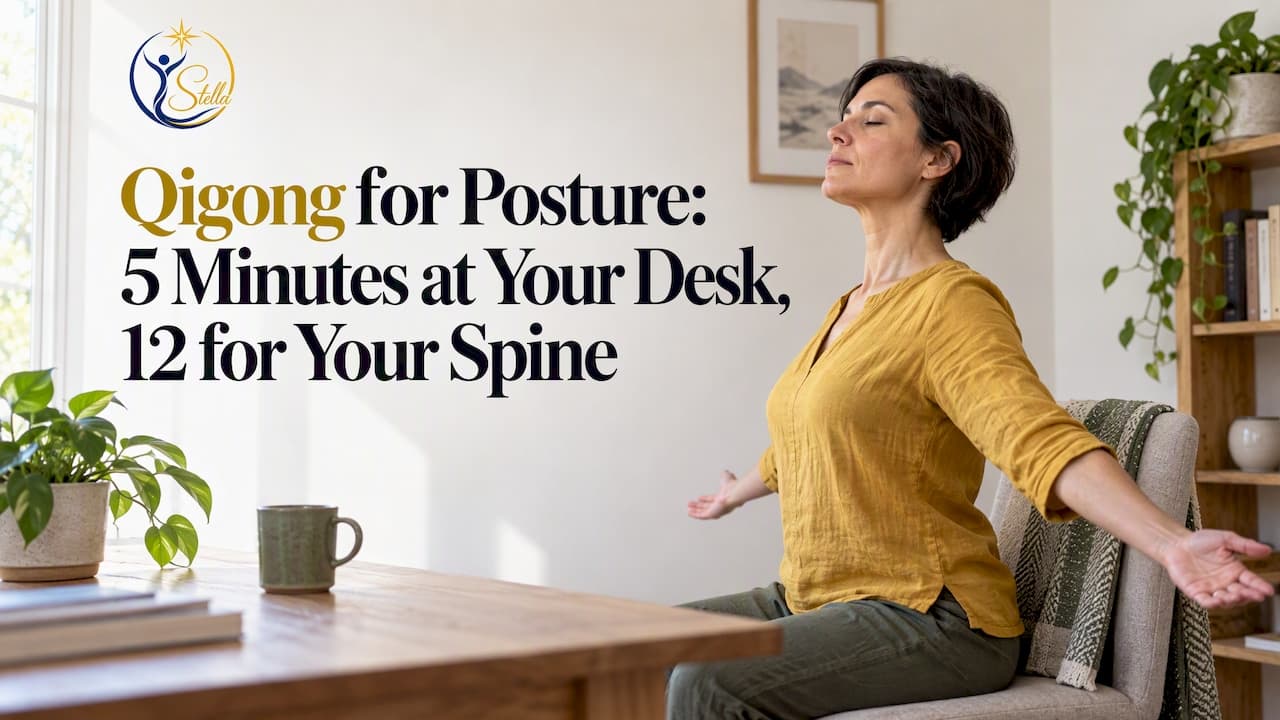
Yes, qigong can improve posture, and the simplest place to start is a standing-rooted breath paired with a gentle crown lift. This cue can help you feel more aligned from the ground up. Meta-analyses and randomized trials have found measurable balance and postural benefits from regular practice. If you carry a diagnosed back condition, check with a GP or physiotherapist before beginning anything new.
TL;DR:
- A 2022 review of 17 randomized trials involving 1,267 participants found Baduanjin improved balance, including a gain of 1.98 points on the Berg Balance Scale.
- Try the 12 minute routine: begin with two minutes of standing root, perform eight repetitions of three movements, then practice supported one leg balance.
- Keep knees soft, shoulders relaxed, and movements small; use seated versions with both feet flat if standing or mobility limits make practice uncomfortable.
- With back problems, consult a GP or physiotherapist first; seek emergency care for severe pain, new weakness, numbness, fever, or unexplained weight loss.
Table of Contents
- How qigong helps posture: concise evidence and mechanisms
- Core qigong posture principles for alignment
- Five practical qigong moves for posture
- Two short routines you can do: 5-minute and 12-minute posture routines
- How often to practice and how progress typically looks
- Safety, contraindications and when to see a GP or physiotherapist
- A practical approach to qigong for posture
- How to continue: relevant courses and sessions from QigongStar
- FAQ
- Sources
How qigong helps posture: concise evidence and mechanisms
The research behind qigong and posture is more substantial than most people expect. A 2022 meta-analysis of 17 randomized controlled trials involving 1,267 participants found that Baduanjin qigong produced meaningful improvements in balance measures, including a Berg Balance Scale gain of 1.98 points and faster Timed Up and Go results, according to pooled data from pubmed.ncbi.nlm.nih.gov. Those two tests matter because they capture the kind of steady, controlled movement that healthy posture depends on.
A separate randomized trial of postmenopausal women found that a 12-week Baduanjin program improved both muscle strength and static postural control compared to a non-practicing group, as reported by a controlled trial in Frontiers in Medicine. A broader 2025 systematic review of traditional fitness qigong exercises echoed this, noting consistent gains in static and dynamic balance, grip strength, and physical performance across multiple trials, with Baduanjin the most frequently studied form, according to this review in Frontiers in Medicine.
A smaller pilot study using 3D motion capture technology on breast cancer survivors found that qigong practice improved vertical spine and head alignment, alongside reductions in anxiety, fatigue, and pain severity, according to Pubmed.
A 2022 meta-analysis of 17 trials found qigong improved Berg Balance Scale scores, a result linked to research summarized on pubmed.ncbi.nlm.nih.gov, reflecting gains in the kind of stability that good posture relies on.
The mechanisms behind these numbers are not mysterious. Qigong sharpens proprioception, your body's internal sense of where it sits in space, while gently mobilizing the spine through slow, repeated motion. It also builds lower-limb strength, which steadies the base your spine rests on, and cultivates mindful body awareness that softens habitual bracing. When you stop guarding your shoulders or clenching your jaw out of unconscious tension, your natural alignment has room to return.

Core qigong posture principles for alignment
Good posture in qigong is felt, not forced. Instead of yanking your shoulders back or holding your spine rigid, you learn to sense a few key points of contact and let the rest of your body organize around them.
- Rooted feet: feel even weight across both soles, as though gently pressing into soft earth.
- Micro-bend in the knees: a slight softness, never locked, which lets energy flow upward instead of stalling in tight joints.
- Neutral pelvis: imagine a bowl of water balanced on your hips, neither tipping forward nor back.
- Subtle crown lift: picture a thread gently lifting the crown of your head toward the sky, lengthening the spine without straining the neck.
- Soft shoulders and relaxed jaw: let gravity drop your shoulders away from your ears and unclench your jaw with each exhale.
The most common mistake is forcing the issue, pulling the shoulders back sharply or bracing the core as if standing at attention. That kind of correction creates new tension instead of releasing old patterns. A gentler fix is to breathe into the area that feels tight and let the crown-lift image do the work of lengthening your spine, rather than muscling it into place.
Pro Tip: Before starting any routine, pause and simply notice how your feet meet the floor; that small pause can help you tune in to your posture before you move.
If you work at a desk, try this: plant both feet flat, breathe out slowly, and let your shoulders relax. This can help interrupt a slump before it sets in.
Five practical qigong moves for posture
Each of these moves targets a different part of the postural chain, from your feet to your neck. Practice them slowly, breathing naturally, and stop short of any sharp discomfort.
- Wuji, or standing root: Stand with feet shoulder-width apart, knees softly bent, arms relaxed at your sides. Breathe slowly through your nose, letting each exhale settle your weight into your feet. Hold for 30 to 60 seconds. If standing is uncomfortable, sit tall in a chair with both feet flat on the floor and apply the same breath cue.
- Heavenly pillar: Slowly tilt your head up to look toward the ceiling, then lower it gently to look toward the floor, keeping the motion slow and the spine long throughout. Repeat 6 to 10 times. Stop if you feel any dizziness or neck strain, and keep the range small if your neck is sensitive.
- Turtle looks behind: Turn your head slowly to look over one shoulder, then return to center and repeat on the other side. Keep your chin level and your neck relaxed rather than straining to see further. For sensitive necks, reduce the rotation range and move even more slowly.
- Two hands holding the kidneys, or holding up the sky: Reach both arms overhead, palms facing up, as if pressing gently against the sky, then lower them slowly. Repeat 6 to 10 times, or hold the raised position for 30 to 60 seconds, breathing steadily. If shoulder mobility is limited, keep your arms lower and bend your elbows slightly.
- Waist rotations: With feet planted and knees soft, gently rotate your torso side to side, letting your arms swing loosely like empty sleeves. Keep the rotation small and controlled if you have any lower back sensitivity, and aim for 6 to 10 slow rotations per side.
- Each move pairs with slow nasal breathing, inhaling as you lengthen and exhaling as you release.
- Modifications for all five moves can be done seated, which is useful for anyone recovering from injury or managing limited mobility.
Two short routines you can do: 5-minute and 12-minute posture routines
Combining these moves into a sequence makes them easier to remember and more effective as a daily habit. Here are two ready-to-follow options, one for a quick break and one for a fuller practice.
- The desk reset: Start with Wuji standing root to settle your breath and posture. Follow with a few repetitions of heavenly pillar to mobilize your neck. Finish with a few repetitions of holding up the sky to open your shoulders and chest.
- The 12-minute spine-strength and balance routine: Begin with 2 minutes of Wuji standing root to establish your base. Move through 8 reps each of heavenly pillar, turtle looks behind, and holding up the sky, pacing each set with slow breath counts. Add 8 waist rotations per side to mobilize the lower spine. Challenge your balance with 30 seconds of standing on one foot, holding the wall if needed. Close with 2 minutes of quiet standing meditation, breathing slowly and noticing how your body feels different from when you started.
Move slowly and attentively throughout, counting your breaths rather than rushing the reps. If you have extra time, a standing qigong meditation practice makes a calming addition to either sequence.
How often to practice and how progress typically looks
Trial evidence offers examples of practice schedules, but the amount of practice varies across programs. A systematic review in Frontiers in Medicine and a randomized trial on postmenopausal women describe qigong programs that reported balance and posture-related findings.
A simple beginner progression can help you build a routine gradually:
- Start: use brief resets to build the habit.
- Week 2: three structured sessions of 10 to 12 minutes each.
- Progress when ready: add repetitions or another short session when it feels manageable.
- Continue at a comfortable pace: adopt a fuller routine as it suits you.
Track progress with simple tools: a single-leg balance check, a posture photo taken from the side, or a quick note on tension and energy levels. You may notice subtle changes in alignment and ease with steady practice.
Safety, contraindications and when to see a GP or physiotherapist
Qigong is gentle, but it is still exercise, and a few sensible precautions apply. UK NHS guidance recommends consulting a GP or physiotherapist before starting a new movement practice if you have an existing back problem, staying active rather than resting for long periods, and expecting any mild exercise-induced discomfort to ease within about two hours, according to NHS inform.
- Seek immediate emergency medical care for severe or worsening pain, new numbness or weakness, or symptoms such as fever or unexplained weight loss.
- If you manage a psychiatric condition, practice with a qualified instructor who can tailor the pace and intensity to your needs.
- For specific concerns like kyphosis, scoliosis, or osteoporosis, a daily posture plan for osteoporosis offers useful guidance on prioritizing safe movement patterns.
For a fuller breakdown of who should modify or avoid certain moves, our qigong contraindications guide covers detailed adaptations.
A practical approach to qigong for posture
We teach these moves because small, repeatable cues can support posture. Our emphasis stays on gentle alignment, steady breath, and routines that fit into a busy day rather than demanding a studio or an hour you don't have.
We aim to make our cues accessible: can you do it at a desk, in socks, on a tired day? If the answer is no, we simplify it. We encourage you to try these routines this week and notice what shifts, then bring your questions to a guided class where we can watch your alignment and offer feedback in real time.
— Stella
How to continue: relevant courses and sessions from QigongStar
If these routines feel good and you want guided feedback on your alignment, we offer sessions and classes. A 30-Min Clarity Session can provide a focused check-in, while a 60-Min Deep Dive Online Session offers more time for practice.
- On-demand classes let you revisit qigong instruction at your own pace.
- Private sessions offer tailored feedback.
- Group classes bring the accountability of a shared practice time, which many people find easier to stick with.
Explore our online qigong classes to book a session or start with a short, guided class this week.
FAQ
Does qigong help improve posture?
Yes, qigong can help improve posture by building balance, strength, and body awareness over time. A meta-analysis of 17 randomized trials found measurable gains in balance tests linked to qigong practice, according to research on pubmed.ncbi.nlm.nih.gov.
What type of exercise is best for posture?
Gentle, controlled movement practices that combine strength, balance, and body awareness tend to work best for posture, and qigong fits that profile well. Traditional fitness qigong forms like Baduanjin have shown consistent improvements in static and dynamic balance across multiple trials, according to a 2025 systematic review.
What are the three golden rules of qigong?
Definitions vary across qigong traditions, but a common framing centers on relaxed posture, regulated breath, and a calm, focused mind. These three elements work together to build the proprioception and spinal mobility described in research on qigong safety and structure.
How do I practice qigong at home?
Start with a simple standing-root posture, feet comfortably apart, breathing slowly while you sense your feet connecting with the floor. From there, add gentle moves like heavenly pillar or holding up the sky, building toward a short routine that fits your needs.
How does qigong support better balance?
Qigong improves balance by strengthening the lower limbs and sharpening proprioception, the sense of where your body sits in space. A meta-analysis found significant improvements in Timed Up and Go results and Berg Balance Scale scores among regular practitioners, according to pooled trial data.
Sources
- Pubmed
- Frontiers | Qigong for Muscle Strength and Static Postural Control in Middle-Aged and Older Postmenopausal Women: A Randomized Controlled Trial
- Pubmed
- Nhsinform