

Yes, qigong can meaningfully ease chronic lower back pain for many people. Clinical trials link it to reduced pain intensity and better daily function, making it a legitimate adjunct to your existing care. Start with the 10 minute routine below, practiced daily or most days, and check the safety cues before you begin. If you notice numbness, weakness, or bladder changes, stop and see a clinician promptly.
TL;DR:
- Short-term qigong programs under 12 weeks produce the most significant pain reduction, with benefits gradually building over several weeks.
- The strongest evidence comes from a 2025 meta-analysis showing modest pain score improvements but more meaningful disability reduction, especially in longer trials.
- Practicing gentle movements like spinal twists and pelvic tilts regularly can address muscle tightness and fear of movement contributing to chronic back pain.
- Online qigong programs have demonstrated effectiveness comparable to in-person classes, making it accessible regardless of location or mobility limits.
- Always seek medical advice if experiencing new neurological symptoms or if pain worsens, and modify movements for specific health conditions or during flare-ups.
Table of Contents
- What Does Clinical Research Show About Qigong and Lower Back Pain?
- Gentle Qigong Movements That Target Lower Back Pain
- A 10-Minute Daily Qigong Routine for Back Relief
- How Often Should You Practice, and What Progress Should You Expect?
- Safety, Contraindications, and Red Flags to Watch For
- How to Choose a Qigong Class or Instructor for Back Pain
- How QigongStar's Courses Support Lower Back Recovery
- What Actually Matters When You're in Pain and Reading About Qigong
- Ready for Guided, Modification-Friendly Instruction?
- Sources
What Does Clinical Research Show About Qigong and Lower Back Pain?
The strongest evidence comes from a 2025 meta-analysis pooling 16 randomized controlled trials and 1,175 participants with chronic non-specific low back pain. It found qigong practice lowered pain intensity by a mean difference of −1.34 points and cut disability scores by −5.88 compared to control groups, according to the systematic review and meta-analysis published on pain and disability outcomes. Those numbers sit close to, but don't always clear, the minimal clinically important difference thresholds researchers typically used to judge whether a treatment feels meaningfully different to the person living with it.
That nuance matters. Pain scores moved in the right direction but modestly. Disability scores, which capture how much back pain interferes with dressing, walking, or sitting through a workday, shifted more convincingly. For someone who has spent months adjusting how they sit at a desk or avoiding a favorite hike, a meaningful drop in disability can outweigh a smaller drop in pain intensity.
By the numbers: The meta-analysis found short-term qigong programs under 12 weeks produced the largest pain reductions, and a virtually delivered tai chi and qigong mind-body program showed ODI improvements of −4.7 at 8 weeks, −6.42 at 12 weeks, and −8.14 at 16 weeks, all statistically significant.
That last trial matters for anyone weighing home practice against in-person classes. Because the program was delivered entirely online, it suggests you don't need a studio or a physical therapist standing over you to get real functional gains. The trend across weeks also tells you something practical: benefits build gradually rather than arriving in a single dramatic session.
Beyond the raw numbers, qigong appears to work on more than muscle tissue. A narrative review of qigong in physical therapy found it particularly effective at reducing kinesiophobia, the fear of movement that keeps many chronic pain sufferers stuck in a cycle of guarding and stiffness. Slow, controlled movement teaches your nervous system that bending and twisting won't necessarily trigger a flare, which is often half the battle with long-term back pain.
Where the evidence is thinner:
- Most trials run 8 to 16 weeks, so long-term data beyond four months is limited.
- Studies vary in which qigong style they test, including baduanjin, liuzijue, wuqinxi, and yijinjene, and some subgroup analysis suggests liuzijue and yijinjing produced larger effects in certain trials.
- Sample sizes in individual RCTs remain modest, even though the pooled meta-analysis totals over a thousand participants.
None of this makes qigong a cure. It makes it a well-supported piece of a broader pain management approach, one with far fewer downsides than most pharmaceutical options for chronic back pain.
Gentle Qigong Movements That Target Lower Back Pain
These six movements draw on baduanjin-style stretching, the qigong tradition most represented in the clinical trials above. Move slowly, breathe through your nose when you can, and never push into sharp pain.
-
Baduanjin spine stretch. Stand with feet hip-width apart, knees soft. Inhale as you reach both arms overhead, lengthening your spine. Exhale as you fold gently forward from the hips, letting your arms drift toward the floor without forcing the stretch. Rise slowly on your next inhale. Repeat 6 to 8 times. Common mistake: rounding hard through the lower back on the way down. Keep the fold shallow and let your hips lead. If standing forward bends bother you, do this seated, hinging forward over your knees instead.
-
Pelvic tilt with breath. Lie on your back with knees bent, feet flat. As you inhale, let your lower back arch slightly away from the floor (anterior tilt). As you exhale, gently flatten your lower back into the floor, tucking your tailbone (posterior tilt). This small, rhythmic motion mobilizes the lumbar spine without any load. Do 10 to 12 slow cycles. Ease off if you feel pinching rather than a gentle stretch. This movement works just as well seated in a firm chair if lying down is uncomfortable.
-
Gentle spinal twist. Sit tall in a chair or on the floor with legs crossed. Inhale to lengthen your spine, then exhale as you rotate your torso gently to one side, hands resting lightly on your knee or chair back for support. Keep the twist small, coming only from where it feels easy. Hold for two breaths, return to center, and repeat on the other side. Do 4 rotations per side. Common mistake: twisting from the lower back instead of the mid-spine, which can aggravate disc issues. If you feel any shooting sensation, stop immediately and see the safety section below.
-
Hip hinge and hip opener. Stand with feet shoulder-width apart. Hinge forward slightly at the hips, keeping your back flat and knees slightly bent, as if closing a car door with your hip. Return to standing, then shift into a gentle standing figure-four stretch by crossing one ankle over the opposite knee (holding a wall for balance if needed) to release the glutes. Alternate sides, 5 reps each. This move directly addresses the hamstring and glute tightness that often accompanies chronic lower back pain.
-
Standing weight shift. Stand with feet hip-width apart, hands resting on your lower belly. Slowly shift your weight onto your right foot, pausing for a breath, then shift to your left. Keep your pelvis level rather than dropping to one side. This rebuilds the proprioception, your body's sense of position in space, that often erodes when pain causes you to move less. Do 8 to 10 shifts per side. If balance feels shaky, practice next to a wall or chair back.
-
Cloud hands (seated or standing). Move your arms in slow, sweeping arcs in front of your torso, one rising as the other falls, shifting your weight gently side to side if standing. This low-effort flowing motion warms the shoulders and mid-back and helps transition your breathing into a slower rhythm before or after the other exercises.
Pro Tip: Film yourself doing the spinal twist and pelvic tilt once a week. Small drifts in form, like twisting further than you think, show up clearly on video even when they're invisible in the moment.
A 10-Minute Daily Qigong Routine for Back Relief
Here's a complete sequence you can follow without any equipment, indoors or out, standing or seated.
- Warm-up, 2 minutes. Begin with cloud hands to loosen the shoulders and mid-back, then move into 6 slow pelvic tilts to wake up the lumbar spine.
- Main sequence, 6 minutes. Perform 6 to 8 baduanjin spine stretches, followed by 4 gentle spinal twists per side, then 5 hip hinge and hip opener reps per side, finishing with 8 standing weight shifts per side.
- Cool down, 2 minutes. Return to slow cloud hands or simply stand (or sit) with hands on your belly, breathing in for a count of four and out for a count of six, for the final minute.
Choosing standing versus seated: if your pain flares with standing, or you have balance concerns, do the entire sequence seated in a sturdy chair. The pelvic tilt, spinal twist, and cloud hands all translate directly to a seated position. The hip hinge can be swapped for a seated hip flexor stretch, and the weight shift becomes a gentle seated weight shift from hip to hip.
Before you finish, run through this quick checklist:
- Posture: shoulders relaxed away from your ears, chin level, weight evenly distributed through both feet or hips.
- Breath: slow, nasal breathing, roughly twice as long on the exhale as the inhale.
- Pain monitoring: a mild stretch sensation is fine; sharp, shooting, or radiating pain means stop and modify.
How Often Should You Practice, and What Progress Should You Expect?
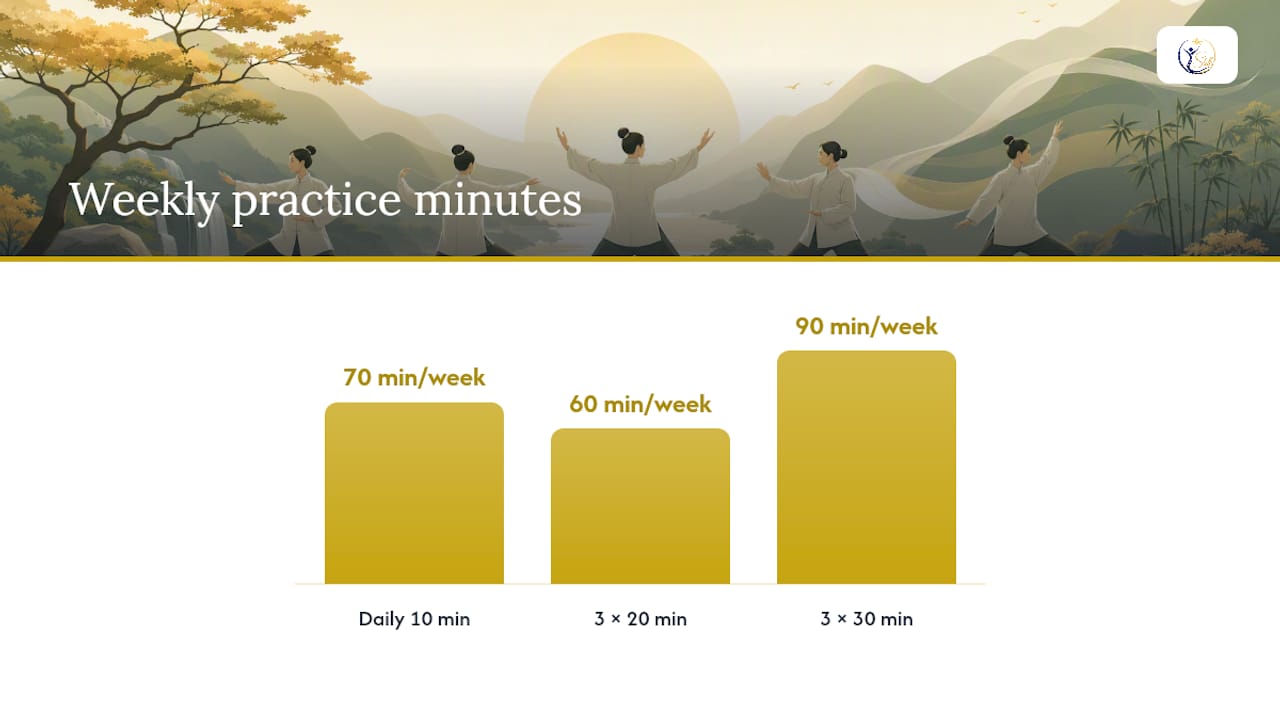
Consistency beats intensity here. Aim for 10 minutes daily, or if that's not realistic, three sessions of 20 to 30 minutes weekly. Both dosing patterns show up in the clinical literature behind qigong's back pain benefits.
Give it time before judging results. The virtually delivered trial cited earlier showed function scores improving steadily across 8, 12, and 16 weeks, with the biggest gains often appearing in the later stretch of that window. Expect the first two to three weeks to feel like habit-building more than pain relief.
Progression works best in this order:
- Add duration before intensity. Extend to 15 or 20 minutes before adding new, more demanding movements.
- Introduce balance-focused moves like the standing weight shift only once your pain has been stable for at least a week.
- Track progress with simple markers: a daily pain rating out of 10, how long you can sit comfortably, or whether you can tie your shoes without bracing.
- Revisit your baseline every 4 weeks rather than daily, since day-to-day pain naturally fluctuates.
Safety, Contraindications, and Red Flags to Watch For
Qigong is low-impact, but chronic back pain sometimes signals something that needs medical attention rather than movement. Know the difference before you start.
Seek urgent medical review, not a qigong session, if you experience any of the following:
- New or worsening leg weakness, numbness, or tingling
- Loss of bladder or bowel control
- Fever alongside back pain
- Back pain following significant trauma, such as a fall or car accident
- Pain that wakes you at night and doesn't ease with position changes
The NHS guidance on back pain reinforces this: lower back pain improves within weeks with gentle activity, but any of the symptoms above warrant a prompt appointment rather than a wait-and-see approach.
Certain conditions call for modification rather than avoidance. If you're recovering from spinal surgery, work only within the range your surgeon has cleared, and skip twisting movements until you get explicit approval. If you have osteoporosis, avoid deep forward folds and keep spinal twists small and controlled. Severe radiculopathy, meaning nerve pain radiating down the leg, means the spinal twist and hip hinge should be done in tiny ranges, or skipped in favor of pelvic tilts alone. During pregnancy, drop any deep forward bends and consult your midwife or doctor about which movements suit your stage.
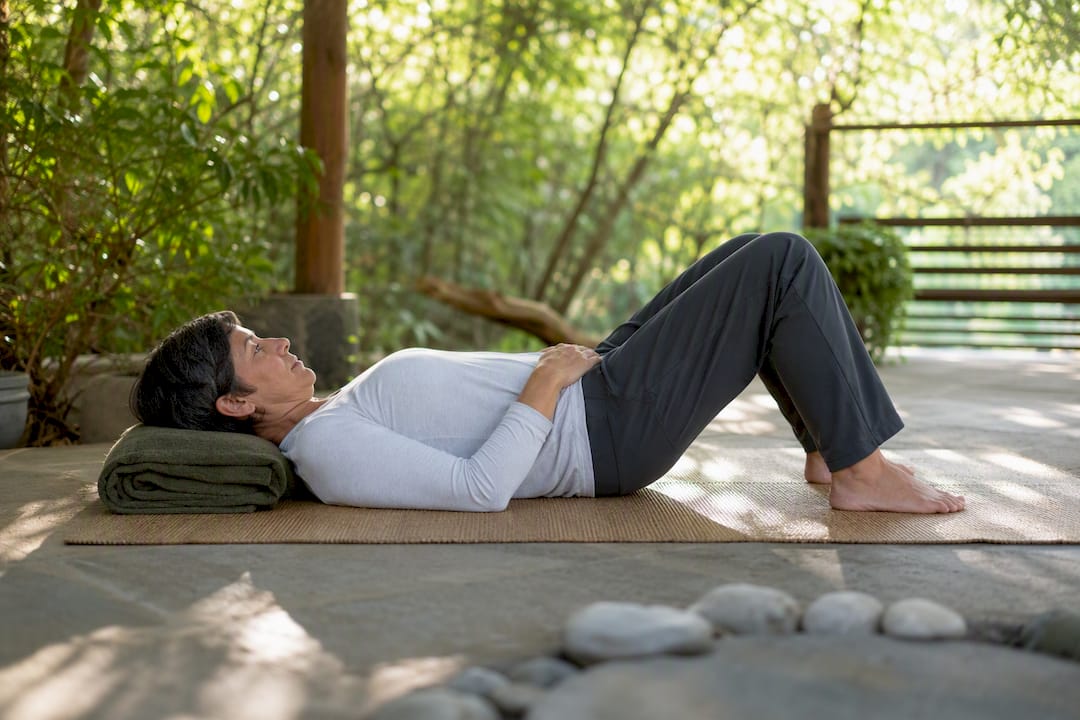
If a flare-up hits mid-routine, stop the movement that triggered it immediately. Regress to gentle breathing and pelvic tilts only for a day or two, then reintroduce other movements slowly. If pain hasn't eased within a few days of rest and gentle movement, contact your clinician rather than pushing through. You can find more detail on who should modify practice in our qigong contraindications guide.
How to Choose a Qigong Class or Instructor for Back Pain
Not every qigong class is built with back pain in mind, so look for these signals before you commit.
- Therapeutic experience. An instructor who has worked with chronic pain populations will know how to modify a forward fold or twist on the spot, not just demonstrate the textbook version.
- Certification. Look for credentials such as Yoga Alliance registration or training through a recognized school like White Tiger Qigong School, which signal a baseline of formal instruction and ongoing standards.
- Willingness to modify. Ask directly whether the instructor offers seated alternatives and one-to-one adjustments during group sessions.
- Class pace and size. Smaller classes generally mean more individual attention, which matters when you're learning to read your own body's signals.
Remote classes suit people with mobility limits or unpredictable flare-ups, since you can pause, sit down, or step away without disrupting a room full of people. In-person classes offer hands-on correction, which some learners need to feel a movement correctly the first few times. A short trial lesson, live or on-demand, is the easiest way to judge whether an instructor's pacing and cueing style actually fits your back.
How QigongStar's Courses Support Lower Back Recovery

QigongStar's courses are built around the same principles behind the routine above: slow, breath-led movement drawn from traditions like White Tiger Qigong and Five Animal Qigong, taught with attention to individual limitations rather than a one-size-fits-all pace. Classes run live and on-demand, so you can practice on your schedule or join guided sessions for real-time correction.
Course content maps directly onto the movements in this article. The spinal mobilization, breath regulation, and balance work you just learned appear throughout QigongStar's programs, expanded with more sequences and deeper instructor guidance on modification. Instructors bring certification through the White Tiger Qigong School and Yoga Alliance, and are trained to adjust pacing for students managing pain, not just general stiffness.
What Actually Matters When You're in Pain and Reading About Qigong
Most articles on this topic bury the useful part under paragraphs of hedging. Here's the honest read: the evidence for qigong and chronic lower back pain is real but modest, and that's actually good news, not a disappointment. A treatment with a small, consistent effect and almost no downside beats a treatment with a dramatic effect and a long list of risks, especially for a condition you'll be managing for years, not weeks.
The conventional advice, rest until it stops hurting, has aged badly. Every piece of research referenced here points the other way: gentle, consistent movement outperforms passive waiting. Where I'd push back on typical wellness content is the framing of qigong as a stand-alone fix. It isn't. It's a genuinely useful adjunct to physiotherapy, movement, and medical care, particularly for the fear of movement that often does more damage than the original injury.
Prioritize consistency over intensity, and prioritize learning good form early, ideally with an instructor who can watch you move, over adding more exercises to a routine you're not doing correctly yet.
— Stella
Ready for Guided, Modification-Friendly Instruction?
If you've worked through the routine above and want real-time feedback on your form, or you simply learn better with a live instructor watching your movement, White Tiger Qigong offers exactly that kind of guided progression. The course builds on the same spine mobilization and breath work covered in this article, with instructors trained to modify moves for exactly the kind of lower back limitations described here, rather than teaching a single fixed sequence to everyone in the room.
You can also explore Five Animal Qigong if you're drawn to a more varied movement style once your back feels ready for it. Both formats run live and on-demand, so you can start with a low-commitment trial lesson before deciding whether to enroll in a full course. Visit the online qigong classes page to see current schedules and sign up for a session that fits your pace and your pain, not the other way around.