
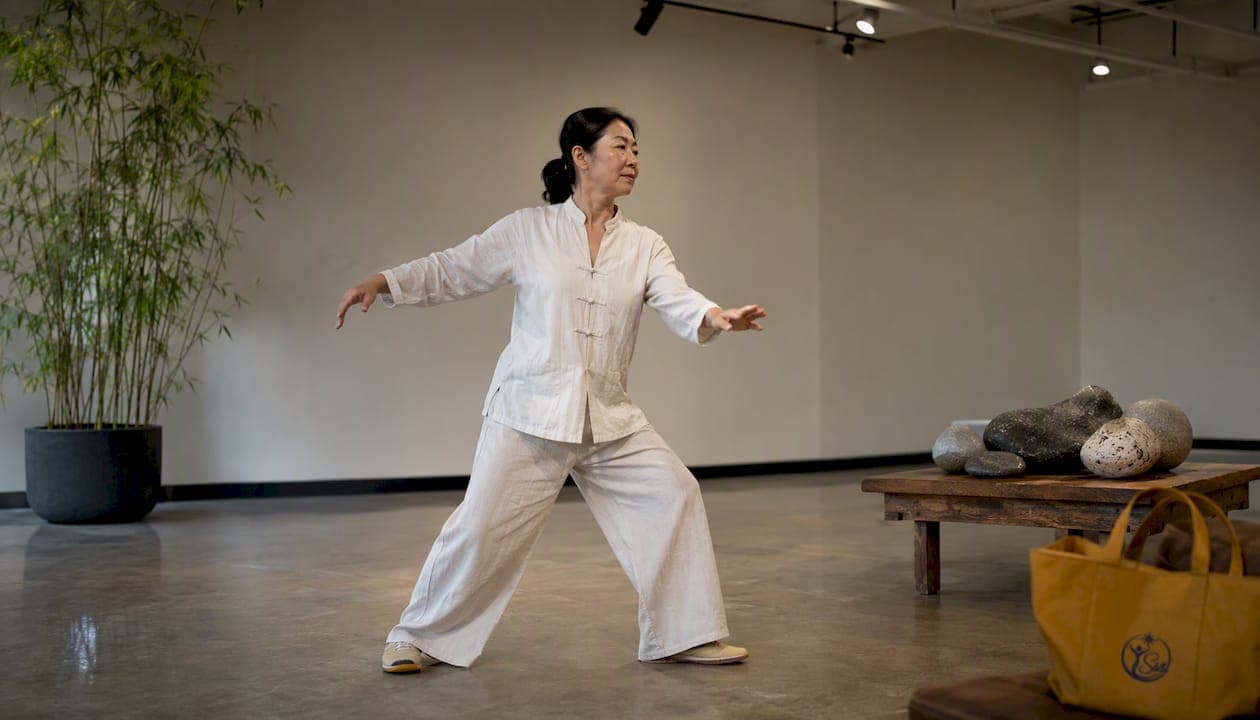
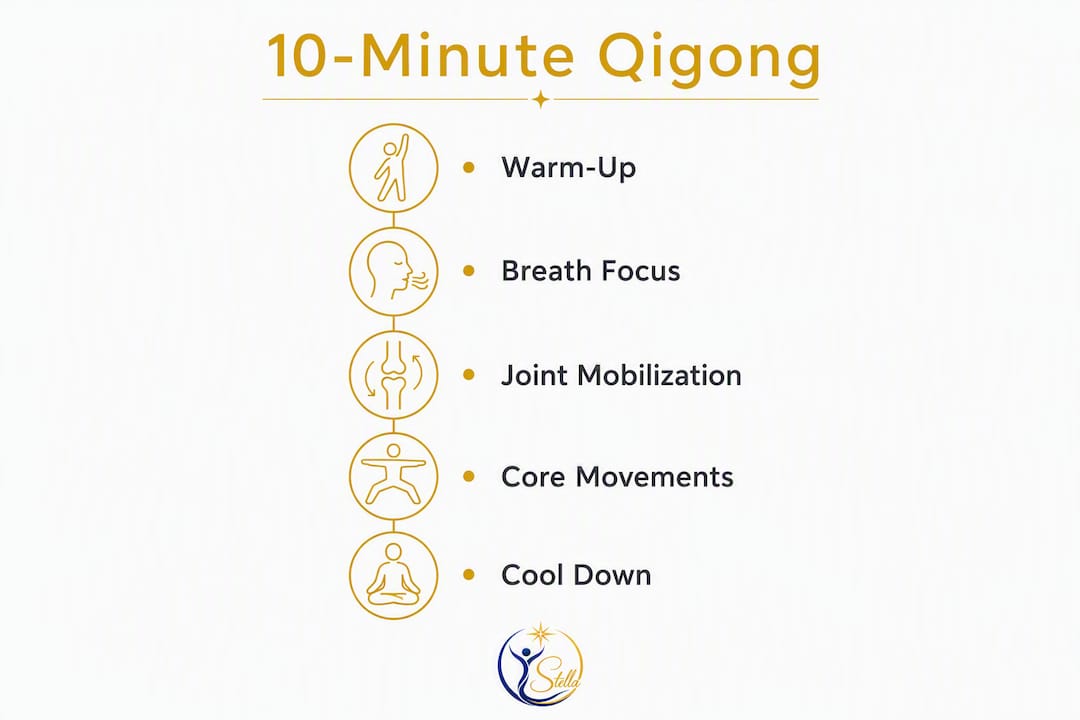
A beginner qigong sequence is a short, structured series of gentle movements practiced in order, coordinated with slow breath, to calm the nervous system, loosen joints, and awaken your body's natural energy flow. You can complete a full beginner routine in a short time. If your schedule is tight, a brief warm-up version covers the essentials; if you have more time, an expanded loop deepens the practice. The sequence below draws from the foundational principles of Ba Duan Jin (Eight Pieces of Brocade), one of the most widely taught beginner qigong systems, and aligns with the White Tiger Qigong and Five Animal Qigong traditions taught at Qigongstar. Here is the full 10-minute routine at a glance:
- Wuji stance / grounding (1 min): stand with feet shoulder-width apart, knees soft, spine tall, eyes soft
- Rhythmic shaking / joint mobilization (1 min): gentle whole-body shake, then slow neck, shoulder, wrist, hip, and knee rolls
- Joint rolls (30 sec): circle the neck, shoulders, wrists, hips and knees gently
- Lifting the Heavens (1.5 min): raise arms overhead on the inhale, press down on the exhale
- Knocking on the Door (1.5 min): gentle torso rotation, arms swinging loosely to tap the lower back and belly
- Heaven-and-Earth stretch (1.5 min): one arm presses up, one presses down, alternating sides
- Gentle squat / grounding pulse (1.5 min): shallow knee bends, weight sinking into the earth on each exhale
- Closing / dantian breathing (1.5 min): hands on lower belly, 6–8 slow, deep breaths to settle qi
Short daily sessions of about twenty minutes or less are the standard recommendation for building a lasting beginner foundation, and this sequence fits comfortably inside that window.
Table of Contents
- What does a step-by-step 10-minute beginner qigong sequence look like?
- How do you do each core movement with good form?
- How long should you practice, and how do you progress over four weeks?
- What principles and safety guidelines should every beginner follow?
- Why is Ba Duan Jin a great starting point, and where do White Tiger and Five Animal qigong fit?
- Key Takeaways
- Why starting small is the most powerful thing you can do
- Ready to go deeper with guided qigong instruction?
- Useful sources and further reading
What does a step-by-step 10-minute beginner qigong sequence look like?
Follow these steps in order. Each one includes a breath cue and a one-line purpose so you know exactly what you are doing and why. Set a phone timer or simply count breaths as noted.
-
Wuji stance (1 minute). Stand with feet parallel, shoulder-width apart. Soften your knees slightly, relax your shoulders, and let your arms hang naturally. Breathe naturally through the nose. Purpose: establish grounded, neutral posture before movement begins.
-
Rhythmic shaking (1 minute). Gently bounce on the balls of your feet so the whole body vibrates loosely. Let your jaw, shoulders, and hands go soft. Breathe naturally. Purpose: release neck and shoulder tension and prepare joints for range-of-motion work.
-
Joint rolls (30 seconds). Slowly circle the neck, roll the shoulders forward and back, rotate the wrists, circle the hips, and gently bend and straighten the knees. Breathe slowly and evenly. Purpose: warm up every major joint before deeper movement.
-
Lifting the Heavens (1.5 minutes / 6–8 repetitions). Inhale as you sweep both arms out and up overhead, palms facing the sky. Exhale as you press palms gently down past the face, chest, and belly. Keep knees soft throughout. Purpose: open the chest, coordinate breath with movement, and lift energy.
-
Knocking on the Door (1.5 minutes / 8–10 repetitions). Pivot your torso left and right in a relaxed swing. Let your arms follow passively so the backs of your hands tap your lower back and your palms tap your lower belly. Inhale center, exhale as you swing. Purpose: massage the kidneys and lower back, release deep-held tension in the torso.
-
Heaven-and-Earth stretch (1.5 minutes / 6–8 repetitions per side). Inhale to prepare. Exhale as you press one palm up toward the ceiling and the other palm down toward the floor, gently stretching the sides of the torso. Alternate sides with each breath. Purpose: stretch the lateral body, stimulate digestive meridians, and soothe the nervous system.
-
Gentle squat / grounding pulse (1.5 minutes / 8–10 repetitions). With feet shoulder-width apart, inhale to prepare. Exhale as you sink into a shallow knee bend, no deeper than comfortable. Inhale to rise. Keep the spine upright and knees tracking over the toes. Purpose: build leg strength, ground energy downward, and reinforce the connection between breath and movement.
-
Closing / dantian breathing (1.5 minutes / 6–8 breaths). Place both hands gently on your lower abdomen, just below the navel. Breathe slowly and deeply into the lower belly, feeling it rise on the inhale and fall on the exhale. Purpose: integrate the effects of the practice, settle the qi, and return the body to a calm, centered state.
When to stop: if you feel sharp pain, sudden dizziness, or significant shortness of breath at any point, stop immediately, sit down, and rest. Do not push through discomfort.
Pro Tip: Set your phone timer for 10 minutes before you begin. Knowing the clock is running frees your mind to stay with the breath instead of watching the time.
Space and clothing: a clear floor area roughly 6 feet by 6 feet is all you need. Wear loose, comfortable clothing and practice in bare feet or flat-soled shoes. A quiet room with natural light makes it easier to stay present, though any calm space works.
How do you do each core movement with good form?
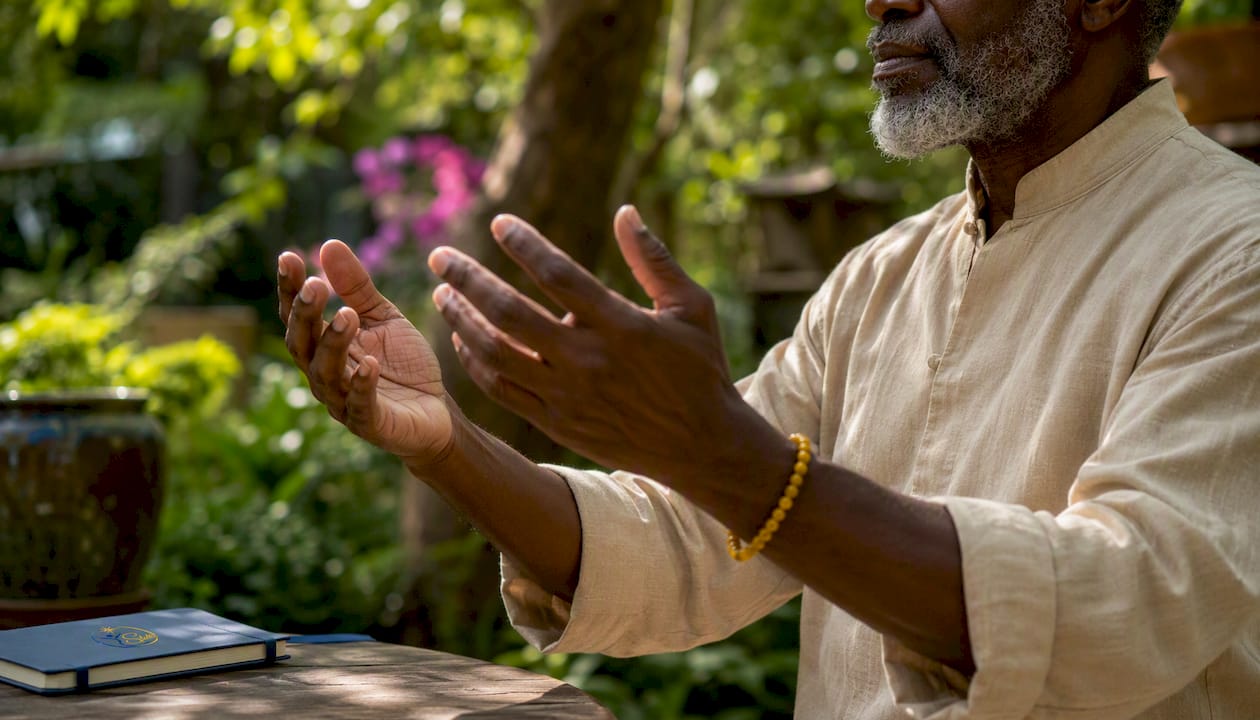
Understanding what each movement should feel like in your body is what separates a practice that genuinely calms and heals from one that just burns time. The table below gives you a quick reference for form, alignment, and modifications.
| Movement | Key alignment cues | Modification |
|---|---|---|
| Wuji stance | Feet parallel, knees soft, tailbone slightly tucked, crown of head floating up | Sit in a chair with feet flat on the floor |
| Rhythmic shaking | Loose jaw, relaxed shoulders, soft knees absorbing the bounce | Hold a chair back lightly for balance |
| Joint rolls | Move slowly through the full range; never force a joint | Reduce range of motion; skip any joint that is acutely inflamed |
| Lifting the Heavens | Arms rise on the inhale; palms press down past face → chest → belly on the exhale | Raise arms only to shoulder height if overhead movement is uncomfortable |
| Knocking on the Door | Torso leads the swing; arms follow passively; feet stay planted | Reduce rotation range; seated version works well for lower-back sensitivity |
| Heaven-and-Earth stretch | One palm presses up, one presses down; avoid locking the elbow | Reduce the press to a gentle reach; seated version is fully effective |
| Gentle squat | Knees track over toes; spine upright; weight in heels | Reduce depth to a micro-bend; hold a chair for support |
| Dantian breathing | Hands on lower belly; breathe into the hands; shoulders stay relaxed | Lie on your back with knees bent if standing is tiring |
Common mistakes to avoid
- Tensing the jaw and shoulders. Most beginners hold tension here without realizing it. Check in every minute or so and consciously soften.
- Moving too fast. Speed is the enemy of qi cultivation. If a movement feels easy, slow it down rather than adding repetitions.
- Locking the knees. Straight-locked knees block energy flow and strain the joint. Keep a micro-bend at all times.
- Holding the breath. Breath should flow continuously. If you find yourself holding, pause the movement and re-establish the breath first.
- Forcing range of motion. Qigong is not stretching. Move to the edge of comfort, not beyond it.
For a deeper look at foundational beginner movements, Qigongstar's beginner guide walks through each posture with additional detail.
How long should you practice, and how do you progress over four weeks?
One of the most common questions beginners ask is how much time they actually need. The honest answer: starting with 5–10 minutes and repeating most days builds the foundation faster than occasional longer sessions.
| Variant | Duration | What it includes | Best for |
|---|---|---|---|
| Starter | 5 minutes | Wuji stance, shaking, Lifting the Heavens, dantian breathing | Absolute beginners; very busy schedules; days when energy is low |
| Core | 10 minutes | Full sequence as described above | Most beginners; daily maintenance practice |
| Extended | 15 minutes | Full sequence plus an extra round of Knocking on the Door and Heaven-and-Earth, and a longer closing breath | Readers ready to deepen; stress-relief focus; rest days |
A 5-minute warm-up focused on joint mobility and breath is also a legitimate standalone practice on days when 10 minutes feels like too much.
Four-week progression plan
- Week 1: Practice the 5-minute starter version daily. Focus entirely on breath coordination and keeping the knees soft. Aim for 5–7 sessions.
- Week 2: Move to the full 10-minute core sequence. Add Knocking on the Door and the Heaven-and-Earth stretch. Aim for 5–7 sessions.
- Week 3: Increase repetitions by 2 per movement. Notice where tension lingers and consciously release it. Aim for 5–7 sessions.
- Week 4: Try the 15-minute extended version 2–3 times this week. On other days, maintain the 10-minute core. Begin exploring 1–3 Ba Duan Jin movements to complement the sequence.
Frequency rule of thumb: 3–5 days per week is a solid starting point. Once the sequence feels natural, 5–7 days per week is comfortable for most people. Listen to your body; a shorter practice on a tired day is always better than skipping entirely.
What principles and safety guidelines should every beginner follow?
Good qigong practice rests on a handful of principles that are simple to understand but take time to embody. Getting these right from the start means your practice will actually work.
Core practice principles
- Wuji posture: neutral, relaxed alignment is the foundation of every movement. Feet parallel, knees soft, spine gently tall, shoulders dropped.
- Breath coordination: every movement has a breath direction. Inhale on expansion (arms rising, body opening), exhale on contraction (arms lowering, body closing). Never force the breath.
- Slow flow: slow, natural movements coordinated with breath are what distinguish qigong from ordinary exercise. Speed reduces the practice to calisthenics.
- Relaxed attention: keep a soft, gentle focus on the movement and the breath. You are not trying to think your way through the sequence; you are feeling it.
- Dantian awareness: gently bring your attention to the lower belly (about two inches below the navel) during the closing breath. This is the body's energetic center in Chinese medicine.
Safety and contraindications
- Dizziness: if you feel lightheaded, stop moving, stand still or sit, and breathe normally. Dizziness in beginners often comes from breathing too deeply too quickly. Ease into the breath work gradually.
- Unusual pain: mild muscle awareness is normal. Sharp, shooting, or joint pain is not. Stop and rest.
- Overstimulation: some beginners feel unusually warm, tingly, or emotionally stirred after practice. This is generally a normal response to increased circulation and energy flow, but if it feels overwhelming, shorten the session and close with extra dantian breathing.
Pro Tip: If you have a cardiovascular condition, are pregnant, or have significant balance challenges, speak with your healthcare provider before beginning any new movement practice. Seated modifications make this sequence accessible to most people, but your clinician knows your specific situation best.
Setting up your practice space
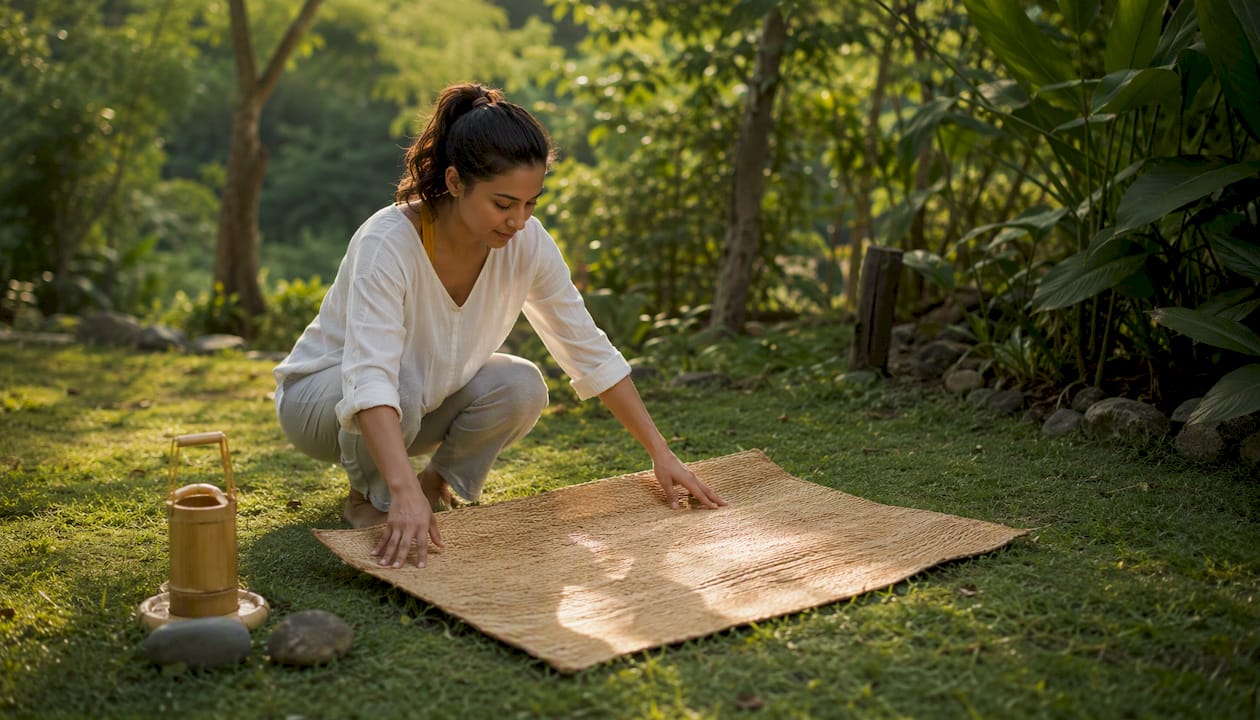
Choose a quiet area with a flat floor, enough room to extend your arms in all directions, and minimal distractions. Natural light and fresh air are helpful but not required. Turn off notifications on your phone after setting the timer. Comfortable, loose clothing and bare feet or flat shoes complete the setup.
Why is Ba Duan Jin a great starting point, and where do White Tiger and Five Animal qigong fit?
Ba Duan Jin, translated as Eight Pieces of Brocade, is one of the oldest and most widely taught qigong systems in the world. Its eight movements cover the full body systematically, making it an ideal learning structure for beginners. You can start with just 1–3 movements and gradually link them into a flowing loop, which reduces the feeling of overwhelm and builds retention naturally. Each movement targets a specific organ system and meridian pathway, so even a partial practice carries real therapeutic value.
White Tiger Qigong and Five Animal Qigong offer complementary emphases that become meaningful once you have a basic foundation.
- White Tiger Qigong emphasizes dynamic spinal movement and breath-led flow, making it particularly effective for stress relief, postural health, and energetic vitality. It is the core system taught at Qigongstar.
- Five Animal Qigong draws on the movement archetypes of the tiger, deer, bear, monkey, and crane to address specific organ systems and therapeutic goals, including digestive wellness and emotional balance.
A recommended learning path for beginners
- Start with the 10-minute sequence above for the first two to four weeks.
- Learn 1–3 Ba Duan Jin movements and practice them alongside the core sequence.
- When you feel comfortable with the basics, explore a structured White Tiger or Five Animal course with instructor guidance for feedback on alignment and breath.
Instructor-led learning genuinely speeds skill acquisition. On-demand video combined with occasional live feedback is an efficient approach for most adult learners, and it is exactly the model Qigongstar offers. Stella, Qigongstar's certified instructor, holds credentials from the White Tiger Qigong School and Yoga Alliance, bringing both traditional lineage and professional teaching standards to every course.
Key Takeaways
A consistent beginner qigong sequence of 10 minutes daily, built around grounding, joint mobilization, breath-led movement, and dantian closing, gives you a complete foundation for mobility, calm, and lasting energetic health.
| Point | Details |
|---|---|
| Start with 10 minutes | The full core sequence runs about 10 minutes and covers every foundational movement a beginner needs. |
| 5- and 15-minute variants exist | Use the 5-minute starter on busy days; try the 15-minute extended version when you want a deeper practice. |
| Practice 3–7 days per week | Begin with 3–5 days per week and increase to daily once the sequence feels natural and comfortable. |
| Ba Duan Jin is your next step | After two to four weeks, add 1–3 Ba Duan Jin movements to deepen your practice and build clear learning milestones. |
| Qigongstar offers guided progression | Qigongstar's White Tiger and Five Animal courses provide instructor feedback, video demos, and structured progression for beginners ready to go further. |
Why starting small is the most powerful thing you can do
Most people who come to qigong for the first time expect it to feel like exercise. They want to feel tired afterward, to feel like they did something. What surprises them is that the most profound shifts, the ones that show up in their sleep, their digestion, their ability to handle a stressful day, come from the quietest, most consistent practices.
What I see again and again with beginners is that the ones who start with five or ten minutes and show up most days make faster, deeper progress than those who attempt an hour-long session once a week. The nervous system responds to repetition and gentleness, not intensity. When you practice the closing dantian breath every day, you are literally training your body to find that calm state on cue. Over weeks, that becomes a resource you carry with you off the mat.
The sequence in this guide is not a warm-up for something bigger. For many people, it is the practice. Give it four weeks of honest daily effort, and you will feel the difference in ways that are hard to explain but impossible to miss.
Ready to go deeper with guided qigong instruction?
The sequence in this guide gives you a solid starting point. When you are ready for structured, instructor-led progression, Qigongstar's online courses take you from these foundational movements into the full depth of White Tiger Qigong and Five Animal Qigong, with short video demonstrations, step-by-step guidance, and a clear progression plan built for beginners.
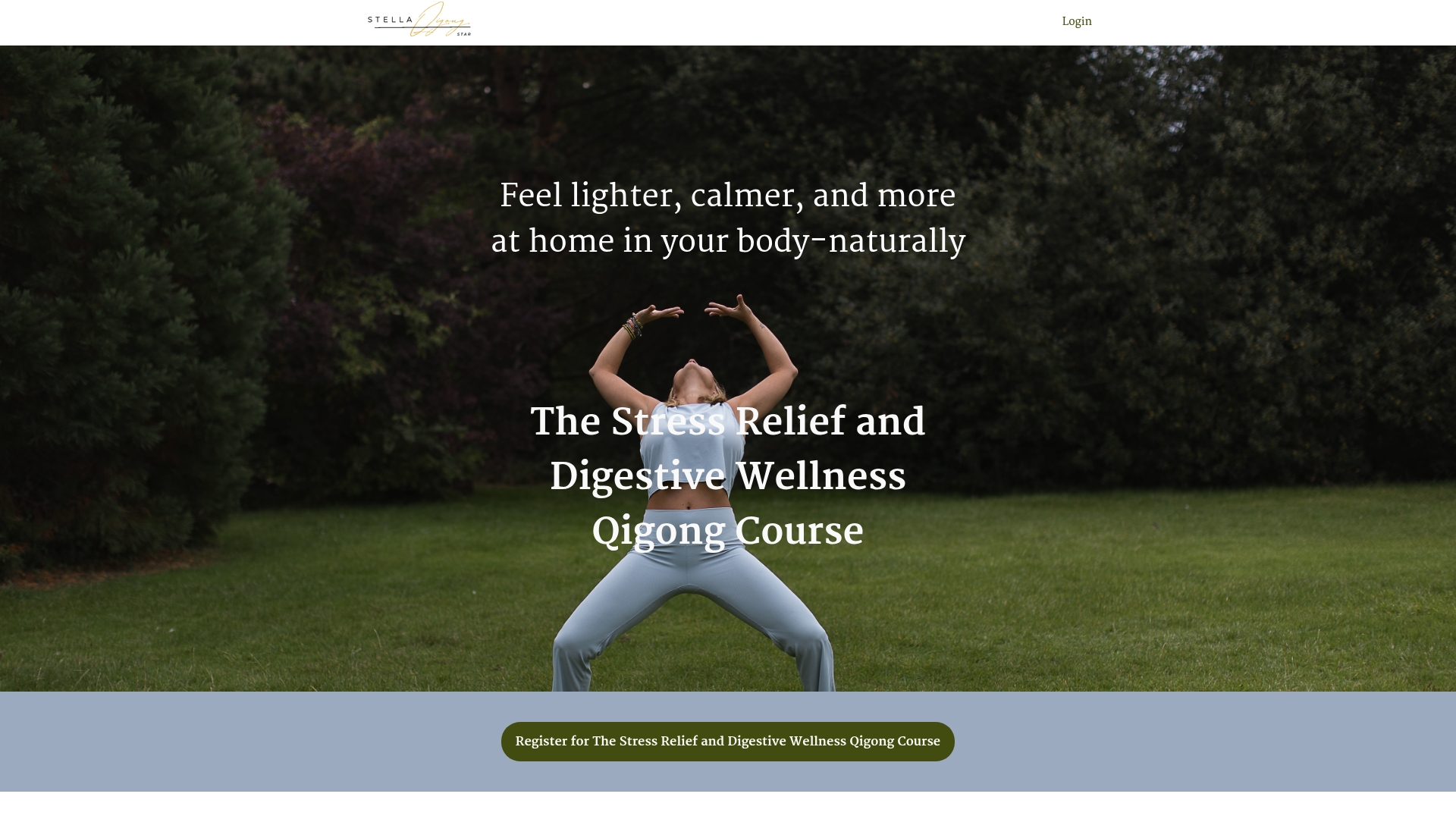
Whether you prefer a self-paced course you can return to anytime, a live virtual class with real-time feedback, or a private session tailored to your specific needs (stress, digestive health, or general wellness), Qigongstar has a format that fits your life. The White Tiger Qigong course and the Five Animal Qigong program are both designed to meet you where you are and guide you forward with care. Visit the online classes page to see current options and book your first session.
Useful sources and further reading
- Qigong Exercises for Beginners: Simple Movements to Get Started — A clear overview of foundational beginner movements, breath coordination, and the purpose of each exercise; a good companion reference for the sequence above.
- Eight Pieces of Brocade (Ba Duan Jin): Beginner Qigong Guide — Detailed breakdown of all eight Ba Duan Jin movements with alignment cues; the natural next read after you have practiced the core sequence for a few weeks.
- How to Start Qigong Practice at Home: A Beginner's Guide — Qigongstar's own guide to setting up a home practice, including environment tips, frequency guidance, and how to progress safely over time.
- NIH: Qigong and Health Outcomes — Peer-reviewed research on the health effects of qigong practice; useful background for readers who want to understand the evidence base behind the practice.
- 15-Minute Qi Gong Sequence for All Levels — A follow-along 15-minute sequence suitable for beginners and intermediate practitioners; a practical option when you are ready to extend your daily practice.