
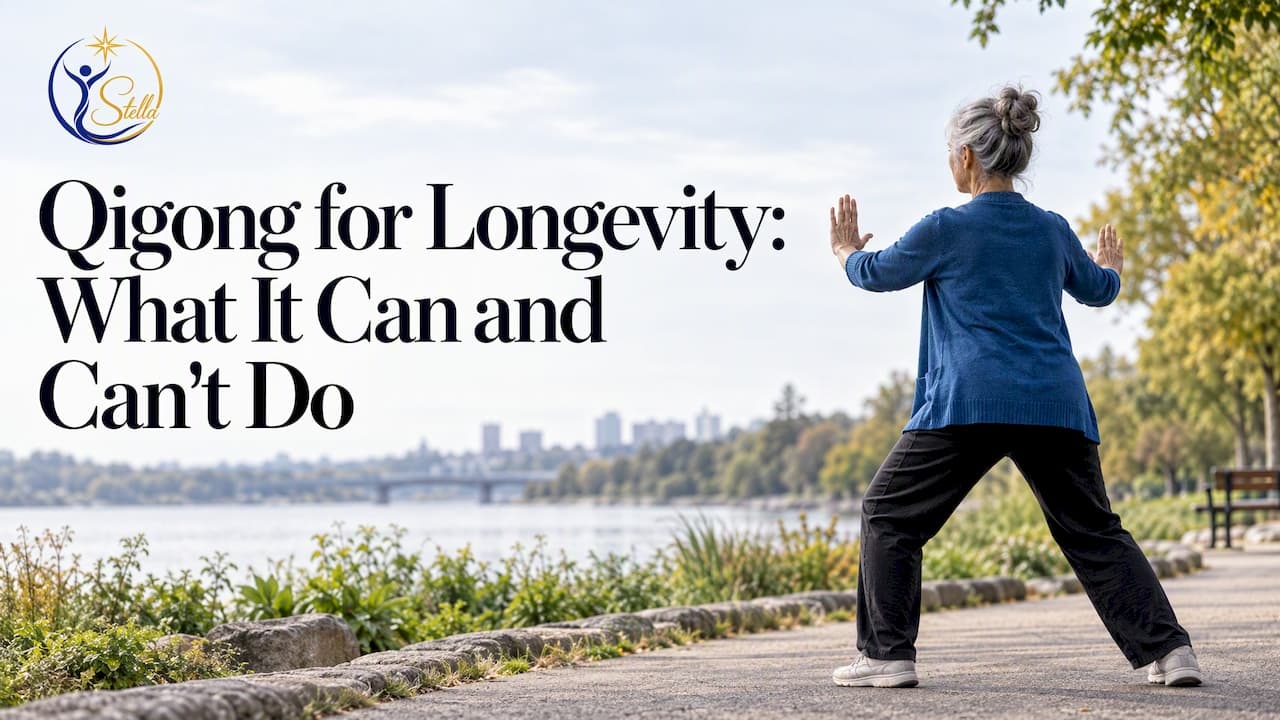
Qigong will not promise you extra years, and no honest teacher should. What the research does support is quieter and more useful: regular, gentle practice can help you keep the strength, balance, calm and confidence that make later life feel full. Those are the things that protect independence as you age, and they are within reach of almost anyone, at any starting point.
This guide explains what "longevity" can realistically mean in qigong, what studies of older adults have found, how often to practise, and how to begin at home in ten minutes a day.
TL;DR
- No study shows that qigong makes you live longer. The evidence is for healthier ageing: better physical function, balance, mood and cognitive health.
- A 2019 review of older adults pointed to about three sessions a week, adding up to at least 1,500 to 2,000 minutes in total, for physical ability.
- Little and often beats occasional long sessions. Start with a few movements, not a whole set.
- Qigong is generally safe for healthy people, but check with your GP or a healthcare provider first if you are pregnant or have a medical condition.
- A certified teacher helps you learn safely, especially if your joints, balance or energy are not what they were.
Table of Contents
- What longevity means in qigong
- What the research actually shows
- Why strength, balance and coordination matter most
- How often should you practise?
- A ten-minute starter routine
- Stress, sleep and the quiet side of ageing
- Our perspective: longevity is a daily practice, not a goal
- Learning with a teacher
- Safety: who should check first
- Making it last
- FAQ
- Sources
What longevity means in qigong
In traditional Chinese medicine, longevity is rarely about the number on a birthday card. It is about yang sheng, the nurturing of life: keeping your energy, digestion, sleep and spirit in good order so that you stay well for as long as you live. If you want the historical background, our guide to ancient Chinese medicine longevity practices explores it in more depth.
The NCCIH describes qigong as a practice developed in China thousands of years ago as part of traditional Chinese medicine, using exercises to optimise energy within the body, mind and spirit, with the aim of improving and maintaining health and well-being. That is a gentle, practical definition, and it frames the goal well: not to fight ageing, but to age with ease.
So when someone searches for anti-ageing qigong, the most honest answer is this. Qigong cannot stop time. It can help you move well, breathe well, sleep better and feel steadier, and those are the qualities people usually mean when they say they want to age well.
What the research actually shows
It helps to be clear about the strength of the evidence. Most trials are small, many are short, and qigong is often studied alongside tai chi. Still, the picture is consistently encouraging for older adults.
Physical ability and mood
A systematic review and meta-analysis of qigong in older adults covered 1,282 people aged 62 to 83. It looked at physical and psychological outcomes, noting that physical limitations, depression and anxiety are common in later life and that mild to moderate exercise can support both body and mind. Its analysis of dosage suggested that three sessions a week, totalling at least 1,500 to 2,000 minutes, was the most effective pattern for physical ability.
That is a useful number to sit with. Three sessions a week of 30 minutes would reach 1,500 minutes in 16.7 weeks, so roughly four months. It is a long game, which suits the subject.

Thinking and memory
A meta-analysis and meta-regression of randomised trials looked at tai chi and qigong in older adults and described them as a potent lifestyle factor for healthy cognitive ageing. The authors suggest the benefit comes directly from improved physical function and indirectly from combining continuous flowing movement, mindful breathing and focused mental meditation.
This is one of the reasons qigong is so appealing. It is not only exercise, and not only meditation. It asks you to coordinate both at once.
Pain, balance and neurological conditions
The NCCIH notes that tai chi and qigong may help to improve balance and stability in older people and in those with Parkinson's disease. Its page on chronic pain and complementary approaches lists qigong among approaches that may help manage some pain conditions.
A 2025 meta-analysis of 833 people with Parkinson's disease found that traditional Chinese exercises improved motor symptom scores. Its subgroup analysis suggested the best results came from sessions of 60 minutes or longer, fewer than three times a week, over fewer than 12 weeks. That differs from the pattern for general physical ability in healthy older adults, which is a good reminder that the best dose depends on who you are and what you want from the practice.
What the evidence does not tell us
- It does not show that qigong extends lifespan.
- It does not replace medical care, medication or physiotherapy.
- Trial participants usually practised with instruction, so the results may not match casual, occasional practice.
If a website promises that qigong will reverse ageing, treat it with caution. The calm, modest claim is the more trustworthy one.
Why strength, balance and coordination matter most
When people talk about longevity, they often picture a long list of exotic remedies. In practice, a great deal of healthy ageing comes down to being able to stand up from a chair, climb stairs, carry shopping and stay upright on an uneven pavement.

The NHS explains that strength and flexibility exercises help increase muscle strength, maintain bone density, improve balance and reduce joint pain. It also points to activities such as tai chi as part of staying strong, balanced and coordinated as we age, which helps prevent falls and preserves independence.
Qigong fits that role well, because the slow weight shifts, soft knees and steady breathing train balance without strain. If bones are a worry, read about tai chi and osteoporosis, where fall benefits are clearer than bone gains. The distinction is worth knowing: the strongest case for gentle movement practices is better balance and fewer falls, not a guarantee of denser bones.
If balance is your main concern, our guide to qigong for balance gives five moves to track over a 5 to 15 minute routine. If dizziness is part of the picture, see qigong for dizziness, and do speak to your GP about it first.
How often should you practise?
The question people ask most is whether they can do qigong every day. For most healthy adults, yes: the movements are gentle, and short daily practice is often easier to sustain than a weekly class alone. The NCCIH says qigong is generally considered safe for healthy people, though it may cause minor muscle aches and pains.
Here is a simple way to think about it.
| Your goal | A sensible rhythm | Notes |
|---|---|---|
| Build a habit | 5 to 10 minutes daily | Same time each day, such as after waking |
| General physical ability | About 3 sessions a week, 30 minutes or more | In line with the 2019 review on older adults |
| Calm and sleep | Gentle practice in the evening | Slow breathing, no strain |
| Managing a health condition | Agree it with your clinician and teacher | Evidence varies by condition |
The Torbay and South Devon NHS tai chi handout makes a point that applies equally to qigong: beginners often feel they must learn everything at once. Its guidance on Shibashi, an 18-movement set, encourages starting with a few movements at a time, with regular daily practice building towards the full set and visible results over around three months. Treat that timeline as a guide rather than a promise, because everyone's body and routine differ.
A ten-minute starter routine
You do not need a special space. A clear patch of floor, comfortable clothes and a chair nearby for support are enough. Move at half the speed you think you should.
- Arrive (1 minute). Stand with feet hip-width apart, knees soft, shoulders loose. Let your breath settle into the lower belly.
- Gentle sway (2 minutes). Shift your weight slowly from one foot to the other, letting your arms swing loosely. Feel the ground under each foot.
- Lifting and lowering the sky (3 minutes). As you inhale, float your palms up in front of you to chest height. As you exhale, press them softly down. Keep your knees slightly bent and your breath unforced.
- Opening the chest (2 minutes). Open your arms wide as you breathe in, and let them close as you breathe out. Let go of tension in your neck.
- Walking slowly (1 minute). Take a few slow steps, heel first, noticing balance as your weight transfers.
- Settle (1 minute). Rest your hands over your lower belly. Breathe slowly and notice how you feel.
If standing is tiring, do the whole sequence seated. Seated qigong is still qigong. If you prefer to move through the world rather than stand still, our beginner's guide to walking qigong is a gentle place to start.
Stress, sleep and the quiet side of ageing
Much of what shortens healthy years is not a single dramatic event. It is the accumulation of strain: months of poor sleep, constant tension, a mind that will not switch off. Slow, rhythmic breathing with soft movement is a practical way to give your nervous system a break.
If your days are busy and your evenings are restless, these two pages may help: build stress resilience with qigong and meditative movement for racing thoughts. Longevity starts long before retirement, and professionals in their thirties and forties who learn to release tension now often find it easier to keep a practice going for decades. Our piece on qigong for professionals covers calm, focus and vitality at work.
Our perspective: longevity is a daily practice, not a goal
We teach qigong rooted in Chinese medicine, with a focus on stress relief, digestive health and overall wellbeing. Our instruction comes from a White Tiger Qigong Level 3 certified teacher who is also accredited by Yoga Alliance, and that shapes how we think about longevity.
We do not promise years. We invite you to build a relationship with your own body. In our experience, the people who benefit most are not the ones who chase a perfect form or a dramatic result. They are the ones who show up for a short, gentle practice again and again, and who learn to notice what their body is asking for.
We also see gut health and stress as deeply linked to how well people feel as they age. A calm nervous system and a settled digestion give you energy that no supplement can imitate. That is why our programmes begin with breath, softness and pacing before anything more ambitious.
And we believe in modification. Qigong should never hurt. If a movement strains your knee, shorten it. If your balance is wobbly, hold a chair. If you are tired, do less. Longevity comes from continuing, and you can only continue what feels kind.
— Stella
Learning with a teacher
Books and videos can inspire you, but a teacher can see what you cannot: a locked knee, a held breath, a shoulder that never relaxes. If you would like guided practice for stress, digestion and steady vitality, we offer online and in-person options with prices as published on our site:
- Qigong for Stress Relief and Digestive Wellness: £116, one-off.
- 30-Min Clarity Session: £85, one-off.
- 60-Min Deep Dive Online Session: £145, one-off.
- 60-Min Face-to-Face Qigong: £165, one-off.
- Group Qigong Classes: see the page for details.
You can see everything on our online qigong classes and courses page, or learn about our two lineages, White Tiger Qigong and Five Animal Qigong. Both are gentle and beginner-friendly.
Safety: who should check first
Qigong is gentle, but gentle does not mean suitable for everyone in every circumstance. The NCCIH advises that pregnant women and people with existing medical conditions should consult a healthcare provider before starting any new exercise routine.
In practical terms:
- If you have heart disease, uncontrolled blood pressure, a recent fall, osteoporosis, severe joint problems or unexplained dizziness, speak to your GP or a physiotherapist first, and tell your qigong teacher too.
- If you are pregnant, read our guide on qigong safety in pregnancy and talk to your midwife.
- Our page on qigong contraindications explains who should modify or avoid practice.
- Stop if you feel sharp pain, chest discomfort, faintness or breathlessness, and seek medical advice.
Mild muscle soreness in the first weeks is common. Pain that stays or grows is not.
Making it last
Healthy ageing is mostly the result of ordinary things repeated. These habits help a qigong practice survive busy weeks.
- Anchor it. Attach your practice to something you already do, such as the kettle boiling or brushing your teeth.
- Keep it small. Five minutes counts. A tiny habit you keep beats a big plan you drop.
- Practise outdoors when you can. Fresh air and daylight make a short session feel richer.
- Track gently. Note how you sleep, how steady you feel on one leg, how your shoulders feel. Progress in qigong is often subtle.
- Join others. A weekly group class gives rhythm and company, which matter for wellbeing at every age.
FAQ
Can qigong really help you live longer?
There is no study proving that qigong extends lifespan. What the research does show is benefit to physical function, balance, mood and cognitive health in older adults, all of which support a healthier later life. Think of it as a way to add quality to the years you have.
Can I do qigong every day?
For most healthy adults, yes. The movements are slow and low-impact, and a short daily session builds the habit. Start with 5 to 10 minutes, listen to your body, and check with your GP first if you have a medical condition or are pregnant.
Is qigong better than tai chi for longevity?
Neither has been shown to be better. Both are gentle, flowing practices that combine movement, breath and focus, and many studies group them together. Qigong is often simpler to learn because the movements are shorter and repeated, so it suits beginners and people who want to practise seated or in small spaces.
How long before I notice results?
Many people feel calmer and more relaxed within a few sessions. Changes in balance and strength take longer. A beginner tai chi handout from an NHS trust suggests visible results around three months with regular daily practice, though this varies from person to person.
Is qigong suitable if I am not very fit?
Yes, in most cases. Every movement can be shortened, slowed or done seated. A certified teacher can adapt the practice to your joints, energy and balance, and your GP can advise if you have a specific condition.
Sources
- Physical and Psychological Health Outcomes of Qigong Exercise in Older Adults: A Systematic Review and Meta-Analysis
- Effects of Tai Chi and Qigong on cognitive and physical functions in older adults
- Traditional Chinese exercises for motor symptoms and mobility in Parkinson's disease (Frontiers in Aging Neuroscience, 2025)
- Qigong: What You Need To Know, NCCIH
- Traditional Chinese Medicine: What You Need To Know, NCCIH
- Tai Chi and Qi Gong, NCCIH
- Chronic Pain and Complementary Health Approaches, NCCIH
- How to improve your strength and flexibility, NHS
- Tai Chi for beginners, Torbay and South Devon NHS Foundation Trust