
Regular qigong practice can modestly support immune function as a safe, complementary wellness habit. A meta-analysis of qigong and tai chi trials found a small but real increase in immune cell markers. The best path forward is a short daily breathing and movement routine, practiced consistently over weeks. Qigong nurtures your body's resilience, but it never replaces vaccination or medical care.
TL;DR:
- Practicing qigong regularly for at least eight weeks can induce small but meaningful improvements in immune cell markers and antibody responses.
- Consistency matters more than session length; daily 10 to 15 minute routines are effective for building resilience and establishing a habit.
- The most significant immune benefits come from sustained, long-term practice rather than occasional or short-term sessions.
- Those with health conditions such as autoimmune disorders or recent surgery should consult a doctor before starting qigong.
- The research supports qigong as a safe, low-cost, complementary practice that influences stress pathways, but it does not guarantee reduced illness frequency.
Table of Contents
- Qigong for Immune System Support: Two Routines You Can Start Today
- How Does Qigong Support Immune Function?
- What Does the Research Actually Show?
- How Often Should You Practice for Immune Benefits?
- When Should You Modify or Avoid Qigong Practice? For detailed safety considerations related to complementary movement and breathing therapies, see PEMF Therapy Side Effects: What You Need to Know.
- Notes From the Practice Room: What Actually Helps Students
- The Real Lesson Buried in the Research
- Ready to Build a Real Qigong Habit? Here's Where to Start
- Sources
- FAQ
Qigong for Immune System Support: Two Routines You Can Start Today
You don't need an hour on a mat or a special studio to begin. What you need is a rhythm your body can learn, and two simple routines cover most of what the research points to: a short daily practice for consistency, and a longer weekly session for depth.
Both routines lean on the same principle. Gentle, repetitive movement paired with slow, deliberate breathing calms your nervous system while quietly engaging the muscles and circulation that support your body's defenses. Think of it less as exercise and more as a daily conversation with your own physiology.
The 10 to 15 minute daily immunity reset
This is the routine you do most days, ideally at the same time so it becomes as automatic as brushing your teeth.
- Warm-up (2 to 3 minutes). Stand with feet hip-width apart, knees soft. Roll your shoulders back slowly ten times, then gently rotate your neck and rock your weight from heel to toe. Let your breath settle into a natural rhythm before you move further.
- Core sequence (6 to 8 minutes). Move through slow, circular arm-raises timed to your breath. Inhale gently through the nose as your arms rise to shoulder height, exhale for twice as long as you lower them, letting your knees soften slightly on the way down. Repeat for six to eight full cycles, then add a gentle torso twist from the waist, arms swinging loosely, for another six cycles.
- Closing breath (2 to 4 minutes). Stand still, hands resting over your lower belly. Inhale for a count of four, hold briefly, and exhale for a count of six to eight. This extended exhale is where the parasympathetic "rest and digest" response actually kicks in, and it's the single most important cue in the whole sequence.
Where to feel it: your lower back should feel loose, your shoulders should drop away from your ears, and your belly should expand outward on the inhale rather than your chest lifting.
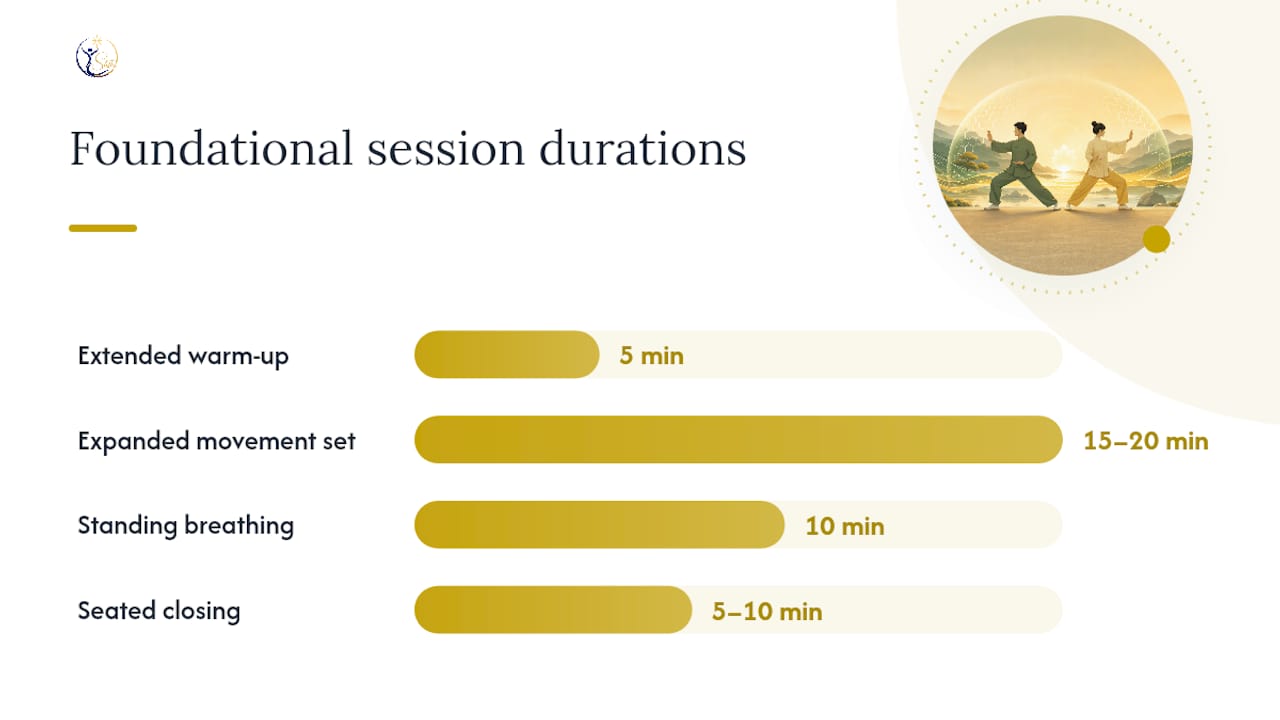
The 30 to 45 minute foundational weekly session
Once or twice a week, give yourself the fuller version. It follows the same shape but goes deeper.
- Extended warm-up (5 minutes). Include joint rotations for ankles, hips, wrists, and shoulders, plus a few minutes of quiet standing to notice tension before you begin moving.
- Expanded movement set (15 to 20 minutes). Layer in wider stances, gentle squatting movements paired with exhalation, and flowing arm patterns that cross the body's midline. Each movement should feel unforced. If something pulls or strains, shrink the range of motion rather than pushing through it.
- Standing breathing practice (10 minutes). Hold a relaxed standing posture, knees slightly bent, and focus entirely on lengthening your exhale. Many practitioners anchor attention at the lower belly, sometimes called the lower dantian, using the exhale to soften the pelvic floor and lower back. This anchoring gives your mind a specific place to return to when it wanders, which matters more than people expect once the novelty of the movements wears off.
- Seated closing (5 to 10 minutes). Sit comfortably, spine tall but not rigid, hands resting on your thighs. Breathe slowly with no particular pattern, simply noticing the after-effects of the practice in your body.
Modifications: if you have limited mobility, every standing movement in both routines can be done seated in a sturdy chair. Keep the breathing cues identical. Someone recovering from injury or managing chronic fatigue should shrink the range of motion first and the duration second, and should never sacrifice the slow exhale to keep up with a movement count.
Progression over weeks: in weeks one and two, focus purely on remembering the sequence and breathing comfortably. By weeks three and four, aim for smoother transitions between movements. From week five onward, most practitioners find the breath and movement start to synchronize without conscious effort, which is usually the point where the practice starts to feel less like exercise and more like a habit you look forward to.
Pro Tip: Practice near a window with natural light if you can. Morning light exposure paired with slow movement seems to help regulate the same stress hormones that qigong's breathing work targets, giving you a small compounding effect for no extra time investment.
How Does Qigong Support Immune Function?
Qigong's influence on immunity runs through your nervous system before it ever reaches your blood cells. The movements and breathing patterns are simple, but the physiological chain they trigger is not.
The most well-documented mechanism involves the vagus nerve. A long, slow exhale activates your parasympathetic nervous system, the branch responsible for calming your body down after stress. Sustained practice appears to improve vagal tone over time, which in turn helps regulate cortisol output. Chronically elevated cortisol suppresses several arms of your immune response, so anything that reliably brings cortisol back into a healthy range removes a real obstacle to normal immune signaling.
Circulation and respiratory mechanics play a secondary role. Gentle, rhythmic movement encourages blood and lymphatic flow, and deeper diaphragmatic breathing strengthens the muscles involved in respiration. Since your lymphatic system has no central pump of its own and relies partly on muscle movement to circulate, slow full-body motion may support the transport of immune cells through lymphatic pathways, and stronger respiratory muscles may support your airway's mucosal defenses.
A third pathway runs through the HPA axis, the communication loop between your brain, pituitary gland, and adrenal glands that governs your stress response. Reviews of qigong practice point to four elements that consistently show up as the active ingredients behind these effects:
- Physical training: the repetitive, low-impact movement itself
- Active relaxation: consciously releasing muscular tension rather than passively resting
- Focused attention: sustained, non-judgmental awareness on the body and breath
- Conscious breathing: deliberately slowed, extended exhalation
According to a review of qigong's stress-prevention mechanisms, these four elements combine to lower activation of the HPA axis, and chronic HPA overactivation is closely tied to the low-grade inflammation associated with a wide range of modern health complaints.
It's worth being precise about what this evidence actually shows. Most of it comes from biomarker changes, cortisol levels, cell counts, inflammatory proteins, rather than from tracking who actually got sick less often. That is a meaningful gap. The mechanisms above are biologically plausible and supported by real data, but they describe a chain of association rather than a proven, direct causal path from "you did qigong" to "you didn't catch a cold." Treat the biology as a strong, reasonable explanation for what researchers observe, not as settled fact.
What Does the Research Actually Show?
The clearest signal comes from a 2020 systematic review and meta-analysis pooling multiple trials of qigong and tai chi. In plain terms, an SMD of 0.28 counts as a small effect by conventional statistical benchmarks, but the confidence interval sitting entirely above zero means the effect is unlikely to be due to chance. This is a modest, real signal, not a dramatic one.
Individual trials add texture to that pooled finding. A 4-week Taoist qigong intervention found participants had significantly higher B lymphocyte counts and B lymphocyte percentages than a control group after just one month of practice, with the count difference reaching a p-value of 0.006. B lymphocytes are the white blood cells responsible for producing antibodies, so a measurable rise here is a meaningful, if narrow, marker of immune activity.
Other reviews report enhanced antibody responses to vaccination in some study groups, hinting at a possible role for qigong as an adjunct that supports the body's response to immunization rather than replacing it. A broader review of qigong and tai chi health benefits that captured this vaccine-response data was equally clear that overall study quality across the field remains inconsistent.
That caveat matters. Common weaknesses across this body of research include:
- Small sample sizes, often fewer than 100 participants per study
- Wide variation in which qigong style was taught and for how long
- Short follow-up periods that rarely extend beyond a few months
- Limited blinding, since participants obviously know whether they are doing movement exercises
A 2012 systematic review focused specifically on qigong and infections reached a similarly measured conclusion: favorable effects on immune markers appeared across controlled trials, but no included trial actually measured whether participants got fewer infections. Marker changes and clinical outcomes are not the same thing, and the honest takeaway is that qigong looks like a safe, low-cost practice with measurable immune-marker effects in some contexts, not a proven shield against illness.
How Often Should You Practice for Immune Benefits?
Consistency beats intensity here. Guidelines drawn from stress-prevention research suggest a moderate frequency and duration of sessions each week as the range most associated with measurable outcomes in study settings. If your schedule can't stretch that far, daily short practices of 10 to 20 minutes still deliver strong stress-control benefits and keep the habit alive on busy weeks.
Give it real time before judging results. Most research suggests several weeks of consistent practice before immune-marker changes become noticeable, aligning with the general rule that qigong rewards prevention and resilience rather than reactive bursts during an acute illness.
- Set a fixed time slot. Attach your practice to an existing habit, like right after your morning coffee or right before you shower.
- Track a few simple markers. Note your sleep quality, your perceived stress level on a 1 to 10 scale, how often minor colds show up, and your general energy, weekly.
- Use micro-practices on hard days. Even five minutes of the closing breath sequence keeps the habit intact when a full session isn't realistic.
- Consider a guided class. Structured group sessions or an on-demand course build in accountability that a solo YouTube routine rarely provides.
Pro Tip: Track your resting heart rate first thing in the morning if you have a fitness tracker or smartwatch. A gradual downward trend over eight to twelve weeks is one of the more accessible signs that your nervous system is settling into a calmer baseline.
When Should You Modify or Avoid Qigong Practice? For detailed safety considerations related to complementary movement and breathing therapies, see PEMF Therapy Side Effects: What You Need to Know.
Qigong is gentle by design, but gentle doesn't mean risk-free for every body. A short safety check before you begin protects the practice's benefits rather than undermining them.
- People who are immunosuppressed, managing an active autoimmune flare, or living with severe lung disease should check with their clinician before starting any new movement or breathing practice.
- Anyone recovering from major surgery within the past few weeks should wait for medical clearance first.
- Pregnant practitioners should avoid deep squatting movements and any pose that compresses the abdomen, favoring seated or standing variations instead.
- Those with balance concerns or mobility restrictions should practice near a wall or sturdy chair and stick to seated modifications until confidence builds.
A Cleveland Clinic overview of qigong's health benefits puts it plainly: qigong is safe to try for most people and may support mental health and immune-related outcomes, but it is not a substitute for medical treatment. If you're fighting an active infection, see a doctor and follow their guidance; use qigong alongside that care, not instead of it. For a full breakdown of who should modify their practice and how, the qigong contraindications guide is worth reading before your first session.
Notes From the Practice Room: What Actually Helps Students
Teaching qigong for stress relief and digestive health for years has shown a pattern: the exhale changes everything. Students who struggle to relax almost always discover their breathing is shallow and rushed. Once they learn to extend the exhale and soften the pelvic floor on the way out, the shift in how they feel is often immediate.
Anchoring attention at the lower belly, the lower dantian, gives the mind a physical home base rather than an abstract instruction to "relax." That small adjustment is usually the difference between a student who fidgets through a session and one who settles into it.
What do students report first? Almost never "my immune system feels stronger." It's sleep. Less tension in the jaw and shoulders. A calmer nervous system that shows up in ordinary daily moments, less snapping at traffic, easier falling asleep. Those shifts are the visible surface of the same stress pathways tied to immune resilience, and they tend to arrive well before any measurable change in blood work. Readers wanting to build this skill with real feedback rather than guesswork can start with structured online qigong courses designed around exactly this progression.
The Real Lesson Buried in the Research
Most articles on this topic oversell the science or undersell the practice, and both mistakes lead readers astray. The honest read of the evidence is that qigong produces a small, statistically real shift in immune markers, not a dramatic one, and that shift shows up most reliably with consistent practice over months, not with occasional sessions during flu season.
Conventional wellness advice tends to frame immune support as something you do reactively, chugging supplements the moment you feel a scratchy throat. The research points the opposite direction: qigong's value is almost entirely preventive. Skipping practice when you're busy and doubling up when you're sick gets the order backward.
If there's one priority worth taking from this article, it's schedule before intensity. A five-minute daily habit sustained for three months will outperform an ambitious hour-long routine abandoned after a week. Build the habit first. Let depth follow.
— Stella
Ready to Build a Real Qigong Habit? Here's Where to Start
Reading about breathing cues and B lymphocyte counts only gets you so far. Qigong is a felt practice, and getting the movements, timing, and breath pattern right is far easier with guided instruction than with trial and error alone. That's exactly the gap these courses are built to close.
If your goal is daily maintenance, a self-paced format works well: you move through the routine on your own schedule and revisit lessons whenever a movement needs refreshing. If you want structured progression with real feedback on posture and pacing, a multi-week course builds that scaffolding in. The 5 Animal Qigong course offers a progressive, multi-week structure well suited to building the kind of consistency this article's research points to, while White Tiger Qigong leans into breath work and physical presence for readers who want to deepen the standing practices described above. Both are taught by Stella, a certified instructor whose teaching centers on stress relief and digestive wellness.
None of this replaces your doctor or your vaccine schedule. What it offers is structure, feedback, and a community that makes an eight-to-sixteen-week commitment far easier to keep. Preview a lesson through the online course catalog and see which format fits your week.
Sources
- The Effects of Tai Chi and Qigong on Immune Responses: A Systematic Review and Meta-Analysis
- Immunomodulatory Effects in Healthy Individuals Following a 4-Week Taoist Qigong Intervention: A Comparative Study
FAQ
What Is the Strongest Herb for the Immune System?
No single herb is definitively the "strongest" for immune support, and claims like that vary widely by source; what the research in this article supports is that consistent movement and breathing practices like qigong offer a well-documented complementary approach alongside a balanced diet.
What Is the Best Exercise to Boost the Immune System?
Moderate, regular movement, walking, swimming, tai chi, and qigong among them, is more strongly linked to immune support than intense or irregular exercise. Qigong's specific advantage is combining gentle movement with slow breathing, which directly targets the stress pathways tied to immune suppression.
Can Qigong Help With Autoimmune Disorders?
Qigong may help manage stress and inflammation-related symptoms as a complementary practice, but anyone with an autoimmune condition, especially during a flare, should consult their clinician before starting and treat qigong as an addition to medical care, not a replacement.
How Do You Boost the Immune System With Chinese Medicine?
Traditional Chinese medicine approaches immune support through practices like qigong, acupuncture, and dietary therapy aimed at reducing stress and supporting the body's natural balance; qigong specifically uses breath and gentle movement to calm the nervous system, which research links to measurable, if modest, immune-marker changes.
How Long Before Qigong Improves Immune Markers?
Most research points to an 8 to 16 week window of consistent practice, two to three sessions per week at 30 to 60 minutes each, before measurable changes in immune markers appear.