
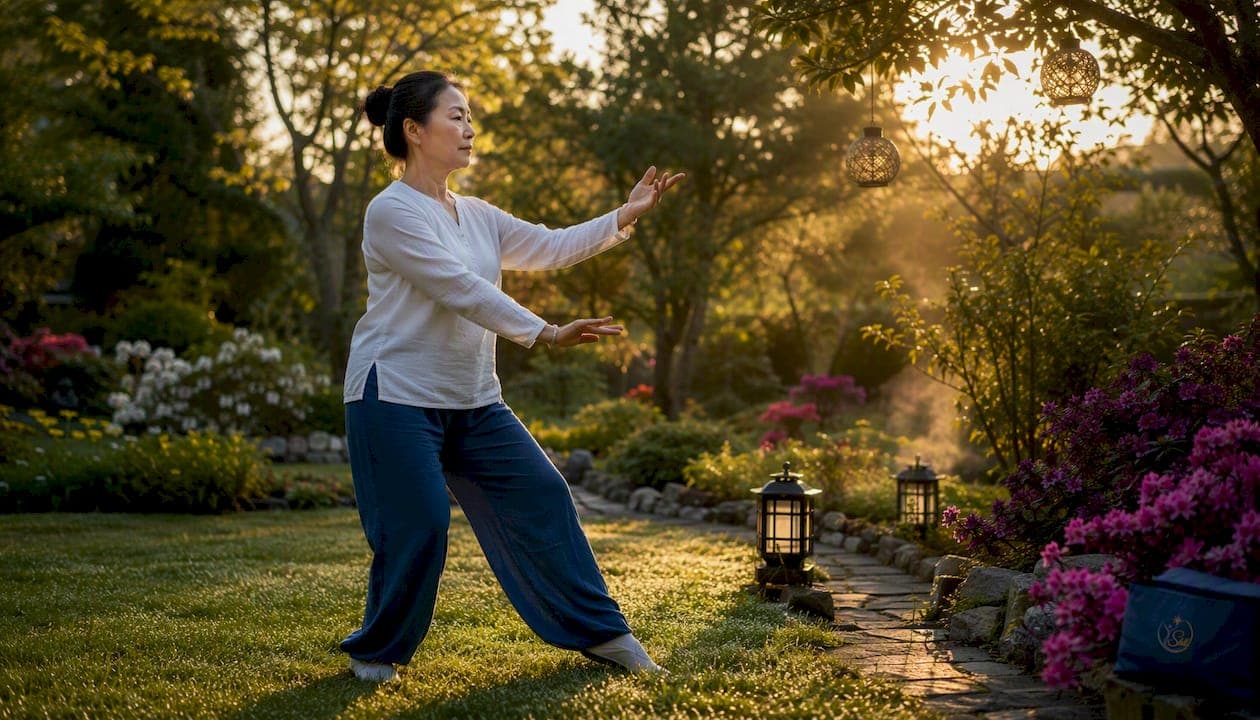
You can reset your nervous system right now. Stand up, soften your knees, and try this 3-minute sequence before reading another word.
Your 3-minute reset:
- Wuji stance (30 seconds): Stand with feet shoulder-width apart, knees slightly soft, arms relaxed at your sides. Close your eyes and feel your weight settle into the ground.
- 5-1-6 breath (1 minute): Inhale slowly through your nose for 5 counts, pause for 1, exhale through your mouth for 6. Repeat 4 times. This breath pattern lengthens the exhale to shift your nervous system toward calm.
- Gathering Qi (1 minute): Slowly raise both arms out to the sides and up overhead as you inhale, then draw your palms down the center of your body as you exhale. Imagine pulling calm energy inward with each pass. Repeat 4 times.
- Cloud Hands (30 seconds): Shift your weight gently left and right, letting your arms float and turn with each shift. Keep your gaze soft and your shoulders loose.
This sequence works best during a mid-afternoon slump, right before a stressful meeting, or any moment when tension is creeping in. No mat, no equipment, no setup required.
A 15-minute qigong session produced significant reductions in state anxiety in participants with no prior qigong experience. If 15 minutes does that, three minutes of intentional breath and movement is a genuinely useful tool.
Table of Contents
- What do the best daily qigong routines actually look like?
- What are the four building blocks of an effective practice?
- When should you practice, and how often?
- How do you make qigong stick as a daily habit?
- Which micro-practices work best for specific stress moments?
- Can anyone practice qigong safely, even with limitations?
- A coached 10-minute routine from Qigongstar
- Key Takeaways
- Why short daily practice matters more than you think
- Ready to go deeper with Qigongstar?
- Useful sources and next steps
What do the best daily qigong routines actually look like?
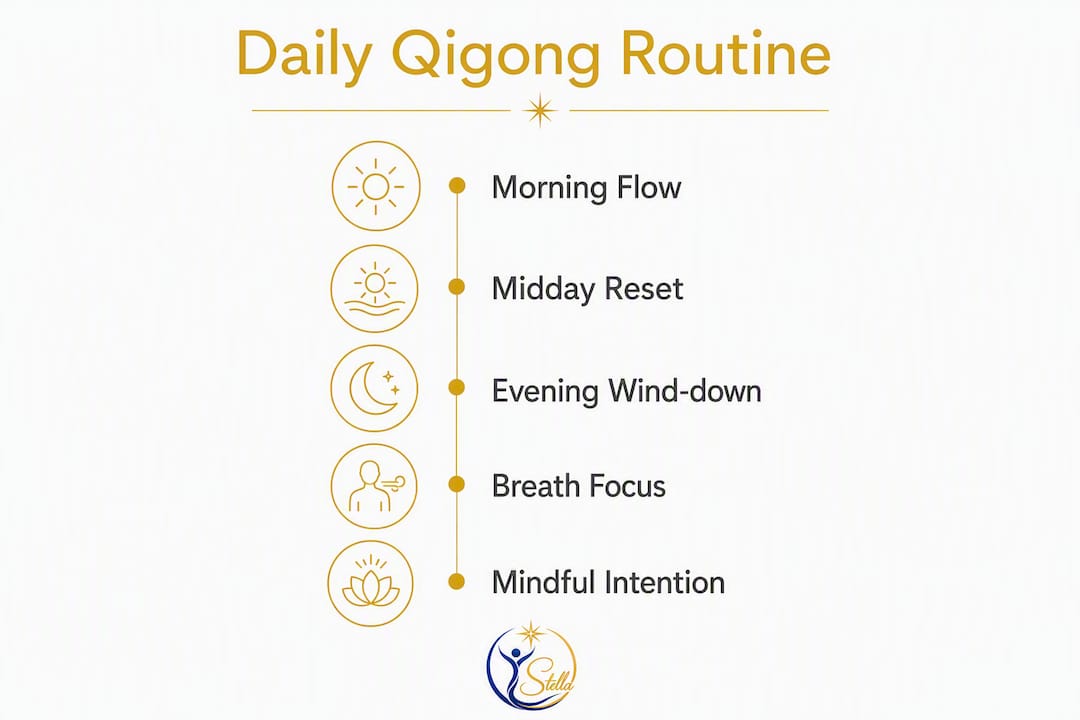
Not every day has the same shape, so your practice does not need to either. Here are three complete routines matched to different schedules and energy levels.
| Routine | Duration | Best For | Difficulty |
|---|---|---|---|
| Morning Energy Flow | 8–10 min | Starting the day with calm focus | Beginner |
| Midday Reset | 3 min | Desk break, pre-meeting, quick recharge | All levels |
| Evening Wind-Down | 15 min | Releasing tension, preparing for sleep | Beginner–Intermediate |
Morning energy flow (8–10 minutes)
This routine wakes up the body gently before the day's demands arrive. Do it barefoot if you can.
- Wuji stance (1 min): Settle into stillness. Three slow 5-1-6 breaths to arrive.
- Opening Qi (2 min): Inhale and float both arms up from your sides to shoulder height; exhale and lower them. Feel the space between your palms and your body. Repeat 8 times.
- Cloud Hands (2 min): Shift weight side to side with soft, flowing arm movements. 10 slow repetitions each direction.
- Gathering Qi (2 min): Draw arms overhead and down the body's centerline on each exhale. 8 repetitions.
- Spinal roll-down (1 min): Slowly roll your chin to chest, then vertebra by vertebra, letting your arms hang. Pause at the bottom, then roll back up.
- Closing breath (1–2 min): Return to Wuji. Three final 5-1-6 breaths. Rest your palms on your lower belly and feel the warmth.
Pro Tip: A short guided video helps enormously here. Watching an instructor's pacing and arm height teaches you more in two minutes than reading instructions for ten.
Midday reset (3 minutes)
This is the routine from the opening. Use it at your desk, in a hallway, or outside. The only requirement is a moment of privacy and a willingness to breathe.

Evening wind-down (15–20 minutes)
This longer practice releases the day's accumulated tension. Slower pace, deeper breath holds, and more floor-based stretching make it ideal before bed.
- Seated Wuji (2 min): Sit at the edge of a chair, spine long, hands on thighs. Five slow breaths.
- Neck and shoulder release (3 min): Gentle head rolls, shoulder circles, and arm swings to loosen the upper body.
- Standing sway (3 min): Stand and sway gently forward and back, then side to side, letting the spine decompress.
- Cloud Hands, slow version (4 min): Same movement as the morning routine, but half the speed. Let each shift feel like moving through warm water.
- Gathering Qi, seated (3 min): Seated version with arms rising on the inhale and descending on the exhale. 10 repetitions.
- Floor breathing (3 min): Lie on your back, knees bent. Place hands on your belly. Breathe into your hands for 5 counts, pause, exhale for 6. Let the floor hold you completely.
What are the four building blocks of an effective practice?
Every qigong session, whether three minutes or thirty, rests on the same four elements. Understanding them makes even the shortest practice more effective.
Breath is the foundation. Slow, conscious breathing with a longer exhale activates the parasympathetic nervous system, the body's rest-and-digest state. The 5-1-6 pattern (inhale 5, pause 1, exhale 6) is a reliable starting point because the extended exhale stimulates the vagus nerve, which governs the calming response. You do not need to breathe perfectly. You just need to breathe consciously.
Gentle movement coordinates with breath to move qi (life energy) through the body. Movements like Cloud Hands and Gathering Qi are slow, circular, and rhythmic, which means they are safe for most bodies and easy to learn. The rhythm itself is calming.
Posture and relaxation work together. Qigong posture is not rigid; it is aligned and soft. A long spine, relaxed shoulders, and slightly bent knees allow energy to flow freely. Tension in the body blocks the practice's benefits before they can take hold.
- Keep knees soft, never locked.
- Relax your jaw, tongue, and the space behind your eyes.
- Let your shoulders drop away from your ears before each movement.
- Root through the soles of your feet, as if your heels are gently pressing into warm earth.
Intention and mindfulness complete the picture. Qigong is not just physical exercise. Bringing your attention to the movement, the breath, and the sensations in your body is what separates qigong from simple stretching. Even a three-minute practice done with full attention produces a noticeably different result than the same movements done while thinking about your inbox.
Pro Tip: If your mind wanders during practice, that is normal. Gently return your attention to the breath. The act of returning is the practice.
When should you practice, and how often?
The honest answer: daily micro-practices of 3–10 minutes will serve you better than occasional long sessions. Consistency matters more than duration, especially in the first few weeks.
For most beginners, a daily qigong routine of 5–10 minutes is the most sustainable starting point. If you can add one longer session of 15–20 minutes once or twice a week, you will build depth faster. But the daily short practice is the non-negotiable anchor.
What to expect over time:
- After 1 week: You will likely notice a subtle shift in how you respond to stress moments. The 5-1-6 breath becomes a tool you reach for automatically.
- After 4–6 weeks: Sleep quality often improves. Tension in the shoulders and neck tends to soften. You may notice you feel calmer in situations that previously triggered a stress response.
- After 8+ weeks: Systematic reviews of randomized trials show statistically significant reductions in perceived stress in some qigong studies versus no-treatment controls. Results vary by individual, but sustained practice consistently produces measurable change.
The minimum viable practice is one conscious breath sequence per day. The ideal practice is 10 minutes daily with one longer weekly session. Everything between those two points counts.
How do you make qigong stick as a daily habit?
The most common reason people stop practicing is not lack of motivation. It is lack of a trigger. Habit stacking, attaching qigong to something you already do every day, solves this almost immediately.
Habit stack ideas:
- Wake-up anchor: Three 5-1-6 breaths before you check your phone. Takes 45 seconds and sets a calm tone for the morning.
- Coffee or tea ritual: While the kettle boils, do 2 minutes of Cloud Hands in your kitchen.
- Commute reset: On public transit, practice conscious belly breathing for your first five stops.
- Lunch break micro-practice: Step outside for the 3-minute Midday Reset before eating.
- Pre-meeting calm: Two minutes of Gathering Qi in a quiet hallway before a stressful call.
- Bedtime wind-down: Five minutes of floor breathing as the last thing before sleep.
For busy professionals, the pre-meeting stack is often the one that creates the fastest, most noticeable payoff, because the benefit is immediate and tied to a concrete daily event.
A simple example weekly schedule:
| Day | Practice |
|---|---|
| Monday | 3-min Midday Reset + 10-min Morning Flow |
| Tuesday | 3-min Midday Reset |
| Wednesday | 3-min Midday Reset + 15-min Evening Wind-Down |
| Thursday | 3-min Midday Reset |
| Friday | 3-min Midday Reset + 10-min Morning Flow |
| Saturday | 15-min Evening Wind-Down |
| Sunday | Rest or 5-min gentle breathing only |
Tracking progress simply: Keep a small notebook or use a phone note. Each day, mark whether you practiced (yes/no) and rate your perceived stress on a scale of 1–10. After two weeks, patterns become visible. Most people find their average stress rating drops by the end of week two, which is enough motivation to keep going.
Which micro-practices work best for specific stress moments?
Qigong does not have to wait for a scheduled session. These three sequences are designed for real-life moments when stress arrives without warning.
Work stress (90 seconds): Sit upright, feet flat on the floor. Place one hand on your belly. Breathe in for 5 counts, pause for 1, exhale for 6. Repeat 4 times. This alone activates the parasympathetic response by extending the exhale and encouraging diaphragmatic breathing. No one around you will notice.
Pre-meeting focus (2–3 minutes): Stand in a hallway or step outside. Wuji stance for 30 seconds. Then 8 slow repetitions of Gathering Qi, drawing your arms overhead and down your centerline. Finish with three 5-1-6 breaths. The combination of gentle movement and breath rhythm shifts the nervous system toward a grounded, alert state rather than a wired, anxious one.
Bedtime wind-down (3 minutes): Lie on your back in bed. Hands on your belly. Breathe slowly and deeply, letting your belly rise on the inhale and fall on the exhale. On each exhale, consciously release tension from one area: jaw, shoulders, hips, legs. By the fourth breath cycle, most people feel a noticeable heaviness and warmth spreading through the body.
Each of these sequences works because slow, rhythmic breathing with a longer exhale directly stimulates the vagus nerve, nudging the body away from fight-or-flight and toward calm. You do not need a mat, a studio, or silence. You need your breath and about two minutes of attention.
Can anyone practice qigong safely, even with limitations?
Yes, with a few thoughtful adjustments. Qigong is one of the most accessible mind-body practices available, and most movements can be adapted for seated practice, limited range of motion, or balance concerns.
- Seated modifications: Every standing movement in this guide can be done seated at the edge of a chair. Cloud Hands, Gathering Qi, and Opening Qi all translate naturally to a seated position without losing their core benefit.
- Balance support: Practice near a wall or hold the back of a chair lightly if standing balance is uncertain. The grounding benefit of Wuji stance is fully available even with light support.
- Reduced range of motion: Movements should never push into pain. Shorten the arc of any arm movement to whatever feels comfortable. The breath and intention carry most of the benefit; full range of motion is a bonus, not a requirement.
- Rhythm adjustments: Slow everything down further if needed. There is no minimum speed in qigong. Slower often means deeper.
Pro Tip: If you are managing a chronic condition, recovering from injury, or are pregnant, check with your healthcare provider before starting any new movement practice. Qigong is gentle, but your body deserves that conversation first.
A coached 10-minute routine from Qigongstar
This sequence comes directly from Stella's teaching framework at Qigongstar, rooted in White Tiger Qigong and certified through the White Tiger Qigong School and Yoga Alliance. Follow it as written, or use it as a template to build your own daily practice.
- Wuji stance (1 min): Feet shoulder-width apart, knees soft, eyes closed. Three 5-1-6 breaths to arrive fully.
- Opening Qi (1.5 min): Float arms from sides to shoulder height on the inhale; lower on the exhale. 8 repetitions. Feel the space between your palms and your body.
- Cloud Hands (2 min): Shift weight left and right with slow, circular arm movements. 10 repetitions each direction. Keep the gaze soft and the jaw relaxed.
- Gathering Qi (2 min): Raise arms overhead on the inhale, draw palms down the body's centerline on the exhale. Imagine gathering calm energy with each pass. 8 repetitions.
- Spinal wave (1.5 min): Gently undulate the spine forward and back in small waves, coordinating each wave with the breath. 8 slow cycles.
- Standing meditation (1 min): Return to Wuji. Rest palms on lower belly. Feel the warmth and stillness you have created.
- Closing breath (1 min): Three final 5-1-6 breaths. On the last exhale, let your shoulders drop completely and your hands fall to your sides.
Stella is a certified White Tiger Qigong instructor and Yoga Alliance-registered teacher. Her online classes and on-demand courses are designed specifically for beginners and busy adults who want a structured, guided path rather than piecing together a practice alone.
Key Takeaways
A consistent daily qigong practice of 3–10 minutes, built around the 5-1-6 breath and foundational movements like Gathering Qi and Cloud Hands, is enough to produce measurable reductions in stress within weeks.
| Point | Details |
|---|---|
| Start with 3 minutes | The Midday Reset (Wuji, 5-1-6 breath, Gathering Qi, Cloud Hands) requires no equipment and works anywhere. |
| Habit stacking works | Attach practice to an existing daily anchor (morning coffee, pre-meeting, bedtime) to build consistency without willpower. |
| Evidence supports short sessions | A 15-minute qigong session was shown to reduce state anxiety in participants with no prior qigong experience; shorter daily sessions compound over weeks. |
| Expect change in 4–8 weeks | Sleep, shoulder tension, and stress reactivity typically improve within 4–6 weeks of daily practice. |
| Qigongstar offers guided structure | Stella's coached online courses provide beginner-friendly, instructor-led routines for stress relief and digestive wellness. |
Why short daily practice matters more than you think
Most people assume they need a full hour of qigong to feel a real benefit. That belief keeps them from starting at all. The research and lived experience of teaching this practice both point in the same direction: three minutes of genuine, breath-centered movement done daily produces more lasting change than a 60-minute session done once a month.
There is also a common misconception that qigong requires a specific setting, a quiet room, incense, or a particular spiritual orientation. None of that is true. The practice lives in the breath and the body. You can do it in a parking lot, at your desk, or in a hotel room. The moment you bring conscious breath and gentle movement together, you are practicing.
What beginners often underestimate is how quickly the nervous system responds. The vagal stimulation from a single round of slow, extended-exhale breathing is not subtle. You feel it within minutes. That immediate feedback is what makes qigong so sustainable as a daily habit: the reward arrives before the session ends.
Start smaller than you think you need to. Stay curious about what you notice.
Ready to go deeper with Qigongstar?
The routines in this guide give you a solid foundation. When you are ready for a structured, progressive program taught by a certified instructor, Qigongstar's online courses take you further without the guesswork of building a curriculum alone.
Stella's 5 Animal Qigong program is a natural next step for anyone who has tried the micro-practices here and wants a themed, lineage-based course that builds strength, calm, and digestive health over time. The White Tiger Qigong program goes deeper into the traditional framework, with certification pathways for those who want to teach. Both are available on-demand, so you practice on your own schedule. Stella is certified by the White Tiger Qigong School and registered with Yoga Alliance, and her courses are built specifically for beginners and busy adults in the U.S. Browse the full range of live and on-demand classes and find the format that fits your life.
Useful sources and next steps
These sources informed this guide and offer reliable next steps for continued learning.
- Qigong Exercises: Your 10-Minute Daily Ritual for Vitality & Calm — Mindvalley's practical breakdown of the 5-1-6 breath and a foundational 10-minute sequence.
- How to Integrate Qigong Techniques into Daily Life — Reality Pathing's guide to micro-practices and habit integration for busy schedules.
- Qigong for Beginners: 10-Minute Daily Practice Guide — Taoism & Manifest's beginner-friendly sequence with foundational movements and timeline expectations.
- The Effect of Qigong Practice on Stress Reduction — J-STAGE study showing significant anxiety reduction after a single 15-minute session in beginners.
- Qigong Therapy for Stress Management: A Systematic Review — MDPI review of randomized controlled trials on qigong and perceived stress; useful for setting realistic expectations.
- Vagus Nerve Stimulation: A Pathway to Balance and Well-being — Art of Qi's explanation of how breath-led movement supports vagal tone and parasympathetic activation.
- Daily Qigong Routine for Stress Reduction That Works — Qigongstar's own step-by-step guide for building a stress-focused daily habit.
- Online Qigong Classes & Courses — Stella's full range of beginner-friendly, on-demand and live classes for stress relief and digestive wellness.
Suggested next actions:
- Try the 3-minute Midday Reset today and note your stress level before and after.
- Practice daily for two weeks, tracking your perceived stress score each day.
- When you are ready for guided instruction, explore Qigongstar's live and on-demand courses to build a structured, progressive practice.