
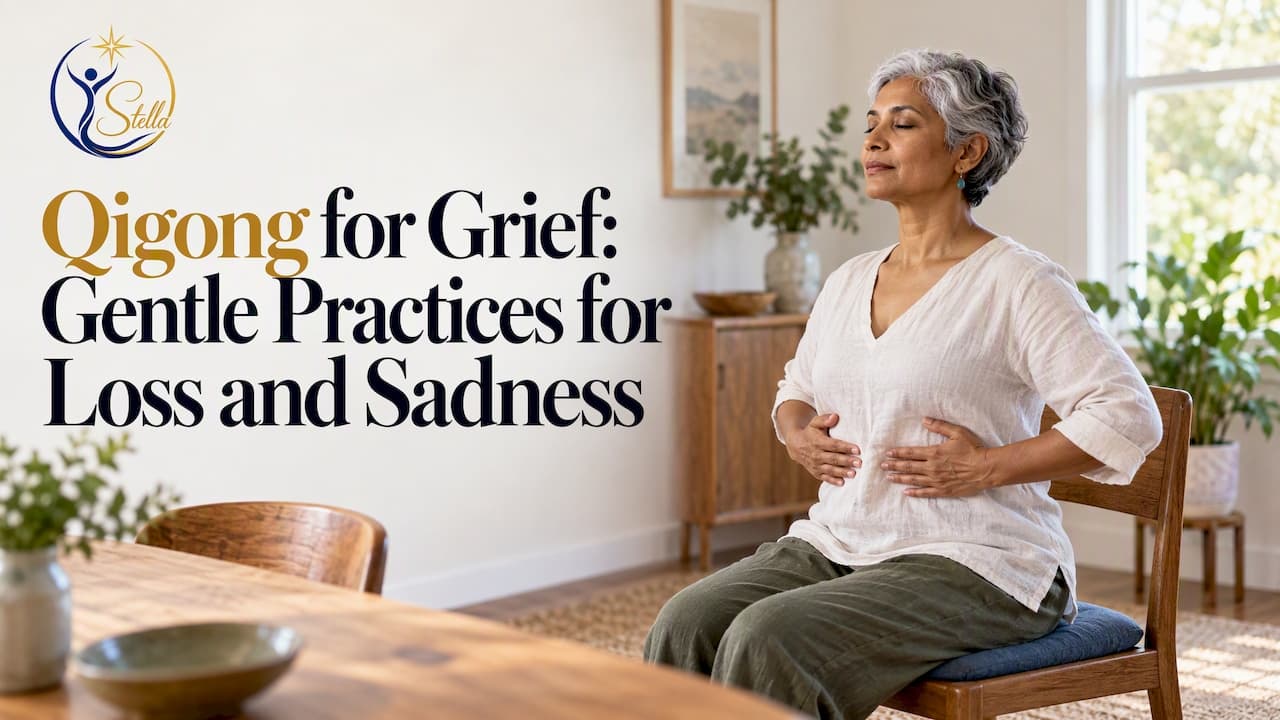
Qigong cannot take grief away, and a good practice will not try to. What it can do is give you something steady to lean on while grief moves through you: slow movement, softer breathing and a few quiet minutes in a body that may feel heavy, tight or exhausted. This guide explains how qigong is used for grief, what the White Tiger Qigong tradition says about grief and the lungs, what research does and does not show, and how to begin gently.
Key takeaways
- Qigong is complementary self-care for grief. It supports steadiness and rest, and it is not a replacement for bereavement support or medical care.
- In White Tiger Qigong theory, grief and sadness are linked with the lungs and the Metal element. This is a traditional framework, not an anatomical claim.
- The best-known grief-related trial used a structured, supported routine over five weeks, which suggests that consistency matters more than intensity.
- Keep practices short, stop or soften if you feel dizzy, breathless or overwhelmed, and speak to your GP if low mood lasts more than two weeks.
Table of Contents
- What grief does to the body
- The White Tiger view: grief, the lungs and the Metal element
- What the research says about qigong and bereavement
- A simple lung-opening practice for sad days
- Building a routine that fits real life
- Headaches, sadness and the body
- When qigong is not enough
- Our perspective at Stella QigongStar
- Practising with guidance
- Frequently asked questions
- Sources
What grief does to the body
Grief is not only an emotion. Many people notice a tight chest, a lump in the throat, shallow breathing, poor sleep, aching shoulders and a bone-deep tiredness that rest does not fix. The NHS describes grief as a natural response to losing someone or something important, and it can arrive in waves rather than in a straight line.
That is worth saying plainly, because many of us have absorbed the idea that grief moves through tidy stages. The familiar five-stage model (denial, anger, bargaining, depression, acceptance) is something some people recognise in themselves. It is not a checklist, and it is certainly not a seven-stage pathway you can fall behind on. The NHS says you may not experience all of the commonly described feelings, may feel them in no particular order, and may move between them unpredictably.
So if you cry in a practice, feel numb in it, or feel angry halfway through, nothing has gone wrong. Qigong is useful here precisely because it asks very little of you. You do not have to talk, explain or perform. You stand, breathe and move slowly, and whatever arises is allowed.
The White Tiger view: grief, the lungs and the Metal element
You asked about the traditional theory, and it is a beautiful one. In the White Tiger Qigong tradition, which draws on Chinese medicine's five-element model, the White Tiger belongs to autumn and to the Metal element. Metal is associated with the lungs and the large intestine, and with the emotions of grief and sadness.
The logic is easy to feel in your own body. The lungs are the organs of taking in and letting go. Every breath is an exchange: you receive fresh air and release what is spent. Autumn mirrors this. Leaves fall, the year contracts, and the natural world teaches release without drama. Grief, in this view, is the emotion of that same movement: it is about letting go of what has gone, and sometimes about finding it hard to let go.
When grief is held without being allowed to move, the tradition says the lungs' energy can become constricted. In practice that might look like a closed, collapsed chest, shallow breath, a quiet voice, frequent colds, or a feeling of being unable to take a full breath in. When Metal is balanced, the same tradition associates it with clear boundaries, a sense of worth, and the ability to release what no longer serves.
A few honest points about how to hold this theory:
- It is a traditional Chinese medicine framework. It is not a claim that your lungs literally store grief, and no responsible teacher should promise to remove grief from an organ.
- It works well as a map for practice. It points you towards the chest, the breath and the shoulders, which are exactly where many grieving people feel it.
- The large intestine link is why some people notice their digestion shifts during bereavement. We see this theme often in our work with gut health, though it is a traditional association rather than a proven mechanism.
The White Tiger itself is a symbol of courage and gentle strength. In qigong it is not about force. It is about meeting something large with a steady, grounded, open body.
What the research says about qigong and bereavement
It helps to be clear-eyed. The evidence on qigong for grief specifically is limited, and anyone who promises a cure is overstating it.

The study most often cited is a 2015 randomised waiting-list trial of bereaved people with chronic-fatigue-syndrome-like illness. The qigong group attended 10 group sessions over five weeks, alongside home practice. At three months, they showed greater reductions in mental fatigue (a change of −8 versus −4 in the comparison group) and physical fatigue (−10 versus −5), and greater improvements in spirituality and psychological quality of life than the control group.
Three things matter when you read that result:
- It is condition-specific. The participants were bereaved and had fatigue-like illness. It does not show that qigong treats grief for everyone.
- The programme was structured. The sessions were two hours long, twice weekly, with 15 to 30 minutes of home practice at least three times a week. A supported routine seems to have mattered more than any single dramatic exercise.
- The framing was regulation, not erasure. The authors describe qigong as a way of regulating body, mind and breath. It creates steadiness and body awareness while you stay free to feel what you feel.
That last point is how we teach it too. If you are also dealing with deep tiredness, our guide to qigong for chronic fatigue sets out a gradual plan, and our article on qigong for depression covers how to approach low mood sensibly.
A simple lung-opening practice for sad days
This is a short, grief-sensitive sequence in the spirit of the Metal element. It takes about five minutes. You can do it standing or seated, and it asks nothing dramatic of you.
Before you begin
Find a quiet corner and have a glass of water nearby. Wear something loose. Decide beforehand that you may stop at any point. That permission is part of the practice.
The sequence
- Settle your feet. Stand with feet hip-width apart and knees soft, or sit with both feet on the floor. Let your shoulders drop away from your ears. Take three ordinary breaths without trying to change anything.
- Rest your hands. Place one hand on your lower belly and one on your upper chest. Notice which rises more. There is no right answer, only information.
- Open the chest slowly. As you breathe in through the nose, let your arms float outwards and up, palms facing forward, as if you are gently opening a pair of heavy doors. Do not pull your shoulders back hard. Let the chest widen by itself.
- Release on the exhale. Breathe out softly through the mouth or nose, and let your hands float down in front of you, palms facing the earth. Imagine the out-breath as the quiet falling of autumn leaves rather than a push.
- Repeat six to nine times. Keep the movement slower than feels natural. If your breath catches or you cry, pause, keep your hands where they are and breathe at whatever pace your body offers.
- Close with stillness. Bring both hands to your lower belly. Stand or sit for a minute. Notice your feet, the weight of your body, the sounds in the room.
When to stop or soften
Stop or make the movement smaller if you feel dizzy, short of breath, or overwhelmed rather than simply sad. Breathe normally, put the kettle on, and speak to someone you trust. If you have a heart or lung condition, or a history of panic attacks, check with your GP before changing how you breathe. Never force a deep breath. Grief often makes a full breath feel impossible, and that is exactly when to shorten the movement, not push through it.
Building a routine that fits real life
The trial's lesson is that small and repeatable beats big and occasional. A realistic plan for the first few weeks might look like this:
| When | What | How long |
|---|---|---|
| Morning | Feet settled, hands on belly and chest, six slow breaths | 2 minutes |
| Midday or after a hard moment | Lung-opening sequence above | 5 minutes |
| Evening | Gentle shoulder rolls and a minute of stillness before bed | 5 to 10 minutes |
Three to five minutes a day, most days, is a perfectly respectable start. As it begins to feel familiar, you can grow towards the 15 to 30 minutes of home practice used in the research. If you have never practised anything like this, our beginner's guide to starting a mind-body practice walks through the first steps.
Timing it around the hardest weeks
Many people find that the hardest stretch is not the funeral. The arrangements, paperwork and visitors give the first days a structure, and then it all goes quiet. NHS information on bereavement after sudden death notes that how people grieve is shaped by many factors, including the relationship and the way the person died. Anniversaries and unexpected reminders can also bring it back.
That quieter period is a good moment to build a small ritual. Pair the practice with water, something to eat, and some rest afterwards, and if you can, have someone you trust available to talk to or simply sit with.
Headaches, sadness and the body
People often search for qigong for headaches or migraines alongside grief, and it makes sense: tension in the neck, jaw and shoulders is common when we are sad and sleeping badly. Slow shoulder and neck release can ease that physical tension for many people, and it is a gentle part of the evening routine above.
But be careful with the difference between tension and a medical problem. Headaches or migraines that are new, severe, frequent, or different from your usual pattern need a GP's assessment, and sudden severe headache needs urgent medical help. Qigong is something you do alongside medical care, not in place of it.
For sadness that is not tied to a recent loss, the approach is similar: small practices, regular timing, and a clear line about when to ask for help, which the next section covers.
When qigong is not enough
Grief is not an illness, but it can become too heavy to carry alone. The NHS advises seeing your GP if low mood lasts more than two weeks, if anxiety is increasing, or if self-help is not helping. You can also consider self-referring to NHS talking therapies as an adult. If you feel unable to keep yourself safe, seek urgent help straight away through 999 or NHS 111.
If grief stays intense and disabling, it deserves professional assessment. Cruse Bereavement Support describes prolonged grief as intense, long-lasting symptoms, together with ongoing difficulty coping, continuing beyond six months after a death. A 2025 UK evidence review notes that prolonged grief disorder is recognised in ICD-11 and DSM-5-TR, with different timing criteria: at least six months after the death in ICD-11, and at least 12 months for an adult death in DSM-5-TR. These are not deadlines for grieving. They are the points at which professional support is particularly worth seeking.
For free, confidential support, Cruse's helpline is run by trained volunteers on 0808 808 1677, and the charity has local services across England, Wales and Northern Ireland.

Supporting someone else, and yourself
If you are the person others turn to, remember that you need care too. Reading about supporting mental health when it matters can help you think about how to be present for a grieving friend or relative without running yourself empty. Then give yourself the same permission to rest, eat properly and practise gently.
Our perspective at Stella QigongStar
We do not teach qigong as a way to get over grief. We teach it as a way to stay in your body while grief is present. After a loss, the mind can race and the body can feel like a stranger. Slow movement and relaxed breathing give you a small, reliable place to come back to, however the day is going.
Our instruction comes from a White Tiger Qigong Level 3 certified teacher who is also accredited by Yoga Alliance. That training is why we are comfortable with the lung and Metal theory as a living tradition, and equally why we are careful with it. We use the idea of the lungs holding grief as an image that guides gentle chest-opening practice, never as a promise to cure or a reason to push the breath.
In our work with stress, burnout and digestive discomfort, we see again and again how emotion and body are not separate. Grief that sits in the chest can show up in the gut, and tension that never gets released can become exhaustion. Our approach is always the same: smaller, slower, more regular. Let the practice be easy enough that you will actually return to it tomorrow. If you want a wider look at where qigong sits among other approaches, our comparison of mind-body healing modalities is a good place to start, and our guide to building stress resilience with qigong shows how to make it part of a working week.
— Stella
Practising with guidance
If you would rather not work it out alone, we offer online and in-person support. Our online qigong classes and sessions include the self-paced Qigong for Stress Relief and Digestive Wellness course at £116, a 30-Min Clarity Session at £85, a 60-Min Deep Dive Online Session at £145, and a 60-Min Face-to-Face Qigong session at £165. We also run group classes. A one-to-one session is a good fit if you want the practice adapted to a tender chest, tired body or a very full week, and you can ask to keep it as quiet and undemanding as you need. You can also explore White Tiger Qigong to see where this lung and Metal theory comes from.
Frequently asked questions
What organ holds onto grief?
In traditional Chinese medicine and White Tiger Qigong, grief is associated with the lungs, and with the Metal element they belong to. This is a symbolic and experiential framework rather than an anatomical fact. It is a helpful reason to practise gentle chest-opening and relaxed breathing, but it does not mean grief can be removed from an organ.
How long does grief exhaustion last?
There is no fixed answer. The NHS and Marie Curie describe tiredness and exhaustion as common in grief, and grief has no timetable. It generally eases gradually, though waves can return, especially around anniversaries. See your GP if low mood lasts more than two weeks or if you are not coping.
Can qigong help with sadness after a bereavement?
It may help you feel steadier, more rested and more connected to your body. One randomised trial of bereaved people with fatigue-like illness found reductions in fatigue and improvements in psychological quality of life after a five-week programme. That is promising but specific, so treat qigong as a support alongside, not instead of, bereavement services or medical care.
Is it normal to cry or feel worse during practice?
Yes. Tears, anger, numbness or a difficult session do not mean you are doing it wrong. Make the movement smaller, slow your breathing and stop if you feel dizzy, breathless or overwhelmed. If practising regularly leaves you more distressed, talk to your GP or a bereavement service.
Sources
- From Body to Mind and Spirit: Qigong Exercise for Bereaved Persons with Chronic Fatigue Syndrome-Like Illness (PMC)
- Get help with grief after bereavement or loss (NHS)
- Help is at hand: bereavement after sudden traumatic death (NHS information)
- Complicated and prolonged grief (Cruse Bereavement Support)
- Helpline (Cruse Bereavement Support)
- Grief, bereavement and prolonged grief disorder: scoping and mapping the evidence