
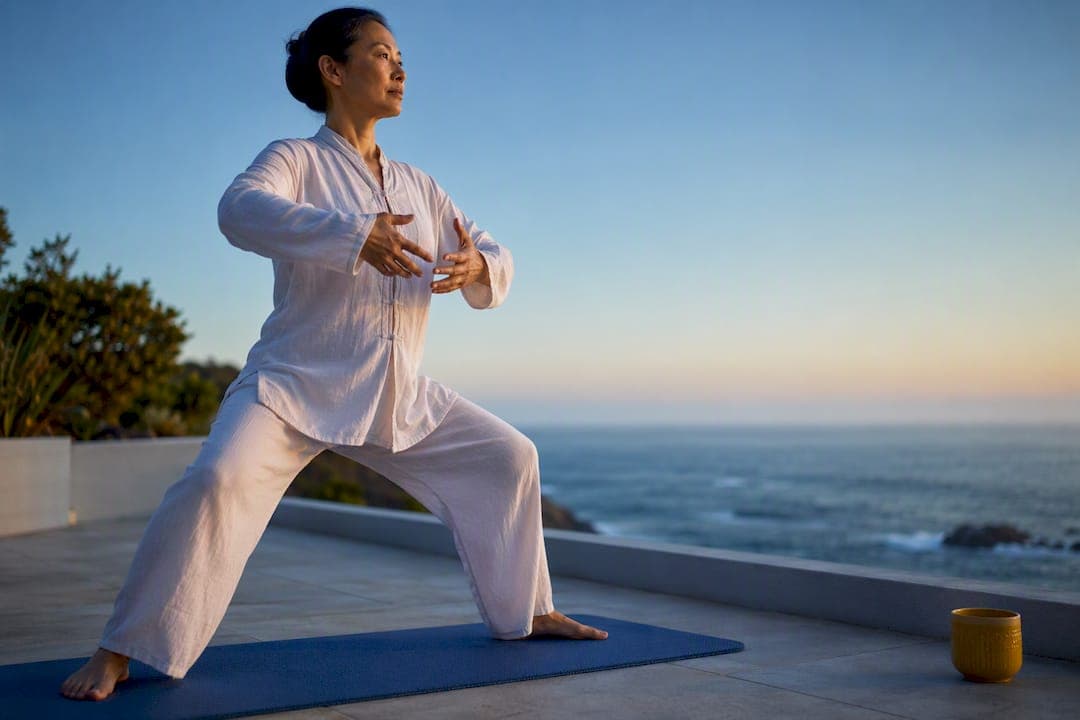
Yes. Consistent qigong practice cultivates presence and can support real spiritual growth through breath, slow movement, and focused awareness. Both active and passive forms count. If you want to feel this for yourself before reading another word, skip to the 15 minute routine below and try it once today.
TL;DR:
- Consistent daily practice of a short, 15-minute qigong routine is more effective for calming the nervous system than longer weekly sessions.
- Both active movement and passive stillness styles of qigong increase parasympathetic activation, supporting internal awareness and spiritual growth.
- Progress occurs in stages: body awareness within weeks, energy awareness after a few months, and a sense of connection or unity after six months or more.
- Proper posture, slow breath, and focused internal attention are crucial for beginners to avoid common errors and deepen their practice.
- Qigong can be practiced safely across faiths and health conditions, especially when working with certified instructors to adapt movements and ensure safety.
Table of Contents
- What Is Spiritual Qigong?
- How Does Qigong Support Spiritual Growth?
- What Are the Stages of Spiritual Growth Through Qigong?
- A 15-Minute Qigong Routine for Presence and Inner Peace
- How Often Should You Practice for Real Change?
- Does Qigong Conflict With Christianity or Other Faiths?
- Notes From a Certified Instructor on Common Sticking Points
- A Teacher's Reflection on Practicing With Patience
- Ready to Practice With Guided Support?
- Sources
- FAQ
What Is Spiritual Qigong?
Qigong translates roughly as "energy work." The name comes from two words, qi (vital energy) and gong (skill cultivated through steady practice). When people talk about qigong for spiritual growth specifically, they mean something narrower than the exercise-class version you might picture: a practice aimed less at flexibility or cardio and more at presence, inner clarity, and a felt sense of connection to something larger than the daily grind.
That distinction matters because qigong actually splits into two working modes, and most beginners only ever encounter one.
Active qigong (dong gong) uses slow, deliberate movement paired with breath. Think gentle arm sweeps that mimic gathering energy toward the body, or a slow twisting motion that opens the chest and spine one vertebra at a time. The movement gives your mind something to track, which is part of why it works so well for people who find silent sitting agonizing.
Passive qigong (jing gong) drops the movement and keeps the stillness. You sit or stand quietly, scanning the body from the inside, following the breath as it moves through the belly and ribs. According to Healthline's overview of qigong meditation, both active and passive styles nudge the body toward a parasympathetic "rest and digest" state, which is the physiological doorway to the clarity most people are actually chasing when they say they want to feel "spiritual."
A few practical distinctions worth knowing before you pick a starting point:
- Active practices suit restless minds and people newer to meditation, since the movement anchors attention.
- Passive practices suit people who already have some sitting-meditation experience and want to go deeper into internal sensation.
- Most spiritual qigong routines, including the White Tiger Qigong lineage taught at Qigongstar, blend both within a single session, moving from active warmth into passive stillness.
- Neither style requires flexibility, athleticism, or any particular body type. Slow is the entire point.
Historically, qigong's spiritual dimension draws from both Taoist and Buddhist streams of Chinese thought. Taoist lineages emphasize harmonizing with natural cycles and cultivating longevity through balanced energy. Buddhist-influenced branches lean more toward stillness, compassion, and non-attachment. Modern spiritual qigong, the kind taught in wellness settings today, tends to borrow from both without requiring you to adopt either belief system. It's a practice, not a religion, which is part of why it travels so well across cultures and faiths.
How Does Qigong Support Spiritual Growth?
The mechanism is less mystical than it sounds and more physiological than most people expect. Slow, coordinated breath and movement shift your nervous system out of sympathetic "fight or flight" mode and into parasympathetic "rest and digest" mode. That single shift is the engine behind almost everything qigong practitioners describe as spiritual opening.
The National Center for Complementary and Integrative Health describes qigong as a mind-body practice with real potential health benefits, while noting that researchers still want larger, more rigorous trials to confirm the full extent of those effects. That caveat matters. Qigong is not a shortcut to enlightenment, and no honest teacher will tell you otherwise. What the current evidence does support is more modest and, frankly, more useful: a repeatable way to calm an overactive nervous system, which in turn opens the door to the kind of quiet clarity people label "spiritual."
Here's the part most articles on this topic skip: the specific mechanism is interoception, your brain's ongoing sense of what's happening inside your own body. Most of us walk around with interoception dialed down to almost nothing. We register hunger, pain, and maybe a racing heart, but the subtler signals, the tightness behind the sternum before a hard conversation, the slight drop in the shoulders when a room finally feels safe, go unnoticed. Slow qigong movement forces you to track exactly those signals. You cannot rush a movement that takes four counts to complete without noticing what your ribs, spine, and breath are doing along the way. That sustained, gentle attention to internal sensation is the raw material of what practitioners call "energy awareness," and it's trainable in the same way a muscle is trainable.
Slow down the movement enough, and the mind has nowhere left to hide. Attention that used to scatter across a dozen worries settles instead on the breath, the spine, the space between one motion and the next. That settling, repeated often enough, is what practitioners mean when they talk about presence.
A Harvard Health review of tai chi, a close cousin of qigong built on the same slow-movement principles, found consistent support for improved balance, reduced stress, and general well-being, alongside a candid admission that some outcomes still lack large randomized trials. Broader reviews indexed on PubMed point the same direction: qigong and related mind-body practices show measurable reductions in stress and anxiety, with researchers consistently calling for bigger studies to nail down exact effect sizes.
Small-to-moderate improvements in stress and quality of life show up repeatedly across systematic reviews of qigong and tai chi, which is a modest but real signal. It also lines up with what shows up in the body itself: research on autonomic regulation and mind-body practice suggests these practices improve how well your nervous system self-regulates, a plausible physical basis for the emotional steadiness so many long-term practitioners describe.
None of this requires you to believe in energy meridians or chi as a literal substance. The breath slows, the nervous system downshifts, and attention that used to scatter starts to settle. Whether you frame that experience in Taoist language, Buddhist language, or plain physiological language is entirely up to you.
What Are the Stages of Spiritual Growth Through Qigong?
Teachers who work with beginners over months, not single sessions, tend to describe progress in three rough stages rather than a straight line. Nobody moves through them on a fixed schedule, and it's normal to slide backward on a stressful week. Still, having a map keeps you from mistaking a plateau for failure.
Stage one: body awareness. This is where every practitioner starts, usually for the first four to eight weeks of regular practice. You're learning to notice tension you didn't know you were holding, to feel the difference between a shallow chest breath and a full diaphragmatic one, to sense where your weight actually sits when you stand. Practical signs you're here: you catch yourself clenching your jaw during the day, or you notice your shoulders creeping up toward your ears before you consciously decide to relax them.
Stage two: energy awareness. Somewhere around two to four months of consistent practice, most people start noticing sensations that go beyond ordinary muscular awareness, warmth pooling in the palms during a hold, a tingling that spreads up the forearms, a sense of pressure or fullness in the lower belly during breath work. Teacher accounts describing this progression note that this stage often arrives once body awareness has stopped requiring conscious effort, freeing up attention for subtler signals.
Stage three: unity or connection. This is the stage people mean when they use the word "spiritual" without qualification. It typically shows up after six months or more of regular practice, though some report glimpses far earlier. The hallmark isn't a dramatic vision. It's usually something quieter: a diminished sense of separation between the practice and ordinary life, a felt sense of being part of something continuous rather than a separate, anxious little island. Practitioners often describe carrying the calm of the session into a difficult meeting or a hard conversation without trying to.
A few honest markers to watch for as you move between stages:
- Moving from stage one to two often coincides with sessions feeling shorter than the clock says, a sign attention has stopped fighting the practice.
- Moving from two to three often shows up first as patience, not bliss. Irritation that used to hijack your whole afternoon starts passing faster.
- Regression is normal during high-stress periods and doesn't erase earlier progress. It just means the nervous system has other priorities that week.
- None of these stages require a teacher's confirmation. You'll know, because the change shows up in ordinary moments, not just on the mat.
A 15-Minute Qigong Routine for Presence and Inner Peace
This sequence blends active and passive elements deliberately, because that blend is what most reliably produces the settling described above. Do it standing if you can. Sitting and modified versions follow.
- Centering breath (3 minutes). Stand with feet hip-width apart, knees soft, arms hanging loose. Close your eyes or soften your gaze downward. Breathe into your belly for a slow count of four, hold for one, release for a count of six. Let each exhale drop your shoulders a little further. This step alone is doing real physiological work, easing you toward the parasympathetic state that makes the rest of the practice possible.
- Opening the heart (4 minutes). Inhale as you sweep both arms out and up from your sides, palms turning to face the sky at shoulder height. Exhale as you draw the palms slowly toward your chest, elbows soft. Repeat this open-and-gather motion in rhythm with your breath, roughly one full cycle every six seconds. Let your chest feel like it's expanding outward on the inhale, not just your arms lifting.
- Connecting heaven and earth (4 minutes). Shift weight slightly into your heels. On the inhale, raise both arms overhead as though reaching toward the sky, palms facing up. On the exhale, bend the knees slightly and let the palms sink toward the ground, as though pressing warmth downward through the earth. This step is where most people first notice the tingling or warmth associated with energy awareness, so don't rush it.
- Gathering and closing (4 minutes). Bring both palms to rest just below the navel, one hand over the other. Breathe quietly here, no more directed movement, just noticing whatever sensation is present. Let your attention rest on the space between your hands and your belly until the timer runs out. Finish with three slow breaths and a gentle bow of the head.
Sitting variation: Do all four steps seated in a supportive chair, feet flat on the floor. Replace the overhead reach in step three with arms raised only to shoulder height, since a full overhead stretch is harder to control from a seated position.
Limited-mobility modification: Every step can be done with the arms moving through a fraction of their normal range. The breath timing matters far more than the size of the movement. A two-inch arm lift paired with full attention beats a wide sweep done on autopilot.
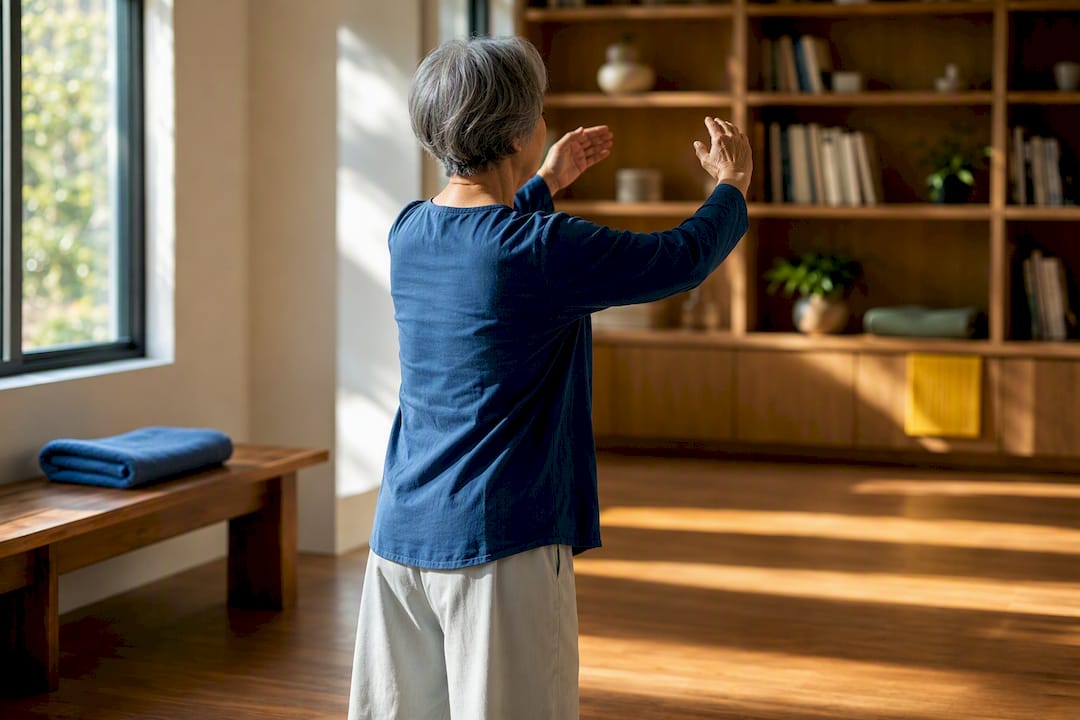
Common errors to avoid: rushing the transitions between steps, holding the breath instead of extending it, and treating the routine as a stretching warm-up rather than the main event. There's no cardio goal here. Slower is almost always more effective.
Pro Tip: If your mind keeps sprinting ahead to your to-do list, don't fight it. Silently name what you notice, "warmth in the palms," "tightness in the jaw," and return to the breath. Naming the sensation out loud in your head does more to anchor attention than gritting your teeth and trying to force stillness.
For a longer daily option once this feels comfortable, a full daily qigong routine for stress reduction extends this same structure to a full session.
How Often Should You Practice for Real Change?
Fifteen minutes a day beats sixty minutes once a week, almost without exception. The nervous system responds to repetition and consistency far more than to intensity, which is good news if your schedule is already full.
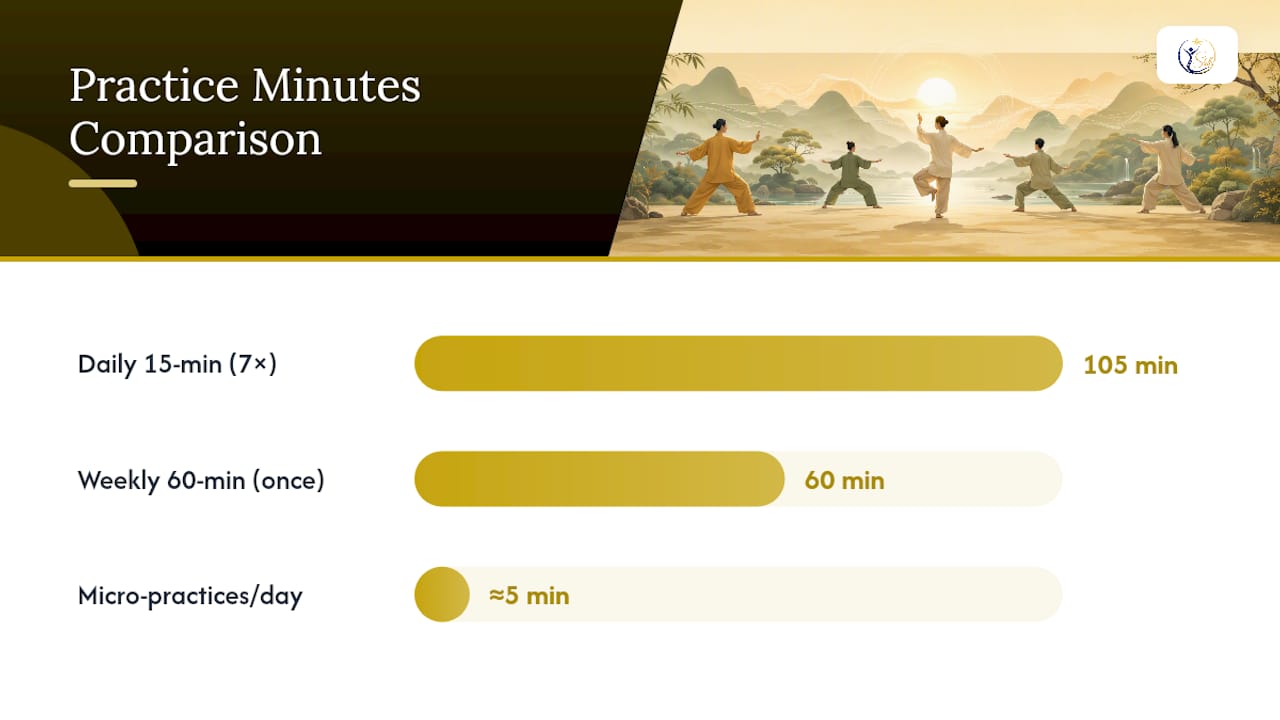
A workable target for most beginners: a short daily session, ideally the same time each day, plus one longer class or workshop weekly if you have access to one. The daily short session keeps the nervous system in the habit of downshifting. The weekly longer session, whether a live class or a guided video, deepens whatever the daily practice has already started to loosen.
Between full sessions, a handful of micro-practices keep the thread going without asking for extra calendar time:
- A 60 to 90 second centering breath before opening your laptop in the morning, hands resting on the belly, three slow exhales longer than the inhales.
- A one to two minute standing pause before a stressful meeting, weight settling into the feet, shoulders dropping on each exhale.
- A two to three minute wind-down before sleep, palms over the belly, no goal beyond noticing the breath slow down on its own.
If workplace stress is a big part of why you started, a short piece on qigong for professionals covers how to fold these micro-practices into a packed workday.
Track progress by feel rather than by metric. Calmer mornings, a shorter fuse for irritation that resolves faster, decisions that feel less frantic, these are the honest markers of change. Resist the urge to judge a session as a failure because you didn't feel warmth in your palms or a wave of peace. Some days the body simply needs the rest more than the sensation, and that's still progress.
Does Qigong Conflict With Christianity or Other Faiths?
No, not inherently. Qigong itself is a practice of breath, movement, and attention, not a theology. It makes no doctrinal claims and asks for no particular belief about the nature of the universe. Many practitioners fold it into an existing Christian, Jewish, Muslim, Buddhist, or entirely secular framework without friction, because the practice describes how attention and the body work rather than what ultimately exists.
That said, some Christian communities express caution around the language of "energy" or "chi," worried it implies a competing spiritual system. If that concern resonates with you, it's worth knowing you can practice the physical and breath components entirely on their own terms, calling the calming effect "God's peace" or simply "the parasympathetic response" rather than adopting Taoist vocabulary you're not comfortable with. The movement doesn't require the language.
A few safety notes matter more than the theological ones:
- People with serious cardiovascular conditions, recent surgery, or significant balance issues should check with a doctor before starting, a precaution NCCIH explicitly recommends for anyone with a serious medical condition.
- Pregnant practitioners should stick to gentle, seated variations and skip any deep knee bends without a clinician's sign-off.
- Dizziness during breath holds is a signal to shorten the hold, not push through it.
- Instructor certification, such as training through the White Tiger Qigong School and accreditation by Yoga Alliance, signals a teacher has met defined training standards rather than picked up movements from a video. That matters more than it sounds, especially for anyone adapting practice around a health condition.
Notes From a Certified Instructor on Common Sticking Points
Stella teaches White Tiger Qigong as a Level 3 certified instructor, trained through the White Tiger Qigong School and additionally accredited by Yoga Alliance. Certification at this level means years of supervised practice and instruction, not a weekend workshop, and it's the reason a teacher can catch subtle postural errors a video tutorial never will.
The same handful of sticking points show up in nearly every beginner, regardless of age or fitness level.
Posture collapsing during passive stillness. Sitting cross-legged can feel calming, but a slumped spine cuts off the breath before it ever reaches the belly. A stable, feet-planted stance often works better for active, energizing practice, while a supported seated posture with a straight spine suits passive stillness work.
Breath racing ahead of the movement. Beginners tend to breathe at their normal daily pace and try to force slow movement on top of it. The fix is almost always the reverse: slow the breath first, then let the movement follow the breath's pace rather than the other way around.
Mental wandering during passive segments. This isn't failure, it's completely normal. The fix isn't willpower. It's returning attention to one fixed physical anchor, usually the sensation of breath at the navel, every time you notice drift.
A simple four-week arc gives beginners enough structure without overwhelming a new habit:
- Week one: Daily 10 minute active-only sessions. Focus entirely on syncing breath to movement, no attempt yet to notice subtle energy.
- Week two: Extend to 15 minutes, adding two minutes of passive stillness at the end of each active session.
- Week three: Shift toward the full 15 minute routine above, now noticing warmth, tingling, or pressure without chasing it.
- Week four: Add one micro-practice during the workday, and one guided class or longer session if possible, to deepen what the daily practice has built.
Pro Tip: If you only remember one adjustment from four weeks of instruction, make it this: exhale longer than you inhale. A four count in, six count out, does more to settle a racing mind than any posture correction ever will.
A Teacher's Reflection on Practicing With Patience
The deepest shift in years of teaching this work isn't the dramatic session where someone feels a rush of energy. It's the quieter, cumulative change: a student who used to snap at their kids after a hard day starts pausing instead, just for a breath, before responding. Nobody puts that on a highlight reel, but it's the actual substance of spiritual growth through embodied practice.
Presence built through the body tends to be sturdier than presence built through insight alone. You can understand a concept intellectually in an afternoon. Learning to feel your own breath slow down under stress takes months of repetition, and that's exactly why it sticks.
If you try the routine above, don't grade the session. Just notice one thing that felt different afterward, such as a looser jaw, a quieter mind, or a longer pause before reacting to something small. Track that gently over time. Curiosity outperforms performance every time in this kind of work. Nobody ever deepened their practice by trying harder. They deepened it by paying closer attention.
— Stella
Ready to Practice With Guided Support?
Qigongstar exists for exactly the moment you've reached after reading this far: you understand the mechanism, you've tried the 15 minute routine, and now you want someone who can catch the small posture and breath errors that self-teaching from an article simply can't fix. That's the real gap between reading about presence and building it, and a certified instructor closes it faster than trial and error ever will.
Qigongstar offers a few honest entry points depending on where you are. If you want structured, guided instruction without a live class schedule, Qigong for Stress Relief and Digestive Wellness runs 116 GBP as a one time purchase. If you want direct feedback on your own posture and breath pacing, a 30 Minute Clarity Session at 85 GBP or a 60 Minute Deep Dive Online Session at 145 GBP gives you one-on-one time with a Level 3 certified White Tiger Qigong instructor. Prefer to work in person? A 60 Minute Face-to-Face Qigong session runs 165 GBP. Group Qigong Classes are also available, with pricing available on request.
Working with a certified instructor means the subtle corrections, a shoulder that's crept up, a breath that's racing ahead of the movement, get caught in real time instead of practiced into a habit. Browse the full online course catalog to find the right starting point, or head straight to the online classes page to book your first session.
Sources
The claims in this article lean on a small set of sources worth reading directly if you want the fuller research picture.
NCCIH's overview of qigong gives the clearest plain-language summary of current evidence and safety guidance available from a government health source. Healthline's guide to qigong meditation breaks down active versus passive technique in practical, beginner-friendly terms. Harvard Health's review of tai chi offers evidence context from a closely related practice. For readers curious about chakra-style energy language and how it compares across traditions, Phone Psychic Readers' guide to chakra imbalance covers the vocabulary some traditions use for similar subtle sensations.
This article is general information, not a substitute for advice from a qualified doctor. Consult a qualified healthcare professional about your own circumstances before acting on anything here.
- Qigong Meditation: For Beginners, Techniques, Benefits, and More — Healthline
- PubMed review (example listing) — Qigong/Tai Chi health benefits
- Qigong: What You Need To Know — NCCIH
- The health benefits of tai chi — Harvard Health
FAQ
What Are the Stages of Spiritual Growth in Qigong?
Most qigong teachers describe three practical stages rather than a fixed numbered list: body awareness, energy awareness, and a felt sense of unity or connection. Some broader spiritual frameworks describe seven stages, but qigong practice itself maps most cleanly onto these three, typically unfolding over weeks to several months of consistent practice.
Why Is Qigong So Effective for Calming the Mind?
Qigong pairs slow, breath-linked movement with focused internal attention, which shifts the nervous system toward a parasympathetic, rest-and-digest state. Reviews indexed on PubMed link this shift to measurable reductions in stress and anxiety, though researchers still call for larger trials to confirm the full range of effects.
How Can I Deepen My Spiritual Growth Through Qigong?
Consistency matters more than session length. A short daily practice, paired with one longer weekly class and a few one to two minute micro-practices during the day, builds the nervous system habit that spiritual growth actually depends on. Working with a certified instructor, such as through Qigongstar's guided sessions, also helps catch posture and breath errors that slow progress when practicing alone.
Does Qigong Conflict With Christianity?
No. Qigong is a practice of breath, movement, and attention rather than a religious doctrine, so it doesn't require adopting any particular belief system. Practitioners across many faiths, including Christianity, fold it into their existing beliefs by focusing on the physical and breath components rather than the traditional energy vocabulary.
Is Qigong Safe for Beginners With Health Conditions?
Generally yes, since qigong is a low-impact, gentle practice, but NCCIH recommends that people with serious medical conditions consult a doctor before starting. Working with a certified instructor also helps you adapt movements safely around any physical limitations you have.