
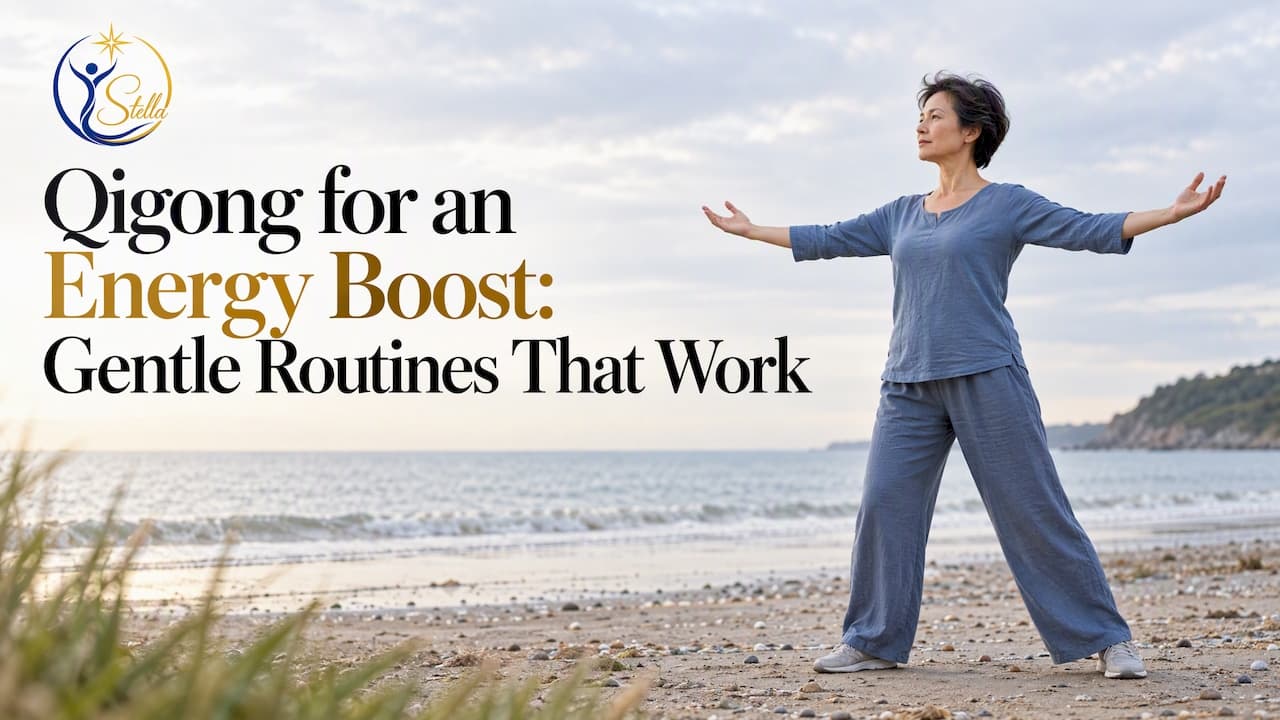
Qigong lifts your energy by calming your nervous system and releasing held tension, not by adding stimulation. Think of it as a slow recharge rather than a jolt of caffeine. Five to ten minutes of gentle, flowing movement and steady breathing, done most days, is enough to start. This guide shows you what the research says, how to practice, a simple routine to try this week, and when to talk to your GP first.
TL;DR
- Qigong builds energy by easing tension and settling the stress response, so you feel restored rather than wired.
- A 2021 meta-analysis of 16 randomized trials found significant reductions in fatigue. The evidence for anxiety and mood is more mixed.
- Short daily sessions of 5 to 10 minutes beat occasional long ones. Keep every movement pain-free, and make it smaller or seated if needed.
- Persistent exhaustion that rest does not fix needs a medical check, not just a new habit.
- If you want guidance, we offer online classes and sessions with a certified instructor, from £85.
Table of Contents
- Why qigong can leave you with more energy, not less
- What the research says about qigong and fatigue
- A 10-minute energizing routine you can do today
- How often and how long: little and often wins
- The rule that protects your energy: no pain, no pain
- Qigong is one piece of the energy puzzle
- Who should check first, and who should modify
- Our perspective: energy comes from release
- Learn with a certified instructor
- Common obstacles and how to soften them
- FAQ
- Sources
Why qigong can leave you with more energy, not less
Most of us reach for stimulation when we are flat: coffee, sugar, a hard workout. These work briefly, then the dip arrives. Qigong takes the opposite route. It combines slow movement, upright posture and unhurried breathing, so your body is invited out of the constant low-level alarm that quietly drains you.
NHS community health resources describe tai chi and qigong-style movement as gentle, flowing exercise that supports energy levels and comfortable range of motion. The effort is deliberately modest. You finish a session feeling steadier, not spent.
In traditional Chinese medicine, qigong is a practice for optimizing the flow of qi, or vital energy, through body, mind and spirit. The US National Center for Complementary and Integrative Health describes it as developed in China thousands of years ago, combining movement, breath and focused attention. You do not have to adopt that framework to benefit. Many of our students simply notice they carry their shoulders lower, breathe more fully and wake with less heaviness.

What "relaxed vitality" feels like
The aim is not to feel buzzing. It is a warm, grounded alertness: a clear head, loose shoulders, a belly that is not clenched. When tension has been held for months, releasing it frees up energy you were spending without noticing. That is why a few quiet minutes can feel surprisingly restorative.
What the research says about qigong and fatigue
Here is what we can say with confidence, and where we should be careful.
Fatigue. A 2021 systematic review and meta-analysis pooled 16 randomized controlled trials and reported significant improvement in overall fatigue intensity with qigong exercise. A later systematic review of qigong and tai chi for ME/CFS looked at randomized trials in people with chronic fatigue syndrome, a condition where fatigue can be disabling. Some of the programs studied ran for roughly 5 to 12 weeks.
Possible biological markers. One randomized trial in people with chronic fatigue measured telomerase activity alongside fatigue symptoms. It is an early and interesting finding, but one trial is not proof, and we would not promise anyone a cellular effect.
Stress, anxiety and mood. The picture here is more cautious. The NCCIH notes that although some studies suggest qigong and similar practices may reduce anxiety, more high-quality studies with larger numbers of people are needed before firm conclusions. A review of qigong in women found improvement in depressive symptoms in around 63% of the trials, while describing the overall evidence as limited.

So the honest summary is this. Qigong is a reasonable, low-risk, evidence-supported way to help with fatigue. It is not a cure for any medical condition, and it works best alongside good sleep, food and medical care.
A 10-minute energizing routine you can do today
This is a simple sequence to wake up your body without strain. Stand with feet hip-width apart, knees soft. If standing is tiring, sit on the front half of a chair. Move at about half the speed that feels natural.
- Settle (1 minute). Stand quietly. Let your shoulders drop. Breathe in through the nose for about four counts and out for about six. Feel your feet.
- Shake and loosen (1 minute). Let your knees bounce gently and your arms swing loosely, as if shaking off water. This clears stiffness without effort.
- Lifting the sky (2 minutes). Breathe in as your palms float up in front of you to chest height, then turn them to the sky as your arms rise overhead. Breathe out as your hands lower like a slow rain. Repeat 8 to 10 times.
- Opening the chest (2 minutes). Sweep your arms wide as if opening a curtain, inhaling. Draw them back in, exhaling. This eases the rounded shoulders of desk work and lets breath reach the lower ribs.
- Gentle waist turns (2 minutes). Turn your torso left and right, arms loose so the hands lightly tap the belly and lower back. This massages the abdomen and warms the spine.
- Gathering the qi (2 minutes). Circle your hands out and around, then bring them to rest over your lower belly. Breathe slowly, and notice any warmth or tingling in your palms.
When you finish, stay still for ten seconds before moving on. That pause is where the practice settles in.
For a longer, step-by-step version, our morning qigong routine to awaken energy and calm walks you through it. If you are brand new, the beginner 10-minute daily sequence is a friendly starting point.
How often and how long: little and often wins
The most common mistake is trying to do too much. Guidance from NHS tai chi and qigong resources, such as this Torbay and South Devon beginners' guide, centers on gentle, regular practice of a few simple movements rather than long, demanding sessions. Our own experience teaching beginners points the same way: ten calm minutes every day tends to do more than one heroic hour on Sunday.
A realistic pattern looks like this:
| Week | Time per day | Focus |
|---|---|---|
| 1 | 5 minutes | Breathing and settling, loosening movements |
| 2 to 3 | 8 to 10 minutes | Add lifting and opening movements |
| 4 to 6 | 10 to 15 minutes | Full routine, plus a short pause at the end |
| 7 to 12 | 10 to 20 minutes | Add one longer session a week if it feels good |
The 5 to 12 week range in the research is a useful guide to patience. Do not expect a transformation by Thursday. Expect small, real shifts: easier mornings, an afternoon slump that feels less steep, a body that holds less tension.
Tying it to a habit you already have
Habit is easier than willpower. Try one of these anchors:
- Right after the kettle goes on in the morning.
- Before you open your laptop.
- When you get home, before you change into evening mode.
- Five minutes before bed, using only the breathing and gathering steps.
Our guide to integrating qigong into your daily routine in minutes has more ideas for busy days.
The rule that protects your energy: no pain, no pain
In strenuous exercise, people say no pain, no gain. For energy-focused qigong we use the reverse. If a posture hurts a joint or feels uncomfortable, make it smaller, do it seated, or skip it. Pushing through discomfort triggers the stress response you are trying to calm, and that can drain you instead of restoring you. NHS community guidance on gentle movement makes the same point about working within comfort.
Perfectionism is the other trap. You do not need the "right" shape for the practice to help. A small, slightly wobbly session you actually do is far better than a perfect one you keep postponing. Keep your knees soft, your breath easy and your attention kind.
Qigong is one piece of the energy puzzle
If you are tired all the time, movement alone will not solve it. The NHS lists common causes of tiredness including poor sleep, stress, hormone changes such as the menopause, and some illnesses or medicines. It suggests keeping regular sleep times, aiming for 6 to 9 hours, and winding down a couple of hours before bed.
The NHS also advises eating regular meals and healthy snacks every 3 to 4 hours to keep energy steady, and notes that even a single 15-minute walk can give an energy boost. A morning qigong session pairs well with a short walk outdoors. If you want to think more about food and fatigue, this practical guide to what to eat when fatigue hits is written for runners but covers principles many people will find useful.
A balanced week for steady energy might include:
- A short qigong practice most days.
- A walk, even 15 minutes.
- Regular meals, with water through the day.
- A consistent bedtime and a calm wind-down.
- Honest rest, without guilt.
If your exhaustion is overwhelming and rest and sleep do not relieve it, see your GP. The NHS notes that this kind of fatigue may point to an underlying medical condition. Our qigong for chronic fatigue 8 to 12 week plan is designed as a gentle complement to medical care, not a replacement.
Who should check first, and who should modify
Qigong is generally considered safe and low intensity for healthy adults, including beginners, and the most common problems are minor muscle and joint aches. The NCCIH advises talking to a healthcare provider before starting if you:
- Are pregnant.
- Have epilepsy or a psychiatric condition.
- Have a history of trauma or abuse.
- Take medications that might interact, or have another medical condition.
In these cases, speak to your GP or the specialist who looks after you, and tell your instructor so movements can be adapted. Rare cases of physical or mental strain have been reported, usually linked to over-intense practice, over-focusing or unrealistic expectations, and the NCCIH recommends learning from a qualified instructor who emphasizes safety and moderation, especially with existing health conditions. Our guide to qigong contraindications explains who should modify or avoid specific movements.
Our perspective: energy comes from release
We meet many people who describe themselves as running on empty. Often they are not lazy or unfit. They are holding tension everywhere: jaw, shoulders, belly, breath. They spend energy just staying braced.
The approach we teach is built on that observation. Gentle movement, slow breath and a quiet mind let the body put the brace down. That is why we are wary of promises about "fast energy". Real vitality tends to arrive quietly, a little more each week, when you stop fighting your own system.
Our teaching comes from White Tiger Qigong and Five Animal Qigong, rooted in Chinese medicine, with a focus on stress and digestive wellness. Many of our students are busy professionals who feel depleted, anxious or burned out, and who often notice their gut reacts to stress too. We keep sessions short, beginner-friendly and adaptable, because the best routine is the one you will actually return to tomorrow.
If you take one thing from this page, let it be this: start smaller than you think you should, and let it be kind.
— Stella
Learn with a certified instructor
Books and videos are a fine start. But a teacher can watch your posture, adjust the pace to your energy and keep your practice safe, which matters most when you are tired or managing a health condition.
All our instruction is delivered by a White Tiger Qigong Level 3 certified instructor who is also accredited by Yoga Alliance. Here is what you can choose from on our online classes page:
- Qigong for Stress Relief and Digestive Wellness: a self-paced course, £116 one-off.
- 30-Min Clarity Session: a short online session, £85 one-off.
- 60-Min Deep Dive Online Session: a fuller one-to-one online session, £145 one-off.
- 60-Min Face-to-Face Qigong: in-person, £165 one-off.
- Group Qigong Classes: a supportive way to practice with others.
If you would like to read more first, explore our White Tiger Qigong and Five Animal Qigong pages, or browse the Qi Blog. Prefer to start with a daily rhythm? Our daily qigong routine for stress reduction is a good companion.
Common obstacles and how to soften them
"I have no time." Use the three-minute version: settle, lifting the sky five times, gathering the qi. It still counts.
"I feel too tired to move." Practice seated. Keep arms low and movements small. On very flat days, only the breathing is enough. If this is your usual state, see a doctor about the cause.
"I do not feel anything." That is normal early on. Awareness grows with repetition. Notice small things: warm hands, a longer exhale, a loosened jaw.
"My mind keeps racing." Let it. Return attention to your feet or your breath without scolding yourself. Our guide to relaxation techniques without therapy offers more ways to settle a busy mind.
"I feel more tired after practicing." You may be doing too much, too fast, or holding postures that strain you. Shorten the session, soften the movements and slow the pace. If it persists, speak with a healthcare professional or your instructor.
FAQ
Does qigong really boost energy?
Research is encouraging for fatigue. A meta-analysis of 16 randomized trials reported significant fatigue reductions with qigong exercise. Results vary between people, and qigong works best alongside good sleep, food and medical care.
How long before I notice a difference?
Some people feel calmer after a single session. For lasting changes in energy, studies of fatigue often run for about 5 to 12 weeks, so give yourself at least a month or two of regular practice. Daily short sessions are a better bet than occasional long ones.
Is qigong safe if I already feel exhausted?
For most healthy adults it is a gentle, low-intensity practice. If your exhaustion is severe or unexplained, see your GP first, and consult them before starting if you are pregnant, have epilepsy or a psychiatric condition, or a history of trauma, as NCCIH guidance advises. Practice within comfort, seated if necessary.
What is the difference between qigong and a normal workout for energy?
A vigorous workout stimulates the body and can leave an already depleted person more tired. Qigong uses slow movement and breath to ease tension and calm the stress response, so you conserve energy rather than burn through it. Many people use both: qigong on low days, stronger exercise when they feel resilient.
Can I learn qigong online?
Yes. Online learning suits beginners who want a flexible pace, and live sessions let an instructor check your form and adapt the movements to you. Our online qigong classes include self-paced and live options.
Sources
- Efficacy of Qigong Exercise for Treatment of Fatigue: A Systematic Review and Meta-Analysis (Frontiers in Medicine)
- Qigong and Tai Chi for ME/CFS: A Systematic Review of Randomized Controlled Trials
- A randomized controlled trial of qigong exercise on fatigue symptoms, functioning, and telomerase activity
- Mind-Body Health Benefits of Traditional Chinese Qigong on Women
- Qigong: What You Need To Know (NCCIH)
- Anxiety and Complementary Health Approaches (NCCIH)
- Tai chi lessons (Kent Community Health NHS Foundation Trust)
- Tai Chi for beginners (Torbay and South Devon NHS)
- Tiredness and fatigue (NHS)
- Self-help tips to fight tiredness (NHS)
- What to Eat for Running Fatigue: A Practical Guide