
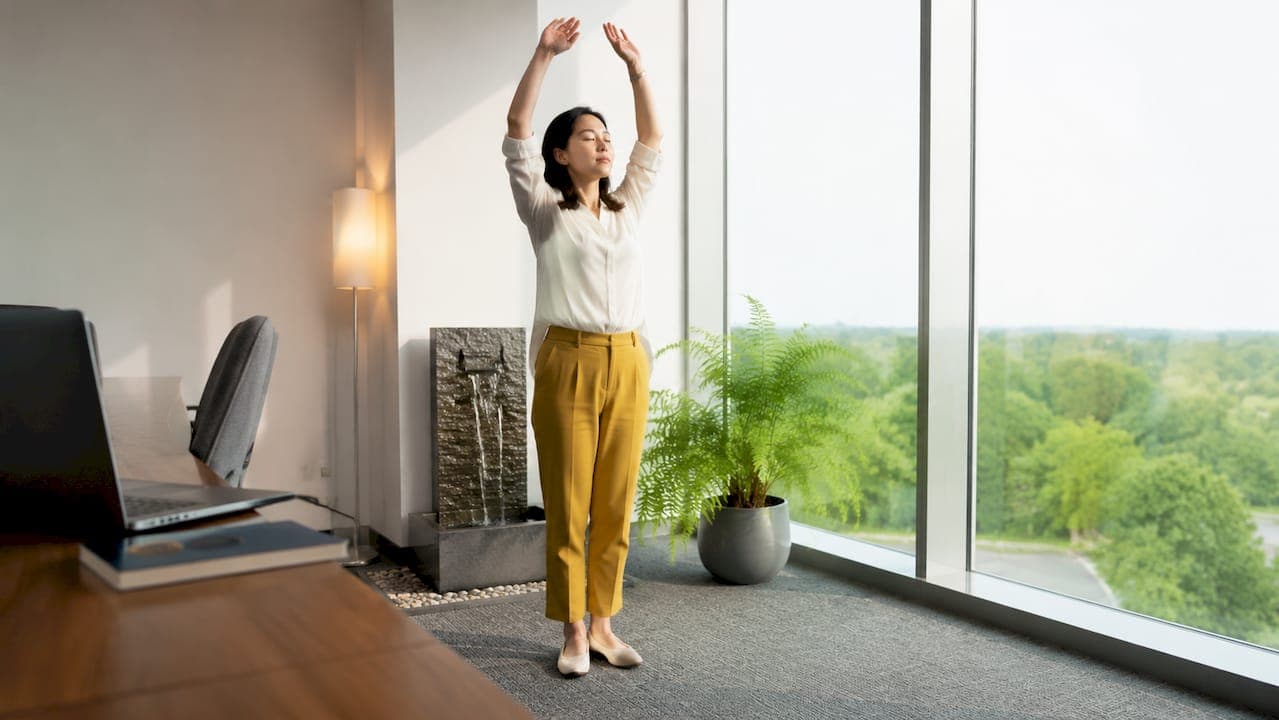
Qigong for professionals is a structured mind-body practice that combines coordinated movement, breath regulation, and postural alignment to shift your nervous system from chronic stress into a calm, focused state. Rooted in Traditional Chinese Medicine (TCM), qigong has moved well beyond its ancient origins. Clinical research now shows that 12 minutes of daily qigong breathwork and grounding movement produces a 42% reduction in anxiety scores after four weeks, outperforming mindfulness-only controls. For busy professionals carrying the weight of deadlines, back-to-back meetings, and chronic screen fatigue, that is not a small number. It means qigong belongs in your workday toolkit, not just on a weekend retreat.
What qigong for professionals actually does to your nervous system
Qigong is defined in TCM as the cultivation of qi (vital energy) through breath, movement, and intention. In physiological terms, it shifts autonomic tone from the sympathetic "fight-or-flight" state to the parasympathetic "rest-and-digest" state. That shift is the foundation of every benefit you feel: reduced muscle tension, clearer thinking, steadier mood.
Most professionals assume that deep breathing alone will do the job. It will not. Movement-based qigong engages the vagus nerve more effectively than breath or seated meditation alone because grounding postures activate mechanoreceptors in your feet, ankles, and joints. Those mechanoreceptors send calming signals to the brainstem before your breath even deepens. The sequence matters: movement first, then breath.

The downstream cognitive effects are real and measurable. Improved autonomic tone reduces cortisol reactivity, which directly supports sustained attention and better decision-making under pressure. When your nervous system is no longer bracing for threat, your prefrontal cortex can do its job. That is why qigong stress relief translates so directly into sharper focus at work, not just a vague sense of calm.
Here is what the physiological shift looks like in practice:
- Vagal activation: Grounding postures with micro-bent knees send calming neurophysiological signals before breath modulation begins
- HRV improvement: A 90-second breathing cue using a 4-second inhale, 2-second hold, and 6-second exhale lowers heart rate variability stress markers by 29%
- Cortisol regulation: Consistent short sessions reduce baseline stress hormone levels over days, not just in the moment
- Attention restoration: Parasympathetic activation restores the focused attention networks that chronic stress depletes
Pro Tip: Start every qigong session by standing with your feet shoulder-width apart and your knees softly bent. Hold that position for 30 seconds before adding any breath work. This grounds your nervous system first and makes the breathing far more effective.
Simple qigong techniques you can practice at your desk
The most accessible entry point for practicing qigong at work is Zhan Zhuang, translated as "Standing Like a Tree." You stand with feet shoulder-width apart, knees gently bent, spine long, and arms held softly in front as if embracing a large ball. Five minutes of guided standing qigong twice daily improved thoracic extension by 11.3 degrees and sustained attention scores by 22% in office workers over four weeks. That single posture, practiced consistently, retrains the postural muscles that desk work slowly collapses.
Follow this sequence to build a complete desk-side practice:
- Root and stand (2 minutes): Take Zhan Zhuang posture. Soften your knees, relax your shoulders, and imagine a golden thread gently lifting the crown of your head toward the ceiling. This is the "golden thread" principle from Wang Zongyue's classical Tai Chi treatise, applied directly to modern desk posture.
- Sink to the Dantian (1 minute): While standing or seated, consciously drop your awareness and breath into the lower abdomen, about two inches below your navel. This "sink to Dantian" cue releases the chest and upper trapezius, where professionals hold the most tension.
- Breath regulation (90 seconds): Inhale for 4 seconds, hold gently for 2 seconds, exhale for 6 seconds. Repeat five times. This specific ratio activates vagal tone and produces measurable HRV improvement within the session.
- Gentle spinal wave (2 minutes): From standing, slowly roll your spine forward vertebra by vertebra, letting your arms hang, then roll back up. This mobilizes the thoracic spine and releases the erector muscles that lock up during long sitting sessions.
- Seated reset (1 minute): Return to your chair. Apply the golden thread and Dantian cues while seated. Notice the difference in how your spine feels compared to your default sitting position.
| Technique | Duration | Primary benefit |
|---|---|---|
| Zhan Zhuang standing | 2 minutes | Thoracic extension, postural reset |
| Dantian breath sink | 1 minute | Upper trapezius release, calm focus |
| 4-2-6 breath sequence | 90 seconds | 29% HRV stress marker reduction |
| Spinal wave | 2 minutes | Thoracic mobility, erector release |
Pro Tip: If you cannot stand at your desk, apply the golden thread and Dantian cues while seated in meetings. No one will notice, and your nervous system will still respond. Subtle postural cues during desk work promote ongoing autonomic balance without requiring any special space or equipment.
How qigong compares to other stress-relief methods for professionals
Professionals typically reach for mindfulness apps, yoga classes, or a short walk when stress peaks. Each has value. Qigong occupies a distinct position because it integrates movement and breath simultaneously, engaging the nervous system through multiple pathways at once rather than one at a time.
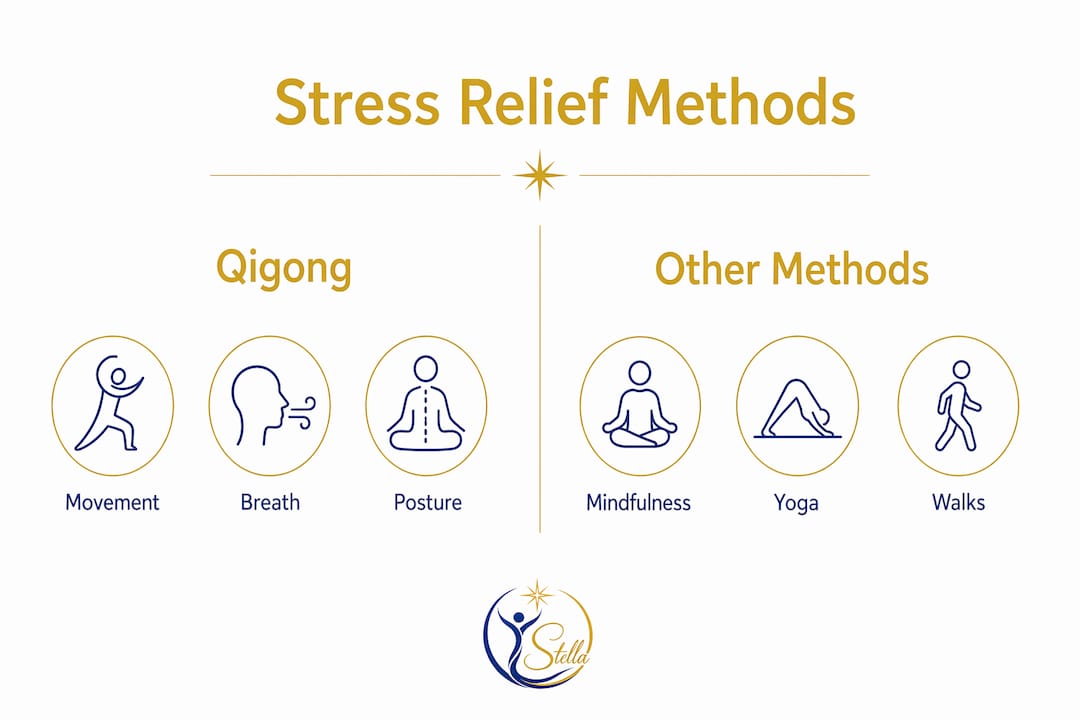
| Method | Mechanism | Adherence rate | Anxiety reduction |
|---|---|---|---|
| Qigong | Movement + breath + posture | 89% adherence | 42% GAD-7 reduction (4 weeks) |
| Mindfulness audio only | Breath + attention | 63% adherence | Lower than qigong in RCT |
| Yoga (vigorous forms) | Movement + breath | Variable | Moderate, effort-dependent |
| Light walking | Movement only | High | Mild, no breath integration |
The adherence gap is the most telling number in that table. At 89% versus 63% for mindfulness audio, qigong's higher completion rate reflects a practical reality: movement gives the busy, restless professional mind something concrete to do. Sitting still and observing thoughts is a skill that takes months to develop. Qigong gives you a physical anchor from day one.
Yoga is a close relative, but many popular forms require a mat, specific clothing, and a level of flexibility that discourages desk workers from starting. Qigong techniques for work are designed to be practiced in office clothes, in a small space, without props. The gentleness is not a limitation. It is the mechanism. Gentle, sustained movement activates the parasympathetic nervous system more reliably than intense physical effort, which can actually spike cortisol.
How to build a sustainable qigong routine into your workday
The most common mistake professionals make with qigong for workplace wellness is treating it like a gym session: something to schedule, prepare for, and complete in a dedicated block. That model fails within two weeks. The approach that works is micro-dosing with short sessions of 5 to 7 minutes timed to natural energy dips in your day.
Your body has predictable low-energy windows. The 11 a.m. pre-lunch dip and the 3 p.m. afternoon slump are the two most reliable. Those are your qigong windows. A 5-minute standing practice at 3 p.m. does more for your afternoon productivity than a second coffee, and it does not disrupt your sleep later.
Build the habit progressively using this approach:
- Week 1: Practice only the 4-2-6 breath sequence once daily, at the same time each day. Keep it to 90 seconds. The goal is consistency, not duration.
- Week 2: Add Zhan Zhuang standing for 2 minutes before the breath sequence. You now have a 4-minute practice.
- Week 3: Add the spinal wave and seated reset. You now have the full 7-minute sequence.
- Week 4 onward: Apply the golden thread and Dantian cues passively during meetings and desk work. Your practice is now woven into your professional identity, not separate from it.
Track three subjective markers each week: neck tension on a scale of 1 to 10, self-rated focus quality in the afternoon, and energy level at 4 p.m. These are the benefits of qigong that show up first, and watching them improve is what sustains the habit. Avoid the temptation to add more techniques before the current ones feel natural. Overexertion or breath retention during qigong causes fatigue rather than recharging, which is the opposite of what you need. You should finish every session feeling calmer and more alert than when you started.
Professionals who embed qigong principles into their daily work identity rather than treating practice as a separate add-on report the highest long-term adherence and the most consistent wellbeing benefits. The goal is not to become a qigong practitioner who also works. It is to become a professional whose nervous system is quietly, continuously regulated throughout the day.
Key takeaways
Qigong for professionals works because it engages the vagus nerve through movement first, then breath, producing measurable reductions in anxiety, improved posture, and sustained focus within minutes of practice.
| Point | Details |
|---|---|
| Movement before breath | Grounding postures activate the vagus nerve before breath work, making the sequence more effective than breathing alone. |
| Micro-dose your practice | Five to seven minutes at natural energy dips (11 a.m. and 3 p.m.) outperforms longer, infrequent sessions for busy professionals. |
| Build progressively | Start with one technique for seven days before adding others to build a habit that actually sticks. |
| Embed, do not separate | Applying golden thread and Dantian cues during desk work sustains autonomic balance without requiring dedicated time or space. |
| Track what matters | Monitor neck tension, afternoon focus, and 4 p.m. energy weekly to stay motivated and measure real progress. |
Why I think of qigong as nervous system firmware, not exercise
I have worked with professionals who have tried every stress-relief method on the market: meditation apps, therapy, gym memberships, weekend retreats. Most of them report the same pattern. They feel better during the activity and worse again within hours. The relief does not transfer.
What I have observed with qigong is different. When you practice consistently, even briefly, you are not just calming down in the moment. You are upgrading your baseline autonomic regulation, the way a software update improves how your whole system runs. That is why I describe it as nervous system firmware rather than exercise or meditation. The benefits compound quietly in the background.
The professionals who see the most transformation are not the ones who practice longest. They are the ones who practice most consistently and who stop treating qigong as something mystical or separate from their work identity. When you sink to your Dantian during a tense meeting, you are not doing qigong. You are just a calmer, more grounded version of yourself. That is the real goal. Start with one technique, practice it until it feels like breathing, then add the next. Your nervous system will do the rest.
— Stella
Start your qigong practice with guided online courses
If you are ready to move beyond reading and into a practice that genuinely transforms how you feel at work, Qigongstar offers structured online courses designed specifically for stress relief and energetic balance.
The 5 Animal Qigong course is a beginner-friendly program rooted in TCM that guides you through five distinct movement forms, each targeting a different organ system and emotional pattern. It is available on demand, so you can practice at 7 a.m. before your commute or at 3 p.m. during your afternoon slump. Stella is certified by the White Tiger Qigong School and Yoga Alliance, bringing both clinical grounding and lived experience to every session. Explore the full range of online qigong classes and find the format that fits your schedule and your goals.
FAQ
What is qigong and how does it help professionals?
Qigong is a TCM-rooted practice combining movement, breath, and posture to shift the nervous system from stress to calm. For professionals, it reduces anxiety scores by up to 42% in four weeks and improves sustained attention and postural alignment during desk work.
How long do I need to practice qigong to feel results?
A 90-second breathing sequence produces measurable HRV stress marker reductions within a single session. Consistent daily practice of 5 to 12 minutes shows significant anxiety and focus improvements within four weeks.
Can I practice qigong at my desk without special equipment?
Yes. Techniques like Zhan Zhuang standing, the 4-2-6 breath sequence, and seated Dantian cues require no mat, no special clothing, and minimal space. They are designed for office environments and can be applied discreetly during meetings.
Is qigong better than mindfulness for work stress?
Clinical research shows qigong produces greater anxiety reduction and higher adherence rates (89% versus 63%) compared to mindfulness audio-only programs. The movement component gives the busy professional mind a concrete anchor that seated meditation does not provide.
How do I learn qigong as a complete beginner?
Start with one technique, such as the 4-2-6 breath sequence, and practice it daily for seven days before adding movement. Guided online courses from platforms like Qigongstar offer structured, beginner-friendly programs that build skills progressively without overwhelm.