
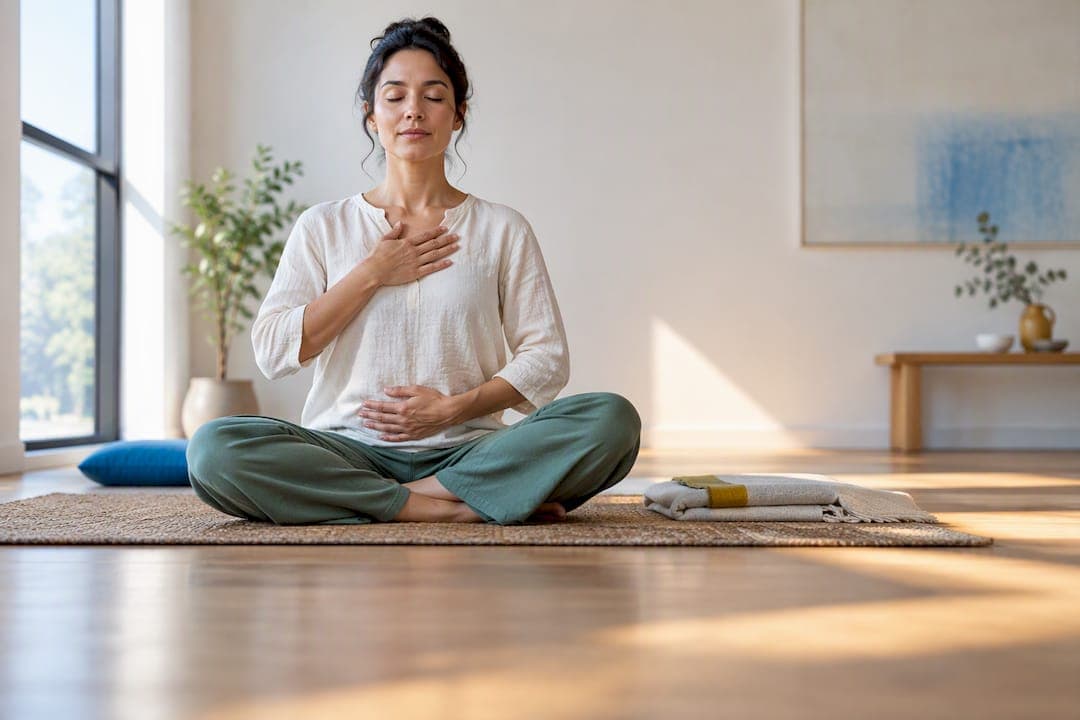
Yes, gentle qigong paired with diaphragmatic breathing can ease menstrual cramp intensity for many women, and you do not need an hour or special equipment to feel the difference. Start with three to five minutes of slow belly breathing plus one soothing abdominal move, done as soon as cramping begins. Stop if pain is severe or unusual, and see a clinician for anything that feels new or alarming.
TL;DR:
- Short daily diaphragmatic breathing sessions lasting five minutes can significantly reduce menstrual pain and improve autonomic balance.
- Gentle movements like pelvic rocking, belly circles, and kidney tapping help ease cramping by promoting blood flow and relaxing pelvic muscles.
- Acupressure on the Sanyinjiao point, combined with heat and breathing, offers a practical, self-administered method to alleviate menstrual discomfort.
- Consistent practice over multiple cycles is necessary to see meaningful relief, with online qigong classes providing personalized guidance.
- Severe or unusual symptoms such as sudden sharp pain, fever, or heavy bleeding require prompt medical evaluation, not just self-care techniques.
Table of Contents
- Five quick, safe practices to try right now
- A 12 to 20 minute qigong routine for menstrual cramps
- What the research shows and how qigong may help
- Using acupressure points safely alongside qigong
- When to seek medical care alongside your practice
- Stella's perspective: what students actually experience
- Where the usual advice on period pain falls short
- How QigongStar can support your practice
- Sources
- FAQ
Five quick, safe practices to try right now
When cramps hit, you do not need to wait for relief to arrive. These are the techniques you can reach for immediately, whether you are curled up at home or trying to get through a workday.
- Diaphragmatic breathing, 30 seconds to 5 minutes: breathe slowly into your belly, letting it rise and fall under your hand, which calms the nervous system and can ease muscle tension within a few cycles.
- Seated pelvic rocking: sit tall, hands on your lower belly, and gently rock your pelvis forward and back for one to two minutes to loosen the lower back and abdomen.
- Gentle self-massage: use flat palms to make slow, warm circles over your lower abdomen, moving clockwise, for two to three minutes.
- SP6 acupressure: press the Sanyinjiao point above your inner ankle with firm but comfortable pressure for one to two minutes on each leg.
- Heat plus breath: a warm compress on the lower belly while you breathe diaphragmatically often eases cramping faster than either alone, and pairing it with an over-the-counter NSAID, if that is your usual approach, is generally fine.
The breathing piece carries real backing: a 2025 trial found that daily diaphragmatic breathing practice significantly reduced dysmenorrhea symptoms over five weeks, and the same research suggests shorter daily doses still offer a calming, parasympathetic effect even outside the full protocol.
Pro Tip: Keep a folded blanket nearby. Pressing it gently against your lower belly while you breathe adds light, comforting pressure that many women find soothing during acute cramping.

Stop any of these and rest if pain sharpens suddenly, if you feel faint, or if something feels different from your usual cycle.
A 12 to 20 minute qigong routine for menstrual cramps
This sequence works whether you are lying on a mat, sitting in a chair, or moving slowly around a quiet room. It follows a simple arc: settle the breath, move the body gently, then close with stillness.
Warm-up, 2 to 3 minutes. Sit or stand comfortably with your feet hip-width apart. Rest one hand on your belly and one on your chest, and breathe slowly so the lower hand rises more than the upper one. Add gentle neck rolls and shoulder circles to release tension you may be holding from the pain itself. If standing feels heavy today, do this whole sequence seated.
- Rocking the cradle (2 to 3 minutes): seated or standing, sway your hips gently side to side as if rocking a baby, letting your arms swing loosely, syncing one sway to one slow breath.
- Waterfall release (2 minutes): inhale as you raise both arms overhead, then exhale slowly as you fold forward from the hips, letting your arms trail down toward the floor like water pouring away tension. Repeat four to six times.
- Belly warming circles (2 to 3 minutes): place both palms over your lower abdomen and trace slow, wide circles, breathing into the warmth building under your hands.
- Kidney tapping (1 to 2 minutes): with loose fists, tap gently along your lower back on either side of the spine, which many women find eases the dull ache that spreads from the pelvis.
- Grounding stance (2 to 3 minutes): stand or sit with a straight spine, hands resting on your thighs, and simply breathe, letting each exhale feel longer than the inhale.
Cooldown, 2 to 3 minutes. Lie down if you can, knees bent and soles of the feet on the floor, and let your breath settle into a natural, unforced rhythm. Notice any place that feels lighter than when you started.
For the full 12 to 20 minute version, move through all five core steps once and repeat the ones that feel most helpful. If you only have five minutes, do the warm-up breath, rocking the cradle, and the grounding stance. If you are dealing with heavy flow or dizziness, skip standing moves entirely and do everything seated or lying down, keeping movements smaller and slower.

Pro Tip: If cramps arrive alongside bloating or digestive upset, slow the belly circles even further and hold your palms still over the area for thirty seconds between each round, a technique also used in routines for gut-related discomfort.
What the research shows and how qigong may help
The evidence on qigong and related mind-body practices for period pain is encouraging without being definitive. A clinical review of Qi Gong therapy for premenstrual syndrome found reductions in pain, depression, and anxiety among women with PMS across several trials, pointing to plausible mechanisms including modulation of neurotransmitters and prostaglandins along with better autonomic balance.
A 2025 trial on diaphragmatic breathing found that daily practice over several weeks significantly reduced dysmenorrhea symptoms compared with a control group, with a reported p-value of 0.0008, a strong statistical signal for a low-cost, side-effect-free practice. The same research noted that online, synchronous instruction produced results comparable to in-person teaching, which is worth knowing if you are considering a virtual qigong class.
A broader picture comes from traditional Chinese medicine research. A 2024 systematic review and network meta-analysis of 57 randomized trials covering 3,903 participants found that meridian-based interventions, including acupressure, moxibustion, warm needling, and acupuncture, produced better pain relief for primary dysmenorrhea than NSAIDs or waitlist controls.
The likely mechanisms at work include:
- Slower, deeper breathing activates the parasympathetic nervous system, which tends to lower overall muscle tension.
- Calming practices may soften the stress-hormone response, easing the tightness that stress adds to cramping.
- Gentle movement and pressure techniques may support healthier blood flow to the pelvis, which can ease spasm-related pain.
These findings come with real limits. Many of the trials behind the TCM meta-analysis were conducted in China, and study designs vary widely in size and rigor, so results are best read as promising rather than settled. Give any new routine several cycles, not just one, before judging whether it is helping.
Using acupressure points safely alongside qigong
Acupressure pairs naturally with qigong because both rely on calm, focused touch rather than force. The point most studied for period pain is Sanyinjiao, known as SP6.
- Find it about four finger-widths above the inner ankle bone, just behind the shinbone.
- Press with your thumb using firm, steady pressure, enough to feel a dull ache but never sharp pain.
- Hold for one to two minutes per leg, breathing slowly throughout, and repeat every few hours during heavy cramping.
- Pair it with lower-abdomen circles or a warm compress for a fuller sense of relief.
An updated systematic review of Sanyinjiao acupressure found small-to-moderate pain reductions across multiple trials, with some evidence that it outperforms placebo for primary dysmenorrhea. Its main advantage is practicality: it is free, self-administered, and easy to combine with breathing or movement work.
Other points people use for related discomfort include ones associated with lower-abdomen tension and general digestive ease, though acupressure should be approached generically rather than through any single school's specific point map. Avoid acupressure entirely over broken or irritated skin, and treat it as a relative caution during pregnancy or if you have unexplained abnormal bleeding, situations where a conversation with your clinician should come first.
When to seek medical care alongside your practice
Qigong and breathwork are meant to sit alongside good medical care, not replace it. Certain symptoms deserve prompt attention rather than a breathing routine: new or unusually severe pain, fever, heavy bleeding that persists beyond your normal pattern, fainting, or pain that appears after years of painless periods. Clinical guidance on secondary dysmenorrhea outlines exactly these red flags as reasons for evaluation.
When you see a clinician, mention that you are using gentle movement and breathing practices, along with how often and for how long, so they have the full picture. Qigong generally combines safely with NSAIDs or hormonal treatments like the pill, since it works through relaxation rather than any drug interaction, but any new or worsening symptom still deserves a proper look rather than a workaround.
Stella's perspective: what students actually experience
Most students tell me relief builds gradually, often within two to three cycles of consistent practice rather than instantly. The women who notice the biggest shift tend to practice breathing daily, not just during cramps, so the body already knows how to drop into that calmer state when pain arrives.
I adjust routines depending on what shows up most: cramp-dominant students get more pelvic rocking and SP6 work, while those with bloating or digestive flare-ups alongside their cycle lean on slower belly circles and the approach I teach for gut-related discomfort. The hardest part for most people is simply remembering to breathe slowly before pain peaks, not after.
Where the usual advice on period pain falls short
Most advice on menstrual cramps treats movement and medication as opposites: either you take something or you stretch a little and hope. What the evidence actually supports is a layered approach, where breathing and gentle qigong reduce baseline tension and reactivity, while medication or acupressure handles acute spikes.
The bigger gap is consistency. A single session during a bad cramp helps in the moment, but the research on breathing practice points to daily use building real change over weeks, not days. If you take one thing from this, prioritize five minutes of slow breathing every day of your cycle, not just the painful ones. That habit, more than any single move, is what seems to shift how your body responds to cramping over time.
— Stella
How QigongStar can support your practice
Learning these moves from a video is one thing. Refining your breath, posture, and pacing with real feedback is another, and that is where a guided session changes what you feel week to week.
- An online clarity session can offer quick, personalized coaching on moves suited to your body and cycle.
- Online qigong classes provide structured, repeatable routines to support your monthly rhythm.
- A longer online session can help develop a more personalized plan addressing cramps along with digestion or stress.
A booked session gives you real-time correction and a routine tailored to your symptoms, while self-practice from this guide is a solid place to start between sessions. Explore the online Qigong classes to find the format that fits where you are right now.
This article is general information, not a substitute for advice from a qualified doctor. Consult a qualified healthcare professional about your own circumstances before acting on anything here.
Sources
- Practicing Diaphragmatic Breathing Reduces Menstrual Symptoms Both During In-Person and Synchronous Online Teaching
- Traditional Chinese medicine interventions based on meridian theory for pain relief in patients with primary dysmenorrhea: a systematic review and network meta-analysis
- Impact of Qi Gong therapy for managing premenstrual syndrome among adolescent girls (and related Qi Gong literature)
FAQ
What do Chinese medicine practices recommend for period cramps?
Traditional Chinese medicine commonly uses acupressure, acupuncture, moxibustion, and warm needling on specific meridian points to ease menstrual pain. A 2024 systematic review of 57 trials found these approaches gave better pain relief for primary dysmenorrhea than NSAIDs or no treatment.
What is the Chinese pressure point for period cramps?
The point most associated with period pain relief is Sanyinjiao, or SP6, located a few finger-widths above the inner ankle bone. An updated systematic review found pressing this point produced small-to-moderate reductions in menstrual pain across multiple trials.
What is the 7-2-1 rule for menstruation?
Definitions of this rule vary and it is not backed by the clinical sources used in this article, so it is best treated as informal guidance rather than a medical standard. If you have seen a version of it online, check it against a qualified clinician before relying on it for your own cycle.
What is the mantra that can help relieve menstrual pain?
There is no single research-backed mantra for period pain, but slow, rhythmic breathing paired with a calming phrase repeated silently can support the relaxation response. The 2025 diaphragmatic breathing trial found the breathing itself, done consistently, meaningfully reduced dysmenorrhea symptoms.