
Yes, qigong can meaningfully ease chronic low back pain when you practice it consistently. Recent trials point to real, measurable relief within weeks, not months, especially for disability and daily function. Your best first step is a gentle 5 to 10 minute standing or seated routine today, then a structured 8 to 12 week plan, tracked with a simple tool like the Oswestry Disability Index, while an online qigong platform can guide you through it safely.
TL;DR:
- Qigong can reduce disability by an average of nearly 6 points on the Oswestry Disability Index within 8 to 12 weeks of regular practice.
- Structured programs lasting at least 8 weeks, with sessions once or twice weekly and home practice, tend to produce the most noticeable improvements.
- Gentle movement and paced breathing in qigong help release tense muscles and calm the nervous system, lowering pain perception and fear of movement.
- Red flags such as worsening weakness, numbness, or bladder issues require immediate medical evaluation before starting qigong or similar exercises.
- Combining qigong with physiotherapy can reduce fear of movement more effectively and improve overall rehabilitation outcomes.
Table of Contents
- What Does the Research Say About Qigong for Back Pain?
- How Does Qigong Actually Reduce Back Pain?
- Three Safe Qigong Routines You Can Try Today
- How Often Should You Practice, and How Do You Know It's Working?
- When Is Qigong Not Enough on Its Own?
- Can Qigong Replace Physical Therapy for Back Pain?
- Why Trust This Guide on Qigong for Back Pain?
- A Teacher's Honest Take on Starting Qigong for Back Pain
- Ready to Start Your Own Qigong Practice for Back Pain?
- Primary Studies and Reviews Worth Reading Next
- Sources
What Does the Research Say About Qigong for Back Pain?
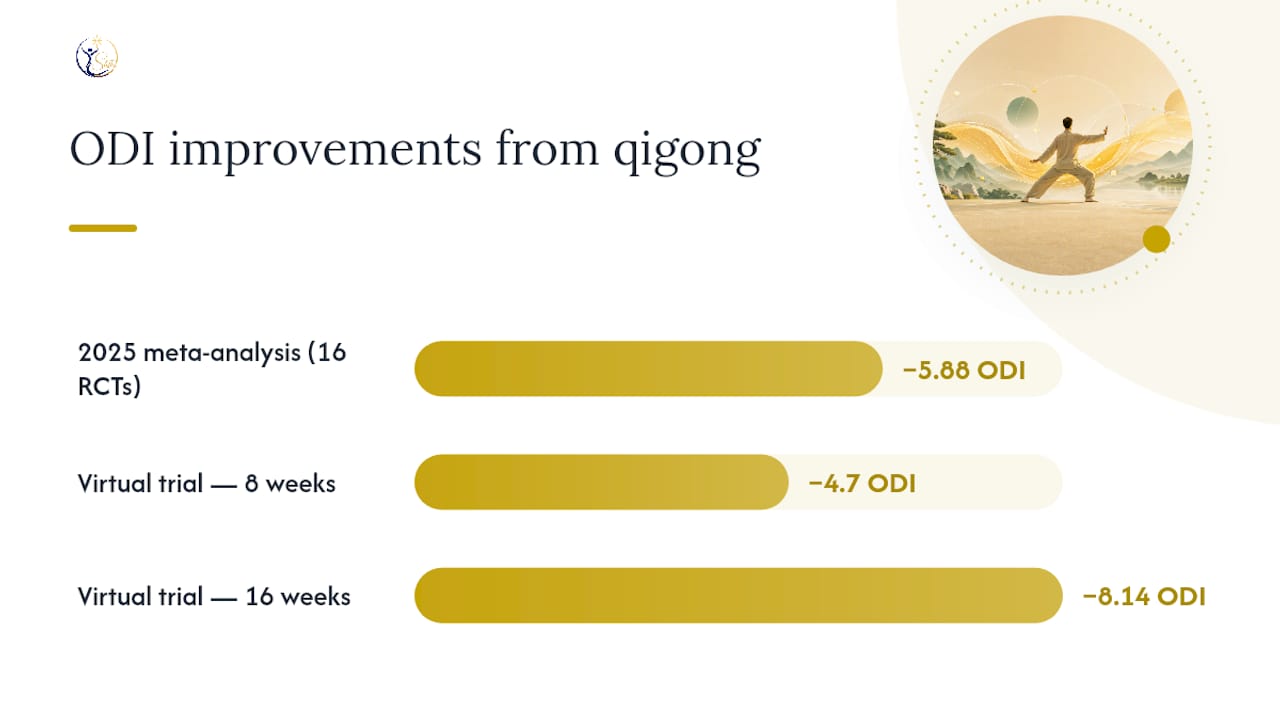
The strongest evidence comes from a 2025 systematic review and meta-analysis pooling 16 randomized controlled trials with 1,175 participants. It found qigong reduced pain by a mean difference of −1.34 and improved disability scores by −5.88 compared with control groups, using the Effect of qigong on pain and disability in patients with chronic non-specific low back pain as its outcome measure. That disability improvement matters because it sits close to what researchers consider a minimal clinically important difference, the threshold at which patients themselves notice their daily life getting easier.
A separate randomized trial gives you a clearer picture of what a real program looks like. The virtually delivered tai chi and qigong program ran for 12 weeks and produced Oswestry Disability Index improvements ranging from −4.7 at 8 weeks to −8.14 at 16 weeks. Participants also reported better sleep and quality of life, and those gains held up a month after the program ended. Nobody dropped out because of side effects, which tells you something about how gentle this practice actually is on the body.
More recent PubMed indexed RCT summaries echo those numbers, showing ODI reductions as high as −8.14 by week 16 in programs that folded qigong into physiotherapy. Some of these trials also tracked kinesiophobia, the fear of movement that keeps so many back pain sufferers stuck in a cycle of avoidance. The trend toward less kinesiophobia didn't always reach statistical significance, but the direction was consistent across studies.
Here's what the trials had in common:
- Sessions ran about 60 minutes, delivered once or twice weekly with home practice filling the gaps.
- Most programs lasted 8 to 16 weeks before researchers measured outcomes.
- Outcome measures centered on the Oswestry Disability Index and visual analog pain scales.
- Participants were often older adults, with a mean age near 59 in the virtual trial.
- Different qigong styles were sometimes lumped together, which makes the heterogeneity across forms like Baduanjin, Liuzijue, and Wu Qin Xi a real limitation.
Here's the number that matters most: a pooled disability improvement of −5.88 points on the ODI, drawn from over a thousand participants across 16 trials. That's not a dramatic cure, but it's a consistent, reproducible signal, and it lands in a range that trial participants describe as noticeably easier movement through the day. Short, supervised courses tended to outperform longer unsupervised stretches of practice, which suggests structure and a bit of accountability help more than sheer time on the mat.
The honest takeaway is this: qigong won't erase chronic low back pain overnight, and the studies themselves warn about short follow-up periods and mixed quality across trials. But the direction of the evidence is unusually consistent for a mind-body practice, and the time commitment shown to produce results is modest. Twenty to thirty minutes a few times a week gets you into the range where these studies found real change.
How Does Qigong Actually Reduce Back Pain?
Slow, flowing movement asks your muscles to release rather than brace. Chronic back pain often comes wrapped in a habit of guarding, where the muscles around an old injury stay tense long after the tissue has healed. Qigong's gentle spinal circles and weight shifts coax those muscles into moving through their available range without triggering the flinch reflex that sharper exercise can provoke. That gradual movement also nudges blood flow through tissue that's been sitting stiff and underused.
Breath does more work here than most people expect. Slow, coordinated breathing activates your parasympathetic nervous system, the branch responsible for calming your body down rather than keeping it on alert. Chronic pain keeps your nervous system in a heightened state, scanning for threats, which paradoxically makes pain signals louder. A few minutes of paced breathing can turn that volume down and reduce the fear-avoidance behavior that often keeps people from moving at all.
Traditional Chinese medicine frames these effects through meridians and acupoints, energetic pathways said to carry vital energy through the body. Some instructors incorporate specific points such as GB30 and BL57 when addressing sciatica-like symptoms down the leg. This framing gives practitioners a useful mental map for where to focus attention, though it works best as a complement to clinical care rather than a replacement for it.
A few honest caveats belong here:
- The exact biological mechanism behind qigong's effects on pain isn't fully mapped out in research.
- Reduced kinesiophobia shows up more reliably in trials than any single physiological marker.
- Small studies have reported lower inflammatory markers after eight weeks of practice, though sample sizes were tiny.
- Clinical outcomes are documented more consistently than the mechanisms that produce them.
Think of it less like a magic fix and more like retraining a nervous system that's been stuck in high alert. The movement matters, the breath matters, and the traditional framing gives you a way to stay engaged with the practice long enough for those effects to build.
Three Safe Qigong Routines You Can Try Today
You don't need a studio or special equipment for any of these. A quiet corner of a room and a few free minutes will do.
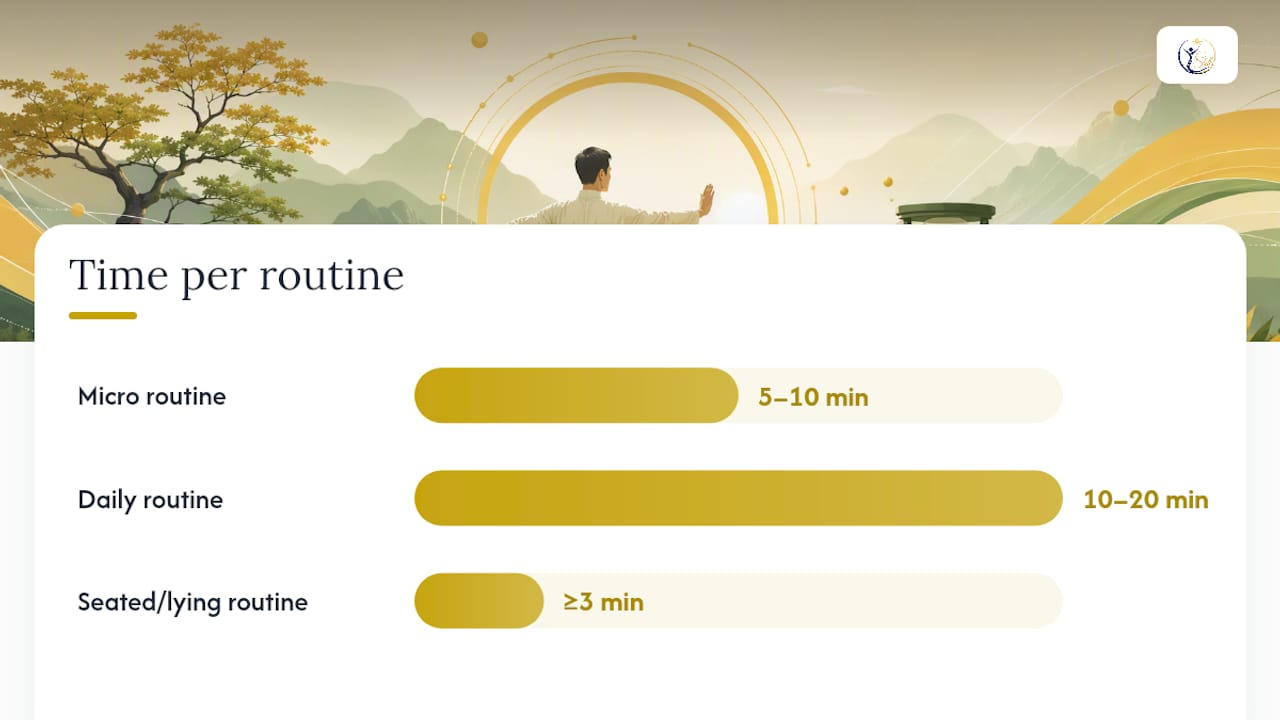
The 5 to 10 minute micro routine, for days when time is tight or pain feels unpredictable:
- Stand with feet hip-width apart, knees soft, and let your arms hang loose at your sides.
- Breathe in slowly through your nose for a count of four, letting your belly expand.
- Exhale for a count of six, feeling your shoulders drop away from your ears.
- Repeat this breath cycle five times before adding movement.
- Gently circle your hips in a small, slow arc, tracing tiny circles about the size of a dinner plate.
- Reverse direction after eight circles, keeping the motion pain-free and unhurried.
- Finish with three more slow breaths, standing still and noticing any change in tension.
Stop or shrink the movement immediately if anything sharpens rather than eases.
The 10 to 20 minute daily routine, best done once you've built some confidence with the basics:
- Warm up with two minutes of gentle marching in place, letting your arms swing naturally.
- Move into slow forward bends from the hips, going only as far as comfortable, for six to eight repetitions.
- Add gentle spinal twists, rotating your torso side to side while keeping hips facing forward, eight repetitions per side.
- Flow into a standing stillness posture for three to five minutes, weight settled evenly through both feet.
- Focus your attention on your lower back releasing with each exhale during this stillness phase.
- Cool down with slow neck rolls and shoulder circles for one to two minutes.
- End seated or lying down for a minute of quiet breathing before returning to your day.
The seated or lying routine, designed for flare-ups or limited mobility:
- Sit tall in a supportive chair or lie on your back with knees bent, feet flat.
- Breathe slowly for one minute, letting your lower back soften into the chair or floor.
- Gently tilt your pelvis forward and back in small, slow movements, six to eight repetitions.
- If seated, rotate your torso slightly side to side, keeping the movement small and controlled.
- Rest both hands on your abdomen and practice five slow breaths, feeling the rise and fall.
- Finish with two minutes of stillness, arms resting naturally, attention on easy breathing.
If you experience sciatica-like symptoms radiating down a leg, keep every range of motion smaller than feels available, and skip any twist or bend that pulls at the nerve pathway. A resource like seated qigong exercises can walk you through additional gentle variations when standing isn't an option.
Pro Tip: Breathe out during the part of the movement that stretches or opens your back, and breathe in as you return to center. This pairing helps your nervous system associate the stretch with release rather than effort, which tends to reduce guarding over time.
How Often Should You Practice, and How Do You Know It's Working?
Consistency matters more than intensity here. Trials that produced measurable results generally asked participants for 10 to 30 minutes of practice, three to five times weekly, sustained over 8 to 12 weeks before checking outcomes. That's the timeframe to give yourself before deciding whether qigong is helping.
A well-structured session moves through four phases: a brief warm-up to wake up the joints, a movement block working through gentle bends and rotations, a stillness segment for breath and nervous system regulation, and a short integration period to notice how your body feels before you return to normal activity.
Tracking progress doesn't require anything complicated:
- Keep a simple pain diary, rating your discomfort on a 0 to 10 scale each morning and evening.
- Note how far you can comfortably bend or twist compared with the week before.
- Watch for changes in sleep quality, since better rest often shows up before pain scores improve.
- Pay attention to whether you're avoiding fewer everyday movements out of fear.
Meaningful change tends to look modest at first: a point or two off your pain diary, slightly easier mornings, a little more confidence bending to tie your shoes. If you're seeing zero change after 8 to 12 weeks of consistent practice, that's a reasonable point to scale up session length or bring in a supervised program. If a session leaves you sore rather than looser, scale back your range of motion before you scale up anything else.
When Is Qigong Not Enough on Its Own?
Most back pain responds well to gentle movement, but certain symptoms mean you need clinical evaluation before continuing any exercise routine, qigong included. According to the NINDS low back pain fact sheet, these red flags call for prompt medical attention rather than a home practice:
- Progressive weakness in your legs or feet that seems to be getting worse.
- Any new loss of bowel or bladder control.
- Numbness or tingling in the saddle area between your thighs.
- Fever accompanying your back pain.
- Sudden, severe pain following a fall or other trauma.
Here's a distinction worth remembering: ordinary post-exercise soreness fades within a day or two and stays mild. A warning sign tends to be sharp, spreading, or paired with sensations that have nothing to do with muscle fatigue, like numbness or a change in bladder habits.
Beyond emergencies, a few situations call for a clinician's clearance before you start: recent spine surgery, a known unstable fracture, severe osteoporosis, or an active inflammatory condition affecting the joints. If any of these apply to you, ask your doctor which movements to avoid, and consider a supervised class over solo practice until you have that guidance in hand. Adapting range of motion downward is almost always the safer choice when you're uncertain.
Can Qigong Replace Physical Therapy for Back Pain?
Qigong works best alongside physiotherapy rather than instead of it, at least based on the trial evidence available. Studies comparing qigong integrated into physiotherapy against conventional strengthening programs have found comparable improvements in disability scores, though the between-group differences often don't reach statistical significance. What stands out is that qigong participants reported greater reductions in kinesiophobia, the fear of movement that keeps chronic pain sufferers stuck in place.
That's a meaningful practical difference even when the pain scores look similar on paper. A patient who's less afraid to move is a patient more likely to stick with any rehabilitation plan.
If you're already working with a physiotherapist, bring this research to your next appointment and ask whether a gentle qigong routine could run alongside your current exercises. Most physiotherapists are open to complementary movement practices, especially ones with documented safety records.
- For milder, chronic discomfort without red flags, a virtual group program offers structure and accountability at lower cost.
- For recent injury, significant disability, or complicating health conditions, one on one supervised sessions give you closer guidance and faster course correction.
- For anyone rebuilding confidence after a flare up, pairing qigong's calming effect on fear of movement with a physiotherapist's strength focus tends to cover more ground than either approach alone.
Why Trust This Guide on Qigong for Back Pain?
This guide draws on peer reviewed trials and a 2025 meta-analysis rather than anecdote, and it pairs that evidence with routines built for real bodies dealing with real pain. Some qigong platforms teach White Tiger Qigong and Five Animal Qigong, two traditional systems rooted in Chinese medicine, through both live and on-demand classes designed to welcome complete beginners.
Some instructors carry certification through the White Tiger Qigong School and Yoga Alliance, a standard that reflects real training rather than a weekend workshop. Classes are built to be gentle from the first session, with modifications offered for limited mobility and chronic pain, so you're never pushed past what your back can safely handle that day.
A Teacher's Honest Take on Starting Qigong for Back Pain
If I could give new students one rule, it would be this: range of motion before repetition, always. Most people rush to do more circles or deeper bends before their body has learned to trust the smaller version of the movement. Safety and breath come first. Everything else builds from there.
The three mistakes I see most often are holding the breath during movement, forcing a stretch past the point of ease, and skipping the stillness segment because it feels like "not doing enough." That stillness is often where the actual nervous system shift happens.
Give yourself 8 to 12 weeks before judging results. Chronic pain took time to build, and it eases on a similarly patient timeline. Small, steady practice beats an ambitious routine you abandon after a week.
— Stella
Ready to Start Your Own Qigong Practice for Back Pain?
Some qigong platforms provide a structured, evidence-informed curriculum built specifically around gentle movement principles, taught by certified instructors rather than an algorithm.
The Five Animal Qigong course suits beginners looking for a well-rounded introduction to flowing movement, breath work, and posture correction, all delivered through on-demand modules you can revisit whenever pain flares up. If you're drawn to a more focused practice with an emphasis on strength and internal stability, the White Tiger Qigong course offers that structure with live class options for readers who want real-time feedback from an instructor. These formats often fit around a work schedule and are designed with beginners and people managing chronic discomfort in mind, rather than advanced practitioners chasing an athletic edge.
Start with a beginner module this week, work through it at your own pace, and give yourself the same 8 to 12 week window the research points to before judging your results.
Primary Studies and Reviews Worth Reading Next
The claims in this guide rest on a specific set of sources, useful if you want to dig into the numbers yourself:
- The 2025 systematic review and meta-analysis of 16 RCTs on qigong for chronic non-specific low back pain.
- The virtually delivered tai chi and qigong randomized trial showing 12-week ODI improvements.
- PubMed indexed RCT summaries covering qigong integrated into physiotherapy programs.
- The NINDS low back pain fact sheet for red-flag symptoms and safety guidance.
These are the same sources behind every effect size and safety recommendation in this guide, so they're worth a direct read if you want the full clinical detail.
This article is general information, not a substitute for advice from a qualified doctor. Consult a qualified healthcare professional about your own circumstances before acting on anything here.
Sources
- Effect of qigong on pain and disability in patients with chronic non-specific low back pain: a systematic review and meta-analysis
- A Tai chi and qigong mind-body program for low back pain: A virtually delivered randomized control trial
- PubMed indexed RCT summaries on qigong and low back pain (2024–2025)
- NINDS: Low back pain fact sheet