
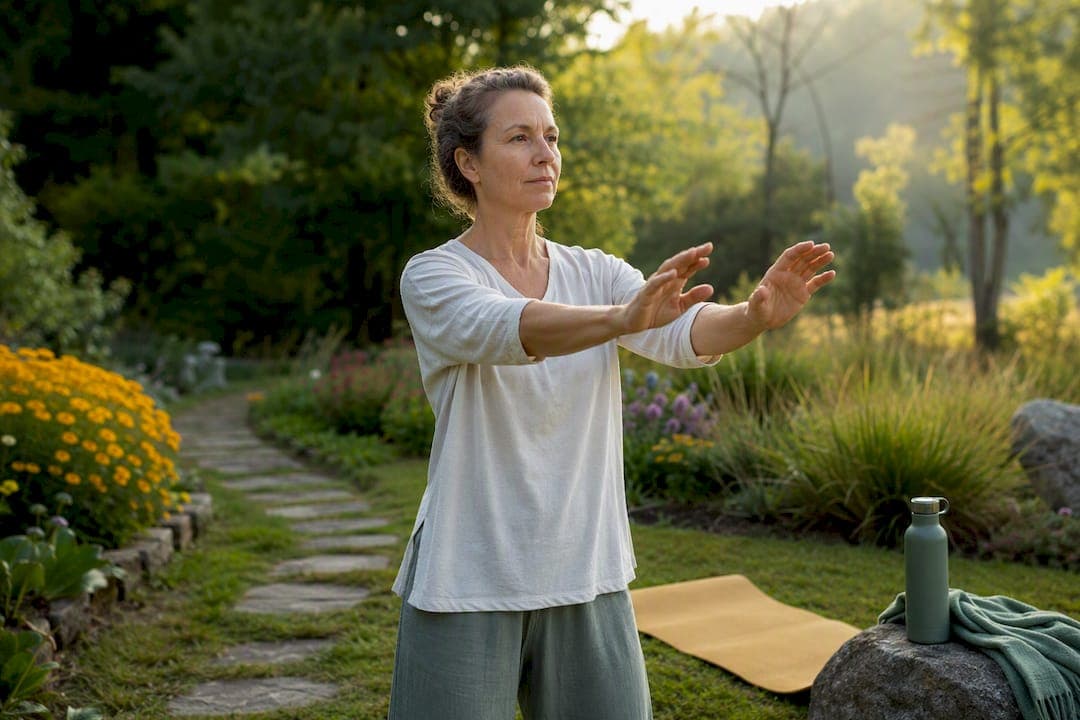
Yes, qigong can ease common menopausal symptoms, including disrupted sleep, stress, hot flashes, and fatigue. A 12-week randomized controlled trial found meaningful improvements in symptom severity and quality of life, and a separate sleep-focused study recorded measurable gains by week six. You don't need special equipment or a studio to start feeling the effects. Try this right now, wherever you're sitting or standing:
- Take three slow breaths, letting your exhalation run longer than your inhale.
- Soften your knees and gently sway side to side for one minute, letting your arms swing loosely.
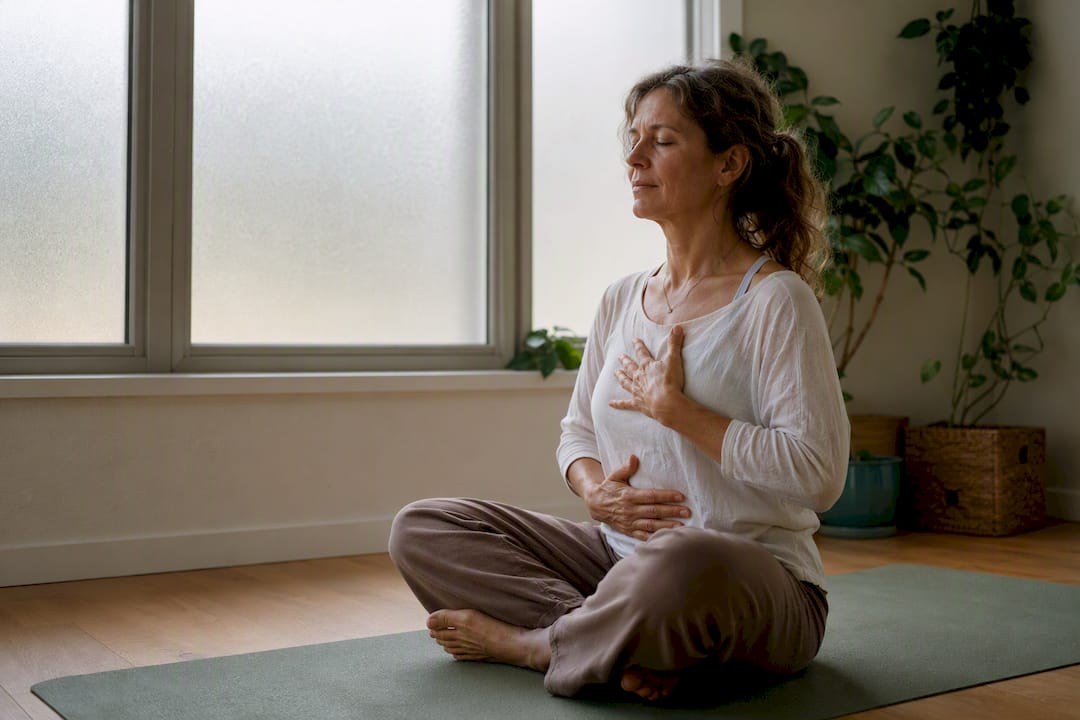
- Bring your hands to your lower belly and breathe into your palms for one minute, feeling the rise and fall.
- Finish with a slow neck roll in each direction, then pause and notice how your body feels.
That's your whole micro-practice, three to five minutes, no mat required. Most women notice calmer sleep and lower stress within about six weeks of consistent practice, with broader relief from hot flashes, joint stiffness, and fatigue often building by twelve weeks.
Key Takeaways
Consistent short qigong practice, five to seven days a week, reliably improves menopausal sleep and stress by six weeks and broader symptom severity by twelve weeks.
| Point | Details |
|---|---|
| Start small, daily | A 3 to 5 minute breath and movement practice builds the consistency that trials show matters most. |
| Sleep improves first | Sleep quality gains often appear by six weeks, based on the Ping Shuai qigong sleep study. |
| Full relief takes 12 weeks | Hot flashes, joint stiffness, and quality of life scores improved most at the 12-week mark in the randomized trial. |
| Adapt, don't skip | Chair-based versions keep you practicing safely through balance issues, fatigue, or low-energy days. |
| Guided classes accelerate progress | Qigongstar's certified instructors offer live and on-demand classes to refine your form beyond a home routine. |
Table of Contents
- How Qigong for Menopause Relief Works on Specific Symptoms
- What Does the Research Say About Qigong and Menopause?
- A Beginner Qigong Routine You Can Do at Home
- How Long Before Qigong Helps With Menopause Symptoms?
- Is Qigong Safe During Menopause? What to Watch For
- Why Trust This Guidance on Qigong for Women in Menopause
- What Actually Matters Most in a Menopause Qigong Practice
- Ready to Deepen Your Qigong for Menopause Practice?
- Sources
How Qigong for Menopause Relief Works on Specific Symptoms
Qigong doesn't work as one vague wellness fix. It targets distinct menopausal symptoms through different pathways, which is why the research on qigong for menopause breaks down by symptom rather than lumping everything into a single outcome.
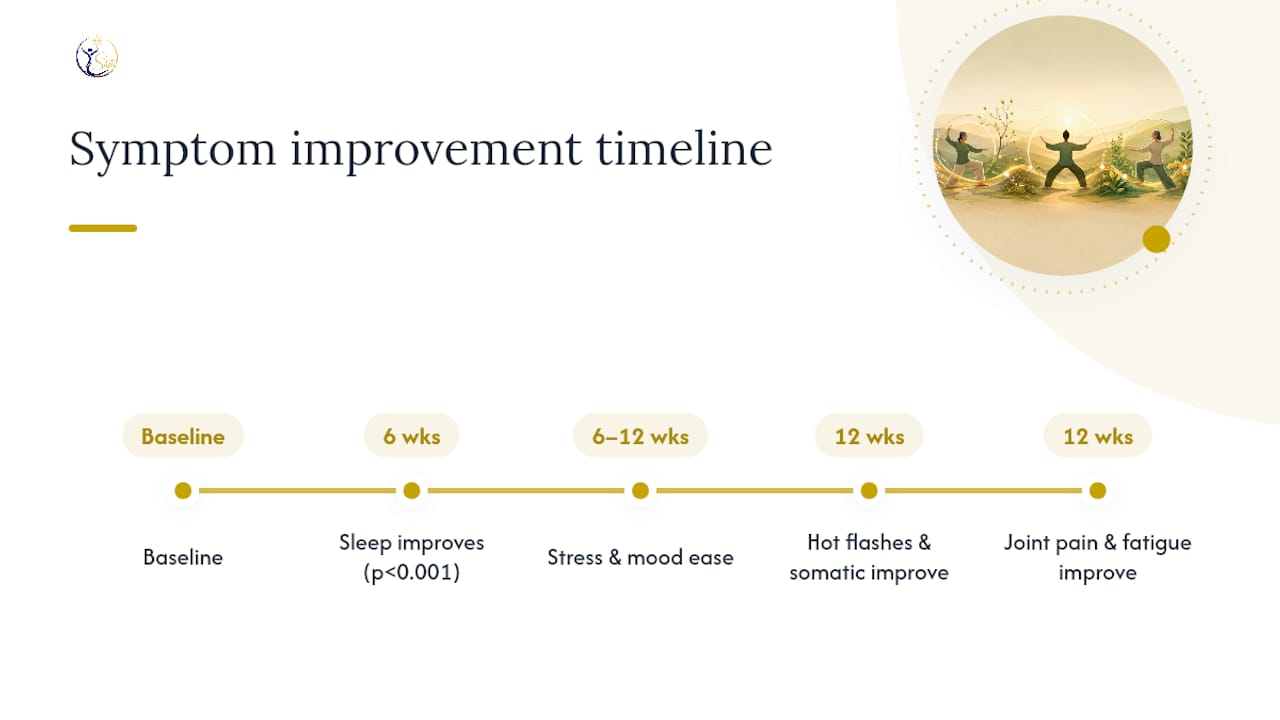
Sleep responds early and reliably. In the Ping Shuai qigong study, women who practiced 30 minutes daily saw significant improvements in sleep quality, measured by the Pittsburgh Sleep Quality Index, at both six and twelve weeks, with the effect growing stronger the longer they stuck with it. That progressive pattern matters. It tells you sleep gains aren't a placebo bump. They build with repetition.
Stress and mood improve through a different mechanism. Qigong combines four elements, physical movement, active relaxation, focused attention, and conscious breathing, that together help shift an overactivated nervous system out of fight-or-flight mode, according to a review of mind-body practice mechanisms. This is the same reason breath-focused resilience training works for anxiety outside of menopause too. The nervous system doesn't know the difference between a hot flash and a stressful email; it just needs a reliable off switch.
Hot flashes and other somatic symptoms showed measurable improvement in the 12-week randomized trial of 125 postmenopausal women, which tracked outcomes using the Menopause Rating Scale and the SF-36 quality-of-life questionnaire. Somatic, psychological, and urogenital symptom scores all improved compared with the control group.
Joint pain and fatigue tend to respond more slowly, tied to circulation and the gentle load-bearing nature of standing qigong postures. Women in the studies rarely reported this as an early win. It showed up more as a twelve-week finding, alongside broader vitality gains.
A quick statistic worth sitting with: in the Ping Shuai trial, sleep and climacteric symptom improvements were both statistically significant at six weeks, with p-values below 0.001. That's a strong signal for a symptom cluster that so often resists quick fixes.
What Does the Research Say About Qigong and Menopause?
The evidence base for qigong and menopause is still young, but it's more rigorous than most people expect from a "gentle movement practice."
The strongest single piece of evidence is the randomized controlled trial of 125 postmenopausal women, run over 12 weeks. Researchers measured outcomes with the Menopause Rating Scale and the SF-36, two validated instruments used widely in menopause research, and found significant improvement across multiple domains in the qigong group compared with controls who received no intervention.
The Ping Shuai qigong study took a different angle, following perimenopausal women through 30-minute daily sessions and checking in at both six and twelve weeks. Improvements in sleep and climacteric symptoms appeared at the six-week mark and continued strengthening through week twelve, which suggests consistency matters more than intensity.
A broader literature review of Baduanjin qigong pulled together 35 trials through June 2023, covering perimenopausal mental health, sleep disorders, and postmenopausal issues like bone density. Program lengths in these trials varied enormously, from a few weeks to a full year, though daily practice showed up as a common thread across the better-performing studies.
| Study | Design | Duration | Key finding |
|---|---|---|---|
| Qigong RCT (postmenopausal women) | Randomized controlled trial, 125 participants | 12 weeks | Improved MRS and SF-36 scores across somatic, psychological, urogenital domains |
| Ping Shuai qigong study | Observational | 12 weeks, 30 min/day | Significant sleep and symptom gains at 6 and 12 weeks (p<0.001) |
| Baduanjin literature review | Review of 35 trials | 3 weeks to 12 months | Improved mental health and sleep, low adverse events |
Across the Baduanjin trials reviewed, only eight out of 35 studies reported any adverse reactions at all, and none of those were linked to the practice itself. Dropout rates were reported as low, which is favorable for an exercise intervention.
The limitations are real, though. Most trials were conducted in China, with one notable exception in Spain, so applicability to women in the UK and elsewhere relies on some extrapolation. Qigong styles also vary widely between studies, Baduanjin, Ping Shuai, and others aren't interchangeable, and few trials used a standardized protocol that would let researchers compare results head to head. Treat qigong as a well-supported complementary practice, not a substitute for medical management of severe symptoms.
A Beginner Qigong Routine You Can Do at Home
This routine borrows from Baduanjin, the Eight-Section Brocade, one of the most studied qigong styles for perimenopausal and postmenopausal symptoms. It takes 10 to 15 minutes and needs nothing but floor space and comfortable clothing.
- Center and breathe. Stand with feet hip-width apart, knees soft. Take three slow breaths, inhaling through your nose and exhaling twice as long. If you like, try "water breath," imagining your breath flowing down through your body like a slow-moving stream.
- Lift the sky. Interlace your fingers, turn your palms up, and raise your arms overhead on an inhale, stretching gently through your spine. Lower on the exhale. Repeat five to eight times.
- Support the moon. Sweep your arms out to the sides and up in a wide arc, as though gathering light above your head, then float them back down. Repeat five to eight times, moving slowly enough that your breath sets the pace, not the other way around.
- Separate heaven and earth. Push one palm up and one palm down simultaneously, then switch sides. This wakes up the shoulders and mid-back, both common trouble spots for stiffness during menopause. Do five reps per side.
- Loosen wrists and neck. Shake out your wrists gently, then roll your neck slowly in both directions. This closing sequence helps release tension that builds during the day.
- Cool down and ground. Finish with a slow, cooling breath through slightly pursed lips, hands resting on your belly, for one minute. Let your body settle before moving on with your day.
If standing is uncomfortable or you're managing joint pain, do this entire sequence seated in a supportive chair. Keep the arm movements the same; simply drop the standing shift and focus on breath timing. On low-energy days, shorten the routine to the centering breath and one flowing movement rather than skipping it altogether. Consistency matters more than completeness.
Pro Tip: *Anchor this routine to something you already do daily, like right after your morning tea or just before bed.
For a more detailed pacing guide, this daily qigong routine for stress reduction offers useful structure if you want to extend your practice beyond the basics above.
How Long Before Qigong Helps With Menopause Symptoms?
Trial data gives you two realistic timelines to work toward, and both are shorter than most women expect.
A 6-week starter plan mirrors the early checkpoint used in the sleep study: practice your 10 to 15 minute routine daily, or at minimum five days a week, and expect early shifts in sleep quality and stress levels rather than dramatic symptom relief. This is the deep-planting stage.
A 12-week program matches the dosage used in the larger randomized trial and the Baduanjin review, where broader improvements in hot flashes, joint stiffness, and overall quality of life became measurable. If you can extend daily sessions toward 20 to 30 minutes by week eight or nine, you're aligning with the protocols that produced the strongest published results.
- Keep a simple weekly log: sleep quality (1 to 5), stress level (1 to 5), and one line on physical symptoms.
- Review your log every two weeks rather than daily. Menopause symptoms fluctuate, so daily tracking can be discouraging and misleading.
- If you plateau past week six with no movement in your log, consider a live class for feedback on form and pacing rather than assuming qigong isn't working for you.
- If symptoms worsen or new ones appear, that's your cue to loop in your GP alongside continuing practice.
Is Qigong Safe During Menopause? What to Watch For
Qigong carries a favorable safety profile.
That said, a few groups need to adapt rather than dive in unmodified:
- If you have balance issues, severe osteoporosis, or a recent cardiac event, practice seated or with a chair for support, and check with your GP before starting.
- Stop immediately if you feel dizzy or lightheaded during standing sequences; sit down and breathe until it passes.
- If you're on HRT or other medications, including something like trazodone for sleep, continue exactly as prescribed. Qigong is a complement to your care plan, not a reason to change or stop medication without talking to your clinician first.
- Mention your qigong practice at your next appointment so your GP has the full picture of what you're doing to manage symptoms.
Why Trust This Guidance on Qigong for Women in Menopause
Qigongstar built its teaching approach around styles with the deepest research backing for women's health, particularly White Tiger Qigong and Five Animal Qigong, both rooted in traditional Chinese medicine's approach to hormonal balance and gut health.
- Instructors are certified through the White Tiger Qigong School and hold Yoga Alliance credentials, so you're learning from people trained specifically in these movement systems, not general fitness coaches applying qigong loosely.
- Courses are built for absolute beginners, with no assumption of flexibility, prior practice, or advanced fitness.
- Live and on-demand online qigong classes let you get real-time correction on posture and pacing, which speeds up the learning curve compared to following a routine from a page alone.
If the home routine above helped, a guided class is the natural next step, especially if you want feedback on whether you're breathing correctly or pacing your movements the way the trials did.
What Actually Matters Most in a Menopause Qigong Practice
Most advice on qigong for menopause either oversells it as a cure-all or buries it under so much caveat that readers give up before trying anything. Neither serves you well. The research supports a specific, bounded claim: consistent short practice, five to seven days a week, produces measurable sleep and stress improvements by six weeks, with broader symptom relief building through twelve. That's not a maybe. It's what the trial data actually shows.
Where conventional advice falls short is dosage vagueness. "Try some qigong" isn't a plan. The studies used daily or near-daily sessions of 20 to 30 minutes, and shorter home practice should be viewed as a bridge toward that target, not a permanent substitute for it.
If you take one thing from this article, prioritize consistency over intensity. A five-minute daily practice you actually maintain will outperform an ambitious 30-minute session you do twice and abandon. Build the habit first. Let the duration grow naturally.
— Stella
Ready to Deepen Your Qigong for Menopause Practice?
If the routine above eased even a little tension, imagine what a structured, instructor-led course does over six to twelve weeks. Qigongstar's online courses and classes give you the same style of guided, breath-led movement used in the trials referenced above, taught by instructors certified through the White Tiger Qigong School and Yoga Alliance, without needing to leave your home or match a studio schedule.
Unlike generic fitness apps or one-size-fits-all yoga routines, Qigongstar's programs, including White Tiger Qigong and Five Animal Qigong, are built specifically around the gentle, hormone-supportive movement principles of Chinese medicine. You get on-demand access for practicing at your own pace, plus live classes when you want real-time correction and community support. If you're ready to move past the beginner routine and build a genuine 12-week practice, browse the current course schedule and find the class that fits where you are right now.
Sources
- Impact of Qigong exercises on the severity of the menopausal symptoms and health‐related quality of life: A randomised controlled trial
- The effect of Qigong on menopausal symptoms and quality of sleep for perimenopausal women: a preliminary observational study
- A literature review of Chinese traditional Baduanjin qigong for perimenopausal and postmenopausal symptoms
- Mechanisms behind mind-body practices (review)