
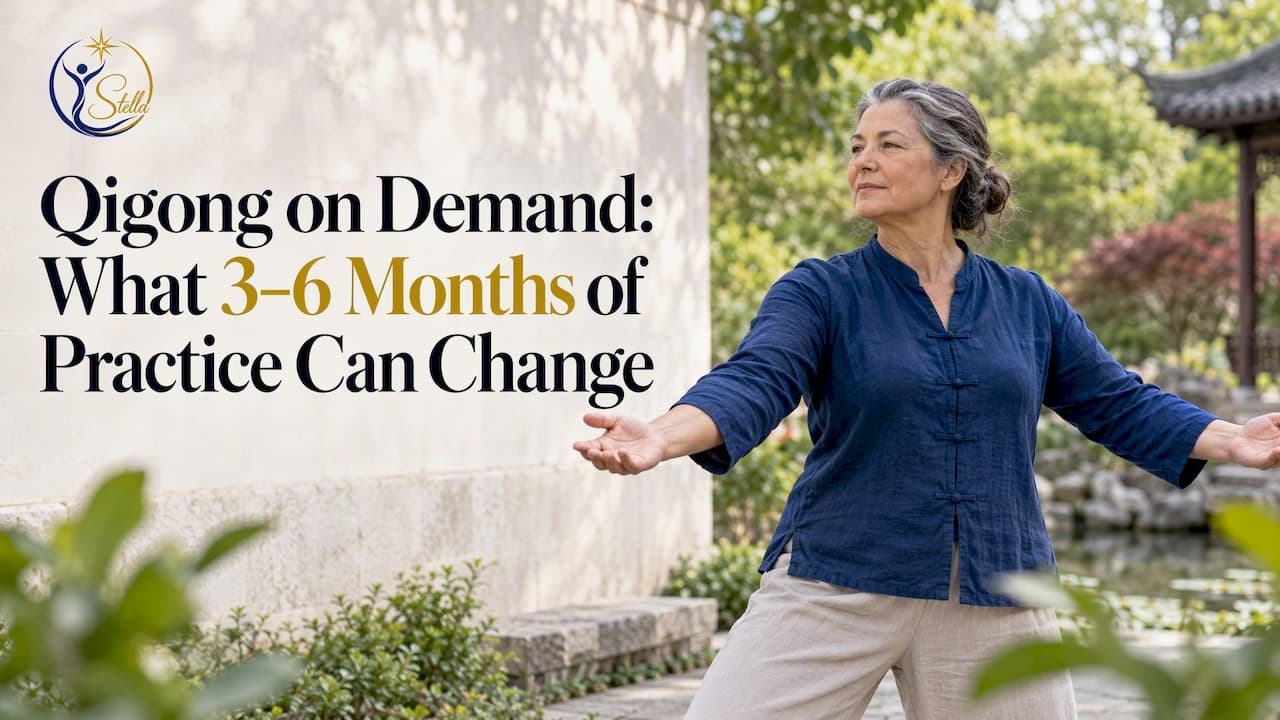
On-demand qigong can reliably support stress reduction, better sleep, improved mobility, and some metabolic markers when you practice it regularly under qualified guidance. The evidence is promising, though it never replaces medical care, and even beginner-friendly recorded routines can bring a calming effect within the first few sessions. Systematic reviews, NCCIH guidance, and platforms like our own QigongStar on-demand courses all point the same direction: consistency matters more than format.
TL;DR:
- Metabolic trials link 30 to 60 minute sessions, two to seven times weekly for three to six months, with reduced waist circumference, systolic pressure, and triglycerides.
- For acute stress, 10 to 15 minute routines can help; sustained anxiety and sleep improvements are linked to regular 30 to 60 minute sessions.
- Choose a progressive recorded course over random videos, then add occasional live instruction for posture corrections; recorded classes offer flexibility but no immediate feedback.
- Trial results vary by qigong style; consult a clinician before starting during pregnancy, after surgery, or with unstable heart disease.
Table of Contents
- Physical benefits you can expect from regular qigong practice
- Mental and emotional benefits: stress, anxiety, mood, and sleep
- Research summary: what systematic reviews and RCTs actually show
- How on-demand qigong works and how to use it effectively
- Safety, side effects, and medical cautions
- Author's perspective: Stella on teaching on-demand qigong and what learners report
- Specific benefits of Qigong for digestive health and gut-related issues
- Comparison of on-demand Qigong versus in-person or live sessions for effectiveness
- Role of breath regulation and spiritual development in enhancing benefits
- Customization and progression advice for different skill levels using on-demand courses
- What the evidence gets right, and what gets oversold
- Try an on-demand class: how to start with our courses
- FAQ
- Sources
Physical benefits you can expect from regular qigong practice
Qigong moves the body gently, but the physiological effects reach further than the slow pace suggests. A systematic review and meta-analysis of people with metabolic syndrome found measurable improvements in cardiovascular risk markers, including reductions in waist circumference, systolic blood pressure, and triglyceride levels, with effects strengthening when practice continued for three to six months. A related 2023 review reached similar conclusions while noting that longer interventions, around six months, tended to produce greater improvements in diastolic blood pressure, HDL cholesterol, and body mass index than shorter programs did, based on seven randomized trials.
Beyond cardiovascular markers, people who practice qigong consistently tend to report better balance, looser joints, and less chronic pain in the neck, back, and knees. These gains come from the practice's emphasis on slow, controlled weight shifts and spinal articulation, the same movement patterns that physical therapists use to rebuild functional mobility after injury.
The trials behind these findings used fairly consistent practice patterns: sessions of 30 to 60 minutes, performed two to seven times a week, sustained for 8 to 24 weeks or longer. You can build toward that rhythm gradually using on-demand classes rather than trying to match it on day one.
A handful of beginner-level movements show up across most on-demand qigong libraries:
- Seated breath-centering: a few minutes of slow belly breathing while seated, often the opening movement in a recorded class.
- Standing grounding: feet shoulder-width apart, knees soft, weight settling evenly, a posture used to anchor the rest of the session.
- Gentle spinal twist: a slow rotation through the torso that loosens the lower back without strain.
- Cloud hands: a flowing arm movement that builds shoulder mobility and coordination.
- Wave-like knee bends: small, rhythmic flexions that warm up the joints before deeper movement.
None of these require equipment or much space, which makes them realistic for a living room or a quiet corner of an office.
Mental and emotional benefits: stress, anxiety, mood, and sleep
Qigong's reputation as a stress reliever holds up under closer research scrutiny and can be complemented by techniques like online hypnotherapy to manage anxiety and stress effectively. A systematic review and meta-analysis of randomized controlled trials in healthy adults found pooled reductions in anxiety with an effect size around -0.75 and in perceived stress around -0.88, both in the moderate-to-large range, typically after one to three months of practice.
Qigong practiced two to three times weekly for a couple of months has been linked to measurable drops in perceived stress, along with improved sleep and reduced fatigue, according to a narrative review of RCTs on workplace stress recovery.
The likely mechanisms are straightforward. Slow, coordinated movement paired with deliberate breathing tends to lower sympathetic nervous system activity, the body's fight-or-flight response, while increasing parasympathetic tone, the rest-and-digest state. Some trials have also recorded reductions in stress hormones like cortisol alongside these shifts, though the research base here is still developing.
Sleep and fatigue often improve on a similar timeline to stress, usually within a few weeks of steady practice, though some people notice calmer evenings after just a handful of sessions. A few practical distinctions help:
- Short routines (10 to 15 minutes) work well for acute stress spikes, like decompressing after a hard meeting.
- Longer, regular sessions (30 to 60 minutes, several times weekly) build the cumulative changes tied to lasting anxiety and sleep improvement.
A small, structured four-week stress reduction program produced significant drops in perceived stress and anxiety compared to a wait-list group, which suggests that even a brief on-demand starting path can deliver an early, motivating result.
Research summary: what systematic reviews and RCTs actually show
The strongest evidence for qigong sits in two places: stress and anxiety reduction, and improvement of several cardiovascular risk markers in people with metabolic syndrome. Reviews pooling multiple randomized trials consistently find moderate-to-large reductions in perceived stress and anxiety, and smaller but still meaningful improvements in blood pressure, waist circumference, and triglycerides.
That said, the research carries real limitations worth knowing before you set expectations:
- Small sample sizes: many trials include fewer than 100 participants, which widens the margin of error.
- Heterogeneity across styles: "qigong" covers dozens of distinct movement traditions, so results from one style do not automatically transfer to another.
- Inconsistent control conditions: some trials compare qigong to no activity at all, others to active alternatives like walking, which makes direct comparisons tricky.
Qigong exercise can improve cardiovascular risk factors in people with metabolic syndrome, with reductions in waist circumference, systolic blood pressure, and triglyceride levels typically seen over weeks to months of practice.
The practical translation: trials that produced the clearest benefits followed a consistent pattern of 30 to 60 minute sessions, two to seven times weekly, sustained for at least two months and often longer for metabolic outcomes. Evidence is strongest for stress, anxiety, and several cardiovascular markers; it is weaker, though still encouraging, for other claimed benefits. Matching your own routine to these trial patterns, rather than practicing sporadically, gives you the best shot at similar results.
How on-demand qigong works and how to use it effectively
On-demand qigong comes in a few formats: short standalone routines, progressive multi-week courses, recordings of live classes that include instructor Q&A, and audio-only guided sessions for days when screen time feels like too much. Each format can deliver real benefit, but progressive courses tend to outperform a grab-bag of random videos because they build skill and breath control in a deliberate order.
A practical path looks like this:
- Weeks 1 to 2: daily micro-routines of 10 to 15 minutes to build the habit and learn basic postures.
- Weeks 3 onward: progress to 30 to 60 minute sessions, two to four times a week, following a structured course rather than switching videos at random.
- Ongoing: revisit foundational movements periodically and seek live feedback when it is available, since small posture corrections make a real difference.
A few habits make on-demand practice stick: set a consistent time of day, dedicate a small patch of floor as your practice space, and keep a short log of how each session felt. Our seated qigong routine is a good starting point if space or mobility is limited.
Pro Tip: Check that your instructor holds a recognized qigong certification, since posture and breath cues from an undertrained teacher can blunt the benefit or increase injury risk.
Safety, side effects, and medical cautions
Qigong is a low-impact practice, and serious adverse events are rare. NCCIH safety summaries note that minor effects like soreness or a mild headache show up in fewer than 10% of participants across studies, and that qigong is generally safe to try for most healthy adults.
A few groups should check with a clinician before starting:
- Pregnant people, since some postures need trimester-specific adaptation.
- Anyone with unstable cardiovascular disease, given the cardiovascular markers qigong can influence.
- People recovering from recent surgery or managing severe musculoskeletal conditions.
On-demand practice adds a layer of self-monitoring since no instructor is in the room with you. Start with beginner-level classes, pause immediately if you feel dizzy or notice chest pain, and use the modifications instructors demonstrate rather than pushing through discomfort. Readers navigating pregnancy specifically can find more detail in our guide on qigong safety during pregnancy.
Author's perspective: Stella on teaching on-demand qigong and what learners report
We structure our on-demand courses the way we would teach a beginner in person: a short starter routine first, then progressive modules that build breath control and posture gradually, with recorded Q&A sessions addressing the questions that come up most often. Learners commonly tell us their stress eases within the first couple of weeks, sleep becomes steadier, and digestion feels calmer once breath-centered movement becomes a habit rather than an occasional experiment.
Our instruction is led by a certified qigong teacher, which shapes how each course is built, slowly, with attention to breath and alignment rather than rushing toward advanced forms. The most consistent pattern we see is simple: small, steady practice beats occasional long sessions, and realistic expectations keep people practicing long enough to notice the difference.
— Stella
Specific benefits of Qigong for digestive health and gut-related issues
Digestive discomfort often tracks closely with stress, and this is where qigong's calming effect on the nervous system does some of its most practical work. Slow diaphragmatic breathing, a core part of nearly every qigong form, gently massages the abdominal organs with each inhale and exhale, while lowering the sympathetic activation that tends to aggravate conditions like irritable bowel syndrome.

Gentle spinal twists and standing postures that engage the core can support healthy digestion by encouraging movement through the midsection, something that static postures throughout a workday rarely allow. People managing IBS or general bloating often describe a double benefit: the breathing itself has a soothing effect in the moment, and the broader stress reduction from regular practice seems to ease flare-ups over time.
This is an area where qigong's traditional roots and its stress-reduction evidence overlap most naturally, since gut symptoms and nervous system state are so closely linked. We cover this connection in more depth in our dedicated piece on qigong for IBS and gut health, including specific sequences aimed at easing bloating.
Comparison of on-demand Qigong versus in-person or live sessions for effectiveness
The research behind qigong's benefits comes almost entirely from supervised or structured practice, not from the delivery format itself, which means on-demand sessions can produce comparable results as long as the instruction quality and session consistency match what trials used. What changes between formats is less the physiological outcome and more the support structure around it.
In-person and live-online sessions offer real-time posture correction, which matters most in the early weeks when you are still learning basic alignment. On-demand recorded courses trade that immediate feedback for flexibility: you can practice at 6 AM or 10 PM, repeat a confusing section as many times as needed, and fit sessions around a schedule that live classes cannot always accommodate. For many people, that flexibility is what makes the difference between practicing twice a week and not practicing at all.

A practical middle ground works well: build your foundation with a structured on-demand course, then check in periodically with a live or face-to-face session for feedback on form. Our 60-Min Deep Dive Online Session offers that kind of live, personalized review alongside the self-paced course structure.
Role of breath regulation and spiritual development in enhancing benefits
Breath is the thread that connects qigong's physical movement to its calming effect on the mind. Every posture in a qigong sequence is paired with a specific breathing pattern, usually slow and diaphragmatic, and this pairing is what shifts the body out of sympathetic activation and toward the parasympathetic state linked to lower perceived stress.
Beyond the physiological piece, qigong's roots in Chinese medicine frame breath and movement as a way of cultivating internal balance, sometimes described as working with the body's energy. You do not need to adopt any particular belief system to benefit from the practice, but many learners find that the meditative, intentional quality of the movement, often described as a kind of self-transformation, deepens their sense of calm beyond what the physical exercise alone would produce.
This is part of why qigong is increasingly described in research as a "meditative movement" practice, where the combination of movement, breath, and focused attention produces effects that neither element delivers on its own. Approaching your on-demand sessions with that same intention, rather than treating the movements as mechanical exercise, tends to deepen the benefit over time.
Customization and progression advice for different skill levels using on-demand courses
A well-built on-demand course should meet you where you are rather than pushing everyone through the same sequence. Complete beginners benefit most from short, seated or gently standing routines that introduce breath coordination before adding complex movement, usually across the first two weeks of practice.
Once the basics feel familiar, progressing to standing forms with fuller range of motion, like our White Tiger Qigong or Five Animal Qigong sequences, lets you build strength and flexibility at a pace your body sets rather than a fixed calendar. People managing joint pain or limited mobility can modify nearly every standing posture into a seated or supported version without losing the breath-and-movement coordination that drives the benefit.
More experienced practitioners tend to extend session length and frequency, moving toward the 30 to 60 minute, multiple-times-weekly pattern that trials associate with stronger cardiovascular and stress outcomes. The goal at every level is the same: progress only when a movement feels fully comfortable, not on a fixed timeline, and return to foundational postures whenever a new sequence feels rushed.
What the evidence gets right, and what gets oversold
The strongest case for qigong is also the most modest one: regular, moderate practice reliably calms the nervous system and nudges a handful of cardiovascular markers in the right direction. That is a real, research-backed result, and it does not need embellishment to be worth your time.
Where conventional advice falls short is the assumption that more intense or more "advanced" practice automatically means better results. The trials behind qigong's strongest findings used modest session lengths and moderate weekly frequency, not marathon sessions or rare forms. Consistency beat intensity in nearly every study we have referenced here.
If you are deciding where to start, prioritize showing up regularly over finding the "perfect" sequence. A short, imperfect daily routine for a month will outperform an ambitious hour-long practice attempted twice before stalling. The format, recorded or live, matters far less than whether you actually return to the mat.
— Stella
Try an on-demand class: how to start with our courses
If the research above has you curious, the most direct next step is trying a structured class rather than piecing together routines from scattered videos. Our Qigong for Stress Relief and Digestive Wellness course (one-off fee) follows the same progressive structure described throughout this guide, moving from foundational breathing into fuller movement sequences at a pace that matches how the research-backed trials were actually run.
For a more personalized entry point, our 30-Min Clarity Session (one-off fee) gives you direct, live guidance before committing to a full course, and our 60-Min Deep Dive Online Session (one-off fee) works well once you want deeper feedback on form.
A sensible starter plan looks like this:
- Weeks 1 to 2: a 10 to 15 minute daily intro routine to build the habit.
- Week 3 onward: progress to 30-minute sessions, two to three times weekly.
- Ongoing: add a live session periodically for posture feedback and course guidance.
Browse the full range of online qigong classes and courses to find the starting point that fits your schedule.
This article is general information, not a substitute for advice from a qualified doctor. Consult a qualified healthcare professional about your own circumstances before acting on anything here.
FAQ
Can you lose weight with qigong?
Qigong is not primarily a weight-loss exercise, but reviews link regular practice to improved metabolic markers like waist circumference and triglycerides in people with metabolic syndrome, typically over three to six months. Any weight change tends to be modest and works best alongside other healthy habits rather than as a standalone method.
What are the six healing sounds in qigong?
The six healing sounds are a traditional qigong breathing practice that pairs specific sounds and exhalations with different organs and emotions, used to release tension and support internal balance. Definitions and exact sound sequences vary somewhat by lineage and teacher, so the specifics taught in one course may differ slightly from another.
Is qigong or tai chi better for older adults?
Both practices use slow, low-impact movement and are generally well tolerated by older adults, with research supporting benefits for balance, mobility, and stress reduction in each. The better choice often comes down to personal preference and which style's pacing and postures feel more comfortable, rather than one being clearly superior for this age group.
What should I check before starting qigong, and are there side effects to know about?
Minor effects like soreness or a mild headache appear in fewer than 10% of participants in studies, and serious adverse events are rare. People who are pregnant, recovering from recent surgery, or managing unstable cardiovascular disease should check with a clinician before starting, and beginners should choose instructor-led classes with clear modifications.
How soon will I notice benefits from on-demand qigong?
Many people notice a calming effect within the first few sessions, while measurable improvements in stress, sleep, and fatigue typically build over several weeks to a few months of consistent practice. Cardiovascular and metabolic improvements tend to take longer, often three to six months of regular sessions.
Sources
- Managing stress and anxiety through qigong exercise in healthy adults: a systematic review and meta-analysis of randomized controlled trials
- Effects of qigong exercise on cardiovascular risk factors in patients with metabolic syndrome: A systematic review and meta-analysis
- Effects of qigong exercise on cardiovascular risk factors in patients with metabolic syndrome: A systematic review and meta-analysis (Frontiers, 2023)
- Qigong: What you need to know — National Center for Complementary and Integrative Health (NCCIH)