
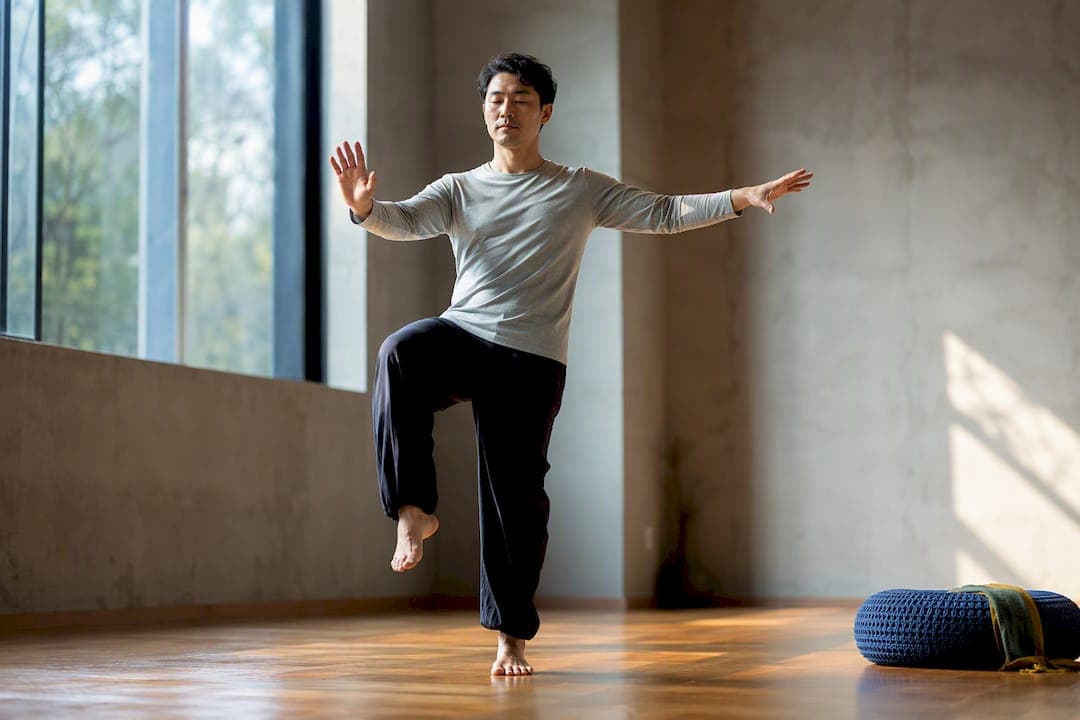
Qigong improves physical balance when you practice it consistently, and the research backs this up across multiple randomized trials. Start today with three exercises: a supported one-leg stand, gentle foot circles, and one or two Baduanjin postures. Practice daily for five to fifteen minutes, or three times weekly, and you should notice steadier footing within a matter of weeks.
TL;DR:
- Consistent practice of Qigong exercises like one-leg stands and foot circles can lead to noticeable balance improvements within a few weeks, especially with daily sessions.
- The largest gains in balance typically occur after 12 to 24 weeks of regular, repeated practice, rather than in shorter durations.
- Tracking progress through simple measures such as one-leg stand time and timed walking tests enhances motivation and guides safe progression.
- Safety precautions, such as using sturdy support and modifying moves for osteoporosis or knee issues, are essential for beginners and those with health concerns.
- Structured courses like Five Animal Qigong or White Tiger Qigong accelerate progress and provide clearer guidance for sustained balance development.
Table of Contents
- Key Qigong Exercises for Balance You Can Start Today
- A 5 to 15 Minute Daily Qigong Routine for Balance
- Safety, Common Issues, and How to Modify
- How Often and How Long: A 12 to 24 Week Plan
- What the Research Actually Shows About Qigong and Balance
- What I Tell Students About Balance Training
- Where the Real Gains Come From (And What Gets Overrated)
- Take Your Balance Practice Further With Qigong Exercises
- Sources
Key Qigong Exercises for Balance You Can Start Today
Balance training works on a simple principle: you challenge your body's stability just enough to make it adapt, without pushing so far that you fall. Qigong does this through slow, controlled movement that trains your muscles, joints, and inner ear to work together. Here are the exercises that build that foundation.
- One-leg stand (Rooster stand). Stand behind a sturdy chair, feet hip-width apart. Shift your weight into one foot and lift the other knee to hip height. Hold, breathing gently, for as long as feels stable. Beginners hold the chair with both hands; once you feel steady, try one hand, then no hands, then closed eyes. Time yourself in seconds and track that number week over week.
- Foot circles and ankle mobility. Sitting or standing, lift one foot slightly and trace slow circles with your toes, ten in each direction, then switch feet. This wakes up the small stabilizing muscles around your ankle that control sway, and it sharpens proprioception, your body's sense of where it is in space without looking.
- Weight-shifting walk. Walk in a straight line, deliberately rolling your weight from heel to toe with each step, pausing half a second on each foot before shifting. This teaches your nervous system to control your center of gravity instead of letting momentum do the work.
- Baduanjin postures. Two postures from the Eight Brocades sequence, "Separating Heaven and Earth" and "The Owl Gazes Back," both require single-leg weight bearing combined with a slow torso rotation, which is exactly the kind of layered challenge that trains real-world stability.
- Wuqinxi crane balance. Borrowed from the Five Animal Frolics tradition, this movement has you extend one leg back while lifting the arms overhead like wings, building the dynamic balance you need for uneven ground.
A 2022 meta-analysis pooling 17 randomized trials found that Baduanjin practice produced measurable gains on the Berg Balance Scale and Timed Up and Go test, and the benefit grew larger with more total practice time. That is the clearest signal we have: more consistent practice, not longer individual sessions, drives the improvement.
Pro Tip: Measure your one-leg stand time with a phone timer once a week, same time of day, same leg first. Small, steady gains here often show up in your everyday stability before you consciously notice them.
A 5 to 15 Minute Daily Qigong Routine for Balance
You do not need a studio or an hour to feel the difference. Pick the version that fits your day.
5-minute version (on the go):
- Joint warm-up: ankle rolls and knee circles, 30 seconds each side.
- One-leg stand, both sides, 30 to 60 seconds each.
- Ten weight shifts, side to side.
- One minute of slow breathing, hands resting on your lower belly.
15-minute version (focused practice):
- Warm-up: neck rolls, shoulder circles, ankle and knee mobility, two minutes.
- Foot circles, both feet, two minutes.
- One-leg stand progressions (chair, then hands-free), four minutes.
- Two Baduanjin postures with balance components, five minutes.
- Weight-shifting walk across the room and back, twice.
- Cool-down: standing stillness with slow, low breathing, two minutes.
Move slowly enough that your breath stays even. If you find yourself holding your breath during the one-leg stand, that is a cue to widen your stance slightly and try again.
Safety, Common Issues, and How to Modify
Balance training carries a small risk of falls if you push too far too fast, so build in safeguards from day one.
- Keep a sturdy chair or countertop within reach for every standing exercise until you can hold thirty seconds unsupported.
- If you have vestibular issues or get dizzy easily, avoid fast head turns and keep your gaze fixed on a point in front of you.
- Mild lightheadedness or muscle soreness after your first few sessions is common and usually settles within a week; if dizziness persists, shorten your hold times.
- With osteoporosis, skip deep forward bends and keep spinal rotation gentle during Baduanjin postures.
- With knee osteoarthritis, reduce how deeply you bend the standing knee and shorten hold times rather than pushing through discomfort.
- Stop and check with a doctor if you feel chest pain, sharp joint pain, or your balance suddenly worsens.
Clinical trials using Qigong protocols in older and frailer participants have reported no serious adverse events when sessions were paced appropriately, which is reassuring if you are starting later in life or after an injury.
Pro Tip: If a posture feels wobbly, shrink the range of motion before you abandon it. A smaller, controlled movement still trains balance; a movement you cannot control does not.
How Often and How Long: A 12 to 24 Week Plan
Your body needs repeated exposure to a challenge before it adapts, and balance is no exception. Aim for one of these two patterns:
- Three sessions a week, 15 to 30 minutes each, or daily sessions of 5 to 15 minutes, whichever fits your schedule better.
- Check your one-leg stand time and a simple Timed Up and Go (walk 10 feet, turn, walk back, time it) every four weeks.
- Expect a noticeable change by week 12; if you keep going to week 24, dynamic balance gains tend to keep building.
- Stack your practice onto an existing habit, right after brushing your teeth or before your morning coffee, so it doesn't depend on motivation.
- Log your times in a notes app or a simple paper chart. Seeing the numbers move is often what keeps people practicing past the first month.
For more ways to fold short sessions into a busy week, see this guide to integrating Qigong into your daily routine.
What the Research Actually Shows About Qigong and Balance
The evidence for Qigong's effect on balance is not thin or anecdotal. A 2022 systematic review of 17 randomized controlled trials involving 1,267 participants found that Baduanjin practice improved Berg Balance Scale scores by an average of 4.82 points and cut Timed Up and Go time by 2.21 seconds compared with control groups. A separate 12-week manualized Medical Qigong protocol produced a clinically significant 11.9-point improvement on the Confidence in Balance and Mobility Scale, with the strongest effects among participants in their sixties and seventies. A 24-week Wuqinxi trial in older women with a history of falls found one-leg stand time increased by up to 80.6 percent by the 24-week mark, with dynamic balance gains outpacing what was seen at 12 weeks.
Three mechanisms explain why this works:
- Strength and proprioception. A 12-week Baduanjin trial in postmenopausal women showed measurable improvements in muscle strength and postural sway metrics, meaning your body literally gets better at sensing and correcting small shifts in weight.
- Weight-shifting practice. Every slow transfer of weight from one leg to the other rehearses the exact motor pattern that prevents a stumble from becoming a fall.
- Confidence. Better balance confidence changes how freely you move through your day, which the Medical Qigong trial captured directly.
The practical takeaway: consistency across 12 or more weeks matters more than cramming long sessions into fewer days.
What I Tell Students About Balance Training
Rooting is the cue I return to most in live classes: imagine your standing foot growing roots into the floor before you even attempt to lift the other leg. Most beginners rush this step, lifting the free leg before their support leg has truly settled, which is why they wobble in the first three seconds rather than after thirty.
Micro-shifts, tiny weight transfers of an inch or less, teach control better than dramatic lunges ever will. And breath timing matters: exhale as you lift, inhale as you lower. Rushed breath is almost always the hidden cause of a shaky stand.
Live classes let me catch these small errors in real time, something on-demand video simply cannot do for a true beginner. Once a student has the pattern in their body, on-demand practice becomes a perfectly good way to keep building.
Both formats have a place; the right one depends on where you are starting from.
— Stella
Where the Real Gains Come From (And What Gets Overrated)
The research is consistent enough to state plainly: Qigong builds measurable balance improvement, and it does so through ordinary, repeatable mechanics, not mysticism. What surprises people is how little drama the effective version requires. You do not need an hour-long practice or a perfect memory of forty postures. You need a handful of exercises done often enough that your nervous system stops treating them as novel.
Where conventional advice falls short is duration guessing. Plenty of general wellness content promises fast results, but the trials that actually measured change ran 12 to 24 weeks, and the biggest dynamic balance gains showed up in the second half of that window. If you quit at three weeks because you don't feel dramatically different, you are stopping right before the data says things start moving.
Prioritize frequency over intensity. A wobbly thirty seconds today, tracked weekly, beats an ambitious routine abandoned after day four.

Take Your Balance Practice Further With Qigong Exercises
Once the basics feel steady, a structured course builds on that foundation faster than solo practice alone. Five Animal Qigong draws on the same Wuqinxi tradition behind the crane balance exercise above, moving you through dynamic animal-inspired postures that layer weight-shifting and coordination onto what you have already practiced.
If you prefer a more structured, progressive path with deeper breathwork and posture refinement, White Tiger Qigong offers exactly that, and it suits beginners and older adults who want clear step-by-step guidance rather than figuring out progressions alone. Both courses run through Stella Qigongstar's online classes, with live sessions for real-time feedback on posture and rooting, plus on-demand lessons you can revisit as your balance improves over the coming weeks. Explore the course options and find the format that matches how you learn best.
Sources
- The effect of Baduanjin on the balancing ability of older adults: A systematic review and meta-analysis
- Effects of the Chinese traditional fitness practice Wuqinxi on balance improvement in older women with a history of falls: a randomized controlled trial