
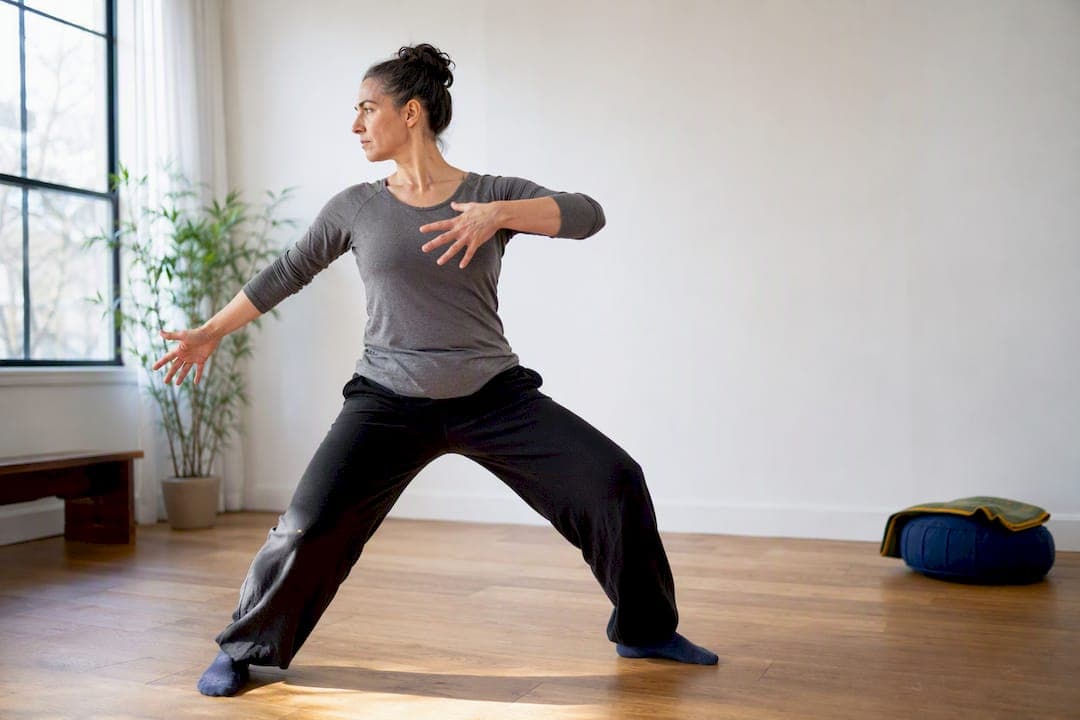
Yes, targeted qigong can stimulate the liver meridian, and it starts with a few honest, repeatable moves: the liver twist, the liver squat, spinal breathing, and the swimming dragon. Practiced gently and consistently, this short sequence tends to ease tension along the inner legs and ribs and support smoother energy flow through the body. If you carry a joint injury, adapt the depth of each stance, and always check with your doctor first if you're managing a diagnosed liver condition or other medical symptoms.
TL;DR:
- Proper muscle engagement during movements like the liver squat and twist enhances safety and effectiveness, preventing reliance on passive stretching.
- Diaphragmatic movement during spinal breathing mobilizes tissues around the liver, supporting energy flow along the meridian pathway.
- Practicing key exercises consistently for several weeks may reduce muscular tension and improve energy circulation, but immediate results are limited.
- Individuals with joint limitations should modify stances or use supports, and stop if experiencing sharp pain or persistent discomfort.
- Qigong supports muscular relaxation and breathing ease but is not a substitute for medical treatment of liver conditions or severe symptoms.
Table of Contents
- What Is Liver Meridian Qigong?
- Core Liver Meridian Exercises: A Step-by-Step Routine
- How Do You Practice Liver Qigong Safely?
- Where Does the Liver Meridian Run, and What Does Imbalance Feel Like?
- Common Mistakes and How to Fix Them
- Who Teaches This Practice, and How Does Stella Structure It?
- When Targeted Meridian Practice Helps, and When It Doesn't
- Ready to Practice With Guidance?
- Sources
- FAQ
What Is Liver Meridian Qigong?
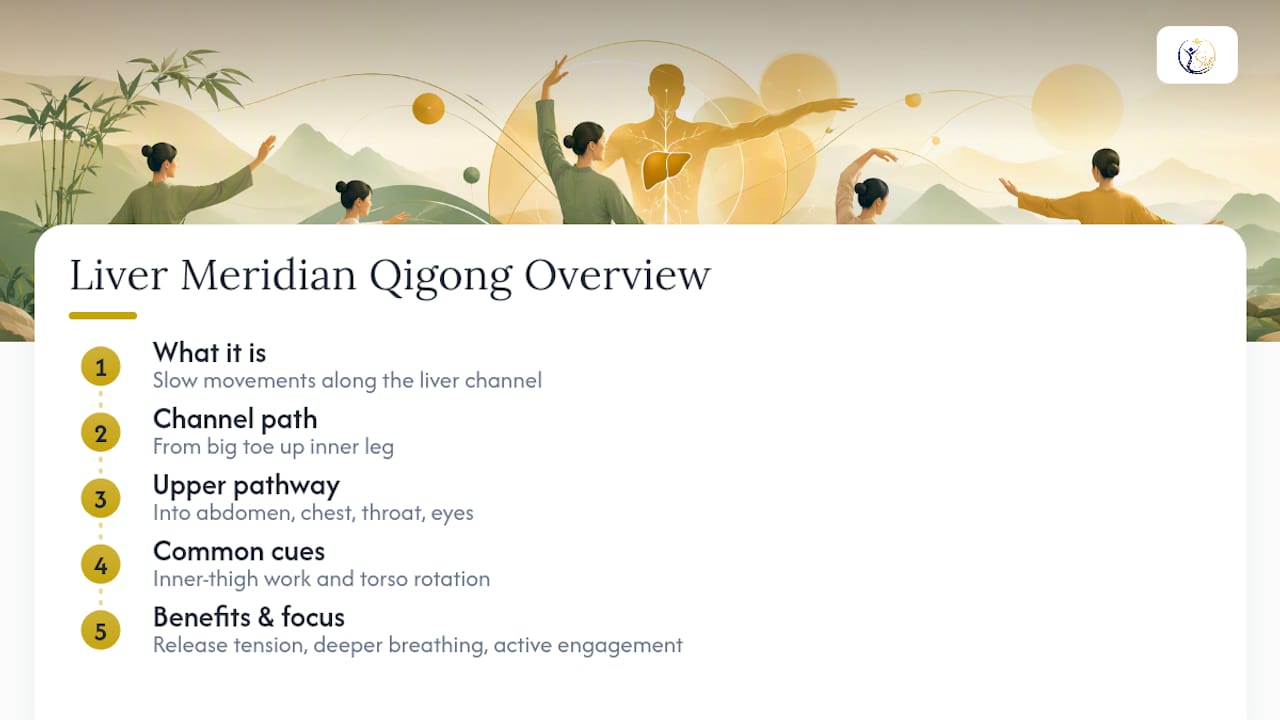
Liver meridian qigong is a set of slow, deliberate movements designed to stretch, compress, and gently massage the pathway Traditional Chinese Medicine calls the Foot Jueyin, or liver channel. This channel runs from the big toe, up the inner leg, into the abdomen, and toward the chest, throat, and eyes, which is why so many liver-focused exercises involve inner-thigh work and torso rotation.
You may also see this practice called liver detox qigong or liver qigong techniques in wellness circles. Those labels can be misleading if taken literally. Qigong doesn't perform the biochemical work your liver does on its own. What it does offer is a gentle, low-impact way to release muscular tension, encourage deeper breathing, and support the kind of steady energy flow that traditional qigong practices have emphasized for centuries. Think of it less as scrubbing your liver clean and more as clearing the pathway around it so energy and blood move without resistance.
The routine below draws on the same class-tested cues used in structured liver meridian exercises, with an emphasis on active muscle engagement rather than passive stretching. That distinction matters for both safety and effectiveness, and we'll get into exactly why in the next section.
Core Liver Meridian Exercises: A Step-by-Step Routine
You don't need special equipment or a studio to begin. What you do need is patience with your own range of motion and a willingness to feel the stretch rather than force it. Here are the five movements that form a well-rounded liver meridian qigong session.
-
Liver twist (straddle torso twist). Stand with your feet wider than shoulder width, toes turned slightly outward, knees soft. Inhale as you lengthen your spine, then exhale as you rotate your torso to one side, letting your gaze follow your leading hand. Lead the rotation from your pelvis rather than yanking with your shoulders. This single cue protects your lower back while increasing the gentle massaging effect on the liver that the twist is designed to create. You should feel a mild pull along your inner thigh and a light squeeze through your ribs on the side you're twisting away from. Beginners can shorten the stance and reduce the rotation to a quarter turn until the hips feel more open.
-
Liver squat, or straddle stretch. From the same wide stance, bend your knees and sink your hips back slightly, as if settling into an invisible chair. Rather than letting your inner thighs go slack, actively contract them, drawing your knees gently inward against the stance. This activation, not passive sinking, is what experienced teachers identify as the mechanism that engages the meridian channel and protects your knees at the same time. Hold for three to five breaths, then rise. Two to three sets of this hold, done slowly, will do more for you than a single deep, unsupported drop into the stretch.
-
Spinal breathing. Sit or stand tall, hands resting on your lower ribs. Inhale slowly through your nose, letting your ribcage expand sideways and your diaphragm drop. Exhale fully, feeling your ribs and belly draw inward. Repeat for eight to ten breaths. This isn't just a breathing warm-up. The diaphragm sits directly above the liver, and its rhythmic movement during spinal breathing mobilizes the tissue around the organ with every cycle.
-
Swimming dragon, or spiral twist. Stand with feet hip-width apart, knees soft. Initiate a wave-like motion starting at your hips, spiraling gently up through your spine and out through your fingertips, as though you were a ribbon caught in a slow current. Alternate the spiral from side to side, keeping your feet grounded. This movement adds rotational variety that a straight torso twist doesn't, encouraging flexibility along the whole meridian line rather than just one segment.
-
Liver cleansing push and pull. Standing in a comfortable stance, coordinate a rolling exchange between your palms, one hand pushing forward and down as the other pulls back and up, syncing the motion with your breath. Many instructors sequence this after a "Pull Down the Heavens" opening and close the set the same way, sometimes adding a soft vocalization, an exhaled "SHUUU" sound, to help release tension on the exhale. This combination of steady breath, rolling hand exchanges, and gentle vocalization is a recognizable hallmark of liver-focused qigong sequences taught in class settings.
Pro Tip: If you only have five minutes, do the liver twist and spinal breathing back to back. Together they cover both the rotational compression and the diaphragmatic movement that liver meridian work depends on.
For any of these moves, especially the swimming dragon's spiral coordination, watching a qualified instructor demonstrate the timing in real time will save you weeks of guessing. A short video or a live class removes the ambiguity that text alone can't fully resolve.
How Do You Practice Liver Qigong Safely?
Safety in liver meridian qigong comes down to four things: your stance, your breath, your muscle engagement, and how honestly you listen to your body along the way.
Muscle activation is the piece most beginners skip. It's tempting to treat these stretches like a passive yoga hold, letting gravity do the work while your muscles go quiet. Start by squeezing gently, holding for a few seconds, then releasing before you deepen the stance further. This progression, engage, hold, deepen, is safer and more effective than sinking straight into your maximum range.
Traditional qigong practices often refer to the Three Regulations: regulating the body (your posture and alignment), regulating the breath, and regulating the mind (staying present rather than distracted). Timing your breath to your movement, inhaling as you lengthen and exhaling as you rotate or release, is what turns a stretch into a qigong practice rather than a warm-up exercise. Some instructors add the liver sound, an audible "SHUUU" exhale, during the twist or the push-pull sequence. It's optional, but many students find it helps release tension they didn't realize they were holding in the jaw or shoulders.
A simple session template looks like this:
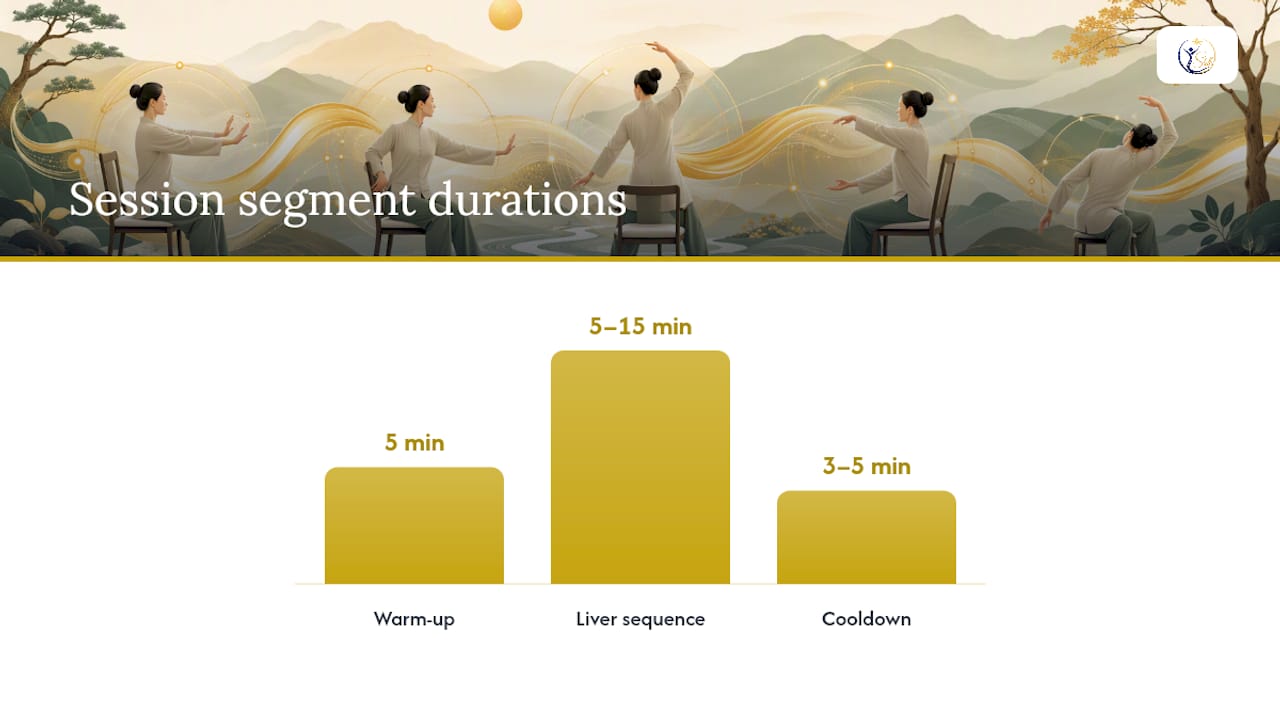
- Warm-up (5 minutes): gentle joint rotations at the ankles, knees, hips, and spine, plus a few rounds of spinal breathing to settle your nervous system.
- Liver sequence (5 to 15 minutes): the liver twist, liver squat, swimming dragon, and push-pull exchange, moving slowly and pairing each movement with breath.
- Cooldown (3 to 5 minutes): standing stillness or a seated pause, letting your breath return to a natural rhythm before you move on with your day.
Aim for daily practice if you can manage it, even if that means just the five-minute version some mornings. Regular practice several times a week is a reasonable minimum for most adults. If your knees or hips are limited, narrow your stance and reduce the depth of the squat. Chair-supported versions of the twist work well for anyone with balance concerns.
Pro Tip: If you feel a sharp, pinching pain anywhere, not the mild stretch sensation along your inner thigh or ribs, stop immediately. Sharp pain is your body's clearest signal that something needs adjusting, whether that's your stance, your depth, or your day off.
Reduce intensity if you notice lingering soreness the next day, dizziness during the twist, or joint discomfort that doesn't ease once you're out of the stance. Persistent pain, numbness, or symptoms that worsen over several sessions warrant a conversation with a clinician before you continue.
Where Does the Liver Meridian Run, and What Does Imbalance Feel Like?
The liver meridian pathway traces a specific route through the body, and knowing it helps you understand where you should actually feel these exercises working.
- Starts at the outer edge of the big toe
- Travels up across the top of the foot
- Runs along the inner leg, passing the inner ankle, calf, and thigh
- Enters the abdomen and passes through the diaphragm
- Continues into the chest and up through the throat
- Connects with the tissue surrounding the eyes
This is exactly why the liver twist and liver squat target the inner thigh and ribs. You're working directly along this channel's physical route.
In Traditional Chinese Medicine, this channel is closely tied to the Wood element and is thought to govern the smooth flow of energy and emotion throughout the body, an idea explored further in this guide to how ancient Chinese healing works. When that flow feels stagnant, TCM associates a cluster of physical signs with the imbalance:
- Dry, red, or blurry eyes
- Brittle or ridged fingernails
- Muscle cramps or spasms, particularly in the legs
- Tension headaches
- Menstrual irregularities in women
According to NHS guidance on complementary therapies, these kinds of symptoms deserve a clinical evaluation if they're severe, persistent, or unexplained, since many conditions unrelated to energy flow can produce similar signs. Qigong may ease the muscular tension and restricted mobility that often accompany these complaints, and some practitioners describe a real, palpable release of tightness after consistent practice. But easing tension is different from treating organic liver disease, and framing "liver detox" claims as physiologic support rather than clinical treatment keeps expectations honest. If you have a diagnosed liver condition, qigong is a complement to your care plan, never a substitute for it.
Common Mistakes and How to Fix Them
Most people who feel frustrated with their qigong progress aren't doing the wrong exercises. They're making one of a handful of small technical errors that quietly undercut the whole practice.
-
Passive stretching instead of active engagement. Sinking into the straddle stretch without contracting your inner thighs turns a meridian exercise into a static hold with little benefit. Fix this by squeezing your inner thighs gently as you settle into the stance, then holding that engagement throughout.
-
Rounding the spine during the twist. A collapsed chest limits the rotation your ribs need and reduces the diaphragmatic compression that makes the liver twist effective. Keep your sternum lifted and lengthen through the crown of your head before you rotate.
-
Shallow, chest-only breathing. If your shoulders are rising and falling but your ribs aren't expanding sideways, you're missing the diaphragmatic movement that spinal breathing depends on. Place a hand on your lower ribs and breathe until you feel that hand move outward.
-
Knees collapsing forward past the toes. This is a common compensation when the stance is too narrow or too deep for your current mobility. Widen your stance slightly and reduce depth until your knee tracks in line with your foot.
A sensible progression ladder looks like this: start with mobility drills (joint rotations and gentle range-of-motion work), move into activation drills (short holds with inner-thigh engagement), and only then add depth to your squats and twists. Increase your hold times or repetitions by small increments, adding one or two breaths per week rather than jumping straight to a deep stance.
If your knees or hips limit you, a chair-supported version of the twist, seated with feet flat and rotating from the torso, still delivers the breath and rotation benefits without the joint strain of a standing straddle. Stop and consult a clinician if you experience sharp pain, numbness that spreads down your leg, or symptoms that worsen rather than ease with rest.
Who Teaches This Practice, and How Does Stella Structure It?
Stella brings a background in both White Tiger Qigong and Five Animal Qigong to her liver meridian sessions, two traditions that emphasize precise joint alignment alongside breath and movement. Students who work through liver-focused routines often report a noticeable easing of tension across the ribs and inner legs within a few consistent weeks of practice.
Her class structure typically opens with joint mobilization, moves into the liver twist and squat with a strong emphasis on inner-thigh activation cues, spends time on breath pacing before introducing the swimming dragon's spiral, and closes with the push-pull exchange and a settling cooldown. Throughout, she repeats a few anchor cues: "lead with the pelvis" during rotations, "squeeze before you sink" during the squat, and "breathe into your ribs, not just your chest" during spinal breathing.
Guided instruction like this matters because a teacher can catch the small misalignments, a collapsing knee, a shallow breath, before they become habits.
When Targeted Meridian Practice Helps, and When It Doesn't
Be honest with yourself about the timeline here. A single session of liver meridian qigong might leave you feeling looser through the hips and calmer in your breath, but the deeper shifts, less muscular tension, steadier energy through the day, better sleep, tend to show up after several weeks of regular practice, not several days.
I think the real value of this routine is how well it fits into an already full life. Five minutes of the liver twist and spinal breathing before bed, or during a work break, does more over a month than one ambitious hour-long session you never repeat. That's the honest trade-off with any meridian-focused practice: consistency beats intensity almost every time.
Where I'd draw a firm line is medical evaluation. If you're dealing with persistent digestive symptoms, unexplained fatigue, or eye and nail changes that concern you, qigong is not where that conversation should start. See a clinician first, then bring qigong in as a complement to whatever plan you and your doctor build together.
If you're unsure whether you're doing these movements correctly, or you simply want feedback on your form, a guided session takes the guesswork out of it faster than any article can.
— Stella
Ready to Practice With Guidance?
Reading about the liver twist and swimming dragon is one thing. Feeling a qualified instructor correct your pelvic lead or catch a knee drifting forward is another, and it's usually the difference between a routine that fades after two weeks and one that actually sticks. Stella built her Qigong for Stress Relief and Digestive Wellness course around exactly this kind of hands-on correction, delivered online so you can practice from home without sacrificing the feedback loop that makes progress stick.
Several session options are available including an introductory clarity session, a full liver sequence deep dive, face-to-face coaching, and group classes; current prices and details can be found on the provider's website. Whichever format fits your schedule, you can review course details and book directly through the online Qigong classes page.
Sources
A few sources are worth bookmarking if you want to go deeper into the theory and safety side of this practice:
- Herbal medicines and complementary therapies — NHS
- Liver meridian — ScienceDirect
- Torso twist for the liver meridian — Meine TCM
- Qigong Practice – Liver Cleansing Exercise — Shelton Qigong
FAQ
How Do You Stimulate the Liver Meridian?
You stimulate it through movements that stretch and compress its pathway, such as the liver twist, straddle squat, and spinal breathing, all of which target the inner leg, abdomen, and ribs where the channel runs.
What Emotion Does the Liver Represent?
In Traditional Chinese Medicine, the liver is associated with the Wood element and is often linked to frustration or anger when its energy feels stagnant, and to patience and a sense of steady direction when it flows smoothly.
Can Qigong Help With Liver Health?
Qigong can ease muscular tension and support relaxed, deeper breathing that many people find beneficial for overall wellbeing, but it is a complement to medical care, not a treatment for organic liver disease. Guided programs like Stella's Qigong for Stress Relief and Digestive Wellness course are designed around this kind of gentle, supportive practice.
What Are the Symptoms of a Blocked Liver Meridian?
Common signs include dry or red eyes, brittle nails, muscle cramps, tension headaches, and menstrual irregularities in women, though these symptoms can also stem from unrelated conditions and warrant medical evaluation if they persist.