
Spleen meridian Qigong exercises are gentle, deliberate movements and self-massage techniques that stimulate digestion, balance spleen energy, and reduce stress for lasting wellness. In Traditional Chinese Medicine (TCM), the spleen meridian governs nutrient transformation, mental clarity, and emotional stability. When this channel flows freely, your digestion feels easy, your energy stays steady, and worry loses its grip. This spleen meridian qigong exercises guide gives you the foundational movements, self-acupressure techniques, timing recommendations, and troubleshooting tips you need to build a safe, effective practice from day one.
What are the foundational spleen meridian Qigong movements for beginners?
Three core movements form the backbone of any beginner spleen channel practice. Each one targets the digestive organs directly, promotes Qi flow along the spleen meridian, and requires no equipment beyond a quiet space and comfortable clothing.
-
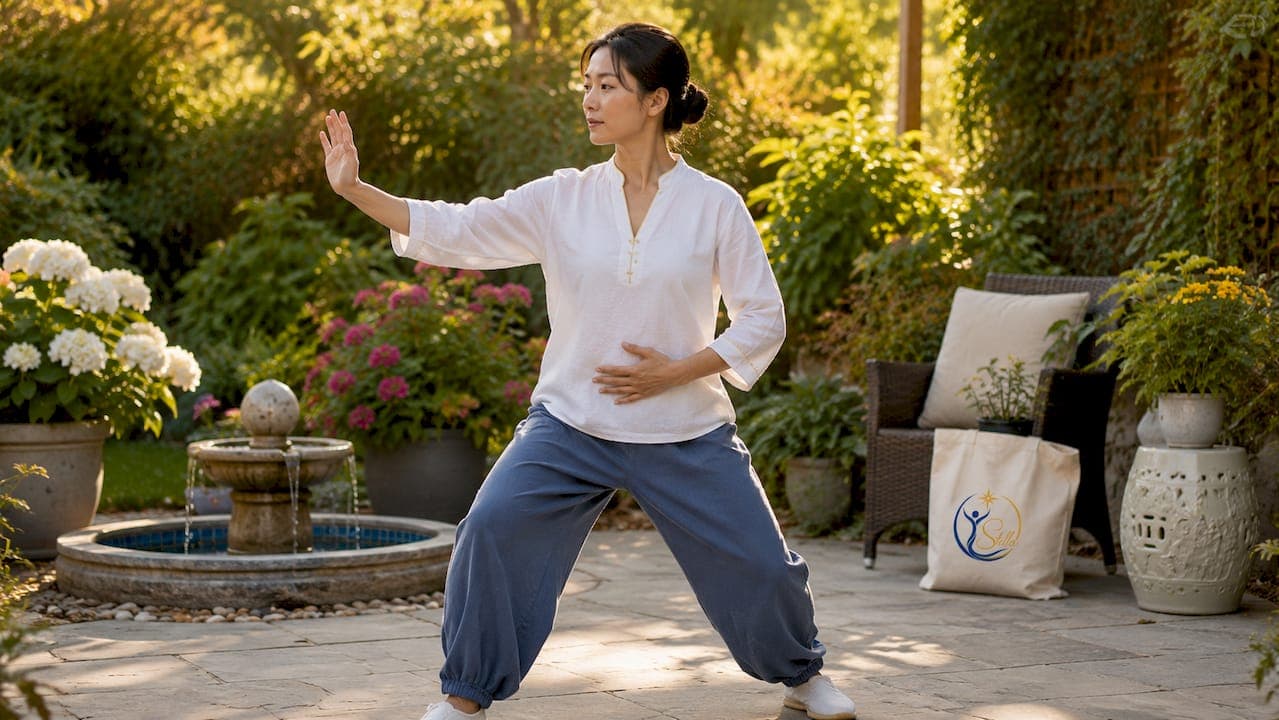
Separate Heaven and Earth. Stand with feet shoulder-width apart. Inhale as you raise one palm toward the sky and press the other toward the earth. Hold for a breath, then switch sides with a slow exhale. This horizontal torso stretch acts as an internal massage for the digestive organs while restoring lateral spinal mobility. It decompresses the rib cage, freeing the stomach and spleen from the compression that builds during long hours of sitting.
-
Gentle spinal twist. Sit or stand with a tall spine. On each exhale, rotate your torso slowly to one side, letting your gaze follow your shoulder. Return to center on the inhale. Rhythmic twisting stimulates the spleen and liver without strain and shifts the body into rest-and-repair mode. This is the movement most practitioners feel first in their gut, often as a gentle warmth spreading through the abdomen.
-
Rocking wave. Stand with soft knees. Initiate a gentle forward-and-back rocking from the pelvis, letting the wave travel up through the spine. Coordinate each rock with a slow breath. The rocking motion calms the nervous system while massaging the digestive organs from the inside. Think of it as wringing out a sponge, releasing stagnant energy and inviting fresh Qi to circulate.
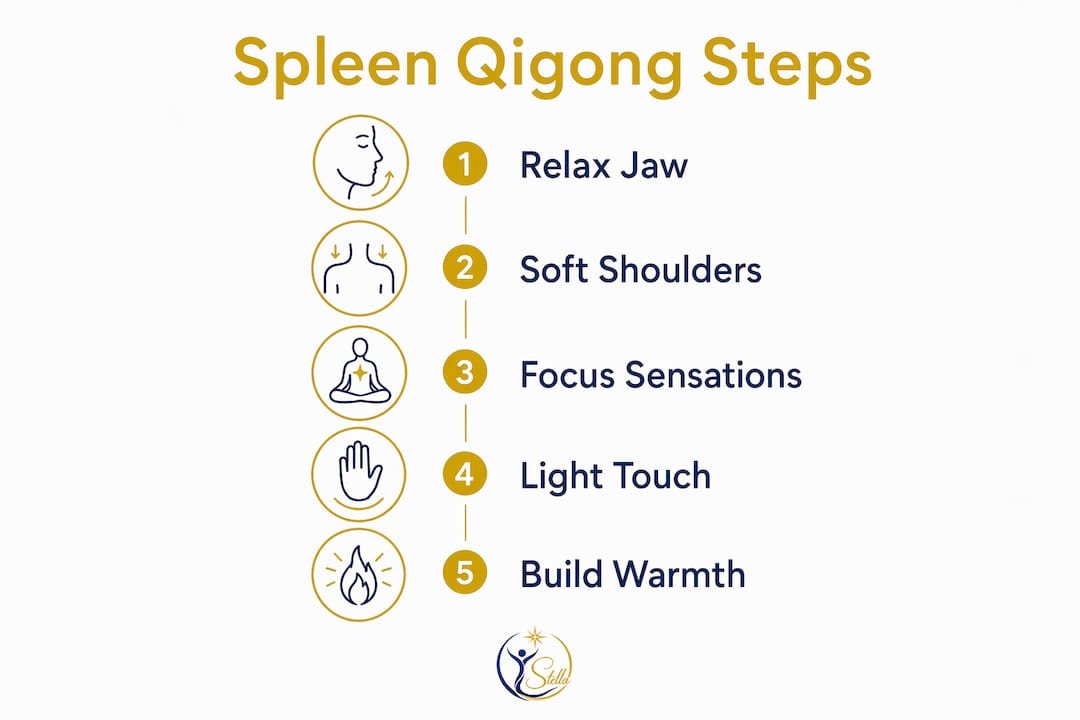
Each movement works best when you keep your jaw relaxed, your shoulders soft, and your attention on the sensations in your belly. Speed is never the goal. Slow, mindful repetition is what opens the spleen channel.
Pro Tip: Place one hand lightly on your lower abdomen while practicing. Feeling the warmth build under your palm confirms that Qi is moving. If you feel nothing at first, slow down even more.

How to use self-acupressure on key spleen meridian points
Self-acupressure complements movement by directly stimulating the spleen channel at its most accessible points. Two points stand out for beginners: Spleen-3 and Spleen-6.
-
Spleen-3 (Tai Bai). Find the inner edge of your foot, just behind the ball of the foot at the base of the big toe. Press with your thumb in slow circular motions for 1–3 minutes per point. This point is the source point of the spleen meridian, meaning it directly nourishes spleen Qi and supports nutrient absorption.
-
Spleen-6 (San Yin Jiao). Measure four finger-widths above your inner ankle bone, just behind the tibia. Apply firm but gentle circular pressure for 1–3 minutes. Spleen-6 is a meeting point of the spleen, liver, and kidney meridians, making it one of the most powerful points for alleviating bloating and restoring energetic balance.
-
Pressure technique. Use your thumb pad, not the tip. Apply pressure on the exhale and ease off slightly on the inhale. This breath-synchronized approach deepens the effect without forcing the tissue.
-
Duration and frequency. Work each point once daily, preferably after your movement practice when the meridian is already warmed up. Avoid pressing on broken skin, varicose veins, or areas of acute inflammation.
-
What to feel. A mild ache or warmth at the point is normal and signals activation. Sharp pain means you are pressing too hard. Ease off immediately.
Overstimulating spleen acupressure points can over-tax the spleen rather than support it. Gentle, consistent stimulation always outperforms intense, infrequent sessions.
Pro Tip: Warm your hands by rubbing them together for 10 seconds before applying acupressure. The added warmth amplifies circulation at the point and makes the technique noticeably more effective.
When and how often should you practice spleen meridian Qigong?
Timing your practice correctly multiplies its benefits. The spleen meridian is most active between 9:00 AM and 11:00 AM according to TCM's organ clock. Practicing during this window aligns your movement with the body's natural energy peak for digestion and transformation.
-
Daily duration. 10–30 minutes of daily practice produces measurable digestive benefits. Ten minutes is enough for beginners. Build toward 20–30 minutes as your body adapts.
-
Best timing. Practice in the morning before eating, or wait at least 2 hours after a meal. Practicing on a full stomach competes with digestion and reduces the effectiveness of the movements.
-
Consistency over intensity. A gentle 15-minute session every day outperforms a 60-minute session once a week. Regularity is what trains the digestive structures, including the diaphragm and surrounding fascia, to maximize efficiency over time.
-
For desk-bound practitioners. If you sit for long periods, a 5-minute spinal twist and rocking sequence at your desk every 2 hours prevents the digestive compression that builds from prolonged sitting. You can also explore a Five Animal Qigong digestion sequence adapted specifically for sedentary lifestyles.
-
Seasonal alignment. Late summer is the season most closely linked to the spleen in TCM's Five Element theory. Deepening your practice during this period strengthens spleen and stomach Qi and prepares the body for the drier, cooler months ahead.
What common mistakes should beginners avoid in spleen Qigong?
Most beginners make the same handful of errors. Knowing them in advance saves weeks of frustration and protects your body.
-
Rushing the movements. Speed disconnects you from the breath and reduces the internal massage effect. If you finish a sequence in under 5 minutes, you are moving too fast.
-
Holding the breath. Breath is the vehicle for Qi. Holding it during a movement blocks the very flow you are trying to create. Keep the breath slow, continuous, and coordinated with each motion.
-
Collapsing the posture. Rounded shoulders and a sunken chest compress the digestive organs. Stand or sit tall before you begin, and check your posture every few minutes during practice.
-
Ignoring fatigue signals. Spleen Qi stagnation can cause bloating, fatigue, and sluggish metabolism. If you feel more tired after practice than before, you are overworking. Reduce duration and intensity immediately.
-
Skipping the cool-down. End every session with 2 minutes of standing stillness, hands resting on the lower abdomen. This allows the Qi you have mobilized to settle and integrate.
"Qigong is not about doing more. It is about doing less, with more awareness. The spleen responds to gentleness. Treat your practice the way you would treat a tender plant: consistent care, never force."
Adjust any exercise that causes discomfort. Pain is never a sign of progress in this practice. If a movement aggravates a symptom, return to simple breath awareness and consult a qualified TCM practitioner or a certified Qigong instructor before continuing.
How does spleen meridian Qigong support digestion, emotions, and energy?
The spleen's role in TCM extends far beyond physical digestion. It governs the transformation of food into Qi and blood, the transportation of nutrients to every cell, and the mental capacity to think clearly without ruminating.
Spleen Qi deficiency links directly to worry and overthinking. This is not metaphor. When the spleen is under-energized, the mind loops on anxious thoughts, appetite becomes erratic, and energy crashes after meals. Qigong addresses this cycle by calming the mind and reducing the mental chatter that drains spleen Qi in the first place. The practice functions as meditation in motion, making it uniquely suited to people whose stress lives in their gut.
The table below shows how each dimension of spleen meridian work connects to a specific benefit.
| Dimension | TCM Mechanism | Practical Benefit |
|---|---|---|
| Physical movement | Decompresses digestive organs, promotes Qi flow | Reduced bloating, improved nutrient absorption |
| Breath regulation | Activates parasympathetic nervous system | Calmer digestion, less post-meal fatigue |
| Self-acupressure | Stimulates Spleen-3 and Spleen-6 directly | Targeted relief for sluggishness and gas |
| Emotional awareness | Quiets overthinking, reduces spleen Qi drain | Steadier mood, less anxiety-driven appetite |
| Seasonal alignment | Synchronizes practice with late summer Qi | Deeper spleen nourishment during peak season |
Qigong also retrains the diaphragm and surrounding fascia to work more efficiently. This is not symptom management. It is structural change that accumulates with consistent practice. People who practice Qigong for IBS and related gut conditions often report that the emotional relief arrives before the physical relief. That sequence makes sense through a TCM lens: calm the mind, and the spleen follows.
Key Takeaways
Spleen meridian Qigong works because it combines gentle movement, breath regulation, and targeted acupressure to restore Qi flow, calm the nervous system, and support digestion from the inside out.
| Point | Details |
|---|---|
| Start with three core movements | Separate Heaven and Earth, spinal twists, and rocking waves open the spleen channel for beginners. |
| Use acupressure at Spleen-3 and Spleen-6 | Apply circular pressure for 1–3 minutes per point daily to relieve bloating and energize digestion. |
| Practice 10–30 minutes daily | Morning or 2 hours post-meal is the optimal window; consistency matters more than duration. |
| Avoid overstimulation | Gentle, regular practice outperforms intense, infrequent sessions and protects spleen Qi. |
| Connect physical and emotional health | Reducing worry through mindful Qigong directly strengthens spleen function in TCM. |
What I've learned from years of spleen meridian practice
The first thing most people notice is not the digestion improvement. It is the quiet. After a week of consistent spleen meridian work, the mental chatter that used to follow meals starts to soften. That shift surprised me when I first experienced it, and it surprises my students too.
What I have come to understand is that the spleen is extraordinarily sensitive to pace. Push too hard, and it retreats. Move with patience, and it opens. The practitioners who see the fastest results are not the ones who practice longest. They are the ones who practice most gently, most consistently, and with the most genuine curiosity about what they feel.
Beginners often want to know when they will "feel" the Qi. My honest answer is: stop looking for a dramatic sensation. The real signal is subtler. It is the moment you realize your belly feels warmer after practice, or that you sat through a stressful afternoon without reaching for food. Those small shifts are the spleen meridian waking up.
If you are just starting out, give yourself 30 days of daily practice before evaluating results. The spleen responds to seasons and rhythms, not to single sessions. Be patient with the process. The rewards are real, and they build quietly, the way good health always does.
— Stella
Structured Qigong courses to support your spleen health
Ready to go deeper than a single practice session? Qigongstar offers structured online courses designed specifically for stress relief and digestive wellness, taught by Stella, a certified White Tiger Qigong instructor.
The 5 Animal Qigong program at Qigongstar includes movement sequences that directly support digestive organ health, including spleen-focused exercises drawn from classical Chinese Medicine traditions. Courses are available on demand, so you can practice at your own pace, whether you have 10 minutes in the morning or a full session on the weekend. Qigongstar's online Qigong classes bring together a community of practitioners working toward the same goals: calmer digestion, steadier energy, and a quieter mind.
FAQ
What is the spleen meridian in TCM?
The spleen meridian is an energy channel in Traditional Chinese Medicine that governs digestion, nutrient transformation, and emotional stability. It runs from the big toe up through the inner leg and into the abdomen.
How long does it take to feel results from spleen Qigong?
Most practitioners notice subtle improvements in digestion and mood within 2–4 weeks of daily practice. Consistent 10–30 minute sessions produce the most reliable results.
Can I practice spleen meridian Qigong if I have IBS?
Yes. Gentle spleen meridian movements and breath regulation are well-suited to people with IBS and other gut-related conditions. Start with shorter sessions and avoid practicing immediately after eating.
What is the best time of day to practice spleen Qigong?
Morning practice before eating, or at least 2 hours after a meal, aligns with the spleen meridian's peak activity window and maximizes digestive benefits.
Is self-acupressure on Spleen-6 safe for everyone?
Spleen-6 acupressure is generally safe for most adults when applied with moderate pressure for 1–3 minutes. Pregnant individuals should avoid this point, as it is traditionally contraindicated during pregnancy.