
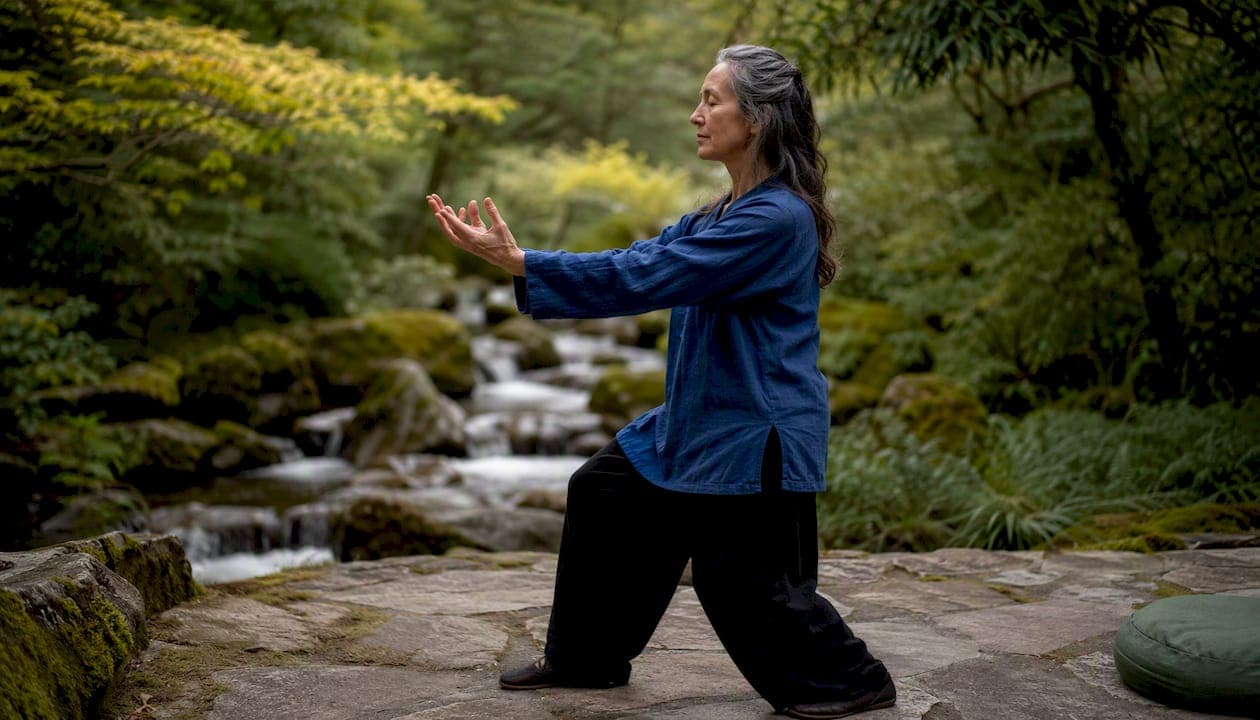
Six moves make up nearly every beginner qigong program worth your time: the Wuji or ready stance, Opening Qi (raising and lowering the arms), Cloud Hands, Gathering Qi (embracing the tree or holding the ball), a gentle spinal twist, and simple shaking or releasing. Learn these six and you have a complete, gentle practice you can return to for years.
Here's something you can try right now, before reading another word: stand with your feet hip width apart, soften your knees, and let your arms hang loose at your sides. Breathe slowly through your nose for six full breaths, feeling your belly expand on the inhale. That's Wuji stance, and it's the foundation everything else in qigong builds on.
- Wuji (ready stance): Feet grounded, knees soft, spine long, mind settling.
- Opening Qi: Arms rise on the inhale, sink on the exhale, like slow water.
- Cloud Hands: Weight shifts side to side while the hands trace soft circles.
- Gathering Qi (embrace the tree): Arms curve as if holding a large ball at chest height.
- Gentle spinal twist: Torso rotates gently while hips stay quiet and stable.
- Shaking/releasing: Light bouncing or shaking to loosen joints and let tension drop.
Key Takeaways
Beginner qigong success depends on mastering six core moves through soft knees, slow breath, and daily repetition rather than chasing advanced forms early.
| Point | Details |
|---|---|
| Learn six core moves | Wuji, Opening Qi, Cloud Hands, Gathering Qi, spinal twist, and shaking cover a complete beginner practice. |
| Follow the three golden rules | Soft knees, low diaphragmatic breath, and relaxed effort protect you from strain. |
| Use the 10-minute routine | Wuji, Opening Qi, Cloud Hands, and Gathering Qi in sequence build consistent change over weeks. |
| Respect safety limits | Modify or pause practice for recent surgery, cardiovascular instability, vertigo, or severe osteoporosis. |
| Progress slowly and consistently | Add time or repetitions only once the current routine feels easy, not effortful. |
| Consider guided instruction | Stella QigongStar's Five Animal Qigong and White Tiger Qigong courses build on these fundamentals with structured feedback. |
This article is general information, not a substitute for advice from a qualified doctor. Consult a qualified healthcare professional about your own circumstances before acting on anything here.
Table of Contents
- What Is Qigong, and What Are the Main Types?
- What Are the Three Golden Rules of Qigong?
- How Do You Do the Core Beginner Qigong Moves?
- What Does a 10-Minute Beginner Qigong Routine Look Like?
- How Do You Practice Qigong Safely?
- What Do Experienced Qigong Instructors Emphasize?
- Can You Teach Yourself Qigong?
- Where Can You Learn More and What Should You Try Next?
- What Should Beginners Realistically Expect in the First Weeks?
- Ready to Learn a Complete Beginner Course?
- Sources
What Is Qigong, and What Are the Main Types?
Qigong pairs slow movement, regulated breath, and focused attention into one practice, according to the National Center for Complementary and Integrative Health. The name itself tells you what it does: qi refers to vital energy or breath, and gong means a skill built through steady, patient practice, as Everyday Health explains in its beginner's guide. Qigong sits within Traditional Chinese Medicine, alongside practices like acupuncture and herbal medicine, though you don't need to study TCM theory to feel its benefits.
Two broad categories cover almost every style you'll encounter. Active qigong, sometimes called dong gong, involves the slow, flowing movements most beginners picture: Cloud Hands, spinal twists, arm raises. Passive qigong (sometimes called meditative or jing gong) focuses on stillness, breath, and inward attention with little or no movement. Healthline notes that most newcomers start with active forms because the physical movement gives your mind something concrete to follow, which makes it easier to stay present than sitting still from day one.
- Even brief daily practice sessions have been linked to better relaxation, steadier balance, and improved body awareness over time.
You'll also hear qigong sorted by intent: medical qigong (health and healing focused), martial qigong (used to build power and resilience for combat arts), and spiritual qigong (aimed at meditation and personal cultivation). The moves in this guide draw mostly from the medical and martial traditions, adapted for gentleness and safety.
What Are the Three Golden Rules of Qigong?
Every qigong teacher worth studying with will circle back to the same three fundamentals: posture, breath, and relaxation. Master these before worrying about anything else.
- Posture: Keep your knees soft (never locked), your spine neutral and long, and your weight evenly distributed between both feet.
- Breath: Breathe slowly and low, letting your belly (not your chest) do the work, a technique wikiHow's practice guide calls essential groundwork before attempting any form.
- Relaxation: Let each movement happen with minimal effort. Forcing a stretch or reaching too far defeats the purpose.
Posture protects your joints and lets qi (or simply, physical ease) move without obstruction. Breath calms your nervous system and paces your movement, so slow inhales and exhales aren't optional extras. Relaxation keeps you from turning a calming practice into another form of strain, which happens more often than beginners expect when they try too hard to "do it right."
Pro Tip: Do a 20-second body check before you begin: bend your knees slightly and notice if your kneecaps still track over your toes (that's soft, not locked). Roll your pelvis forward and back once to find neutral, the point where your lower back feels neither arched nor tucked. Finally, let your shoulders drop away from your ears. This three-point check takes less time than tying your shoes and prevents most beginner strain before it starts.
How Do You Do the Core Beginner Qigong Moves?
Each move below builds on the last, so practice them in this order the first few times through.
-
Wuji (ready stance). Purpose: settles your nervous system and establishes baseline posture. Start with feet hip width apart, knees soft, arms relaxed at your sides. Cues: lengthen your spine, tuck your chin slightly, relax your jaw, let your tongue rest behind your upper teeth, soften your gaze, breathe into your lower belly, and hold for one to two minutes. Breathe naturally throughout, no forced counting yet. Common mistakes: locking the knees (soften them further), holding tension in the shoulders (shrug once, then release), and shallow chest breathing (place a hand on your belly to feel it rise). Modification: this stance works seated in a firm chair with feet flat on the floor.
-
Opening Qi (raising and lowering the arms). Purpose: connects breath to movement and opens the chest. Start from Wuji. Cues: inhale as your arms float up to shoulder height, palms facing up; pause briefly at the top; exhale as your arms sink back down, palms turning to face the floor; repeat six to eight times, letting the movement lead slightly ahead of the breath. Breath timing: full inhale on the rise, full exhale on the descent. Common mistakes: rushing the movement (slow it until the breath and arms finish together), raising the shoulders instead of the arms (keep shoulders soft and down), and holding the breath at the top (keep air moving). Modification: reduce the range to waist height if shoulder mobility is limited.
-
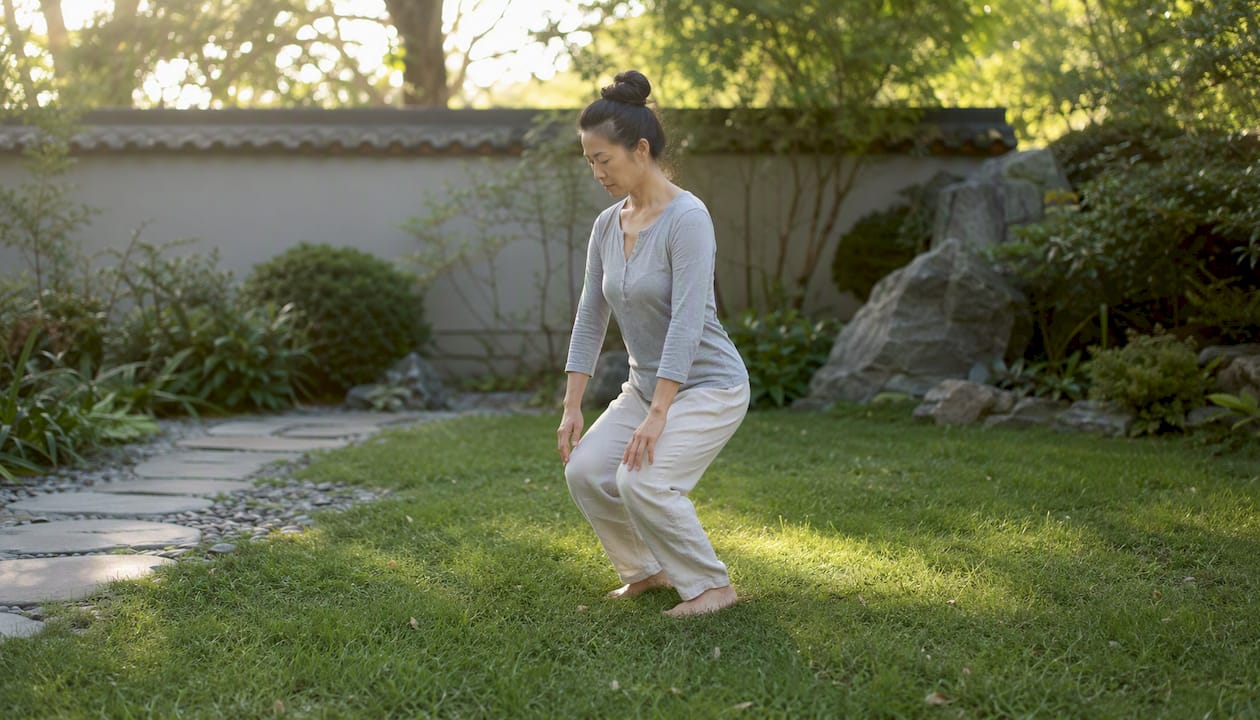
Cloud Hands. Purpose: builds balance, coordination, and gentle rotation through the spine. Start standing with feet slightly wider than hip width, weight centered. Cues: shift your weight onto your right leg while your right hand circles up and across your chest, palm facing in; your left hand circles low near your hip; as weight shifts left, hands trade positions in a smooth, continuous exchange; keep your gaze soft and your torso upright; continue for six to ten slow cycles. Practice guides consistently link this move to improved balance and proprioception when done at a slow, controlled tempo. Common mistakes: shifting weight too fast (slow the transfer until you can feel it happening), twisting from the lower back instead of the hips (let the whole torso rotate as one unit), and looking down at your feet (lift your gaze forward). Modification: practice the arm circles while seated, without the weight shift, if standing balance feels unsteady.
-
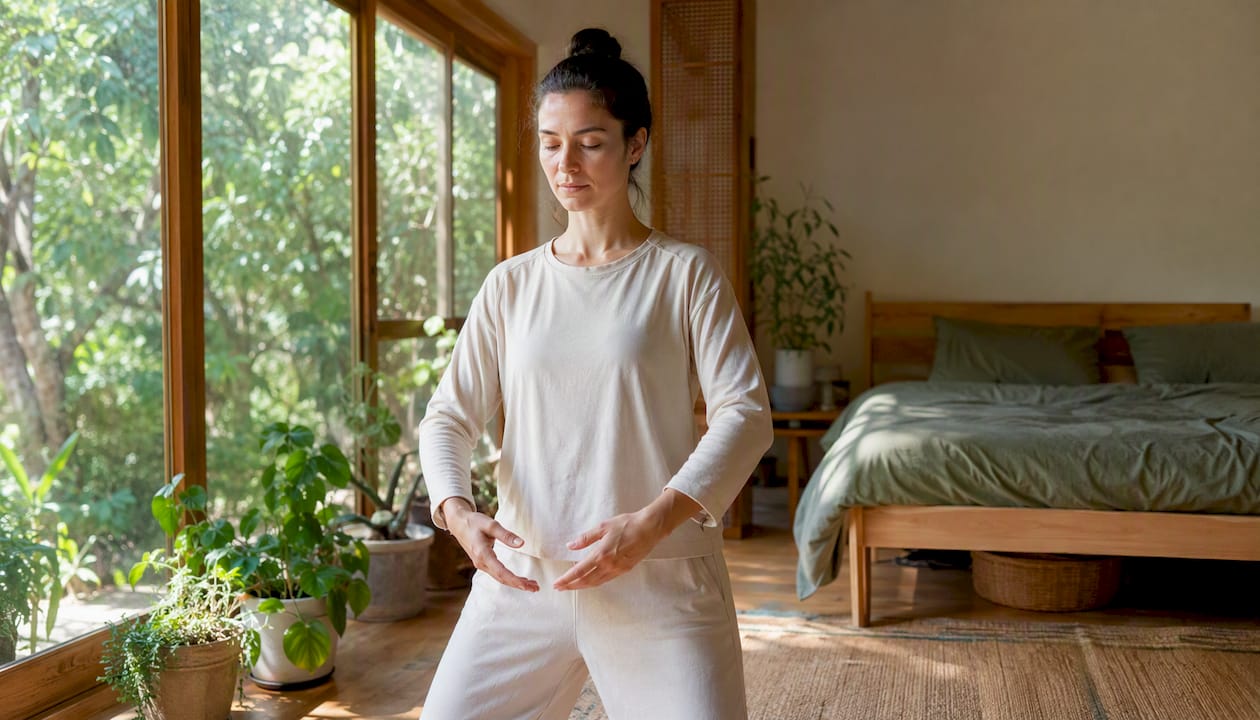
Gathering Qi (embrace the tree, or holding the ball). Purpose: builds shoulder stability and a sense of internal fullness. Start standing with feet hip width apart, knees soft. Cues: raise your arms as though wrapping them around a large tree trunk or holding a ball at chest height, elbows slightly lower than your wrists, fingers gently curved but not tense; inhale as you imagine the space between your palms expanding; exhale as you imagine it gently compressing, without your hands actually moving much; hold for one to three minutes. Common mistakes: raising the shoulders toward the ears (drop them and lengthen your neck), locking the elbows straight (keep a soft bend throughout), and gripping the fingers (let them stay loose, like holding a bird without letting it fly away). Modification: rest your forearms on a table edge if shoulder fatigue sets in early.
-
Gentle spinal twist. Purpose: mobilizes the mid back and releases tension along the spine. Start standing with feet hip width apart, arms relaxed. Cues: let your arms swing loosely as your torso rotates gently to the right, then to the left, allowing your arms to trail like ropes rather than driving the motion; keep your hips facing mostly forward with only a slight turn; continue for eight to ten rotations total. Common mistakes: over-rotating the hips along with the spine (anchor the hips and let the twist happen higher up), snapping the movement instead of flowing through it (slow down until it feels liquid), and holding the breath during rotation (breathe continuously, exhaling slightly deeper on each turn). Modification: reduce the rotation range by half, or perform seated with feet flat.
-
Shaking and releasing. Purpose: loosens joints, discharges tension, and closes the practice. Start standing, knees soft. Cues: let your whole body bounce gently, like a light jog without lifting your feet; let your arms flop loosely; shake for thirty to sixty seconds, then come to stillness in Wuji for a final minute to notice the difference. Common mistakes: bouncing too hard on the knees (soften the bounce until it feels more like a gentle wobble), tensing the jaw or fists (consciously release both), and skipping the closing stillness (this final minute is where the settling actually happens). Modification: seated shaking works fine for the arms and shoulders if standing bouncing isn't comfortable.
Photos or a short video clip demonstrating each transition make these cues far easier to absorb than text alone, which is worth keeping in mind if you're following along at home.
| Move | Emphasizes posture | Emphasizes breath | Emphasizes balance | Emphasizes relaxation |
|---|---|---|---|---|
| Wuji | High | Moderate | Low | High |
| Opening Qi | Moderate | High | Low | Moderate |
| Cloud Hands | Moderate | Moderate | High | Moderate |
| Gathering Qi | High | Moderate | Low | High |
| Spinal twist | Moderate | Moderate | Moderate | Moderate |
| Shaking/releasing | Low | Low | Low | High |
What Does a 10-Minute Beginner Qigong Routine Look Like?
A short, repeatable sequence beats an ambitious one you abandon after three days. A commonly recommended structure runs Wuji, Opening Qi, Cloud Hands, and Gathering Qi in sequence, which Taoism & Manifest's beginner guide frames as enough to produce noticeable change within a few weeks of daily practice.
| Minutes | Move | Approximate breath cycles |
|---|---|---|
| 1 to 2 | Wuji (ready stance) | 6 to 10 |
| 2 to 4 | Opening Qi | 6 to 8 |
| 4 to 6 | Cloud Hands | 8 to 10 |
| 6 to 10 | Gathering Qi | 6 to 8 |
| 6 to 10 | Closing stillness | 4 to 5 |
For a fuller 15-minute version, add the gentle spinal twist for two minutes after Cloud Hands, and close with a minute of shaking before returning to stillness. Our detailed beginner sequence walks through this exact 10-minute structure with extra pacing notes if you want a written companion while you practice.
- Add time in one-minute increments once ten minutes feels easy, not effortful.
- Add repetitions to Cloud Hands or the spinal twist before adding new moves.
- A sign you're ready to progress: you finish the routine feeling calmer and looser, not fatigued or achy.
- If any move causes discomfort that lingers after practice, scale back the range rather than pushing through it.
How Do You Practice Qigong Safely?
Qigong is gentle, but gentle doesn't mean risk-free for everyone. A handful of conditions call for real caution or a conversation with a professional first.
- Recent surgery: Skip twisting or reaching moves until you've been cleared by your surgeon; stick to seated breathing practice in the meantime.
- Unstable cardiovascular conditions: Check with your doctor before starting, and avoid extended standing stances if you feel lightheaded.
- Acute vertigo or dizziness: Practice seated, avoid Cloud Hands' weight shifts, and stop immediately if the room feels like it's spinning.
- Severe osteoporosis: Reduce the range of the spinal twist significantly, and avoid any bouncing during the shaking movement.
- Respiratory conditions: Shorten breath holds, breathe at a pace that feels comfortable rather than forcing a deep diaphragmatic breath, and rest as needed.
Our contraindications guide covers modifications for these situations in more depth if any apply to you.
Pro Tip: If a move causes sharp pain, numbness, or dizziness that doesn't settle within a minute of stopping, pause your practice and check in with a GP or physiotherapist before continuing. Mild muscle fatigue is normal; pain that lingers is a signal, not something to push through.
Qigong works well alongside conventional care, but it isn't a replacement for it. NCCIH's public health guidance is clear that people managing existing health conditions should loop in their healthcare provider before relying on qigong to address a specific medical issue.
What Do Experienced Qigong Instructors Emphasize?
Ask any handful of qigong teachers what separates a good beginner practice from a frustrating one, and you'll hear the same handful of priorities repeated. Alignment comes first: soft knees, a neutral pelvis, and relaxed shoulders matter more than how far you can reach or how long you can hold a stance.
Beginners tend to progress faster when they prioritize foundational alignment and get real feedback on posture, rather than rushing to learn more moves before the basics settle in.
Slow tempo, breath-first sequencing, and consistency over duration round out the list. A five-minute daily practice done attentively outperforms a rare thirty-minute session done on autopilot, which is part of why the 10-minute routine above works as well as it does for most beginners.
- Alignment and posture correction come before adding new movements.
- Breath leads the movement, not the other way around.
- Showing up daily matters more than how long each session runs.
- Feedback from an instructor catches habits you can't see in yourself.
Stella at Stella QigongStar teaches through the White Tiger Qigong lineage and Five Animal Qigong, both built specifically to make these fundamentals accessible to complete beginners. Because qigong sits outside strict government regulation, looking for an instructor who talks about alignment and foundational posture, rather than one who rushes you through advanced forms, is one of the better signals of quality instruction you can rely on.
Can You Teach Yourself Qigong?
You can absolutely start qigong on your own, and plenty of practitioners do exactly that with good results. Whether it's the right path for you depends on how you learn best and what you're hoping to get out of the practice.
Self-teaching pros:
- Free or low cost to start, with no scheduling constraints.
- Flexible pacing lets you repeat a move as many times as you need.
Self-teaching cons:
- No one to correct alignment mistakes you can't feel yourself making.
- Easy to plateau or unknowingly reinforce a poor habit for months.
If you're going the self-teaching route, follow these steps:
- Start with the 10-minute routine above and repeat it daily for a full week before adding anything new.
- Record yourself on your phone occasionally and compare your posture against a reliable teacher video.
- Run the three-point alignment self-check (knees, pelvis, shoulders) before every session.
- Attend at least one live class, even a single session, to get direct feedback you can't give yourself.
Mindvalley's beginner guide makes a similar case for keeping sessions short and using guided video as a stand-in for a teacher's eye, at least early on. That said, some signs mean it's time to find an instructor rather than keep going solo: pain during practice that a modification doesn't resolve, cues that consistently confuse you, or goals (chronic stress, digestive issues, a specific health condition) that call for more tailored guidance than a general routine can offer. Our guide on starting qigong practice at home covers this decision in more detail.
Where Can You Learn More and What Should You Try Next?
Once the six core moves feel familiar, a handful of resource types will help you go deeper without overwhelming your practice.
- Short guided videos: Best for learning alignment cues you can't get from text alone.
- Structured online courses: Better for building a complete, progressive skill set over weeks.
- Live classes: The only format that gives you real-time feedback on your form.
- Books on active qigong: Useful for understanding the reasoning behind specific movements.
- Posture and alignment cheat sheets: Handy quick references once you've learned a move properly.
Stella QigongStar's online course options include beginner pathways through both Five Animal Qigong and White Tiger Qigong, combining on-demand video lessons with live sessions so you get structured progression and real feedback in one place. If you want one clear next step, try this: run the 10-minute routine above for seven straight days, and keep a simple daily note of your sleep and stress levels. That small feedback loop tells you more about whether qigong is working for you than any amount of reading.
What Should Beginners Realistically Expect in the First Weeks?
The first eight weeks of qigong practice rarely feel dramatic, and that's by design, not a sign you're doing something wrong. In the early weeks, most beginners notice their Wuji stance start to feel less awkward, their breath drop lower and slower without as much conscious effort, and small moments of genuine presence creeping into a practice that once felt purely mechanical.
Perfect form isn't the goal in week one, or even week eight. Consistency and attention matter far more than precision this early, and chasing textbook alignment before your body is ready for it tends to build tension rather than release it. What actually moves the needle is showing up for ten quiet minutes, noticing what you feel, and letting the moves get smoother on their own timeline.
Pairing your daily practice with a short journal entry, even just a sentence about how your shoulders felt or whether your mind settled faster than yesterday, gives you a record of progress that's easy to miss otherwise. Small shifts add up quietly in qigong, and a few written words each day are often the only proof you'll notice they happened at all.
Ready to Learn a Complete Beginner Course?
If the six moves above felt good in your body, a structured course gives you the next layer: proper sequencing, breath pairing, and the kind of feedback a written guide simply can't offer. Unlike piecing together routines from scattered videos, a guided course walks you through each movement with consistent cueing from someone trained specifically to catch the small alignment slips that cause frustration later.
Stella QigongStar's online Qigong classes and courses are built around exactly the two styles referenced throughout this guide: Five Animal Qigong and White Tiger Qigong. Here's what you can expect:
- Beginner-friendly course structure covering foundational posture, breath, and the core moves detailed above.
- A mix of on-demand video lessons and live virtual sessions, so you can learn at your own pace and still get real-time feedback.
- Programs specifically suited to complete beginners working on stress relief, digestive wellness, or general vitality.
- Instruction grounded in White Tiger Qigong lineage training and Yoga Alliance certification standards.
Take a look at the Five Animal Qigong course page to see which beginner pathway fits your goals, and start with whichever format, on-demand or live, suits your schedule this week.
Sources
- Qigong: What You Need To Know | NCCIH
- Qigong Meditation: For Beginners, Techniques, Benefits, and More
- Qigong for Beginners: 10-Minute Daily Practice Guide – Taoism & Manifest
- What Is Qigong? A Beginner's Guide
- Qigong for Beginners: 4 easy moves that supercharge your mood and vitality