

Community support is defined as the network of social relationships, shared resources, and mutual accountability that helps individuals sustain healthy behaviors and manage stress over time. Research from the CDC, NIH, and YMCA confirms that how community supports your wellness journey goes far beyond simple encouragement. It shapes your biology, your habits, and your ability to recover from setbacks. Whether you practice qigong, manage anxiety, or simply want to feel less alone in your efforts, the right community can be the difference between a practice that fades and one that genuinely transforms your life.
How community supports wellness journey outcomes through social connection
Social connection is not a soft benefit. The CDC identifies stable, positive relationships as protective factors that directly help people cope with stress and mental distress. That means community is a clinical asset, not just a feel-good bonus.
The NIH Social Wellness Toolkit goes further, explaining that social connections influence your biology and overall well-being. Shared routines, walking schedules, and goal-sharing mechanisms are not incidental. They are the mechanisms through which community turns intention into sustained behavior. When you commit to a weekly qigong class with others, your nervous system registers that commitment differently than a solo resolution made in January.
Research published in Science Advances found that bonding with multiple social groups is positively associated with better mental health outcomes across large datasets. This matters because it suggests you do not need one perfect community. You benefit from layering connections, a qigong group here, a walking club there, an online wellness forum in between.
"Community engagement turns wellness intentions into habits, capitalizing on social accountability and shared routines." — NIH Social Wellness Toolkit
The key mechanisms at work include:
- Emotional buffering: Knowing others share your struggles reduces the physiological stress response.
- Behavioral modeling: Watching peers maintain healthy habits makes those habits feel achievable.
- Accountability loops: Shared schedules create gentle social pressure that sustains practice during low-motivation periods.
- Biological reinforcement: Social bonding triggers oxytocin release, which directly calms the nervous system.
What types of community support actually help your well-being
Not all support feels the same, and understanding the difference helps you seek what you actually need. Social support in wellness contexts falls into four distinct types: emotional, informational, appraisal, and practical.
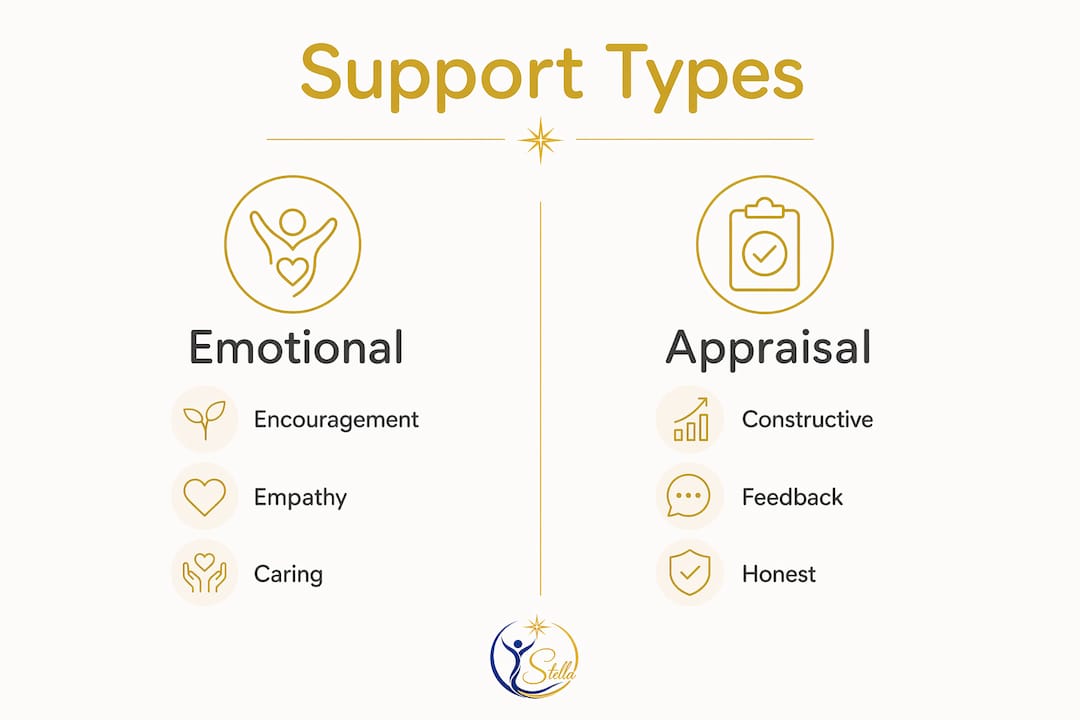
Emotional support is what most people picture first. It includes empathy, encouragement, and the sense that someone genuinely sees your struggle. Peer groups built around shared practices, like a Five Animal Qigong cohort or a mindfulness circle, naturally generate this kind of warmth. Informational support means receiving guidance, resources, or knowledge that helps you make better decisions. A moderated online wellness forum where members share research-backed tips is a good example.
Appraisal support is subtler but powerful. It involves receiving honest, constructive feedback that helps you calibrate your progress. A trusted wellness group that tells you "your breathing technique has improved" gives you something a solo practice cannot. Practical support is the most tangible form: a friend who drives you to a class, a group that shares a meal plan, or a cohort that checks in when you miss a session.
The YMCA's Community as Medicine program is one of the clearest real-world examples of all four types working together. Its 12-week cohort combines guided movement, structured conversation, and mutual support to build resilience and reduce isolation. Participants start and progress together, which research confirms reduces dropout rates significantly compared to individual programs.
| Support type | How it shows up in wellness communities |
|---|---|
| Emotional | Peer encouragement, shared vulnerability, group empathy |
| Informational | Curated resources, expert-led sessions, member tips |
| Appraisal | Progress feedback, goal reviews, honest check-ins |
| Practical | Shared schedules, carpooling, accountability texts |
Online communities add a fifth dimension: accessibility. A 2026 JMIR study found that digital peer support programs using moderated chat groups, micro-tasks, challenges, and badges improved engagement and generated meaningful social connectedness. The study showed reduced loneliness and improved BMI in participants over six months compared to control groups. That is a measurable, physical result from a digital community.
Pro Tip: When joining an online wellness group, look for one with a named moderator and clear community guidelines. Moderated spaces consistently produce better outcomes than open, unstructured forums.
Practical ways to build and engage with supportive wellness communities
Finding the right community is one thing. Staying engaged is another. The NIH recommends operationalizing social support into repeatable micro-commitments rather than relying on motivation alone. That means building small, consistent touchpoints with your community rather than waiting for big moments of connection.
Here is a practical framework for building your support system in wellness:
- Start with one anchor commitment. Choose one recurring group activity, a weekly class, a walking club, or a shared practice session. Consistency matters more than frequency at the start.
- Share a specific goal publicly. Telling your community "I want to practice qigong three times a week for 30 days" activates social accountability in a way that private goals do not.
- Use cohort-based programs when possible. Programs where everyone starts together, like a structured 8-week course, create natural momentum. You are less likely to quit when others are moving at the same pace.
- Layer digital and in-person connection. A live class builds depth; an online group sustains it between sessions. Both serve different functions and work best together.
- Track behavioral wins, not just symptoms. A 2026 JMIR RCT found that peer support benefits often appear first as improved activity levels and reduced loneliness before any change in anxiety or depression scores. Celebrate showing up, not just feeling better.
- Contribute as well as receive. Communities thrive when members give encouragement, share resources, and check in on others. Your participation strengthens the group for everyone, including yourself.
For those exploring sustainable wellness habits, community is the infrastructure that makes those habits stick. Solo willpower has a ceiling. Shared commitment does not.
Pro Tip: Schedule your community check-ins the same way you schedule a doctor's appointment. Treat them as non-negotiable. The NIH toolkit specifically recommends shared schedules as one of the most reliable tools for maintaining social wellness.
When community support can fall short
Community is not a universal remedy, and approaching it with clear eyes protects you from disappointment or harm. A 2026 JMIR realist review found that online support groups can reduce isolation and distress in the right conditions, but may actually worsen symptoms when the group is unmoderated, poorly matched to participant needs, or lacks clear safety norms.
The same review highlighted that context matters enormously. A group focused on chronic illness management may not serve someone navigating general stress. A high-intensity fitness community may feel alienating to someone recovering from burnout. Matching your community to your current needs, not your aspirational self, is the more compassionate and effective approach.
Watch for these warning signs in any wellness community:
- No visible moderation. Groups without a named facilitator or clear rules can drift toward harmful comparisons or triggering content.
- Pressure to perform or report. Healthy communities invite sharing; they do not demand it.
- One-size-fits-all advice. Communities that push a single protocol regardless of individual circumstances may do more harm than good.
- Symptom-shaming. Any group that implies you are not trying hard enough if your anxiety has not resolved is not a safe space.
The JMIR review also notes that user autonomy and privacy are non-negotiable in effective online wellness communities. You should always feel in control of what you share and how you participate. If a community makes you feel worse after engaging, that is important information. Leaving is not failure. It is discernment.
For guidance on navigating digital wellness spaces safely, the beginner tips for online wellness courses from Qigongstar offer a grounded starting point.
Key takeaways
Community support is the single most reliable external factor for sustaining a wellness practice through stress, setbacks, and low-motivation periods.
| Point | Details |
|---|---|
| Social connection is protective | CDC and NIH confirm stable relationships directly reduce stress and improve mental health outcomes. |
| Four support types matter | Emotional, informational, appraisal, and practical support each serve distinct roles in wellness communities. |
| Cohort programs reduce dropout | Programs like YMCA's Community as Medicine use shared timing to keep participants engaged and progressing. |
| Moderation is non-negotiable | Unmoderated online groups can worsen symptoms; always choose communities with clear guidelines and named facilitators. |
| Behavioral wins come first | Peer support often improves activity levels and reduces loneliness before it shifts anxiety or depression scores. |
Why I believe community is the missing piece most wellness seekers overlook
I have watched hundreds of people begin a qigong or movement practice with genuine commitment, only to quietly fade away within weeks. Almost without exception, the ones who stay are the ones who found a group. Not a perfect group. Not a group that agreed on everything. Just a group that showed up consistently and made space for each other.
The conventional wellness narrative focuses almost entirely on the individual: your discipline, your routine, your mindset. That framing places the full weight of transformation on your shoulders alone. What I have seen, and what the research now confirms, is that this framing is incomplete. Your nervous system is a social organ. It regulates differently in the presence of others who share your intention.
What surprises most people is that the benefit does not require deep friendship. A weekly qigong class with acquaintances you genuinely respect can shift your stress baseline more than months of solo practice. The shared breath, the shared rhythm, the quiet acknowledgment that you all showed up again, that is medicine. It is subtle, but it accumulates.
My honest advice: do not wait until you feel ready to join a community. Join first. The readiness comes from the belonging, not before it. And if the first group is not right, try another. The fit matters. Your energy knows the difference between a community that nourishes and one that drains.
— Stella
Deepen your practice with Qigongstar's community-centered courses
Qigongstar's 5 Animal Qigong program is built around exactly the kind of community support this article describes: structured cohort learning, expert guidance, and a shared practice environment that keeps you motivated and accountable. Each course combines gentle movement, breath regulation, and mindful awareness in a format designed to soothe stress and awaken your body's natural vitality.
If you are ready to experience the calming power of qigong within a supportive group setting, Qigongstar's online qigong classes offer both live and on-demand options for every schedule and experience level. You do not need prior experience. You just need to show up, and the community will meet you there.
FAQ
How does community support improve mental health?
Community support improves mental health by providing protective social relationships that buffer stress, reduce isolation, and activate accountability. The CDC identifies stable, positive relationships as direct protective factors against mental distress.
What is the most effective type of community for a wellness journey?
Cohort-based programs with clear structure and moderation, like YMCA's Community as Medicine, consistently show the strongest results because participants progress together and benefit from both peer support and expert guidance.
Can online wellness communities be as effective as in-person groups?
Yes, when properly moderated. A 2026 JMIR study found that digital peer support programs with structured features reduced loneliness and improved physical health markers over six months, comparable to in-person program outcomes.
How do I know if a wellness community is right for me?
A good fit means you feel safe sharing, the group's focus matches your current needs, and a named moderator maintains clear guidelines. If engaging with a community consistently leaves you feeling worse, it is not the right match.
How long does it take for community support to affect my wellness?
Behavioral improvements like increased activity and reduced loneliness often appear within weeks, while deeper shifts in anxiety or mood may take longer. Tracking multiple outcomes, not just symptom scores, gives you a clearer picture of progress.