

Your circadian rhythm is defined as the roughly 24-hour internal biological cycle that governs sleep timing, hormone secretion, metabolism, and body temperature. Understanding how circadian rhythm affects wellness matters far beyond getting a good night's sleep. When this internal clock runs on time, your energy is steady, your mood is stable, and your body repairs itself efficiently. When it falls out of sync, the consequences ripple across nearly every system in your body. The latest research confirms that circadian misalignment is a distinct risk factor for type 2 diabetes, cardiovascular disease, and metabolic dysfunction, independent of how many hours you sleep.
How does circadian rhythm affect wellness and sleep quality?
The circadian rhythm is controlled by the suprachiasmatic nucleus (SCN), a small cluster of neurons in the brain's hypothalamus that acts as your master clock. The SCN receives light signals from your eyes and uses them to synchronize peripheral organ clocks throughout your body. When your sleep schedule, meal timing, and light exposure align with the SCN's signals, your body runs smoothly. When they don't, internal desynchrony develops, and no amount of extra sleep fully corrects it.
Two hormones sit at the center of this system. Melatonin rises in the evening to prepare your body for sleep, while cortisol peaks in the early morning to wake you up and sharpen your focus. A well-aligned circadian rhythm keeps these hormones on schedule. Disruptions, such as late-night screen exposure, irregular bedtimes, or shift work, delay melatonin release and blunt the morning cortisol surge, leaving you groggy, anxious, and mentally foggy.
The link between circadian biology and mood is direct. Research shows that circadian disruption impairs cognitive performance and increases vulnerability to anxiety and depression. Your brain's emotional regulation centers depend on consistent hormonal rhythms to function well. When those rhythms are erratic, emotional resilience drops.
Key behaviors that disrupt sleep patterns and wellness include:
- Scrolling on a phone or tablet within 60 minutes of bedtime (blue light suppresses melatonin)
- Sleeping in significantly on weekends, creating "social jet lag"
- Eating large meals late at night, which shifts peripheral organ clocks out of phase
- Consuming caffeine after 2:00 PM, which delays sleep onset by several hours
- Irregular wake times, which prevent the SCN from anchoring a stable rhythm
Pro Tip: Set a consistent wake time seven days a week, including weekends. Your SCN anchors to your wake time more reliably than your bedtime, making this the single most effective habit for stabilizing your sleep-wake cycle.
What is the impact of circadian misalignment on metabolic health?
Circadian misalignment occurs when your behavioral timing, such as when you sleep, eat, and exercise, conflicts with your internal biological clock. A 2026 biobank study of 73,888 adults found that late timing of behavior, including evening chronotype and misaligned sleep, is a distinct risk factor for type 2 diabetes, obesity, and hypertension, beyond sleep duration alone. That finding reframes the conversation. It's not just how long you sleep. It's when you sleep.
Night shift work amplifies this risk significantly. Up to 18% of European workers are shift workers, and combining night shift schedules with circadian markers associates with a 45.6% increased risk of cardiovascular-kidney-metabolic disease. That is a substantial population carrying a largely preventable burden.
The Circadian Imbalance Index (CII) is a newly derived research tool that captures multiple contributors to circadian misalignment in a single score. The CII includes not just sleep timing but also factors like neuroticism, caffeine use, and low vitamin D levels. This broader view reveals that circadian health is shaped by lifestyle habits most people never connect to their body clock.
The hormonal mechanism behind this risk is well established. Melatonin, cortisol, and leptin shifts caused by circadian imbalance promote systemic inflammation via TNF-α and IL-6, impair mitochondrial function, and increase oxidative stress. The result is a cellular environment that favors insulin resistance, fat storage, and arterial damage.
"Circadian disruption is a root mechanism for multisystem disorders requiring network-based treatment approaches that prioritize rhythm alignment across the cardiovascular, renal, hepatic, and cerebral systems. Treating one organ in isolation misses the underlying timing failure driving disease across all of them."
Review finding from the journal Medicine Plus, 2026
| Risk factor | Effect of circadian misalignment |
|---|---|
| Type 2 diabetes | Late chronotype increases risk independent of sleep duration |
| Cardiovascular disease | 45.6% increased risk in shift workers with circadian markers |
| Obesity | Misaligned meal and sleep timing disrupts leptin and insulin signaling |
| Systemic inflammation | TNF-α and IL-6 elevation from hormonal rhythm disruption |
| Skin barrier function | Late bedtimes impair skin microbiome diversity and barrier integrity |
How does circadian rhythm connect to gut health and whole-body wellness?
Your gut microbiota follows its own daily rhythm, and that rhythm is tightly linked to your circadian clock. Gut microbiota and circadian rhythm show bidirectional molecular crosstalk, meaning your body clock shapes your microbiome, and your microbiome feeds signals back to your body clock. When circadian disruption breaks this dialogue, microbial dysbiosis follows, and the downstream effects reach far beyond digestion.

Disrupted gut microbiota rhythms contribute to metabolic dysfunction, immune dysregulation, and neurological changes. The gut-brain axis carries microbial signals directly to mood-regulating centers in the brain. This is one reason that people with chronic sleep disruption often report digestive discomfort, low mood, and brain fog simultaneously. These are not separate problems. They share a common root in circadian and microbial timing.
Late bedtimes and circadian disruption also harm skin barrier function and skin microbiome diversity. Melatonin supplementation improves the skin clock and barrier integrity partly through gut microbiota mediation. This gut-skin-clock connection shows just how far circadian biology reaches into your daily experience of health.
Practical strategies to restore this balance include:
- Time-restricted feeding. Eating within a consistent 8–10 hour window aligned with daylight hours improves insulin sensitivity and supports microbial rhythm. This chronotherapeutic approach improves metabolic health beyond diet quality alone.
- Probiotic-rich foods. Fermented foods like yogurt, kefir, kimchi, and sauerkraut support microbial diversity and help restore temporal homeostasis after disruption.
- Polyphenol-rich diet. Foods high in polyphenols, such as berries, green tea, and dark chocolate, selectively feed beneficial microbes that support circadian signaling.
- Consistent meal timing. Eating at the same times each day anchors peripheral organ clocks in the gut, liver, and pancreas, reinforcing the signals sent by the SCN.
Pro Tip: Finish your last meal at least two to three hours before bed. Late-night eating shifts your liver and gut clocks out of phase with your brain clock, which is one of the fastest ways to fragment your circadian rhythm.
Practical ways to align your circadian rhythm for better wellness
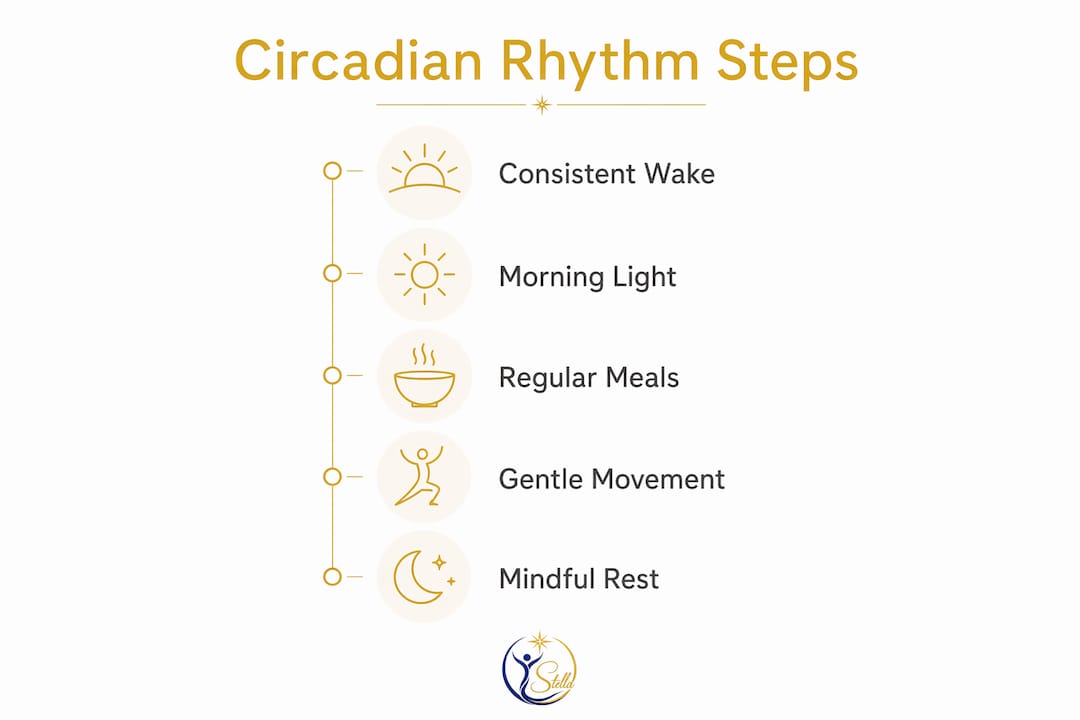
Restoring your circadian rhythm does not require a complete lifestyle overhaul. Yale School of Medicine guidance from 2026 identifies five core pillars, called zeitgebers (external time cues), that reset and anchor your internal clock. These are daylight exposure, physical exercise, social activity, meal timing, and a regular sleep schedule. Working with all five creates a compounding effect that no single habit achieves alone.
Consistent daily routines for meal timing and sleep improve energy, focus, and sleep quality within weeks. That timeline is encouraging. You do not need months of perfect behavior to feel a difference. Small, consistent shifts in timing produce measurable results relatively quickly.
Here is a practical framework for daily rhythm alignment:
- Morning light exposure. Step outside within 30 minutes of waking. Natural light is the strongest zeitgeber and sets your cortisol and melatonin timing for the entire day.
- Fixed wake time. Choose a wake time and protect it every day, including weekends. This is the anchor point for your entire circadian system.
- Move your body in the morning or early afternoon. Exercise is a powerful zeitgeber. Late-evening intense workouts can delay sleep onset by raising core body temperature and cortisol.
- Eat within a consistent window. Align your first and last meals with daylight hours. Avoid eating within two to three hours of bedtime.
- Dim screens after sunset. Use blue-light filtering settings or glasses in the evening. Even moderate screen light delays melatonin release.
- Limit caffeine after 2:00 PM. Caffeine has a half-life of roughly five to six hours. Afternoon coffee directly delays your sleep onset and fragments your sleep architecture.
Mind-body practices like Qigong add a dimension that pure scheduling cannot. Gentle, rhythmic movement combined with breath regulation calms the nervous system, lowers cortisol, and signals to your body that it is safe to wind down. Qigongstar's daily wellness rituals approach treats consistent practice timing as a zeitgeber in its own right, reinforcing the body's natural rhythms through movement and breath. Building a mind-body routine that includes Qigong at a fixed time each day gives your nervous system a reliable daily cue, much like morning light does for your SCN.
Pro Tip: Practice Qigong or gentle breathwork at the same time each day, ideally in the morning or early evening. The rhythmic, predictable nature of the practice acts as a calming time cue that helps your body clock settle into a stable pattern.
Key Takeaways
Your circadian rhythm governs sleep, metabolism, gut health, and mood simultaneously, and restoring its alignment through consistent timing habits produces measurable wellness improvements within weeks.
| Point | Details |
|---|---|
| Circadian rhythm controls more than sleep | It regulates hormones, metabolism, gut microbiota, and immune function across your whole body. |
| Misalignment carries serious health risks | A 2026 study links late chronotype and shift work to a 45.6% increased cardiovascular-kidney-metabolic disease risk. |
| Gut and circadian clocks are linked | Disrupted circadian rhythm causes microbial dysbiosis, which drives metabolic, immune, and mood issues. |
| Five zeitgebers reset your clock | Light, exercise, social activity, meal timing, and sleep schedule work together to re-anchor your rhythm. |
| Consistency beats perfection | Regular timing of sleep and meals improves energy and focus within weeks, even without perfect adherence. |
Why I think most people are fixing the wrong thing
Most wellness advice focuses on sleep duration. Eight hours is the target, and if you hit it, you assume you're doing well. What I've found, both personally and through years of working with students at Qigongstar, is that timing matters far more than most people realize. You can sleep eight hours and still feel exhausted if those hours are at the wrong time for your biology.
The piece that gets overlooked most often is the role of daily rituals as biological signals. Your body clock does not just respond to light. It responds to the predictable rhythm of your entire day: when you eat, when you move, when you connect with others, and when you rest. When those cues are scattered and inconsistent, your internal clock drifts, and no supplement or sleep tracker fixes that drift.
What I've seen work, genuinely and sustainably, is the combination of timing consistency with a calming mind-body practice. When students commit to Qigong at a fixed time each day, something shifts beyond the physical benefits. The nervous system starts to recognize the rhythm. Stress responses soften. Digestion improves. Sleep deepens. These are not coincidences. They are the body responding to a restored sense of internal order.
The most overlooked wellness tip I can offer is this: treat your daily routine as medicine. The timing of your habits is as important as the habits themselves. Circadian biology is not a niche topic for sleep researchers. It is the foundation of every health outcome you care about.
— Stella
Qigongstar's online classes and circadian wellness
Gentle, rhythmic movement practiced at a consistent time each day is one of the most natural ways to support your body's internal timing.

Qigongstar offers online classes in 5 Animal Qigong and White Tiger Qigong, both designed to calm the nervous system, support digestive health, and reduce the stress that fragments your circadian rhythm. These practices combine gentle movement, breath regulation, and mindful awareness to soothe tension and awaken your body's natural vitality. Classes are available on demand, so you can build them into your daily rhythm at whatever time works best for you. Explore Qigongstar's online qigong classes and find a practice that fits your life and supports your wellness from the inside out.
FAQ
What is circadian rhythm and why does it matter for health?
Circadian rhythm is your body's roughly 24-hour internal clock that regulates sleep, hormone release, metabolism, and immune function. When it runs on schedule, your energy, mood, and digestion all benefit.
How does light exposure affect your circadian rhythm?
Morning natural light is the strongest external time cue for your circadian clock, triggering cortisol release and setting your melatonin timing for the evening. Evening screen light delays melatonin and pushes your sleep cycle later.
Can circadian disruption cause digestive problems?
Yes. Your gut microbiota follows its own daily rhythm linked to your circadian clock, and disruption causes microbial dysbiosis that drives digestive dysfunction, inflammation, and metabolic issues.
What is the fastest way to reset a disrupted circadian rhythm?
Yale School of Medicine identifies consistent wake time, morning light exposure, and regular meal timing as the most effective first steps. Most people notice improved energy and sleep quality within a few weeks of applying these consistently.
Does Qigong support circadian rhythm health?
Qigong's gentle, rhythmic movement and breath regulation lower cortisol and calm the nervous system, which supports the hormonal conditions needed for healthy sleep onset and circadian alignment.