
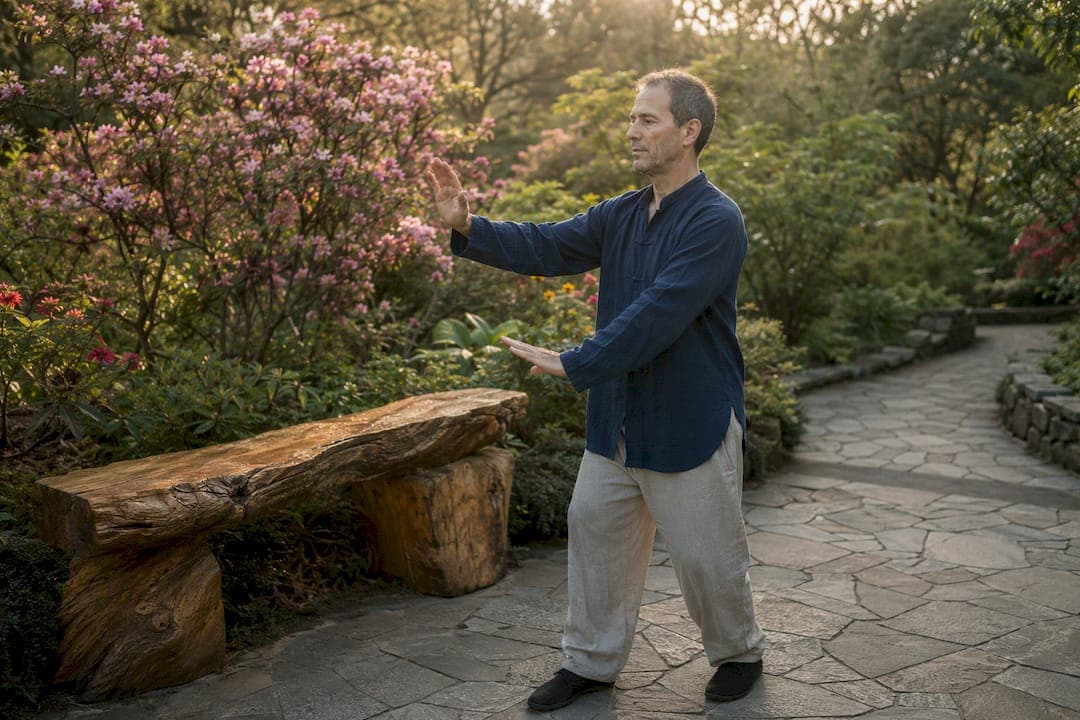
The easiest meditative movement types to start with are walking meditation, breath-linked movement, mindful stretching or chair-based movement, simple qigong, and gentle yoga. Each one asks for almost nothing but your attention and a few quiet minutes.
Here's why each works for a first attempt. Walking meditation turns something you already do into an anchor for your mind, so there's no new skill to learn. Breath-linked movement pairs slow motion with your natural exhale and inhale, calming your nervous system almost immediately. Mindful stretching or chair-based movement removes the barrier of needing to get on the floor, making it the most accessible option for stiff joints or limited mobility. Simple qigong blends gentle motion with breath regulation in short sequences you can learn in one sitting. Gentle yoga, especially yin-style holds, gives your body permission to slow down without demanding flexibility you don't have yet.
To begin, pick just one of these:
- Choose the type that matches your body today, not your goals for next year.
- Set a timer for a few minutes so you're not guessing when to stop.
- Try the matching mini-practice below before you do anything else.
Key Takeaways
Easy meditative movement types work because they replace the difficulty of sitting still with a physical anchor, making presence easier to access for most beginners.
| Point | Details |
|---|---|
| Start with one type | Choose walking, qigong, or chair stretching based on your body's needs today, not your fitness goals. |
| Movement beats stillness for beginners | Rhythmic motion gives restless minds an anchor that seated meditation often can't provide. |
| Evidence backs the gentle practices | Tai chi and qigong are linked to reduced anxiety and depression symptoms in multiple clinical reviews. |
| Close with stillness | A minute of quiet after any practice helps your nervous system integrate the calming effect. |
| Progress gradually | Add a minute or two per week rather than jumping to long sessions right away. |
Table of Contents
- What Is Meditative Movement, and How Does It Differ From Sitting Still?
- What Meditative Movement Actually Helps With
- The Easy Meditative Movement Types Worth Trying First
- How to Start Today: A 5 to 10 Minute Session Template
- Beginner Qigong Mini-Routine From Stella
- Staying Safe: When to Modify or Pause
- Where to Keep Learning
- Sources
What Is Meditative Movement, and How Does It Differ From Sitting Still?
Meditative movement, often called moving meditation, is any slow, repetitive physical activity done with full attention on sensation and breath rather than on performance or exercise goals. It's meditation with your eyes open and your body engaged, instead of meditation that asks you to sit motionless and quiet your thoughts.
The difference matters more than it sounds. Seated meditation asks your mind to settle on its own, which can feel nearly impossible if you're wired, restless, or new to the practice. Movement gives your attention somewhere concrete to land: the pressure of your foot on the floor, the stretch across your shoulders, the rhythm of your breath matching your steps. Mindfulness educators have found that this rhythmic anchor helps people with an active mind settle into presence more easily than breath-focused stillness alone.
What ties these practices together isn't the specific movement. It's the pacing, the breath synchronization, and the willingness to repeat something simple until your attention softens into it. You'll see this show up across several familiar formats:
- Walking, taken slowly and deliberately
- Qigong and tai chi, rooted in traditional Chinese movement
- Gentle or yin-style yoga
- Free or mindful dance
- Breathwalk and other breath-led sequences
None of these require special equipment, a studio, or advance experience. They only require you to slow down enough to notice what your body is already doing.
What Meditative Movement Actually Helps With
Meditative movement lowers stress, eases anxiety, improves balance, and builds body awareness, and it does this with evidence behind it, not just wellness folklore. Systematic reviews of tai chi and qigong studies report reductions in anxiety and depression symptoms across multiple trials, which puts these gentle practices in different territory than casual stretching.
The physical side matters just as much for beginners. Tai chi in particular has been shown to improve balance and reduce fall risk, a benefit that compounds as we age and one that seated meditation simply can't offer. Broader research on meditation-based interventions also points to measurable drops in blood pressure and improved emotional regulation among regular practitioners.
For someone just starting out, a few benefits stand out above the rest:
- Easier focus than seated meditation, since movement gives your attention a job to do.
- Reduced anxiety, particularly with slow, repetitive practices like qigong.
- Better balance and joint mobility, which matters whether you're 25 or 75.
- A gentle re-entry into body awareness if you've felt disconnected from physical sensation for a while.
The mental-health signal is one of the more encouraging findings here: multiple studies link consistent tai chi and qigong practice with meaningfully lower anxiety scores, which suggests the "gentle" label doesn't mean the effects are gentle too.
The Easy Meditative Movement Types Worth Trying First
Each of these easy meditative movement types takes less than ten minutes to learn and even less to practice. Try one today, not all seven.
Walking meditation
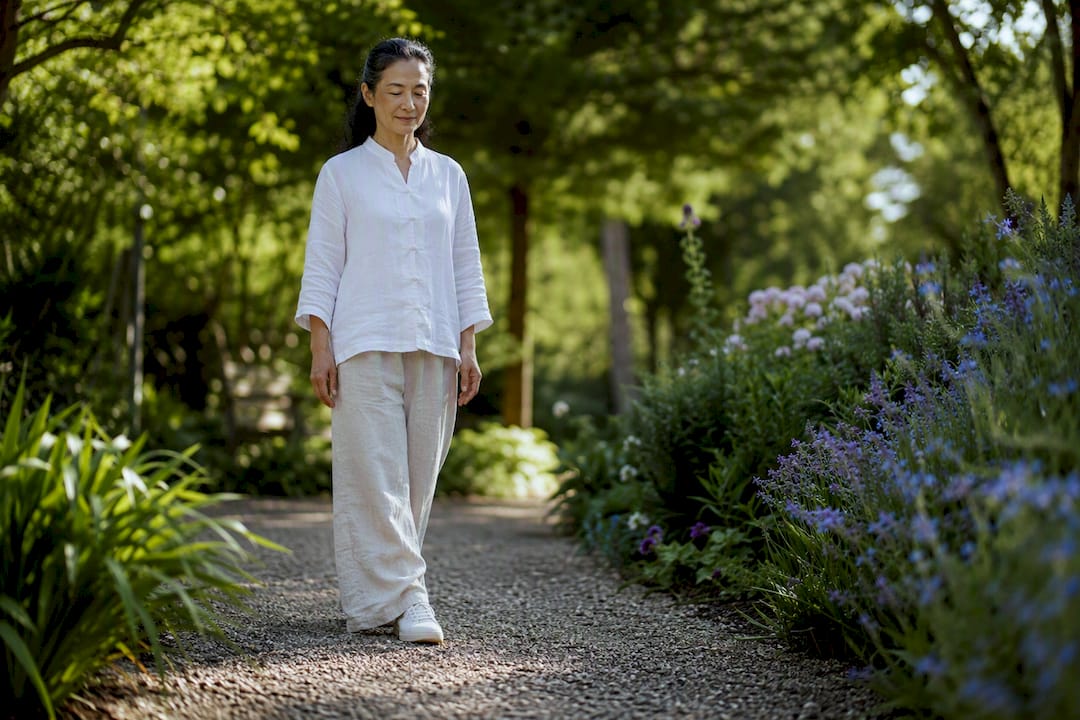
Walking meditation slows an everyday action down until each step becomes the entire point of your attention. It works as meditation because walking meditation focuses attention on each step and bodily sensation, giving your mind a simple, repeating anchor instead of asking it to sit with nothing.
Try this for a few minutes:
- Find a quiet stretch of hallway, sidewalk, or yard.
- Walk slower than feels natural, noticing your heel, then your foot, then your toes touching down.
- Breathe naturally and let each step sync loosely with your inhale or exhale.
- When your mind wanders, gently return attention to your feet.
- Pause for 30 seconds of stillness before you finish.
Difficulty: very easy. Intensity: low. Time: short periods. Best for: grounding and mental reset. This practice is remarkably portable and works in a hallway, parking lot, or crowded city block as easily as a quiet garden.
Qigong
Qigong pairs gentle, circular movements with slow, regulated breathing, drawing on centuries of Chinese medicine practice aimed at balancing energy and calming the nervous system. It qualifies as meditative movement because qigong combines gentle movement and breath regulation, and its slow tempo makes it approachable even for people with zero martial arts or yoga background.
Try this for a few minutes:
- Stand with feet shoulder width apart, knees soft.
- Raise both arms slowly to shoulder height on an inhale.
- Lower them slowly on an exhale, palms facing down.
- Repeat for 8 to 10 rounds, letting your breath lead the pace.
- Stand still for one minute afterward, noticing any warmth or tingling.
Difficulty: easy. Intensity: low. Time: short periods. Best for: stress relief and energy balance. You can also do this seated, hands resting on your thighs instead of raising overhead.
Tai chi (simple form)
Tai chi shares qigong's slow, deliberate quality but adds a flowing, weight-shifting element that builds balance over time. A short sequence of just two or three moves still delivers meditative benefits without requiring the full traditional form.
Try this for a few minutes:
- Stand with knees slightly bent, weight centered.
- Shift your weight slowly onto your right foot as your arms drift up and to the right.
- Shift back to center, then repeat to the left.
- Move slowly enough that you can feel each transfer of weight.
- Continue for 10 to 12 slow repetitions.
Difficulty: easy to moderate. Intensity: low to moderate. Time: short periods. Best for: balance and mobility. Beginners often rush the weight shift. Slow it down until it feels almost too slow.
Breath-linked movement (breathwalk)
Breath-linked movement ties every motion to a specific point in your breath cycle, so the body becomes a kind of metronome for the breath itself. Teachers describe this synchronization as producing physiological coherence that calms the nervous system, and they consistently recommend closing with a minute or two of stillness to let that calm settle in.
Try this for a few minutes:
- Stand or sit comfortably and take three normal breaths to settle.
- Raise your arms overhead on a slow inhale.
- Lower them just as slowly on the exhale.
- Repeat for 6 to 8 rounds, letting breath length dictate movement speed, not the other way around.
- Sit or stand in stillness for 60 to 90 seconds before moving on with your day.
Difficulty: easy. Intensity: low. Time: short periods. Best for: nervous system regulation.
Pro Tip: Beginners often try to make the movement look polished. Slow, imperfect, and rhythmic beats smooth and rushed every time.
Gentle or yin-style yoga
Yin yoga holds simple poses for one to five minutes at a time, working with gravity and patience rather than strength or flexibility. It counts as meditative movement because the long holds force your attention to stay with sensation, breath, and the slow release of tension rather than moving quickly from pose to pose.
Try this for a few minutes:
- Sit on the floor or a chair and fold forward gently over your legs or a table.
- Let your head and arms hang, breathing into your lower back.
- Hold for 90 seconds, breathing slowly.
- Come up slowly and repeat with a gentle seated twist on each side, holding 60 seconds per side.
- Finish seated upright for 30 seconds before standing.
Difficulty: easy. Intensity: low. Time: 5 to 10 minutes. Best for: mobility and deep relaxation. MBSR-style mindful movement programs emphasize working at roughly 60 percent of your capacity, never pushing toward a deeper stretch than feels kind to your body that day.
Mindful stretching and chair-based movement
Mindful stretching takes ordinary stretches, the kind you might do half-consciously after sitting too long, and slows them down enough to notice what's actually happening in your muscles and breath. This is the most accessible entry point on this list for anyone with joint pain, limited mobility, or a wheelchair.
Try this for a few minutes, seated:
- Sit tall in a chair with feet flat on the floor.
- Roll your shoulders slowly backward five times, breathing with each roll.
- Reach one arm overhead and lean gently to the opposite side, holding 20 seconds.
- Repeat on the other side.
- Finish with both hands resting on your knees, three slow breaths.
Difficulty: very easy. Intensity: very low. Time: short periods. Best for: accessibility and gentle mobility.
Mindful or freeform dance
Freeform dance means moving to music or silence with no choreography, no mirror, and no goal beyond noticing how your body wants to move. It's meditative because the lack of a script forces you to stay present rather than executing memorized steps.
Try this for a few minutes:
- Choose slow, instrumental music or none at all.
- Close your eyes if that feels safe and comfortable.
- Let your arms, then torso, then legs move however feels natural.
- Notice sensation rather than judging how you look.
- Come to stillness for 30 seconds when the time is up.
Difficulty: easy. Intensity: low to moderate. Time: short periods. Best for: emotional release and energy.
Short biofeedback-style micro-movements
Tiny, repeated movements, like slowly clenching and releasing a fist or rolling your ankles in a seated position, give you a meditative practice when you have almost no time or space at all. These work because even a single joint moving with attention pulls your mind out of rumination and into the present moment.
Try this for a couple minutes:
- Sit or stand comfortably.
- Slowly clench one hand into a fist over a count of five.
- Release just as slowly over a count of five.
- Repeat with the other hand.
- Finish with three slow ankle rolls per foot.
Difficulty: very easy. Intensity: very low. Time: brief practice. Best for: quick resets during a busy day.
How to Start Today: A 5 to 10 Minute Session Template
This simple sequence gives you the core benefits of meditative movement in one sitting, no experience required. Copy the steps below and adjust the timing to fit whichever type you chose above.
- Minute 0 to 1: Sit or stand quietly and take three slow breaths to arrive in your body.
- Minute 1 to 2: Set a timer for your chosen practice length, then start moving slowly, letting breath set the pace.
- Minute 2 to 7: Continue your chosen movement (walking, qigong, stretching, or another type from the list above), returning attention to sensation each time your mind drifts.
- Minute 7 to 9: Slow the movement further until you come to a natural stop.
- Minute 9 to 10: Sit or stand in stillness, noticing how your body feels compared to when you started.
Timer tip: use your phone's simple countdown timer rather than a meditation app with chimes if you're new to this. A plain, quiet vibration at the end lets you finish on your own terms instead of being startled out of the moment. Aim for three sessions a week to start, then build toward daily practice once it feels familiar rather than forced.
Beginner Qigong Mini-Routine From Stella
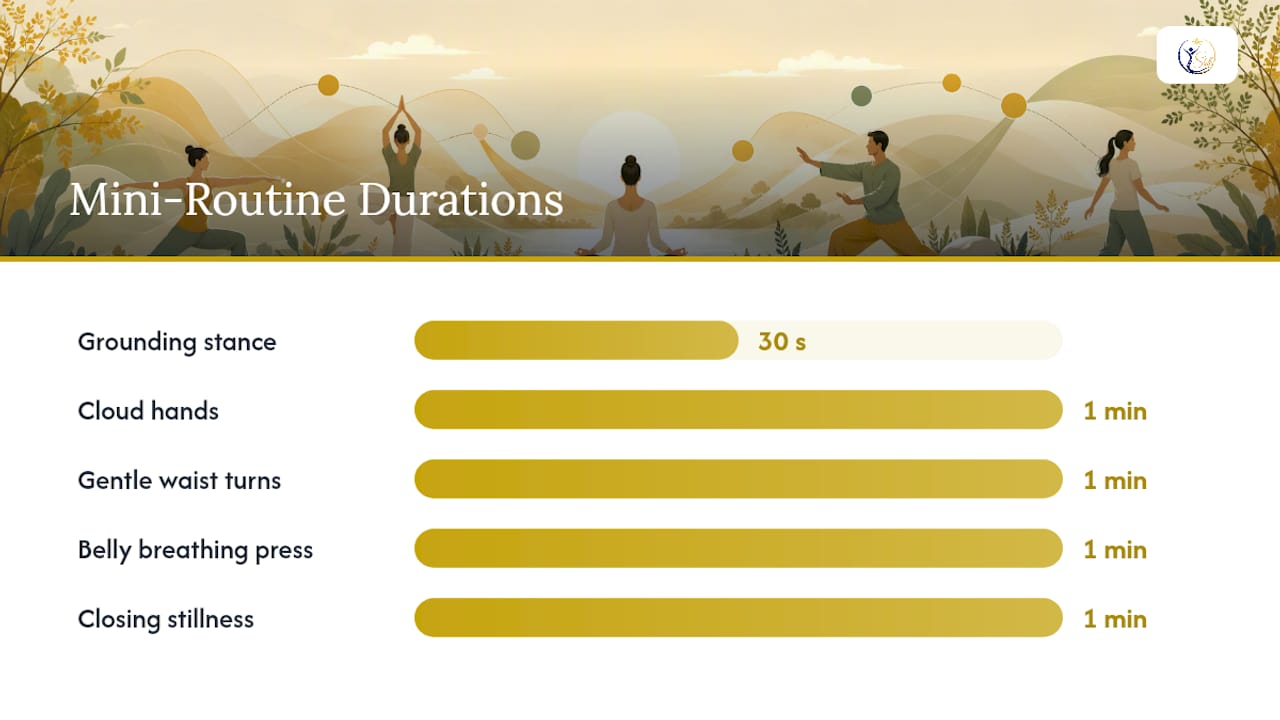
I've taught qigong long enough to know that beginners don't need a long form, they need a short one they'll actually repeat. This routine draws on the same breath-and-movement principle behind traditional qigong practice and takes about five minutes, easing stress and settling digestion without asking much of your body.
Try this sequence:
- Grounding stance (30 seconds): Feet shoulder width apart, knees soft, hands resting at your sides.
- Cloud hands (1 minute): Slowly sweep both arms in wide circles in front of your torso, following your breath.
- Gentle waist turns (1 minute): Rotate your torso slowly left and right, arms loose, as if wringing out tension.
- Belly breathing with hand press (1 minute): Place both hands on your lower belly, breathing so your hands rise and fall.
- Closing stillness (1 minute): Stand quietly, noticing warmth or ease in your chest and abdomen.
If standing for that long feels tiring, do the entire sequence seated, keeping your feet flat and your spine tall. I'm a certified White Tiger Qigong instructor, and this short sequence is the same style of practice I use to open longer sessions with new students.
Staying Safe: When to Modify or Pause
Listen to your body first, technique second. Meditative movement should feel calming, not straining, and any sharp discomfort is a signal to stop rather than push through.
Pause and check in with a doctor if you notice any of the following:
- Dizziness or lightheadedness during or after movement.
- Sharp or shooting pain in a joint or muscle.
- Shortness of breath that doesn't ease when you slow down.
- A diagnosed heart, balance, or neurological condition that hasn't been cleared for gentle exercise.
Most practices adapt easily. Do any of them seated in a chair, shrink the range of motion, or slow the tempo even further than the script suggests. Progress gradually, adding a minute or two every week rather than jumping straight to a 20 minute session.
Where to Keep Learning
A short YouTube guide, an app-led session, or a local community class can all deepen what you've started here. Look for a few resource types as you explore further:
- Short, teacher-led guide videos for form checks.
- App-based movement meditations with adjustable session length.
- In-person or online community classes for accountability.
- Books on tai chi, qigong, or mindful movement fundamentals.
- Chair-friendly guided routines for limited mobility days.
When choosing a guided class, favor shorter sessions (10 to 20 minutes) for your first few tries, and check that the teacher lists real credentials rather than vague wellness titles. Qigongstar's online qigong classes offer exactly this kind of structured, teacher-led path if the mini-routine above left you wanting more.
A note on starting small
I've watched plenty of students try to do too much in week one, then quit by week two. The hiccup is almost always overcommitting to length instead of consistency. Five honest minutes, repeated often, changes more than one perfect session ever will.
Sources
- Move with Mindfulness - Meditation | Headspace
- PMCID: PMC5425577
- The health benefits of tai chi | Harvard Health
- Qigong: What You Need To Know | NCCIH
- Walking meditation | Greater Good in Action (GGIA)
- A 12 Minute Meditation to Make Movement Mindful with Cara Bradley - Mindful