
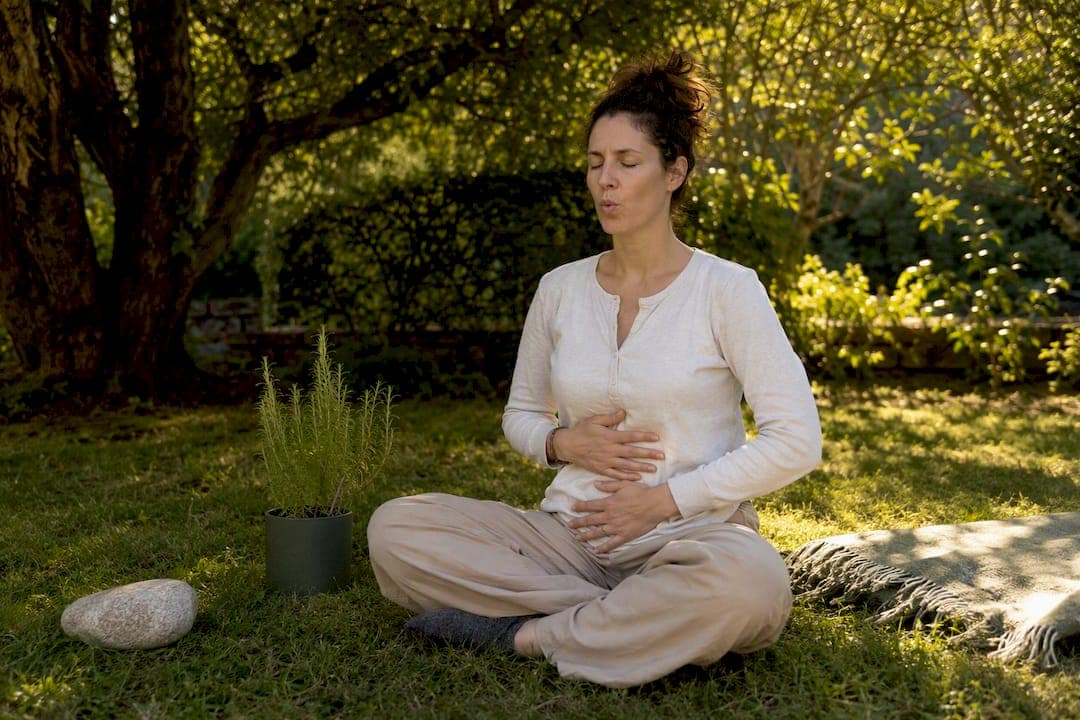
When a panic attack starts, focus on your exhale first. Let it slow down and lengthen while your inhale takes care of itself. This is the single most useful move you can make in the first 30 seconds of an attack, and it works because your out-breath, not your in-breath, is what signals safety to your nervous system.
Here's the whole sequence, memorized in three steps:
- Ground: Sit if you can, feel your feet or seat supporting you.
- Exhale: Purse your lips and blow out slowly, counting to five or six.
- Allow: Let the inhale come naturally through your nose. Don't force or deepen it.
Repeat this for a minute or two. The surge usually softens rather than vanishes instantly, and it gets easier and faster with regular practice.
Key Takeaways
Slowing and lengthening the exhale during a panic attack is the single most reliable immediate technique, and daily practice makes it faster and more automatic.
| Point | Details |
|---|---|
| Lead with the exhale | Slow, pursed-lip exhales calm the nervous system faster than trying to control the inhale. |
| Skip the holds if tense | Drop breath holds in 4-7-8 or box breathing if they feel tight or worsen panic. |
| Pair breath with grounding | Anchor each exhale to a sensation, like feet on the floor, using 5-4-3-2-1 grounding. |
| Practice five minutes daily | Cyclic sighing for five minutes a day lowers resting breathing rate and improves mood over time. |
| Know your limits | Seek emergency care for chest pain or fainting, and avoid paper-bag breathing without medical advice. |
| Build the habit with guidance | Qigongstar's online courses train breath regulation through gentle daily movement practice. |
Table of Contents
- Breathwork Techniques for Panic Attacks: Step-by-Step Methods
- What Grounding Moves Should You Pair With Breathing?
- How to Build a Daily Practice That Actually Reduces Panic Attacks
- When Should You Avoid Breathwork or Seek Help Instead?
- Why Slow Exhales Calm the Panic Response
- What I've Learned Teaching Breathwork for Anxiety
- Build a Safer Daily Breath Practice With Guided Qigong
- Sources
Breathwork Techniques for Panic Attacks: Step-by-Step Methods
Not every technique suits every moment of panic, so it helps to know a few and reach for whichever fits how intense things feel. All four below share one rule: the exhale leads, and you never force a deep inhale while you're already gasping.
1. Exhale-focused slow breathing. This is your default, especially early in an attack. Breathe out through pursed lips for a count of six, pause briefly, then let a normal inhale happen through the nose. Repeat for a short duration, about a minute or two. If counting feels like too much to track, just whisper "long, slow, out" as you exhale.
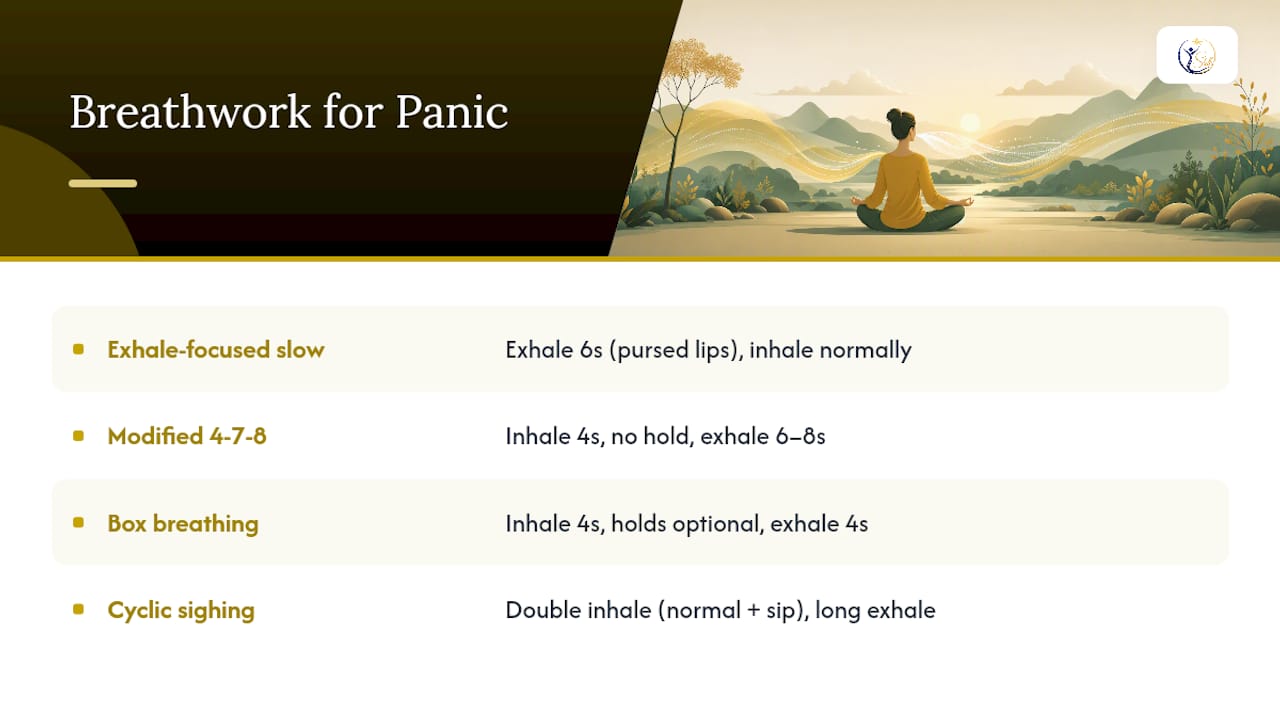
2. Modified 4-7-8 breathing. The classic version asks you to inhale for 4, hold for 7, exhale for 8. During acute panic, drop the hold. It can feel suffocating when your chest is already tight. Instead, inhale gently for 4, skip straight to a slow exhale for 6 to 8, and repeat. The lengthened exhale still does the calming work without the breath-holding that can spike anxiety in sensitive people.
3. Box breathing, with an escape clause. Traditional box breathing runs inhale 4, hold 4, exhale 4, hold 4, in a repeating square. If a hold ever feels tight or panicky, drop it and just cycle inhale 4, exhale 4. There's no failure state here. The shape is a guide, not a rule.
4. Cyclic sighing. Take a normal inhale through the nose, then a second, smaller sip of air on top of it, then release everything in one long, slow exhale through the mouth. This double-inhale, long-exhale pattern is one of the most effective exhale-focused techniques practical guides recommend for interrupting hyperventilation.
Pro Tip: Pick one technique and rehearse it when you're calm, not just during an attack. A single well-practiced script beats a mental menu of five options you have to choose between while panicking.
What Grounding Moves Should You Pair With Breathing?
Breathing alone can feel abstract when your mind is racing, so pair each exhale with something physical you can feel. The classic 5-4-3-2-1 method works well here: name five things you see, four you can touch, three you hear, two you smell, one you taste, timing each category to a slow out-breath.
Simple physical anchors work just as well:
- Press your feet flat into the floor as you exhale.
- Cup your hands over your nose and mouth and feel the warmth of your own breath.
- Drop your shoulders away from your ears on the exhale.
A useful mnemonic: exhale, then anchor. Every out-breath gets paired with one sensation, which keeps your attention tethered to your body instead of the spiral in your head.
How to Build a Daily Practice That Actually Reduces Panic Attacks
The techniques above work better and faster the more you've rehearsed them, which is why a short daily habit matters more than most people expect. A Stanford Medicine trial found that five minutes of daily cyclic sighing lowered resting breathing rate and improved mood more than comparison relaxation exercises over the course of the study.
Try this brief breathing sequence daily, ideally at a calm moment rather than during panic.
- Sit comfortably, inhale through the nose, add a second short sip of air.
- Exhale slowly and fully through the mouth for as long as feels comfortable.
- Repeat for five minutes, letting the exhale get slightly longer as you relax into it.
If you have less time, a 2 to 3 minute nasal-breathing routine with longer exhales than inhales still builds the same skill. Some practitioners also explore Buteyko-style concepts, measuring something called the BOLT score to gauge carbon dioxide tolerance and gently extend it over time. That kind of structured retraining is worth pursuing with a clinician's guidance rather than on your own, since pushing CO2 tolerance too fast can backfire. NHS guidance also recommends practicing diaphragmatic breathing regularly, specifically so it's already familiar and easier to use once panic hits.
When Should You Avoid Breathwork or Seek Help Instead?
Breathwork is a self-help tool, not a substitute for medical care, and a few limits matter. Skip paper-bag breathing unless a clinician has specifically advised it. It carries real risks for people with heart or lung conditions and isn't something to try unsupervised.
Get emergency care for chest pain, fainting, or a first-ever severe attack, since these can mimic other medical emergencies. Talk to a doctor or therapist if attacks are frequent or disrupting daily life. And know that breath focus can briefly heighten anxiety for some people before it helps, so start gently and lean on professional support if that happens.
Why Slow Exhales Calm the Panic Response
A long, slow exhale activates your vagus nerve, which triggers the parasympathetic system, your body's built-in brake pedal. Practitioner writing on mindfulness describes this as "letting be" rather than fighting the sensations, and mindfulness practices and noticing sensations offer complementary perspectives supporting slow, steady breath as a genuine down-regulator of the nervous system, not just a distraction technique.
Qigong practice builds this same skill through gentle, repeated breath regulation, so the nervous system learns the pattern of calm on its own terms, not just under duress.
Pro Tip: Give yourself one phrase to remember under stress, something like "exhale six, feet down." One rehearsed script beats a mental list every time panic actually hits.
What I've Learned Teaching Breathwork for Anxiety
Students almost always tell me the exhale-focused breath felt awkward for the first week, then oddly automatic by the second. That shift is normal, not a sign you're doing it wrong. Practice gently, be patient with slow progress, and reach out for professional support if attacks keep escalating. You deserve both the tool and the help.
Build a Safer Daily Breath Practice With Guided Qigong
Self-teaching breathwork from articles works for many people, but it has a ceiling. Without feedback, it's easy to hold your breath too long, force inhales that spike anxiety, or lose the habit after a week. Qigongstar's online Qigong classes build breath regulation into gentle, progressive movement sequences, so slow-exhale practice becomes automatic rather than something you have to remember mid-crisis.
The on-demand courses include White Tiger Qigong and Five Animal Qigong, both structured around breath-led movement that's beginner-friendly and self-paced. If you'd rather build the skill with guidance than trial and error alone, start with a class this week and give your nervous system a steadier practice to return to.
Sources
- Breathing exercises for stress — NHS
- 'Cyclic sighing' can help breathe away anxiety — Stanford Medicine
- Breathwork for Panic Attacks: What Actually Helps — Inhale