
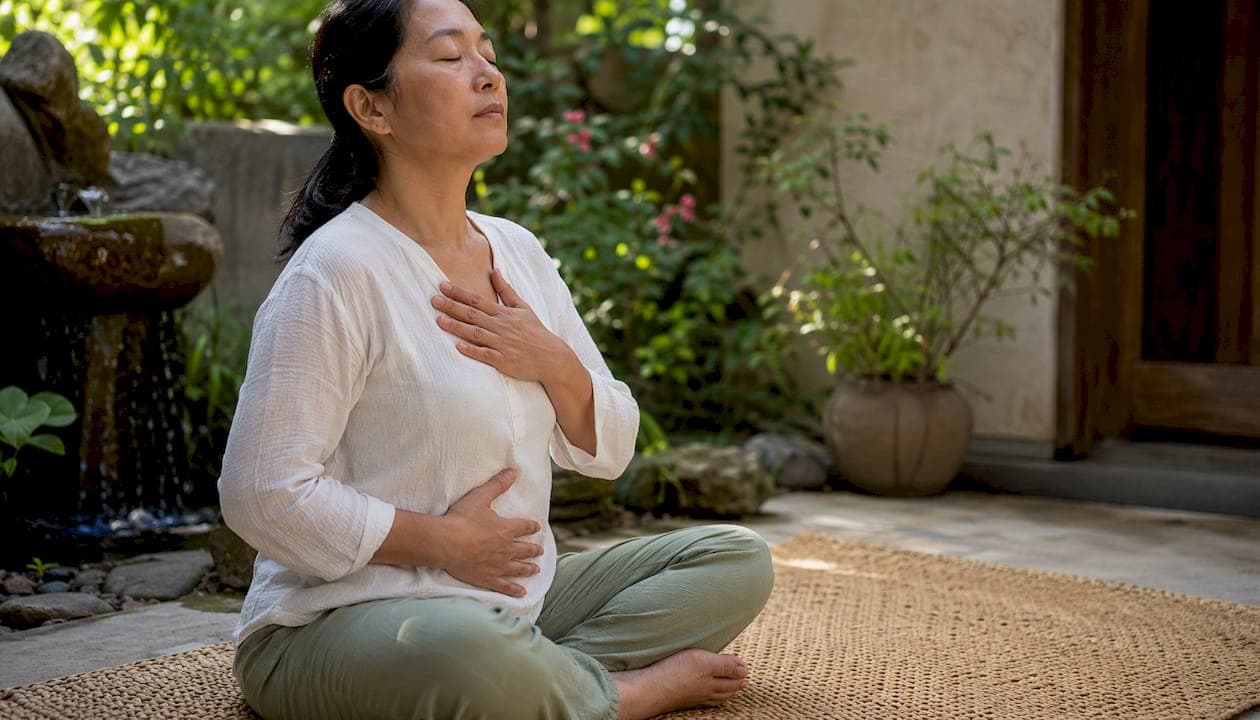
Breath is the practical bridge in Qigong: it anchors your attention, moves and refines your Qi, and shifts your body toward genuine physiological rest. Everything else in Qigong practice, the postures, the flowing movements, the meditative stillness, works through that bridge. When your breath softens, your nervous system follows.
Here's the fast version before we go deeper:
- Breath anchors attention and coordinates movement — it gives your mind a steady, physical place to rest while your body moves through a form.
- Breath moves and refines Qi in the traditional framing, guiding energy along the meridians and settling it in the Dan Tian, your body's lower energy center.
- Slow abdominal breathing engages the vagus nerve, nudging your body out of stress mode and into rest and repair.
Try this now: breathe in gently through your nose for a slow count of four, letting your belly soften and expand. Exhale through your nose for a count of six, feeling your lower abdomen draw in. That's the whole practice in miniature. Everything below just deepens it.
Key Takeaways
Breath in Qigong works because it simultaneously anchors your attention, moves Qi in the traditional framework, and triggers measurable parasympathetic relaxation in the body.
| Point | Details |
|---|---|
| Breath is the bridge | It links mind, movement, and Qi, and it's the fastest lever you have for shifting your body toward rest. |
| Follow the three golden rules | Keep breath relaxed, abdominal, and mind-attentive; never force depth or hold at the top of an inhale. |
| Match technique to purpose | Use natural abdominal breathing daily, Dan Tian breathing for stillness, and cleansing or filling breaths to open a session. |
| Watch for red flags | Dizziness, racing heart, or a history of cardiovascular issues means slow down and check with a clinician. |
| Learn advanced methods with guidance | Reverse breathing and sound-based exhalations belong in a supervised setting, such as Qigongstar's certified course programs. |
Table of Contents
- What Is the Role of Breath in Qigong?
- What Are the Three Golden Rules of Qigong Breathing?
- How Do You Practice Qigong Breathing Exercises Step by Step?
- How Do You Coordinate Breath With Qigong Movement?
- What Does Research Say About Qigong Breathing and the Body?
- What Are the Common Mistakes and Safety Risks in Qigong Breathing?
- How Can You Build a Breath-Focused Qigong Practice?
- How Do Instructors Sequence Breath Training for New Students?
- Ready to Learn Breath-Centered Qigong With Guidance?
- Frequently Asked Questions
- Sources
What Is the Role of Breath in Qigong?
Ask ten Qigong teachers what breath does and you'll hear two different vocabularies describing the same experience. One speaks in the language of Qi, meridians, and the Dan Tian. The other speaks in the language of the vagus nerve, blood pressure, and heart rate variability. Neither is wrong. They're describing the same phenomenon from different centuries.
In the traditional frame, breath is what moves Qi through the body's energetic pathways. Practitioner writing consistently describes breath as the central link that anchors attention and harmonizes internal states, giving the mind something concrete to hold onto while it guides energy through the meridians. Classic Qigong theory also holds that "the lungs govern Qi," meaning respiration itself is treated as the mechanism that generates and circulates vital energy, not just a byproduct of it.
In the practical frame, that same breath is doing measurable work on your body. The National Center for Complementary and Integrative Health describes Qigong as a practice that typically coordinates slow movement, rhythmic breathing, and a calm meditative state, combining physical and psychological elements used for health promotion and rehabilitation. Slow, abdominal breathing lowers blood pressure and can activate peristalsis, the wave-like muscle contractions that move digestion along, according to principles outlined by acupuncture practitioners.
Here's where the two frames genuinely overlap, not just coexist:
| What tradition says | What physiology observes |
|---|---|
| Breath anchors the mind and stills scattered thoughts | Slow breathing reduces sympathetic nervous system activity |
| Breath guides Qi downward to the Dan Tian | Diaphragmatic breathing engages the vagus nerve near the abdomen |
| Abdominal breathing "intensifies" Qi and supports digestion | Belly breathing activates peristalsis and can ease bloating |
| Smooth, unforced breath allows energy to flow freely | Relaxed breathing avoids the stress response triggered by shallow, forced breathing |
The practical payoffs show up quickly for most beginners:
- Falling asleep faster on nights you practice, because slower breathing lowers arousal before bed.
- A gentle drop in resting blood pressure over weeks of consistent practice.
- A noticeably quieter, more focused mind within a single session, since breath gives your attention a job to do.
If you want a deeper look at how different breath styles map to different health goals, Qigongstar's guide to breathwork styles breaks down several variations you'll encounter as you progress.
What Are the Three Golden Rules of Qigong Breathing?
Every technique in this article builds on three principles. Learn these before you learn any specific method, because they determine whether a technique helps you or works against you.
- Relaxed. No part of the breath should feel gripped or effortful. Your shoulders, jaw, and throat stay soft through the entire cycle.
- Natural and abdominal. The breath originates low, in the belly, not high in the chest. It moves at a pace your body would choose on its own, just slightly slowed and noticed.
- Mind-attentive. Your awareness stays with the breath itself, not wandering to your to-do list or forcing a particular sensation to appear.
Where beginners go wrong is almost always the same handful of habits:
Do: let the exhale be slightly longer than the inhale. Don't: hold your breath at the top of the inhale, hoping it will "concentrate" the energy.
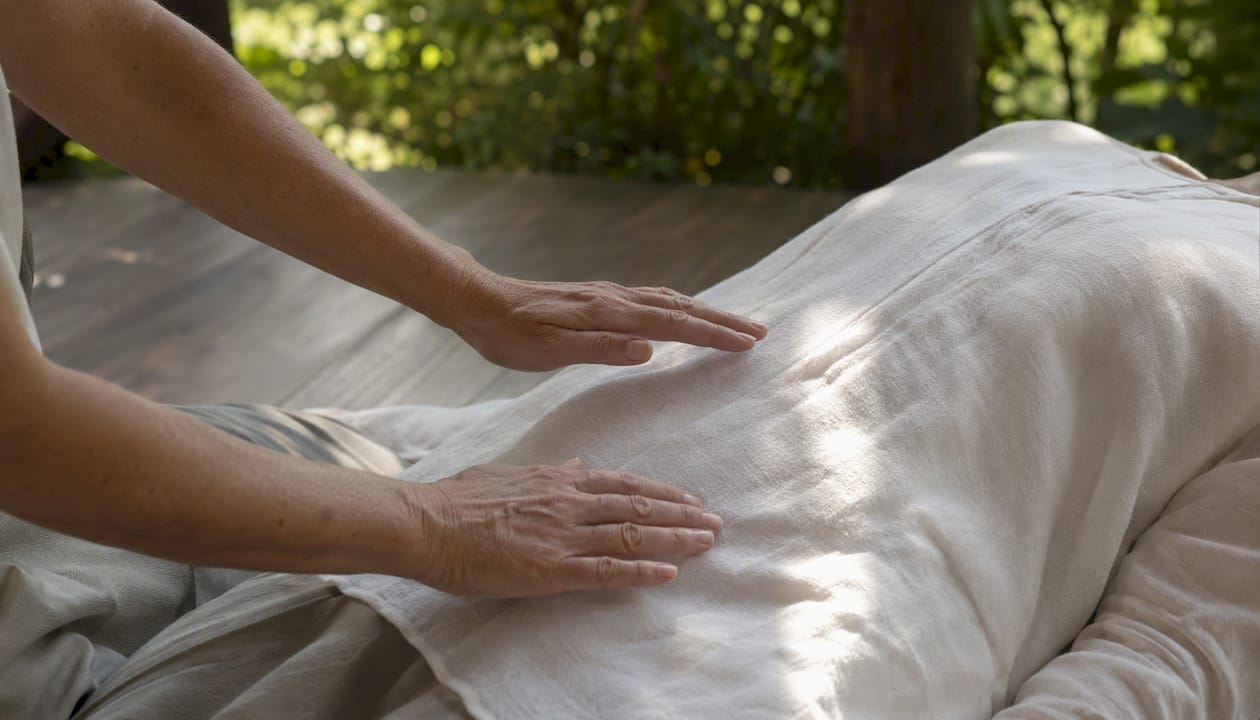
Do: breathe through your nose with a relaxed throat. Don't: gasp or pull air in through a tight mouth.
Do: let your belly move passively as the diaphragm does its work. Don't: actively punch your belly in and out to force a bigger movement.
There's a phrase Qigong teachers return to again and again: breath that becomes "like silk," so soft it's almost imperceptible. That softness is both a goal and a diagnostic. If you can hear your own breathing or feel any strain in your throat or chest, you're forcing it, and forced breath creates tension that blocks the very energetic flow you're trying to cultivate.
Pro Tip: Place one hand lightly on your belly and one on your upper chest. If the chest hand moves more than the belly hand, you're breathing too high. Slow down until the belly hand does most of the work.
How Do You Practice Qigong Breathing Exercises Step by Step?
Different situations call for different breathing techniques. Here's how to build the core repertoire.
- Natural abdominal breathing (your foundation). Sit or stand with a relaxed spine. Inhale through your nose, letting your belly expand outward without forcing it. Exhale through your nose, letting your belly draw gently inward. Repeat for 8 to 10 cycles before moving to anything else.
- Diaphragmatic belly breathing. Similar to abdominal breathing, but with more deliberate attention on the diaphragm doing the lifting. Inhale for a count of four, pause briefly without tension, exhale for a count of six. This ratio, a longer exhale than inhale, is the same pattern researchers used when observing changes in blood pressure and peripheral oxygen saturation during controlled respiration.
- Dan Tian breathing. Once abdominal breathing feels natural, add a mental focus point about two inches below your navel. Imagine each inhale gathering energy there, each exhale settling it deeper. This is the technique most associated with the traditional idea of breath "moving Qi."
- Cleansing breath. A firmer, sometimes audible exhale through the mouth, used at the start of a session to release stale tension. Inhale normally through the nose, then exhale through slightly parted lips with a soft "haaa" sound.
- Filling breath. The counterpart to cleansing breath: a slow, full inhale through the nose intended to draw in fresh energy, often used after the cleansing breath to reset the system. Some traditions also teach a teacher-guided "prescription breath", a pattern tailored to an individual student's needs.
A few variations you'll encounter as you explore different schools:
- Nasal exhale versus mouth exhale. Nasal breathing throughout is calming and is often the first method taught to beginners because it supports mental steadiness. Mouth exhalations show up in cleansing techniques for a sharper release.
- Reverse breathing (advanced). Here the belly contracts on the inhale instead of expanding, the opposite of natural abdominal breathing. It's a legitimate technique in later stages of practice, but it changes intra-abdominal pressure in ways that beginners shouldn't attempt without supervision.
- Sound-based exhalations. Certain traditions pair specific sounds with the exhale for targeted effects, like releasing tension in a particular area. These are prescriptive tools, not something to improvise.
Match the technique to the moment: natural abdominal breathing for warm-up and cooldown, Dan Tian breathing for meditative stillness, cleansing and filling breaths to open or close a session, and paced diaphragmatic breathing when you specifically want a calming, blood pressure lowering effect.
Pro Tip: If you ever feel light-headed, you're pacing too aggressively. Return to your natural breathing rate for a few cycles before trying the technique again, and never chase a longer count than feels effortless.
How Do You Coordinate Breath With Qigong Movement?
Moving Qigong forms add a layer of coordination on top of everything you've just learned, but the underlying rule doesn't change: breath still leads.
The most common pattern pairs the inhale with opening or lifting movements and the exhale with closing or sinking movements. As your arms rise and open in a form like Lifting the Sky, you inhale. As they lower and settle, you exhale. This isn't a rigid formula, though. The timing should stay organic. If a movement takes longer than your natural breath cycle, let the breath adjust to the movement rather than rushing the breath to match a beat.
A few sensory cues help you know you're doing it right:
- Your lower abdomen softens and moves without you consciously pushing it.
- Your ribs expand slightly outward and to the sides on the inhale, not just forward.
- Your throat stays loose enough that you could swallow comfortably at any point in the cycle.
- Your shoulders stay level and uninvolved in the breathing effort.
Breath is what keeps moving Qigong from becoming just another exercise routine. When your mind drifts, and it will, the fastest way back isn't to correct your posture or your form. It's to notice your next exhale and let that single breath pull your attention back into the body. This is why instructors often describe breath as the anchor of moving meditation: it's the one constant thread running through every posture change, and returning to it is far easier than trying to mentally "refocus" in the abstract.
What Does Research Say About Qigong Breathing and the Body?
The traditional language of Qi and meridians has a real physiological counterpart, and that's worth taking seriously rather than dismissing as metaphor.
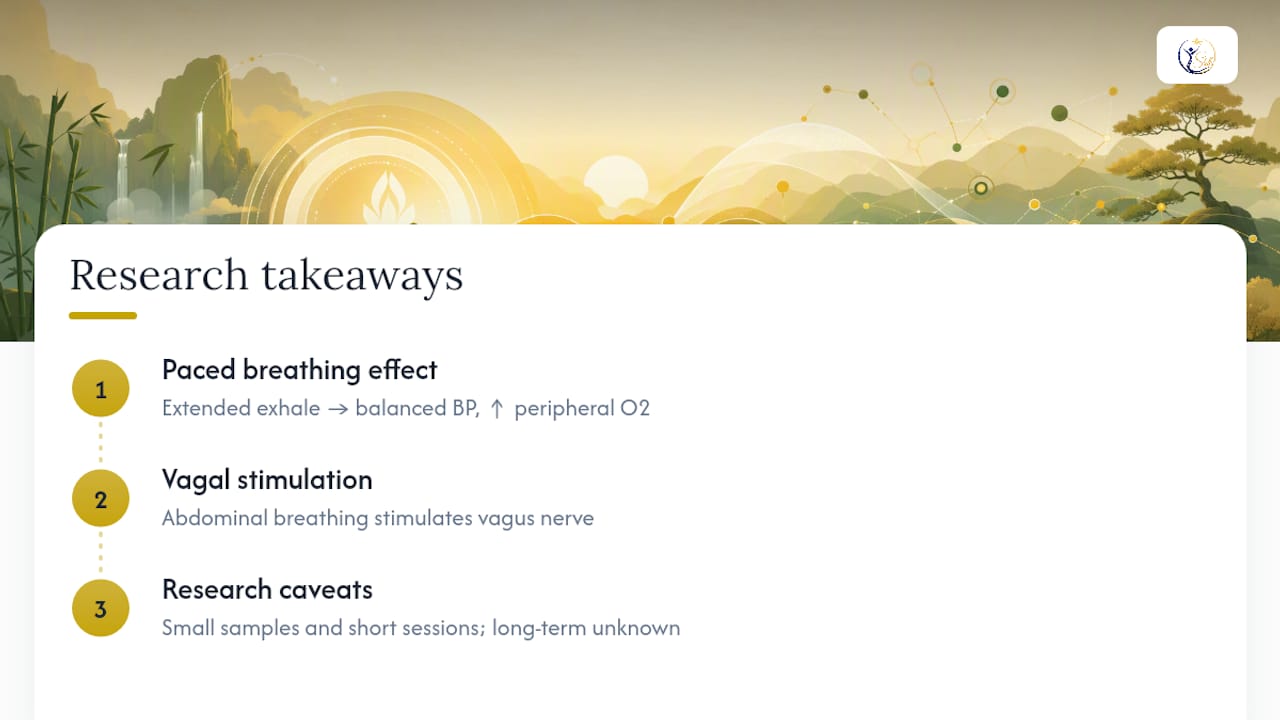
A 2001 study examined controlled respiration patterns, specifically a 15 second exhale paired with a 5 second inhale, and found this pattern was associated with more balanced blood pressure and increased peripheral oxygen saturation compared to normal resting breathing. That's a strikingly long exhale relative to inhale, longer than most beginners would use, but it illustrates the underlying mechanism: extending the exhale relative to the inhale reliably shifts the body's cardiovascular measures.
The lower abdomen and diaphragm sit close to major branches of the vagus nerve, the primary channel of the parasympathetic nervous system. Slow, deep breathing that expands the belly appears to stimulate this nerve directly, which is likely part of why abdominal breathing produces such a fast, noticeable calming effect compared to shallow chest breathing.
Three things are worth holding onto here.
What the evidence supports: slow, extended-exhale breathing changes measurable variables, including blood pressure and oxygen saturation, within a single session.
What the evidence doesn't fully settle: how much of Qigong's broader reputation for calm and wellbeing comes specifically from breath versus the combined effect of the movement, the meditative attention, and the breath together. Qigong practice bundles all three, and most research studies the bundle rather than isolating breath alone.
The honest caveat: a lot of the physiological research on paced breathing comes from small samples and short lab sessions. That's a legitimate signal, not a guarantee. Acute changes measured in a lab over minutes are a different thing from durable, long-term outcomes measured over months of home practice. If you want the deeper mechanics of how breath supports stress resilience specifically, Qigongstar's guide to building stress resilience covers that ground in more detail.
What Are the Common Mistakes and Safety Risks in Qigong Breathing?
Most beginner problems with breath come from good intentions applied too forcefully. Wanting to breathe "deeply" is not the same as wanting to breathe "hard," and confusing the two causes most of the trouble.
- Forcing the breath to be deeper than feels natural. Fix: let depth increase gradually over weeks, not within a single session. Depth should feel like an unlocking, not a stretch.
- Holding the breath during transitions between movements. Fix: if you're not sure what to do with your breath during a transition, default to a slow exhale. It's rarely wrong.
- Attempting reverse breathing without guidance. Fix: stick with natural abdominal breathing until an instructor introduces reverse breathing directly to you, since it shifts internal pressure in ways that can affect blood pressure if done incorrectly.
- Rapid, shallow pacing dressed up as "energizing" breath. Fix: energizing breathwork in Qigong is still controlled and rhythmic. If you feel your heart racing or your head going light, you've drifted into hyperventilation, not energized Qi.
Reverse breathing and sound-based exhalations are genuinely useful tools further along in training, but they carry real risk of dizziness or blood pressure shifts if practiced incorrectly. They belong in the hands of a teacher who can watch you do them, not in a solo experiment from a description on a page.
A short list of medical situations that warrant a conversation with your doctor before starting any breath-focused practice: a history of cardiovascular disease, uncontrolled hypertension, pregnancy, or a seizure disorder. None of these rule out Qigong. They just mean your breathing pace and depth should be set with a clinician's input rather than guessed at from general guidance, and this article is general information, not a substitute for that conversation.
How Can You Build a Breath-Focused Qigong Practice?
You don't need an hour and a special room to get real benefit from breath work. Here are three templates scaled to how much time you actually have.
- 5-minute reset. Sit or stand comfortably. Spend 1 minute settling into natural abdominal breathing. Spend the remaining 4 minutes on diaphragmatic breathing with a slightly longer exhale than inhale. Ideal for a work break or right before a stressful conversation.
- 15-minute session. Begin with 2 minutes of natural abdominal breathing to settle. Move into 5 minutes of gentle standing or seated movement, coordinating inhale with opening and exhale with closing. Add 5 minutes of Dan Tian breathing in stillness. Close with 3 minutes of seated cooldown breathing at your natural pace.
- 30-minute full sequence. Open with a cleansing breath, 3 to 5 cycles, to release tension. Follow with a filling breath, 3 to 5 cycles, to draw in fresh energy. Spend 15 minutes on a moving Qigong form with coordinated inhale and exhale on each posture change. Finish with 7 to 10 minutes of standing or seated stillness focused entirely on Dan Tian breathing.
| Session length | Core focus | Best used for |
|---|---|---|
| 5 minutes | Diaphragmatic breathing only | Quick stress reset, on the go |
| 15 minutes | Two techniques plus light movement | Daily maintenance practice |
| 30 minutes | Full cleansing, filling, and moving sequence | Deeper energy work and longer relaxation |
If standing or moving is difficult, every one of these templates works seated. Simply replace the moving Qigong segment with extra time in Dan Tian breathing or gentle seated arm movements timed to your breath. Progression is a matter of increments, not leaps: add a minute or two to your seated stillness each week rather than jumping straight to the 30-minute sequence. For a fuller daily structure once these templates feel familiar, Qigongstar's daily Qigong routine guide lays out a week-by-week build.
How Do Instructors Sequence Breath Training for New Students?
The order in which you learn breathing skills matters as much as the skills themselves. Teaching reverse breathing or sound-based exhalations to someone who hasn't settled into natural abdominal breathing tends to backfire, producing tension instead of ease.
The typical sequence starts with relaxation and natural abdominal breathing in stillness, done for several sessions before any movement is added. Only once that breath feels automatic, no conscious effort needed to keep it low and soft, does coordination with movement get introduced. Reverse breathing, sound techniques, and more advanced Dan Tian work come later still, usually with direct, one-on-one correction, because these methods are much easier to learn by feel than by description.
Expectations matter here too. Sleep quality and a general drop in stress reactivity are often the first things students notice, sometimes within two to four weeks of consistent short sessions. The subtler traditional sensations, warmth or tingling that practitioners associate with Qi moving to the Dan Tian, tend to take longer, often several months of regular practice before they register clearly. That gap between the physiological wins arriving early and the energetic sensations arriving later trips up a lot of beginners who expect everything at once.
If your progress plateaus, and most practitioners hit at least one plateau, it's rarely a sign you're doing something wrong. More often it means your body has adapted to your current pace and depth, and it's time for a small adjustment: a slightly longer exhale, a new technique like the filling breath, or simply a session with an instructor who can watch your shoulders and throat for tension you can't feel yourself. Self-correction from written instruction only goes so far, and that's exactly where a live set of eyes on your form makes the difference.
Ready to Learn Breath-Centered Qigong With Guidance?
Everything in this piece works better with real-time correction, because breath habits are physical habits, and physical habits are hard to see in yourself. A structured course gives you what a written guide can't: someone watching your shoulders, your throat, your pacing, and telling you the moment tension creeps in.
Qigongstar's Five Animal Qigong course builds breath training into every session, starting with the same natural abdominal breathing covered here and progressing at a pace suited to your body, not a generic timeline. You'll get foundational breathing and posture work first, then tailored modifications as you're ready for them, whether you're practicing standing or seated. Instructors are certified through the White Tiger Qigong School and Yoga Alliance, and courses run both live and on-demand, so you can start with whichever format fits your schedule. If you'd rather explore the full catalog first, Qigongstar's online classes and courses page lays out every format available. Pick a start date and let an instructor correct the details a page never can.
Frequently Asked Questions
What is the main role of breath in Qigong? Breath serves as the practical connector between your mind, your movement, and your Qi. It gives your attention a steady focus point while also triggering real physiological relaxation, particularly through vagus nerve activation from slow abdominal breathing.
Should you breathe through your nose or mouth during Qigong? Nasal breathing is the standard recommendation for most Qigong practice, since it supports a calmer mental state and better filters the air. Mouth exhalations are reserved for specific techniques, like cleansing breath, meant to release tension.
Is reverse breathing safe for beginners? Reverse breathing, where the belly contracts on the inhale, is considered an advanced technique. It changes internal pressure in ways that can affect blood pressure, so it's best learned directly from a qualified instructor rather than attempted alone.
How long before you feel the benefits of Qigong breathing? Many practitioners notice improvements in sleep and stress reactivity within two to four weeks of consistent short sessions. The subtler traditional sensations associated with Qi moving through the body often take several months to become clear.
Can Qigong breathing lower blood pressure? Slow, extended-exhale breathing has been associated with more balanced blood pressure and improved oxygen saturation in controlled studies. Results vary by individual, and anyone with uncontrolled hypertension should practice under medical guidance.
Sources
- PubMed: Controlled respiration patterns and cardiovascular effects (2001)
- National Center for Complementary and Integrative Health: Qigong — What You Need to Know
- The Role of Breath in Taijiquan and Qigong — Qi Journal
- V. Principles of Qigong ① Breath – Acupuncture Times
- Belly Breathing – Qigong Meditation
- Qi Gong Breathing Exercises | Qiang Shan Ba Gua Zhang