
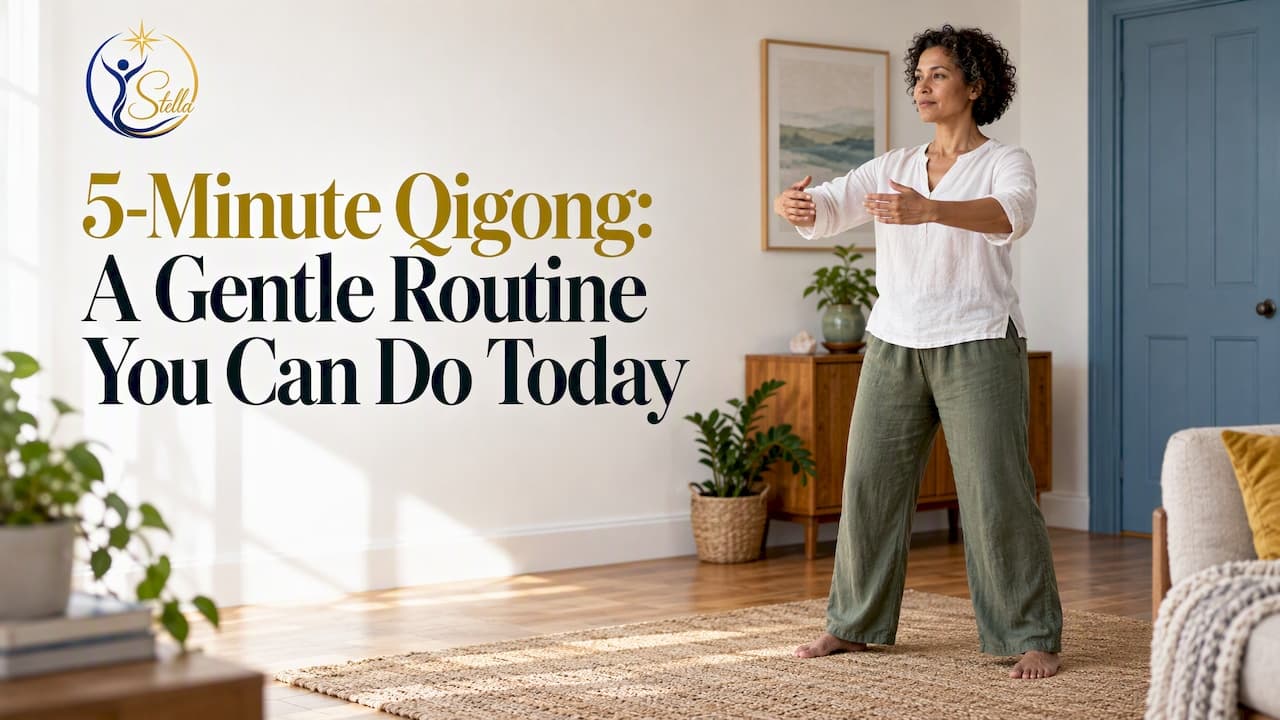
Five minutes is enough to start qigong. You can settle your posture, slow your breath, move your arms with the rhythm of that breath and finish in stillness. You can do it standing or sitting, in loose clothes, with no equipment. Below you will find the full routine with timings, a seated version, a straight look at what five minutes can and cannot do, and ways to make the habit last.
TL;DR
- A 5-minute qigong session has four parts: settle (1 minute), breathe with arm movements (2 minutes), gentle side-to-side movement (1 minute), stand or sit quietly (1 minute).
- Keep every movement small, smooth and pain-free. If you feel pain, dizziness or breathlessness, stop.
- Five minutes is a consistency tool. Research looks at repeated programs, so treat it as a daily habit rather than a cure.
- You can practice it seated, which suits desk days, tired evenings and limited mobility.
- If you want guidance on your own posture and breath, we teach live and on-demand classes online.
Table of Contents
- What 5-minute qigong actually is
- Before you begin
- The 5-minute routine, step by step
- Timing at a glance
- The seated version
- What five minutes can and cannot do
- Common mistakes and how to avoid them
- Where to fit your five minutes
- Our perspective on short practice
- Growing the habit beyond five minutes
- Learn with a teacher
- FAQ
- Sources
What 5-minute qigong actually is
Qigong is often translated as cultivating or working with qi. Qi can mean breath or inner vitality, and gong means a skill built through regular effort. In practical terms, qigong combines gentle movement, posture, breathing and focused attention, and the same review notes it can be adapted to seated or lying practice.
That last point matters for a short session. A five-minute routine is not a squashed-down class. It is a small, complete practice with a beginning, a middle and an end. You arrive, you move with your breath, and you finish quietly. That shape is what separates qigong from simply waving your arms slowly.
The skill is not memorizing a long sequence. It is coordinating four things at once: your posture, your breath, your movement and your attention. Five minutes is a very good size for learning that coordination, because you can repeat it every day without it becoming a project.
Before you begin
A few simple preparations make the five minutes feel like a pause rather than a chore.
- Clothing: NHS teaching guidance recommends loose clothing and a quiet space with good air circulation.
- Footwear: flat shoes or bare feet on a non-slip floor. If the floor is slippery, practice seated.
- Space: enough room to lift your arms to shoulder height without touching anything.
- Start small: the same NHS guidance suggests beginning with only a few movements rather than trying to learn all 18 Shibashi movements at once. This routine follows that spirit.
- Timer: set a gentle alarm for five minutes so you do not watch the clock.
If you have a joint condition, are recovering from an injury, are pregnant, or have a heart or balance problem, speak to your GP or physiotherapist before you adapt any movement practice. Tell them what you plan to do. They can say which movements to skip.
The 5-minute routine, step by step
Read through it once, then try it with your eyes mostly open. After a few days you will not need the page.
Minute 1: Settle your posture
Stand with your feet about hip-width apart. Soften your knees so they are never locked. Let your shoulders drop away from your ears, and let your arms hang loosely. Imagine a thread lifting the crown of your head gently upward while your tailbone feels heavy.
Take several relaxed breaths through your nose. Do not force them deep. Simply notice the air moving in and out, and let your jaw and your tongue soften.
Minutes 2 and 3: Float the arms with the breath
As you breathe in, let your arms float up in front of you, palms facing down, to about shoulder height. Your elbows stay slightly bent, and your wrists stay soft. As you breathe out, let your palms press gently down as your knees bend a little, as if you were lowering your hands onto the surface of water.
Repeat for around two minutes. Let the breath lead and the arms follow. If your shoulders creep upward, lower the height of your hands. A smaller movement done well is better than a large one done with tension.
Minute 4: Gentle side-to-side movement
Shift your weight slowly onto your right foot as your hands drift to the right, then slowly to the left. This is the beginning of the movement known as cloud hands, and you can keep it very simple: your hands travel in front of your body like slow clouds while your hips and waist turn only as far as feels easy.
Keep your head level and your gaze soft. Your breath stays natural. If you find yourself holding your breath while concentrating, smile slightly and let the exhale go.
Minute 5: Stand quietly
Bring your feet back to hip-width. Rest your hands low on your belly, one over the other, and close your eyes if that feels comfortable. Breathe naturally for the final minute. Notice the warmth in your palms, the weight in your feet and the rhythm of your breath.
When the timer sounds, take one slightly deeper breath, rub your palms together, and place them gently over your face before opening your eyes. Then carry on with your day more slowly than you started it.
Timing at a glance
| Minute | What you do | What to notice |
|---|---|---|
| 1 | Settle posture, several relaxed breaths | Shoulders dropping, jaw softening |
| 2 to 3 | Arms float up on the inhale, down on the exhale | Breath leading the movement |
| 4 | Gentle side-to-side weight shift, cloud hands | Smooth turning from the waist |
| 5 | Stand or sit quietly, hands on belly | Warmth, weight, steady breath |
The seated version
You do not need to stand. Sit toward the front of a sturdy chair with both feet flat on the floor and your spine tall but relaxed. Follow exactly the same four parts, but keep the arm movements a little lower and let your upper body do the gentle turning in minute 4.
Seated practice is not a lesser version. It is a practical one for office days, long train journeys, evenings when you are tired, and anyone whose balance or stamina is limited. Readers who want more of this style can try our 7-minute seated qigong routine or the desk qigong exercises for 1, 3 or 5 minutes.
If standing balance is a worry, it helps to read about balance training and fall prevention for older adults and to choose the seated version until your confidence grows.
What five minutes can and cannot do
Here is the honest picture. Five minutes can be a real moment of calm. It can help you build a daily habit, and a habit is where most of the value of any practice lives. What the evidence does not show is a guaranteed clinical effect from exactly five minutes.
A 2021 evidence map of traditional Chinese mind-body therapies, covering 116 systematic reviews and 44 meta-analyses, found positive or potentially positive results across many outcomes. But a 2013 meta-analysis of qigong for anxiety, depression and psychological well-being concluded that the psychological benefits were preliminary, and that the included studies had important methodological limitations. It also noted that interventions lasting three to four months seemed to be the norm for showing change.
In other words, studies tend to test repeated programs over weeks or months, not a single short session. So we suggest thinking of your five minutes as the seed of a routine: small enough to do on a bad day, regular enough to matter over time.
If you are living with anxiety, low mood, burnout or a diagnosed gut condition such as IBS, qigong can sit alongside the care your GP or specialist provides. It should not replace it.

Common mistakes and how to avoid them
Qigong is generally low impact, and the reviewed studies have not shown serious adverse effects. But it is not risk-free. Ordinary exercise strain, a fall, or an aggravated joint can happen when movements are forced. In the 2021 systematic review of qigong, 4 of 79 participants in one included study reported mild knee or shoulder problems linked to incorrect movements, and the symptoms eased once the movements were corrected. The same source also points out that rare psychological adverse events have been reported and that risks may be under-reported.
Watch for these common errors:
- Pushing into discomfort. The principle taught by Kent Community Health NHS Foundation Trust is to work within your limits. Your practice should feel calm and sustainable, not like a test of endurance.
- Locking the knees. Keep a soft bend. If you feel your knees bearing weight, bend a little more or sit.
- Lifting the shoulders. Lower your hands until your shoulders relax.
- Holding the breath. Let the breath stay natural. Do not force deep breathing.
- Rushing. Speed removes the quality that makes the practice calming.
Stop and rest if you feel pain, dizziness, breathlessness or unusual distress. If symptoms persist, speak to your GP.
Where to fit your five minutes
The best time is the one you will actually keep. Some ideas:
- Before the first message of the day. Five minutes before checking your phone sets a different tone.
- Between meetings. Stand up, step away from the screen and run through the routine. It works as a reset.
- After work. Use it as a threshold between the working day and home.
- Before a meal. Many people with sensitive digestion like to be settled before eating. This is a personal observation rather than a proven effect, so see how it feels for you.
- Before bed. Keep the movements very slow and spend longer in the final quiet minute.
Attach the practice to something you already do every day, such as boiling the kettle or brushing your teeth. That is usually more reliable than relying on willpower.
Our perspective on short practice
We teach qigong rooted in Chinese medicine, and our work centers on stress relief, digestive wellness and the pressures of modern professional life. Many people come to us saying they have no time. We understand that, and we do not think the answer is a heroic 60-minute plan that collapses by Thursday.
We would rather you did five calm minutes every day than one long session once a month. A short routine lets your nervous system learn that stopping is safe. Over weeks you begin to notice the moment tension builds, and you have a way to meet it: drop the shoulders, lengthen the exhale, and let the arms float.
We also believe short practice is only the doorway. The finer points, such as how far to bend the knees, where your attention rests, and how to adapt a movement for a tender joint, are much easier to learn with a teacher watching you. Our instruction is led by a White Tiger Qigong Level 3 certified instructor who is also accredited by Yoga Alliance, and we bring that professional standard to every beginner who wants to practice safely and gently.
So start with five minutes. Be kind to yourself when you miss a day. Come back the next morning as if nothing happened, because nothing did.
— Stella
Growing the habit beyond five minutes
Once the five-minute routine feels natural, usually after a couple of weeks of regular practice, you might lengthen it a little rather than add difficulty. Options include:
- Move to our 10-minute beginner qigong sequence when you want a little more flow.
- Use a short qigong warm-up with seated options before other exercise.
- Explore qigong for flexibility if stiffness is your main concern.
- Read about relaxation techniques without therapy or natural ways to ease stress without medication if stress is what brought you here.
If you are interested in how relaxed breathing, attention and gentle movement can support emotional wellbeing, this piece on healing mental health through movement is a good companion read. It does not replace a conversation with a qualified professional if you are struggling.
A word on the traditional frameworks you may meet as you go deeper. The Five Elements of Wood, Fire, Earth, Metal and Water are a traditional interpretive system, not the scientific elements, and different schools pair movements, organs, seasons and emotions differently. Treat those associations as part of the tradition rather than as clinical evidence. They can be a meaningful way to practice, and we are happy to explore them in class, but they do not need to be understood for your five minutes to be worthwhile.
Learn with a teacher
If you want your five minutes to be more precise, and to connect it with stress relief and digestive wellness, our online qigong classes are a gentle next step. Here is what is on offer:
- Qigong for Stress Relief and Digestive Wellness: £116, one-off, a self-paced program.
- 30-Min Clarity Session: £85, one-off, a short personal session online.
- 60-Min Deep Dive Online Session: £145, one-off, for a more detailed look at your practice.
- 60-Min Face-to-Face Qigong: £165, one-off, in person.
- Group Qigong Classes: see the classes page for details.
If you are curious about our teaching styles, you can also look at Five Animal Qigong, or visit the Qigongstar home page to see everything we offer. A short session is a very good place to ask how to adapt movements to your body.
FAQ
Is five minutes of qigong enough to make a difference?
Five minutes can help you feel calmer in the moment and, more importantly, it helps you build a daily habit. The research we have looked at evaluates repeated programs lasting weeks or months, so we cannot promise a specific effect from five minutes alone. Think of it as a foundation, not a complete treatment.
Can I do 5-minute qigong sitting down?
Yes. Qigong can be adapted to seated or even lying practice. Sit at the front of a sturdy chair with your feet flat, keep the arm movements small, and let your breath lead. The seated version is a fully valid practice.
Are there any side effects or risks?
Qigong is generally low impact, and reviews have not shown serious adverse effects, but it is not risk-free. Forcing movements can strain a knee or shoulder, and rare psychological reactions have been reported. Work within your limits, stop if you feel pain, dizziness or breathlessness, and talk to your GP or physiotherapist if you are adapting movements for rehabilitation.
What time of day is best?
There is no single best time. Morning suits those who want a calm start, midday helps as a reset between tasks, and evening works for winding down. Choose the moment you can repeat most reliably.
Do I need to know the five elements to start?
No. The Five Elements are a traditional framework that can enrich your practice later. For a five-minute routine, you only need posture, breath, gentle movement and a quiet finish.
Sources
- Mind-Body Health Benefits of Traditional Chinese Qigong on Women: A Systematic Review of Randomized Controlled Trials
- Tai Chi for beginners: a basic introduction to the forms (Torbay and South Devon NHS Foundation Trust)
- Mind-Body Therapies From Traditional Chinese Medicine: Evidence Map (Frontiers in Public Health)
- The Effects of Qigong on Anxiety, Depression, and Psychological Well-Being: A Systematic Review and Meta-Analysis
- Tai chi lessons (Kent Community Health NHS Foundation Trust)