
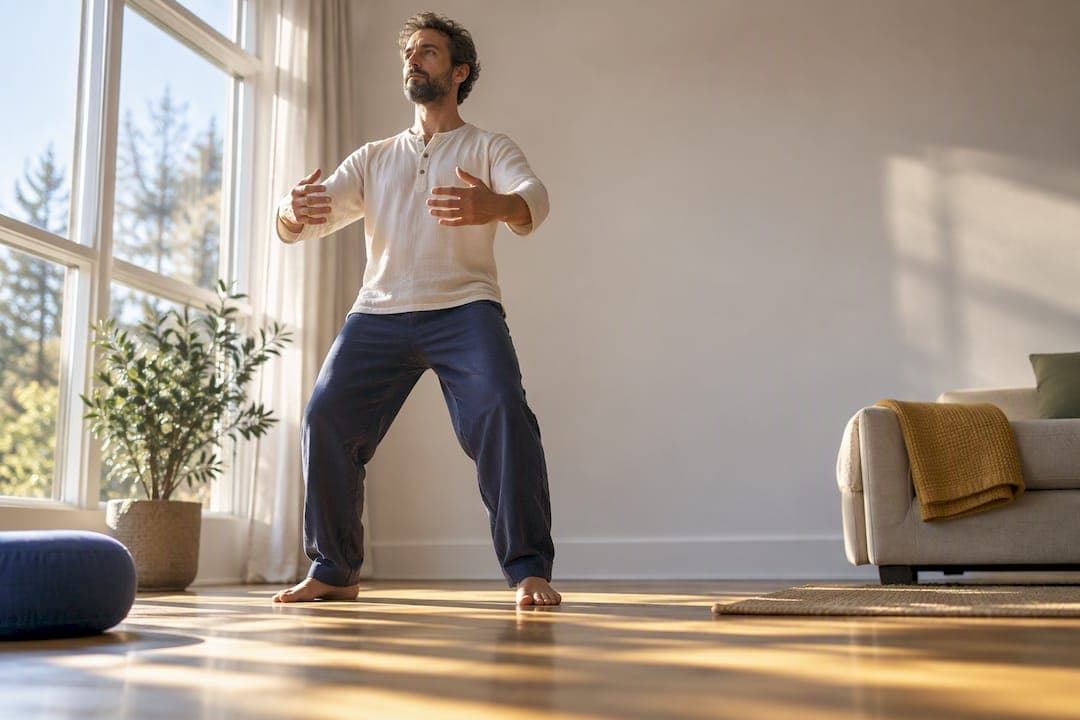
Zhan Zhuang standing meditation supports posture, balance, respiratory efficiency, and stress reduction, with clinical trials pointing to real gains in cardiac function, mood, and quality of life. Randomized controlled trials and systematic reviews show these benefits, though many studies come from smaller samples concentrated in China. If you have a heart condition, joint injury, or balance impairment, the postures need adapting, and a qualified instructor can help you get there safely.
TL;DR:
- Most research on Zhan Zhuang benefits comes from small Chinese studies, with stronger evidence supporting cardiac, balance, and mental health improvements.
- Clinical trials show 12-week programs can significantly improve heart function, balance, psychological well-being, and sleep quality, especially in cardiac patients and those with anxiety.
- Practice involves standing for 10 to 25 minutes daily, emphasizing proper posture, diaphragmatic breathing, and gradual buildup over weeks for measurable benefits.
- Safety considerations include adapting postures for those with joint issues or balance impairments, and seeking medical clearance for cardiac or severe mobility concerns.
- Combining Zhan Zhuang with other therapies supports recovery and mental health, but most claims require consistent practice and professional guidance to ensure correct technique and safety.
Table of Contents
- At-a-Glance: Physical, Cardiopulmonary, and Mental Benefits Of Zhan Zhuang
- How Does Standing Still Actually Create These Effects?
- What Do Clinical Trials Actually Show?
- How Do You Practice Zhan Zhuang Safely as a Beginner?
- Who Benefits Most From Zhan Zhuang Practice?
- What Are the Real Limits of the Current Evidence?
- Who's Behind This Guidance, and How Does QigongStar Teach Zhan Zhuang?
- Can You Combine Zhan Zhuang With Other Training or Therapy?
- How Long Before You Notice Real Changes?
- Why Does an Ancient Standing Posture Produce Modern Clinical Results?
- An Instructor's Note on Realistic Habits and Common Mistakes
- Ready for Guided Zhan Zhuang Instruction?
- Sources
- FAQ
At-a-Glance: Physical, Cardiopulmonary, and Mental Benefits Of Zhan Zhuang
Think of Zhan Zhuang as strength training disguised as stillness. You stand in one position, often for just a few minutes at first, and your body quietly does the work of realigning itself while your nervous system downshifts out of fight-or-flight mode.
The physical case for zhan zhuang benefits starts with posture. Holding a static stance with a lengthened spine and soft knees forces your deep postural muscles, the ones that slouching lets go dormant, to switch back on. Practitioners often describe a sensation of gentle spinal decompression, as the vertebrae settle into better alignment under sustained, low-level muscular support rather than gravity alone. Because the position is isometric, your legs and lower back also build static-load strength and endurance without the joint stress of dynamic exercise, which makes it a reasonable entry point for people who find squats or lunges hard on the knees.
Balance is where some of the more measurable evidence lives. Small trials assessing standing meditation and related standing Qigong forms report improvements in single-leg stance time and postural sway, both of which are standard predictors of fall risk in older adults. That matters more than it might sound: sway is one of the few balance metrics that responds fairly quickly to targeted training, and Zhan Zhuang's demand for constant micro-adjustment while standing still is exactly the kind of stimulus that improves it.
On the cardiopulmonary side, the practice centers on diaphragmatic breathing rather than shallow chest breathing. A randomized controlled trial of Three-Circle Post Standing Qigong in college students found measurable improvements in respiratory efficiency and peripheral tissue oxygenation, suggesting the breathing pattern trained during standing practice has effects that outlast the session itself. Related standing Qigong research also points to favorable changes in blood pressure and heart rate variability (HRV), a marker of how well your autonomic nervous system balances stress and recovery.
Mental health outcomes show up consistently across the literature, even when study designs vary. A systematic review and meta-analysis of Baduanjin exercise, a related standing mind-body practice, found meaningful improvements in psychological well-being alongside reductions in depression and anxiety symptoms compared with usual care. Sleep quality and general stress tolerance are frequently reported secondary benefits, likely tied to the same parasympathetic activation that lowers blood pressure.
Quality-of-life metrics tie the physical and mental threads together. In cardiac populations specifically, standing practice has been linked to improvements in:
- Six-minute walk distance (6-MWD), a standard measure of functional exercise capacity
- Minnesota Living with Heart Failure Questionnaire (MLHFQ) scores, which capture how much a condition limits daily life
- Self-reported stress and mood ratings across multiple smaller trials
- Sleep onset and sleep quality in insomnia-prone practitioners
None of this means Zhan Zhuang replaces cardiac rehab or antidepressant treatment. It means the same simple standing posture that corrects your alignment also appears to nudge your nervous system, blood pressure, and mood in a healthier direction, and the evidence for that is stronger than most people expect from something that looks like standing still.
How Does Standing Still Actually Create These Effects?
The mechanisms behind zhan zhuang benefits fall into four overlapping categories: autonomic regulation, respiratory physiology, neural changes, and biomechanics. None of them work in isolation, which is part of why the practice produces such a broad benefit profile from what looks like a single simple posture.
Autonomic regulation sits at the center of most explanations. Sustained, relaxed standing combined with slow breathing appears to shift the balance between your sympathetic (stress) and parasympathetic (recovery) nervous systems toward the latter. Several practitioner-focused physiological reviews describe improved heart rate variability coherence during and after standing practice, along with lower cortisol readings in some smaller studies. This is the same autonomic pathway targeted by biofeedback therapy and slow-breathing protocols used in anxiety treatment, except here it's trained through posture and stillness rather than a monitor.
Respiration does more mechanical work than people assume. Diaphragmatic breathing during Zhan Zhuang increases the excursion of the diaphragm with each breath, which improves ventilation efficiency and also acts as a pump for venous return, helping blood move back to the heart more efficiently. That's a plausible piece of why standing practice shows up in cardiac rehabilitation trials.
Neuroimaging offers some of the most interesting evidence to emerge recently. A functional near-infrared spectroscopy (fNIRS) study of Tai Chi standing meditation found significantly increased oxygenated hemoglobin concentration in the dorsolateral and ventrolateral prefrontal cortex during standing practice, along with strengthened functional connectivity between prefrontal regions.
Statistic callout: The fNIRS study found statistically significant increases in prefrontal cortex oxygenation during standing meditation (p < 0.05), with stronger functional connectivity between regions associated with attention and emotion regulation.
Since the prefrontal cortex governs attention, working memory, and emotional regulation, this gives a physiological explanation for why practitioners so often report feeling calmer and more mentally clear after a session, rather than just relaxed in a vague sense.
Biomechanics rounds out the picture. Static loading in a Zhan Zhuang stance is a low-intensity but sustained demand on the muscles that stabilize your ankles, knees, hips, and spine. Holding that position forces continuous small corrections, which is a proven way to refine proprioception, the sense of where your body is in space, and that improvement in proprioception is very likely what shows up downstream as better balance and reduced postural sway. The sustained but gentle spinal loading, done with correct alignment, also encourages intervertebral spacing that many practitioners experience as decompression rather than compression, unlike prolonged sitting or poor standing posture.
Put together, these four mechanisms map fairly cleanly onto the clinical endpoints researchers actually measure: better HRV and lower blood pressure explain cardiac gains, prefrontal changes explain mood and attention improvements, and biomechanical retraining explains the posture and balance effects. It's a rare case in mind-body research where the "why" and the "what" line up this well.
- Autonomic shift toward parasympathetic dominance, supporting lower blood pressure and improved HRV
- Diaphragmatic breathing improving ventilation efficiency and venous return
- Increased prefrontal oxygenation and connectivity linked to attention and mood regulation
- Static-load biomechanics refining proprioception, balance, and spinal alignment
What Do Clinical Trials Actually Show?
The strongest clinical evidence for standing meditation benefits comes from cardiac rehabilitation research, with mental health trials close behind and other applications still in earlier stages.
A systematic review and meta-analysis of 50 randomized controlled trials covering nearly 4,000 patients with chronic heart failure found that standing Baduanjin exercise, a close cousin of Zhan Zhuang that incorporates standing postures, produced significant improvements in left ventricular ejection fraction (LVEF), six-minute walk distance, and MLHFQ scores compared with medication alone. Subgroup analysis in that review found that 12-week interventions produced the most pronounced cardiac improvements, which is a useful benchmark if you're trying to judge how long to commit before expecting measurable change.
On the mental health side, the Baduanjin meta-analysis on psychological well-being and glycemic control in type 2 diabetes reported a standardized mean difference of roughly 0.96 for psychological well-being, a fairly large effect size in behavioral research, along with statistically significant reductions in depression and anxiety scores. Glycemic outcomes also improved compared with usual care, though the review noted the advantage was less consistent when standing Qigong was compared directly against other structured exercise programs rather than no exercise at all.
| Trial or review | Population | Key outcomes measured | Reported direction of effect |
|---|---|---|---|
| Standing Baduanjin meta-analysis (50 RCTs) | Chronic heart failure patients | LVEF, 6-MWD, MLHFQ | Significant improvement over usual care |
| Baduanjin meta-analysis | Type 2 diabetes patients | Psychological well-being, depression, anxiety, glycemic measures | Significant improvement in mental health; mixed vs. other exercise for glycemic control |
| Three-Circle Post Standing Qigong RCT | College students | Respiratory efficiency, peripheral oxygenation, psychological measures | Improved on both physiological and psychological measures |
| Expert panel consensus | Cancer care programs | Quality of life, immune markers, program delivery standards | Recommended as supportive care; evidence described as preliminary |
The international expert panel guidelines for Qigong in cancer care add an important caveat to this picture. The panel recommended mindful Qigong exercise, including standing forms, as a supportive addition to conventional cancer treatment, but stopped short of endorsing it as a standalone therapy and called for better-trained instructors and more standardized delivery protocols.
That caveat applies across the whole evidence base, honestly. Sample sizes in individual trials are often modest, outcome measures vary from study to study, and a large share of the research originates from institutions in China, where standing Qigong forms are more deeply embedded in both clinical and community health settings. That doesn't invalidate the findings, but it does mean the evidence is strongest for cardiac rehabilitation and psychological well-being, and still preliminary for applications like cancer supportive care, chronic pain, and Parkinson's disease. Treat those as promising leads worth discussing with your clinician, not settled science.
How Do You Practice Zhan Zhuang Safely as a Beginner?
A basic Zhan Zhuang session takes 15 to 25 minutes and needs nothing more than floor space and comfortable clothing. Here's a structure that lines up with how most clinical protocols dose the practice:
- Warm up for two to three minutes. Gently rotate your ankles, knees, hips, shoulders, and neck to release tension before you settle into stillness.
- Find your stance. Stand with feet shoulder-width apart, weight distributed evenly across what practitioners call the "tripod" of the foot, the heel and the base of the big and little toes.
- Soften your knees. Bend them slightly, never past your toes, and let your pelvis tuck gently under so your spine lengthens rather than arches.
- Shape your arms. The classic "hug a tree" position, arms rounded in front of the chest as though embracing a large trunk, is the most common of the five foundational postures, alongside variations that raise the arms overhead, lower them at the sides, or hold them in front of the abdomen.
- Breathe diaphragmatically. Let your belly expand on the inhale and fall on the exhale, keeping your shoulders relaxed and your jaw unclenched.
- Hold for 10 to 15 minutes to start. Clinical protocols investigating cardiac and psychological outcomes often built toward 20 to 30 minute daily sessions sustained over a 12-week period before measuring results, so patience with the buildup matters more than intensity on day one.
- Cool down with slow walking or gentle stretching for two to three minutes to ease back into normal movement.
If standing for extended periods isn't realistic because of knee pain, hip replacement, recent surgery, or balance concerns, the postures adapt well to a seated version against a wall or supportive chair, and shorter holds of three to five minutes still deliver a meaningful training stimulus when done consistently. Our guide to standing Qigong meditation for stress relief and posture walks through additional posture variations if you want to go deeper before your first guided session.
Pro Tip: If your legs start shaking during a hold, that's your stabilizing muscles working, not a sign you're doing it wrong. Shift your weight slightly, take a breath, and settle back into stillness rather than locking your knees to stop the tremor.
Watch for red flags that call for caution: chest pain, dizziness, sharp joint pain, or shortness of breath beyond normal exertion are all reasons to stop and check with a doctor before continuing, particularly if you have an existing cardiac condition. Our breakdown of Qigong contraindications covers who should modify or avoid standing practice altogether.

Who Benefits Most From Zhan Zhuang Practice?
The evidence points most clearly toward a handful of groups, though the practice is gentle enough that most healthy adults can start without special preparation.
- Older adults concerned about falls benefit from the balance and single-leg stance improvements reported in smaller trials, since postural sway is one of the more responsive predictors of fall risk.
- People recovering from cardiac events or living with heart failure show the strongest clinical trial support, with standing Baduanjin linked to improved LVEF, 6-MWD, and quality-of-life scores over 12-week programs.
- Adults managing anxiety, insomnia, or chronic stress see consistent symptom improvement across mental health focused studies, likely tied to the autonomic and prefrontal changes described earlier. Our piece on Qigong for depression explores program-level guidance for mood-focused routines.
- People with chronic pain or early motor-control changes, including some Parkinson's patients, show posture and gait improvements in smaller clinical observations, though this evidence remains preliminary and standardized protocols are still lacking.
- People undergoing cancer treatment may benefit from standing Qigong as a supportive addition to conventional care, per expert panel guidance, provided the instructor understands their specific treatment context.
Caution is warranted for anyone with unstable angina, uncontrolled arrhythmia, severe mobility impairment, or an acute injury. Those situations call for medical clearance and likely a modified, supervised approach rather than an unsupervised standing routine.
What Are the Real Limits of the Current Evidence?
Zhan Zhuang research has real strengths, but it isn't without gaps worth knowing before you set expectations. Studies use inconsistent terminology, sometimes calling the same standing posture Zhan Zhuang, standing Qigong, or standing Baduanjin, and they rarely match dosing or session length precisely, which makes direct comparison across trials harder than it should be.
Most of the higher-quality randomized trials and meta-analyses come from research institutions in China, where standing Qigong is culturally and clinically more established. That concentration doesn't undermine the findings, but it does raise fair questions about how well results generalize to different populations, healthcare systems, and baseline fitness levels elsewhere in the world.
The field also needs larger, multicenter trials with longer follow-up periods. Most current studies track outcomes over 8 to 12 weeks, which is enough to detect meaningful change but not enough to say whether benefits persist, plateau, or require ongoing practice to maintain, and common sense suggests the latter is most likely.
Realistically, expect incremental change over weeks rather than an instant transformation. Posture and balance improvements tend to show up first, often within a few weeks of consistent practice, while cardiac and mood-related benefits documented in trials generally needed the full 12-week window to become measurable.
Who's Behind This Guidance, and How Does QigongStar Teach Zhan Zhuang?
This guide reflects the same evidence-first approach that underpins the White Tiger Qigong and Five Animal Qigong programs taught at Qigongstar, both rooted in Chinese medicine and refined for modern stress, digestion, and mobility needs. The instructor holds advanced certification in White Tiger Qigong as well as Yoga Alliance accreditation, combining wellness and communications expertise in teaching the material.
Supervised learning matters more with standing practice than it might seem. A trained eye catches misalignments, like locked knees or held breath, that are hard to self-correct from a video alone, and that hands-on feedback tends to improve both safety and how consistently people actually stick with practice. Group classes and live sessions add accountability that a solo YouTube routine rarely provides.
Can You Combine Zhan Zhuang With Other Training or Therapy?
Zhan Zhuang works well as a complement rather than a replacement for other fitness or therapeutic routines, largely because it targets things most training programs skip: static postural endurance, breath control, and parasympathetic recovery.
If you already run, lift weights, or take cardio classes, a short standing session on rest days can support recovery by encouraging the parasympathetic shift described earlier, without adding joint strain. Some practitioners use five to ten minutes of standing practice as an active cool-down after strength training, since the slow breathing helps bring heart rate down gradually rather than stopping abruptly.
For people in structured cardiac rehabilitation, standing Qigong is best treated as a scheduled addition alongside prescribed aerobic and resistance work, not a substitute for either. The 12-week trial windows referenced in the cardiac research assumed standing practice ran in parallel with, not instead of, standard rehab protocols.
If you're managing anxiety or insomnia alongside therapy or medication, standing practice pairs naturally with cognitive behavioral techniques, since both work on similar physiological pathways around stress reactivity. A short evening session, done consistently, can also serve as a wind-down ritual before other sleep hygiene steps like reducing screen time.
The throughline across all of these pairings is dosage awareness: adding 10 to 20 minutes of standing practice rarely conflicts with other regimens, but skipping recovery entirely to fit in more training defeats the purpose of a practice built around restoration.
How Long Before You Notice Real Changes?
Timelines for zhan zhuang benefits vary by what you're tracking, and setting realistic expectations early prevents the common mistake of quitting right before results show up.
Postural awareness and a subjective sense of calm often appear within the first one to two weeks of daily practice, simply because you're spending focused time paying attention to alignment and breath that most days don't otherwise include. Measurable balance improvements, like reduced postural sway, tend to take longer, generally several weeks of consistent practice, since motor learning of that kind builds gradually.
The clinical trials with the clearest data, particularly those measuring cardiac function and psychological well-being, used 12-week intervention windows before assessing outcomes.
Beyond 12 weeks, benefits appear to plateau or continue building slowly with sustained practice, though longer-term follow-up data is limited. The honest expectation to set is this: think in months, not days, and treat early sessions as skill-building rather than results-chasing. The people who stick with Zhan Zhuang long enough to see the cardiac, mood, and balance benefits documented in trials are the ones who treated the first few weeks as practice, not proof.
Why Does an Ancient Standing Posture Produce Modern Clinical Results?
Zhan Zhuang traces back centuries within Chinese martial and medical traditions, originally developed as a foundational training method within internal martial arts like Yiquan and Xingyiquan, long before anyone measured heart rate variability or ran a randomized trial. Practitioners were taught that standing still, done correctly, built a kind of internal strength and rootedness that dynamic movement alone couldn't develop.
That framing turns out to hold up surprisingly well under modern physiological scrutiny. Traditional Chinese medicine describes the practice as cultivating and balancing qi, the body's vital energy, through stillness and breath. Modern research doesn't measure qi directly, but the autonomic regulation, improved oxygenation, and prefrontal cortex changes documented in contemporary studies describe a remarkably similar outcome in different language: a nervous system brought into better balance, and a body retrained to hold itself with less wasted tension.
Understanding that lineage matters for practice, not just curiosity. The old instruction to "stand like a tree, rooted yet flexible" isn't poetic filler. It's a practical cue for the exact biomechanical goal researchers now describe as improved proprioception and postural stability. When you understand why a tradition built a practice around genuine stillness rather than constant motion, the modern clinical findings stop feeling like a coincidence and start feeling like confirmation of something practitioners already understood through direct, repeated experience, long before neuroimaging existed to show it.
An Instructor's Note on Realistic Habits and Common Mistakes
If you take one thing from this guide, let it be this: commit to 10 minutes a day for four weeks before judging whether Zhan Zhuang works for you. That small window is enough to build the habit without the pressure of a lofty goal derailing you by day three.
The mistakes I see most often are subtle. People hold tension in their shoulders without noticing, hold their breath instead of breathing into the belly, or let their weight collapse onto the outer edges of their feet instead of grounding through that full tripod. Each one is fixable with a simple cue: soften, breathe, root down.
Track your sessions, even loosely, and consider a guided class if you can. A teacher's eye catches what a mirror can't.
— Stella
Ready for Guided Zhan Zhuang Instruction?
Reading about zhan zhuang benefits gets you halfway there. Getting the posture, breath, and progression right, especially if you're managing stress, digestive issues, or a health condition that needs adapting, is where working with a certified instructor pays off, and it's the gap between an article and a real, correctable practice that Qigongstar was built to close.
The Qigong for Stress Relief and Digestive Wellness course walks you through standing practice and complementary movement sequences at your own pace for £116, one-off, with the progressions and safety adaptations this article's evidence points to. If you'd rather start with focused, personal feedback, the 30-Min Clarity Session at £85 or the 60-Min Deep Dive Online Session at £145 give you direct correction on alignment and breath from a White Tiger Qigong Level 3 certified instructor, something no article or video can fully replace. Prefer in-person coaching? The 60-Min Face-to-Face Qigong session at £165 is also available. Visit the online classes page to see current availability and book the format that fits where you're starting from.
Sources
- The effect of Three-Circle Post Standing (Zhanzhuang) Qigong on the physical and psychological well-being of college students
- Baduanjin exercises and psychological well-being and glycemic control in type 2 diabetes (systematic review and meta-analysis)
FAQ
How long should you practice Zhan Zhuang each session?
Beginners should start with 10 to 15 minutes and build gradually toward 20 to 30 minutes as strength and comfort improve. Clinical trials measuring cardiac and psychological outcomes typically used daily practice sustained over a 12-week period before assessing results, which is a reasonable timeframe to commit to before judging your own progress.
What are the main health benefits of Zhan Zhuang?
Zhan Zhuang benefits include improved posture, better balance, reduced stress and anxiety, and gains in cardiovascular measures like six-minute walk distance and ejection fraction documented in clinical trials. It also supports better sleep and diaphragmatic breathing, with some evidence pointing to improved immune and metabolic markers in specific populations.
What are the five basic postures in Zhan Zhuang Qigong?
The five commonly taught postures vary slightly by tradition, but generally include arms rounded in front of the chest ("hug a tree"), arms raised overhead, arms extended forward at chest height, arms held low near the abdomen, and arms relaxed at the sides. Each uses the same foundational stance: soft knees, a lengthened spine, and weight distributed evenly across the foot.
What does "Zhan Zhuang" actually mean?
Zhan Zhuang translates roughly to "standing like a post" or "standing stake," describing the rooted, tree-like stillness the practice is built around. It originated within Chinese martial arts traditions as a foundational training method for building internal strength and stability before movement.
Is Zhan Zhuang safe for people with heart conditions?
Standing Baduanjin, a closely related practice, has shown clinical benefits for patients with chronic heart failure in supervised research settings, but anyone with an unstable cardiac condition needs medical clearance first. Qigongstar's guided sessions can help adapt postures safely, though a doctor's input always comes first for cardiac cases.