

Digestive Qi, known in Traditional Chinese Medicine as Gu Qi or Food Qi, is the energy your Spleen and Stomach extract from what you eat and drink. It is not a metaphor. In TCM physiology, it is the raw material your body converts into daily energy, blood, and immune strength, and when it runs low, you feel it fast.
Weak digestive Qi tends to show up as a familiar cluster: afternoon fatigue that coffee doesn't touch, bloating after ordinary meals, loose stools, and an appetite that never quite feels satisfied. These aren't isolated nuisances. In TCM theory, and echoed in a PubMed Central review of Spleen–Stomach function, they're downstream effects of one system struggling to do its job. Your gut isn't just digesting lunch. It's manufacturing the fuel your entire body runs on.
Here's why this matters beyond the discomfort:
- Energy production: Gu Qi is the foundation of what TCM calls postnatal Qi, the energy you generate daily (versus the Qi you're born with).
- Immune resilience: Weak Spleen–Stomach function is linked to lowered defensive Qi, leaving you more prone to colds and fatigue.
- Whole-body reach: Symptoms of weak digestive Qi often extend past the gut into muscles, complexion, and mental clarity.
Resources like Qi Energy in Chinese Medicine and applied practices from Qigongstar both treat digestive Qi as something you can actively strengthen, not just something you're stuck with.
Key Takeaways
Digestive Qi (Gu Qi) is the energy your Spleen and Stomach extract from food, and its quality directly shapes your daily energy, immunity, and gut function.
| Point | Details |
|---|---|
| Gu Qi comes from Spleen and Stomach | The Stomach "ripens" food while the Spleen extracts and distributes the refined Gu Qi. |
| Patterns differ significantly | Deficiency, stagnation, and rebellious Qi produce distinct symptom clusters requiring different responses. |
| Diet and routine drive change | Warm, cooked foods and regular mealtimes are among the most reversible ways to support Spleen function. |
| Watch for red flags | Blood in stool, unexplained weight loss, or severe pain need prompt medical evaluation, not self-treatment. |
| Guided Qigong builds consistency | Qigongstar's 5 Animal Qigong and White Tiger Qigong courses offer structured, breath-based practice to support digestive Qi over time. |
Table of Contents
- What Is Digestive Qi in TCM? Understanding Gu Qi and Spleen-Stomach Function
- Key Functions of Digestive Qi in Daily Health
- Recognizing Deficiency, Stagnation, and Rebellious Stomach Qi
- What Weakens Digestive Qi: Diet, Lifestyle, and Aging
- What Happens During a TCM Diagnostic Visit
- What the Research Says About TCM and Digestive Health
- Simple, Safe Ways to Strengthen Digestive Qi
- How Qigong Practice Supports Digestive Qi
- A Teacher's Note on What Qigong Can Realistically Do
- Ready to Support Your Digestive Qi With Guided Practice?
- Frequently Asked Questions
- Sources
What Is Digestive Qi in TCM? Understanding Gu Qi and Spleen-Stomach Function
To understand digestive Qi, picture your Stomach and Spleen as two workers on the same assembly line, each with a distinct job.
TCM describes the Stomach's role as "rotting and ripening." Think of it as the initial breakdown, similar to how your stomach churns food into a workable slurry before it moves further along your digestive tract. The Spleen then performs "transformation and transportation." It extracts the usable essence from that processed food, which TCM calls Gu Qi, and sends it upward and outward to the rest of the body. This upward movement matters. Unlike most of digestion, which we associate with things moving down and out, the Spleen's defining action is lifting refined nutrients toward the lungs and heart.
Here's the pathway in plain terms:
- Food enters the Stomach, which "ripens" it into a usable form.
- The Spleen extracts Gu Qi, the refined essence, through its "transformation and transportation" function.
- Gu Qi ascends to the chest, where it combines with air Qi (Qing Qi) drawn in through breathing.
- That combination forms Zong Qi, or "gathering Qi," which powers breathing and circulation.
- Gu Qi also contributes to Ying Qi (nutritive Qi) and, ultimately, to Blood formation.
Gu Qi is described as the essential energy extracted from food by the Spleen and Stomach, serving as the foundational postnatal substance used to build Zong Qi, Ying Qi, Wei Qi, and Blood, according to Me & Qi's explanation of Gu Qi.
Picture it as a small refinery sitting in your midsection: raw material goes in, and several different finished products come out, each feeding a different system in your body. This is also why breathwork is inseparable from digestive health in Qigong practice. Gu Qi alone isn't complete; it needs the air you breathe to become the Zong Qi that powers your heart and lungs, a detail explained in Qi Energy in Chinese Medicine. The Satyori glossary on Gu Qi adds a useful detail here too: the Spleen's ascending action is what sends refined essence upward, which is precisely why Spleen weakness so often produces the sinking, heavy fatigue people describe rather than sharp digestive pain.
| TCM Term | Plain-English Equivalent |
|---|---|
| Rotting and ripening (Stomach) | Initial breakdown of food |
| Transformation and transportation (Spleen) | Extracting and distributing nutrients |
| Gu Qi | Digestive energy extracted from food |
| Zong Qi | Combined food and breath energy powering the chest |
| Ying Qi | Nutritive energy that nourishes tissues and forms Blood |
Key Functions of Digestive Qi in Daily Health
Digestive Qi does more than fuel digestion itself. It's the starting material for several systems working in parallel, which is why a Spleen–Stomach problem rarely stays confined to your gut.
Core functions include:
- Energy production: Gu Qi forms the backbone of postnatal Qi, the energy your body generates fresh each day from food.
- Blood formation support: Ying Qi, derived from Gu Qi, contributes directly to Blood production in TCM physiology.
- Muscle nourishment: The Spleen is said to govern muscles and limbs, so muscle tone and stamina depend partly on Gu Qi supply.
- Defensive Qi foundations: Wei Qi, your body's protective energy against external pathogens, draws on the same Gu Qi pool.
- Digestive motility: The Spleen's ascending action and Stomach's descending action keep food moving in the right direction.
This is why weak Gu Qi rarely stays quiet. A pale complexion, low stamina, and easy bruising can all trace back to a Spleen–Stomach system that isn't producing enough refined Qi to keep pace with demand.
Pro Tip: Practitioners often ask about chronic muscle fatigue, not just digestive complaints, when assessing Spleen function. If your limbs feel heavy or weak most afternoons, even without intense exercise, that's frequently read as a sign of underlying digestive Qi weakness rather than a muscular issue on its own.
Recognizing Deficiency, Stagnation, and Rebellious Stomach Qi
Not every digestive complaint points to the same pattern. TCM distinguishes at least three distinct presentations, and telling them apart matters for choosing the right support.
Spleen (digestive) Qi deficiency tends to feel like running on empty. Core symptoms include persistent fatigue, loose stools, poor appetite, and a general sense of heaviness or sluggishness after eating. People with this pattern often describe feeling worse, not better, after large or rich meals.
Qi stagnation in the middle burner feels different. Instead of depletion, it's congestion: bloating, visible distension, irregular bowel patterns that swing between loose and constipated, and a sense of tightness or fullness under the ribs. Stress is a common trigger here.
Rebellious stomach Qi describes energy moving in the wrong direction. Instead of descending normally, Stomach Qi rises, producing acid reflux, belching, hiccups, or nausea. As one clinical framework puts it:
Stomach Qi must descend while Spleen Qi must ascend; when that rhythm fails, often due to stress or stimulating foods, symptoms such as reflux or indigestion emerge.
Quick comparison:
- Deficiency: low energy, loose stools, weak appetite, worse with exertion.
- Stagnation: bloating, distension, emotional trigger patterns, worse with stress.
- Rebellious Qi: reflux, belching, nausea, worse after eating quickly or lying down.
Red flag: blood in the stool, unexplained weight loss, persistent vomiting, or severe abdominal pain are not TCM pattern issues to self-manage. See a doctor promptly if any of these appear.
What Weakens Digestive Qi: Diet, Lifestyle, and Aging
Most digestive Qi problems trace back to a short list of repeat offenders, and the good news is that many are within your control.
Dietary causes top the list: excessive cold or raw foods, heavy dairy consumption, and greasy or processed meals all tax the Spleen's ability to transform food efficiently. Lifestyle patterns compound the problem. Irregular meal timing, chronic overeating, and skipping meals entirely all disrupt the steady rhythm your digestive system relies on. Add ongoing stress or overwork, and the Stomach's descending function starts to falter, which is part of why rebellious Qi symptoms so often appear during stressful stretches. Aging and chronic illness play a role too, gradually reducing the Spleen's transformative capacity over time.
Here's the practical distinction that matters:
- Highly responsive to change: diet composition, meal timing, stress management, sleep habits.
- Needs professional attention: chronic illness, long-standing deficiency, or any red-flag symptom listed earlier.
Small, consistent adjustments, like eating meals at the same time daily or warming up cold foods, tend to produce noticeable improvement in digestive Qi functioning within weeks rather than requiring an overhaul.
What Happens During a TCM Diagnostic Visit
A first visit for digestive concerns follows a fairly predictable pattern, and knowing what to expect makes the process far less intimidating.
Expect questions covering:
- Meal patterns, appetite, and food preferences (do you crave warm or cold foods?)
- Stool consistency, frequency, and any recent changes
- Energy levels throughout the day, particularly after meals
- Sleep quality and stress levels
- Menstrual history, when relevant, since Blood and Qi are closely linked in TCM
The practitioner will also look for physical signs that support the intake conversation:
- Tongue appearance: a pale tongue, sometimes with visible tooth marks along the edges, often signals Spleen Qi deficiency.
- Pulse quality: a weak or thin pulse can point toward deficiency patterns; a wiry pulse often suggests stagnation.
- Abdominal palpation: tenderness or distension in the middle abdomen helps distinguish stagnation from straightforward deficiency.
Treatment plans commonly combine acupuncture, herbal formulas, dietary therapy, and Qigong. Realistic timelines matter here: mild cases often shift within a few weeks of consistent changes, while longer-standing deficiency patterns may take more time with combined care.
What the Research Says About TCM and Digestive Health
Modern research on TCM's digestive framework is a mixed picture, and it's worth understanding both sides before you decide how to weigh it.
On the supportive end, a PubMed Central review documents how Spleen–Stomach dysfunction correlates with the systemic symptoms TCM has long described, including fatigue and digestive complaints. That's a meaningful bridge between classical theory and observable clinical patterns.
The caveats matter just as much. A clinical-review style analysis notes that while some TCM interventions show promise, many trials suffer from small sample sizes, inconsistent methodology, and heterogeneous designs that make broad conclusions difficult. Evidence tends to be stronger for specific interventions like acupuncture and weaker or more mixed for broader herbal protocols.
Discuss complementary therapies openly with your clinician, and stay alert to possible interactions between herbs and prescription medications, advises the National Center for Complementary and Integrative Health.
The practical takeaway: TCM's descriptive framework for digestive symptoms often aligns well with what patients experience, but treat any herbal formula the way you'd treat a new medication. Tell your doctor, ask about interactions, and seek urgent care for any red-flag symptom rather than waiting out a self-treatment plan.
Simple, Safe Ways to Strengthen Digestive Qi
Supporting digestive Qi doesn't require a dramatic overhaul. It requires consistency, and most of the effective changes are things you can start today.
Diet first. Favor warm, cooked, and easily digestible foods: congee, soups, steamed vegetables, and slow-cooked grains all support the Spleen's transformation work. Limit excessive raw salads, iced drinks, and greasy or heavily processed foods, especially if you already notice bloating or loose stools, since cooling foods can dampen digestive fire in people prone to Spleen weakness.
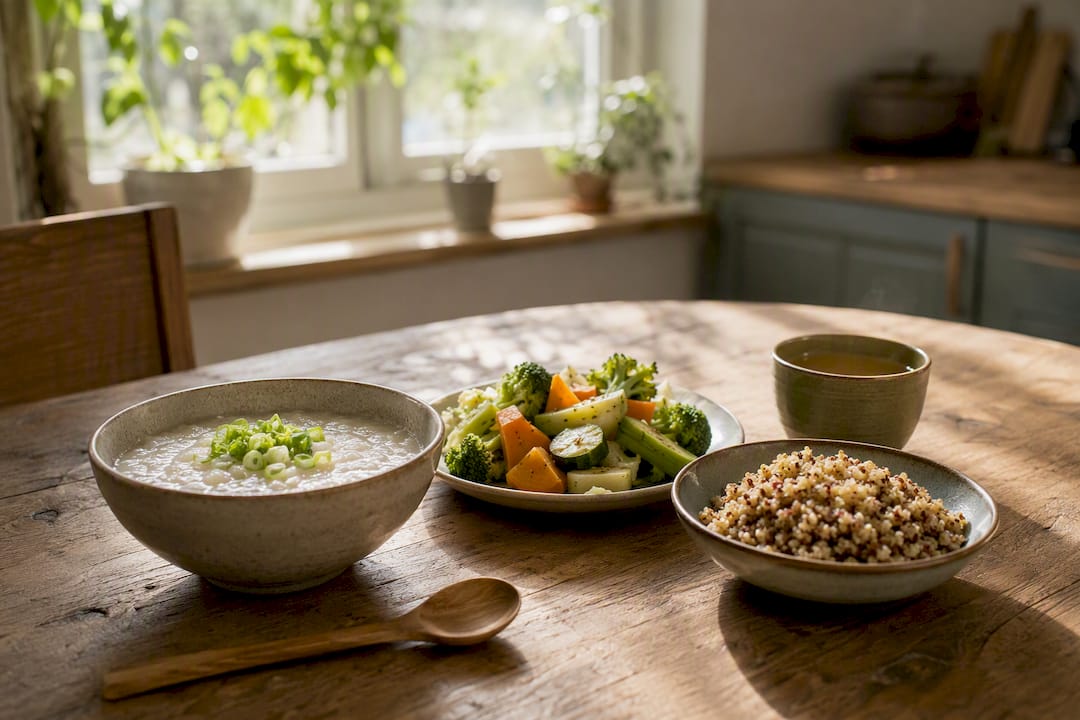
Build steady habits. Eat at roughly the same times each day. Avoid eating while stressed, distracted, or rushing between tasks. Mindful eating isn't just a wellness suggestion here. It functions as a required digestive exercise, since the Stomach's descending action and the Spleen's transforming action both work better when your nervous system isn't in fight-or-flight mode during a meal.
Self-care techniques worth learning:
- Acupressure on ST-36 (Zusanli): located about four finger-widths below your kneecap, along the outer edge of your shinbone. Gentle, firm pressure for one to two minutes, once or twice daily, is widely used to support digestive Qi.
- Consider acupuncture if symptoms persist beyond a few weeks of dietary changes, particularly for stagnation or rebellious Qi patterns.
- Approach herbs cautiously. Formulas traditionally used for Spleen support can interact with prescription medications, including blood thinners and diabetes medications. Work with a licensed practitioner rather than self-prescribing.
Pro Tip: Press ST-36 while seated, not standing, so you can apply steady pressure without wobbling. Pair it with slow, deep breathing for a minute, and you'll often notice a subtle easing of bloating within that first session.
See a doctor or qualified practitioner if you notice persistent unexplained weight loss, blood in the stool, or severe abdominal pain. These fall outside what dietary changes or acupressure should be expected to resolve. For everything else, give changes two to four weeks before expecting a noticeable shift. Digestive Qi responds to consistency, not intensity.
How Qigong Practice Supports Digestive Qi
Qigong offers a direct, physical way to support the ascending and descending rhythm digestive Qi depends on, and you don't need special equipment to try it.
A simple five-step practice:
- Sit or stand comfortably with your spine relaxed but upright.
- Place both palms over your lower abdomen, just below your navel.
- Breathe slowly into your belly, letting your hands rise and fall with each breath, for eight to ten cycles.
- Gently massage or tap the ST-36 point on each shin for thirty seconds per side.
- Finish with three slow, deep breaths, imagining warmth spreading through your midsection.
In TCM terms, this routine helps regulate the ascending and descending movement of Spleen and Stomach Qi. In plain terms, slow diaphragmatic breathing supports vagal tone, which influences gut motility and stress response. This offers a physiological explanation for why this style of practice tends to ease bloating and sluggish digestion over time.
If acute abdominal pain, fever, or vomiting are present, skip the routine and seek medical evaluation first. For a longer guided version, Qigongstar's 5–10 minute daily digestion routine walks through a fuller sequence, and the Spleen meridian exercise guide offers additional beginner-friendly options.

A Teacher's Note on What Qigong Can Realistically Do
Clients who commit to a few minutes of daily practice alongside dietary changes typically notice a shift within three to six weeks, usually starting with better energy and less afternoon bloating before deeper changes in stool patterns or appetite follow. Qigong is not a quick fix, and it works best as one piece of an integrated approach that includes food choices, meal timing, and stress management rather than a stand-alone cure. What tends to surprise people most is how much a slower, more attentive way of eating changes the results, sometimes more than the movements themselves. Practiced consistently, breathwork and gentle abdominal movement give your Spleen and Stomach the steady rhythm they need to do their job well.
Ready to Support Your Digestive Qi With Guided Practice?
Reading about Gu Qi and the Spleen–Stomach partnership is a solid start, but movement and breath are what actually put the theory into practice. That's the gap guided Qigong classes are built to close: you get a structured routine designed around digestive support, rather than piecing one together from scattered videos and guesswork.
Qigongstar's 5 Animal Qigong course is built around gentle, whole-body movement sequences that support digestion, stress relief, and energetic balance, with both live and on-demand formats so you can fit practice into your actual schedule. If you're drawn to a more specialized lineage, the White Tiger Qigong program offers certified instruction rooted in the same Spleen–Stomach principles covered here. A first session typically walks you through breath basics and a short standing routine, no prior experience needed. If you're managing a diagnosed digestive condition, check with your doctor before starting any new movement practice. Browse the full class schedule and pick a session that fits your week.
Frequently Asked Questions
What is digestive Qi explained in the simplest terms? Digestive Qi, or Gu Qi, is the energy your Spleen and Stomach extract from food and drink. It fuels your daily energy, supports blood formation, and feeds your body's defensive functions.
What are the signs of weak digestive Qi? Common signs include persistent fatigue, bloating, loose stools, poor appetite, and a pale complexion. Muscle weakness and low stamina can also point to underlying Spleen–Stomach weakness.
How can I improve digestive Qi naturally? Favor warm, cooked foods over raw or cold ones, eat on a consistent schedule, and practice mindful, unhurried eating. Gentle Qigong breathing routines and acupressure on ST-36 can also help support digestive function over time.
Is digestive Qi the same as gut health in Western medicine? Not exactly, though the concepts overlap. TCM's digestive Qi framework describes functional patterns and energy flow, while Western gut health research focuses on measurable factors like the microbiome and motility. Some overlap in symptoms and outcomes exists, but the underlying models differ.
When should I see a doctor instead of trying natural remedies? See a doctor promptly if you notice blood in your stool, unexplained weight loss, severe abdominal pain, or persistent vomiting. These symptoms fall outside what dietary changes or Qigong practice are meant to address.
This article is general information, not a substitute for advice from a qualified doctor. Consult a qualified healthcare professional about your own circumstances before acting on anything here.
Sources
For readers who want to go deeper into the physiology and evidence behind digestive Qi, these sources offer a solid starting point: