

The Six Healing Sounds are six soft exhale-sounds paired with slow breath and gentle movement, drawn from a traditional Chinese qigong practice called Liu Zi Jue. Each sound rides on a long, quiet exhale to help release tension and settle the nervous system.
Try one right now: inhale slowly through your nose, then exhale softly through your mouth on a long "Xu" sound, like a gentle "shhh." Let your shoulders drop as the breath empties.
- Keep it soft. This is a supportive practice, not a substitute for medical care.
- If anything feels strained, stop and breathe normally.
Key Takeaways
The Six Healing Sounds pair slow nasal inhales with soft mouth exhales shaped into six sustained sounds to support relaxation and emotional balance, best learned gradually and with guidance.
| Point | Details |
|---|---|
| Six sounds, one breath pattern | Xu, He, Hu, Si, Chui, and Xi each ride a slow, soft exhale after a nasal inhale. |
| Start small | Beginners do well with 3 to 6 rounds of one sound before attempting a full six-sound cycle. |
| Chui breaks the pattern | Most sounds are sustained on a level tone, while Chui can be quicker or more forceful. |
| Supportive, not medical | Treat the practice as a complement to stress management, not a replacement for clinical care. |
| Guided practice deepens results | Qigongstar's live and on-demand classes with certified instructor Stella offer pronunciation coaching and personalized modifications beyond what a solo read-through can teach. |
Table of Contents
- What Are the Six Healing Sounds in Qigong?
- How Do You Practice the Six Healing Sounds Step by Step?
- How Do You Pronounce Each of the Six Healing Sounds?
- What Benefits Can You Realistically Expect?
- Who Should Modify or Avoid This Practice?
- How Can You Fit This Into a Daily Routine?
- Learn the Six Healing Sounds With Guided Instruction
- Sources
What Are the Six Healing Sounds in Qigong?
Liu Zi Jue, sometimes called the "Six Character Formula" or "Six Syllable Secret," has roots in Taoist and Traditional Chinese Medicine practice, where breath, sound, and movement were treated as one integrated tool for health rather than three separate habits. The framework is simple: one way to inhale, six ways to exhale. You breathe in gently through the nose, then release the breath through the mouth while shaping it into one of six sounds: Xu, He, Hu, Si, Chui, and Xi.
Your posture stays relaxed throughout. No forcing, no clenching, no performance. Most of the six sounds are held on a level, sustained tone, stretched across the whole exhale. The fifth sound, Chui, is the exception. It can be pronounced more quickly or with a touch more force, a small variation that traditional teachers use to distinguish it from the others. A gentle, matching movement often accompanies each sound, though the movement always stays secondary to the breath.
How Do You Practice the Six Healing Sounds Step by Step?
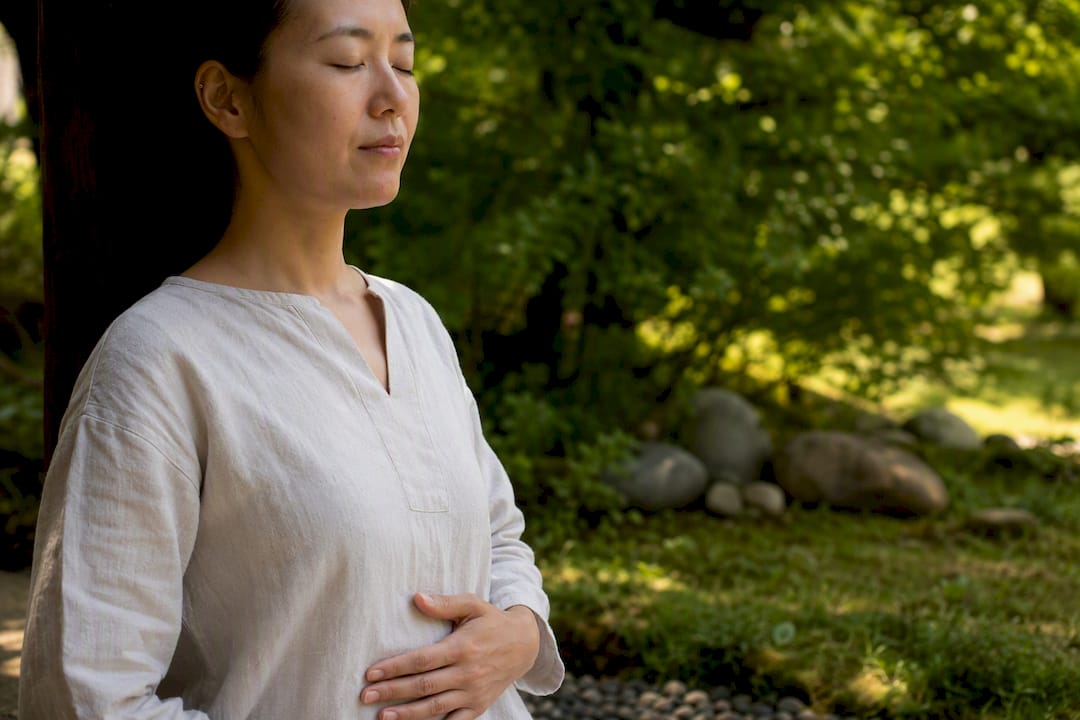
You don't need a mat, a special outfit, or years of training to begin. Sit in a chair with your feet flat on the floor, or stand with your knees soft and your jaw loose. Let your belly, not your chest, lead the breath.
Here's a simple routine to follow:
- Inhale slowly through your nose, letting your belly expand.
- Exhale through your mouth on your chosen sound, keeping the volume low and the tone steady.
- Let a small, natural movement accompany the exhale if it feels right, such as a gentle arm sweep or a soft bend at the knees.
- Pause for a breath or two before repeating.
- Repeat the same sound for 3 to 6 rounds, or move through all six sounds once for a full cycle.
Beginners generally do well starting with 3 to 6 rounds of a single sound, especially on days when energy feels low. Once that feels natural, you can build toward a full cycle of all six, once or twice a day. There's no rush here. Qigong rewards consistency over intensity, and five focused minutes daily will do more for you than one long session a week.
Watch for a few warning signs as you practice: tightness in your throat, lightheadedness, or an urge to breathe faster instead of slower. Any of these mean you're pushing the sound instead of letting it float on the breath. Soften the volume, shorten the exhale, or simply pause.
Pro Tip: Rest one hand lightly on your belly as you exhale. If you feel it pulling in and up on its own, you're using your abdominal muscles correctly, which protects your throat from strain.
How Do You Pronounce Each of the Six Healing Sounds?
Each sound in Liu Zi Jue carries its own mouth shape, breath texture, and traditional organ association. Practicing one sound at a time until it feels familiar works better than rushing through all six on day one.
- Xu (rhymes with "shoe," said softly): lips slightly open, tongue relaxed, air moving in a thin, even stream. Traditionally linked to Liver Qi, this sound is often the easiest starting point for beginners.
- He (like the letter "h" followed by a soft "uh"): mouth relaxed, exhale wide and warm. Associated with Heart Qi.
- Hu (like "hoo," rounded lips): breath feels centered and grounding, aimed at supporting Spleen and Stomach Qi.
- Si (like "sss," a thin hiss through nearly closed teeth): a fine, controlled stream of air tied to Lung Qi.
- Chui (like "chway," blown out with more force): the one sound that breaks from the level tone. This quicker articulation supports Kidney Qi.
- Xi (like "shee," light and airy): a gentle, almost whispery release connected to the Triple Burner, the TCM concept covering the body's fluid pathways.
Most of these sounds stretch across the full length of your exhale in a steady, level tone, while Chui stands apart with its shorter, firmer delivery. Don't worry about perfect pronunciation early on. What matters more is a relaxed exhale and a sound you can sustain without straining your throat.
What Benefits Can You Realistically Expect?
People who practice the Six Healing Sounds regularly tend to report a familiar cluster of effects: a calmer baseline, longer and steadier breaths, less muscular tension, and an easier time processing stress as it arises rather than letting it build. In TCM framing, certain sounds are also associated with supportive digestive effects, which lines up with why practitioners often pair breathwork like this with broader qigong routines for stress relief.
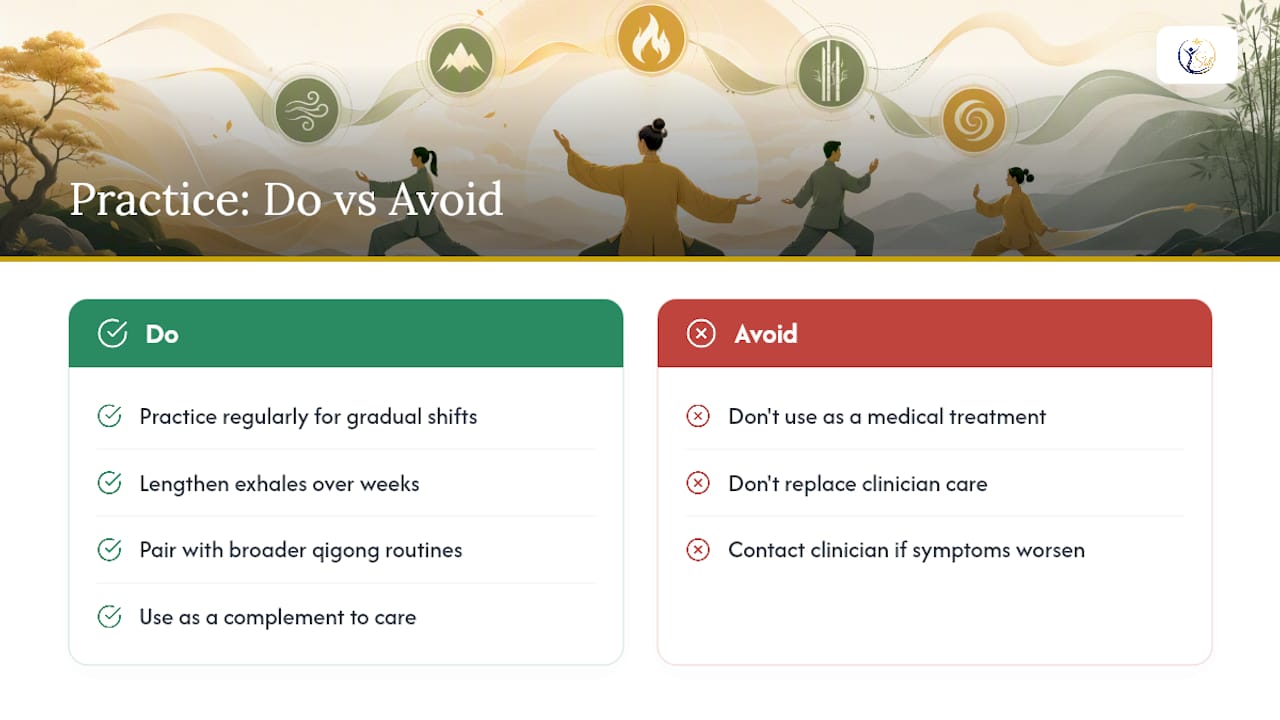
What the practice is not: a medical treatment. It's a supportive mind-body exercise, and it should never replace care for an acute illness or a diagnosed condition. If you're managing anxiety, a digestive disorder, or a chronic health issue, treat the Six Healing Sounds as a complement to your care plan, not a stand-in for it, and loop in your clinician if symptoms are new or worsening.
With regular practice, most people notice gradual shifts rather than instant transformation. Your exhale gets longer over a few weeks. Tension you didn't know you were holding in your jaw or shoulders starts to loosen. Emotional reactions that used to spike now have a little more space around them.
Who Should Modify or Avoid This Practice?
This practice is gentle by design, but gentle doesn't mean risk free for everyone. Stop immediately and rest if you notice dizziness, chest pain, or breathlessness that doesn't ease when you return to normal breathing.
A few situations call for extra caution or a modified approach, including pregnancy, an acute respiratory illness, or recovery from recent surgery. If any of these apply to you, check the full guidance on qigong contraindications before starting, and consider working with an instructor who can adjust the practice for your situation.
Modifying the practice is simple:
- Practice seated instead of standing.
- Focus on a single sound instead of the full cycle.
- Shorten each round and rest longer between exhalations.
- Drop the movement entirely and let the breath and sound do the work alone.
How Can You Fit This Into a Daily Routine?
A five-minute morning session, one round of all six sounds while the house is still quiet, is often enough to shift your baseline for the day. In the evening, extend that to 15 to 20 minutes, cycling through the sounds two or three times as a way to unwind before sleep.
The practice pairs naturally with other slow, breath-centered work. Coherent breathing, gentle qigong sequences, and restorative stretching like yin yoga all reinforce the same nervous system response: longer exhale, slower heart rate, quieter mind. Rotating your routine with the seasons can also keep it fresh, an approach covered in more depth in this guide to seasonal qigong variations.
Tracking doesn't need to be complicated. Note whether you practiced each day and rate your stress on a simple 1 to 10 scale before and after. Small, honest records like this reveal patterns faster than memory alone.
Learn the Six Healing Sounds With Guided Instruction
Reading the steps is one thing. Getting the breath, the sound, and the movement to work together smoothly is another, and that's where a little guided feedback changes everything. Stella, a certified instructor through the White Tiger Qigong School and Yoga Alliance, built Qigongstar around exactly this gap between reading about a practice and actually feeling it work in your body.
Inside Qigongstar's online classes, you get live and on-demand sessions where pronunciation gets corrected in real time, movements get scaled to your body, and modifications get built around your actual limitations instead of a generic checklist. That kind of individualized coaching is hard to replicate from an article, however detailed. Beginners often start with a short entry-level class to feel the rhythm before committing further, and the same platform offers complementary paths like White Tiger Qigong for anyone who wants to build a fuller practice around breath, digestion, and stress resilience. If the Six Healing Sounds gave you a taste of what slow, intentional breathwork can do, the next step is simple: book a class and let someone who's trained in this actually watch you breathe.
A Teaching Note From Stella
I've watched beginners spend weeks worrying about getting the pronunciation exactly right, when the real shift happens once they stop forcing the sound and let the exhale carry it. Start with one sound, one week. Give it room before you add the rest.
If you want feedback on your breath and posture, join a live class or try an on-demand lesson. Guided correction speeds up everything.
— Stella
Sources
- Six Healing Sounds - Liu Zi Jue (Wikipedia)
- Six Healing Sounds Qigong: A Beginner’s Guide to Liu Zi Jue (Old Pueblo Tai Chi blog)