
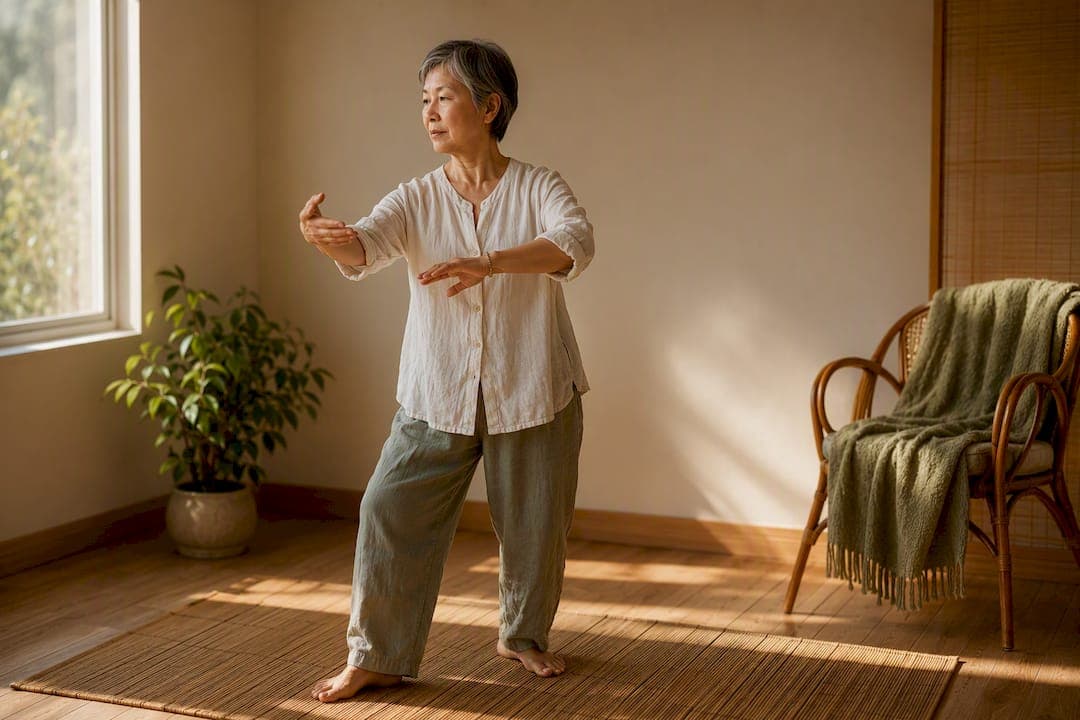
Qigong can genuinely improve how well you sleep, and you don't need weeks of practice to feel the shift. A 2025 systematic review of 15 randomized trials found meaningful improvements in sleep quality scores among practitioners, with Baduanjin style showing the strongest results. Tonight, try the 10-minute routine below: gentle standing posture, slow breathing, and three calming movements before bed. If you have a heart condition, recent surgery, or severe dizziness, check with your doctor before starting, and ease into it slowly.
TL;DR:
- The strongest evidence supports consistent nightly routines of around 10 minutes, combining gentle postures, breathing, and tension-release movements.
- Improvements in sleep often coincide with reduced inflammation markers like IL-1β and IL-6, indicating a biological link between movement, inflammation, and rest.
- Variability between studies suggests that individual results depend on starting health, consistency, and style, with subjective sleep quality improving before objective measures.
- Those with health conditions such as heart issues or balance problems should modify or consult a doctor before starting Qigong.
Table of Contents
- What Does the Research Say About Qigong and Sleep?
- A Guided 10-Minute Bedtime Qigong Routine
- How Do You Perform the Core Qigong Exercises Correctly?
- When and How Often Should You Practice for Sleep Benefits?
- Is Qigong Safe for Everyone, and When Should You Modify It?
- Who's Behind This Routine?
- What Actually Matters Most Here?
- Ready to Build a Consistent Qigong Practice?
- Sources
What Does the Research Say About Qigong and Sleep?
The clearest evidence comes from a 2025 meta-analysis pooling 15 randomized controlled trials and over a thousand participants. It found Qigong practice improved scores on the Pittsburgh Sleep Quality Index (PSQI) by a mean difference of −2.47 points compared to control groups, according to the systematic review and meta-analysis. Lower PSQI scores mean better sleep, so a shift of that size is roughly the difference between "I toss and turn most nights" and "I fall asleep without a fight."

Not every Qigong style produced the same results. Baduanjin, an eight-movement sequence built around gentle stretching and breath timing, showed particularly consistent benefits in that same review. That's worth knowing if you're choosing where to start, because Baduanjin also happens to be the style researchers use most often in sleep trials, largely because it's simple enough for beginners and older adults to learn in a single session.
One trial worth understanding in detail: a 10-week study of older Chinese immigrants in the US had participants practice Baduanjin five days a week using video guidance. Researchers tracked overall health, fatigue, cognitive function, and sleep. The intervention study found significant improvements in health, fatigue, and cognition, with sleep measures showing improvement over the control group that approached statistical significance. That pattern shows up across the research: sleep often improves alongside other markers like fatigue and mood, not in isolation.
Here's where it gets more interesting from a mechanism standpoint. A separate randomized, waitlist-controlled trial looked at people with depressive symptoms and sleep disturbances, and measured blood markers alongside sleep scores. Participants who practiced Qigong showed improved PSQI scores and a drop in two inflammatory markers, interleukin-1 beta and interleukin-6, according to the trial published in Sleep. Researchers noted a correlation between the drop in IL-1β and the improvement in sleep, suggesting a plausible biological pathway connecting movement, inflammation, and rest, though this remains one study and not a settled mechanism.
A handful of key findings stand out across this body of research:
- Qigong practice, especially Baduanjin, produces a measurable improvement in subjective sleep quality (PSQI) in most trials reviewed.
- The strongest results come from consistent practice over 8 to 12 weeks, not one-off sessions.
- Reductions in inflammatory markers (IL-1β, IL-6) accompanied sleep improvement in at least one controlled trial.
- Separate research on a 12-week Health Qigong program found improvements in objective sleep measures too, including less time awake after sleep onset tracked by wrist actigraphy, not just self-reported scores.
The headline number: Across 15 randomized trials and more than a thousand participants, Qigong improved PSQI sleep scores by a mean difference of −2.47 points, with Baduanjin practitioners showing an even stronger shift of −2.89.
None of this means Qigong works identically for everyone. The 2025 meta-analysis reported substantial variation between studies, with an I² statistic of 82.3%, a sign that differences in Qigong style, participant age, health status, and session length all shaped the outcomes. That heterogeneity is a legitimate limitation, and it means your own results may land anywhere from modest to substantial depending on consistency and starting point. Clinical reviews also note that most trials measure subjective sleep quality first, with objective changes (like actigraphy-tracked sleep efficiency) showing up later with sustained practice. Expect to notice a change in how rested you feel before you see it reflected in any tracker.
A Guided 10-Minute Bedtime Qigong Routine
This sequence draws directly on the movements shown to help sleep in clinical trials, adapted into a routine you can do in loose clothing, socks or bare feet, in a quiet corner of your bedroom.
- Wuji stance (1 minute). Stand with feet hip-width apart, knees soft, arms relaxed at your sides. Let your shoulders drop and your jaw unclench. This stillness signals your nervous system that the day is winding down.
- Cleansing breath (1 minute). Inhale slowly through your nose for a count of four, letting your belly expand. Exhale through your mouth for a count of six. Repeat six to eight times. The longer exhale is what shifts your body toward rest.
- "Two hands hold up the heavens" (1.5 minutes). Interlace your fingers, palms up, and slowly raise your arms overhead on an inhale, straightening through the spine. Lower on the exhale. Repeat six times, slow and unhurried.
- "Drawing the bow to shoot the hawk" (1.5 minutes). Shift into a wide stance, draw one arm across your chest and extend the other outward like pulling a bowstring, then switch sides. This gentle twist releases tension held in the upper back, a common site of stress after a long day.
- "Wise owl gazes backward" (1.5 minutes). Turn your head gently to look over one shoulder while keeping your hips facing forward, then switch. Move slowly. This one targets the neck and eyes, both frequent culprits behind screen-related tension before bed.
- Neck and shoulder release (1.5 minutes). Drop your chin slowly to your chest, roll your head in a small half circle from shoulder to shoulder, then let your shoulders rise on an inhale and fall heavy on an exhale.
- Closing relaxation (2 minutes). Return to Wuji stance or sit on the edge of your bed. Close your eyes, breathe naturally, and let your attention settle on the weight of your body. Notice, without judging, how your breathing has changed since you started.
If standing for the full sequence isn't comfortable, every step in the routine has a seated version. Sit toward the front of a chair with feet flat on the floor and follow the same arm and breath patterns; Qigongstar's seated Qigong routine walks through a full seated sequence if you want more detail. Short on time? A five-minute micro-version works too: cleansing breath for one minute, "two hands hold up the heavens" for two minutes, and closing relaxation for two minutes.
Pro Tip: Match your exhale to whatever feels like a natural sigh, not a forced count. Beginners often rush the out-breath, which keeps the nervous system in an alert state instead of a resting one.
Each piece of this routine does specific work. The standing posture quiets the constant fidgeting that keeps your mind alert. The slow, extended exhale activates your parasympathetic nervous system, the "rest and digest" branch that lowers heart rate and blood pressure. And the gentle rotational movements in Baduanjin release physical tension that otherwise keeps translating into mental restlessness once you lie down.
How Do You Perform the Core Qigong Exercises Correctly?
Getting the technique right matters more than moving fast through a sequence, and a few consistent habits separate a routine that works from one that just feels like stretching.
Diaphragmatic breathing is the foundation everything else builds on. Place one hand on your chest and one on your belly. As you inhale, your belly hand should rise more than your chest hand. Count four seconds in, hold for one, and release for six seconds out. This 4:1:6 pattern is a reasonable starting count; some practitioners prefer a straightforward 4:6 without the hold. Qigongstar's guide to breathwork styles covers several variations if you want to experiment beyond this basic pattern.
Wuji standing (Zhan Zhuang) looks deceptively simple but rewards attention to detail:
- Feet hip-width apart, weight distributed evenly through both feet, not leaning forward or back.
- Knees very slightly bent, never locked.
- Spine long but not rigid, as if a string gently lifts the crown of your head.
- Shoulders rolled back and down, away from your ears.
- Tongue resting lightly against the roof of your mouth, jaw unclenched.
The three Baduanjin moves each follow a similar rhythm: inhale on the expansive part of the movement, exhale on the return. For "two hands hold up the heavens," the common mistake is rushing the overhead reach. Slow it down until the stretch through your sides feels deliberate. For "drawing the bow," keep your gaze soft and your weight centered rather than leaning into the stance. For "wise owl gazes backward," the rotation should come from your upper spine, not by cranking your neck.
If any standing posture puts strain on your knees or lower back, every move translates to a seated position: keep your spine long, feet flat on the floor, and follow the same arm movements and breath timing. The breath-to-movement pairing is what makes these exercises effective, whether you're standing or seated, so don't skip it even when you shorten the sequence.
When and How Often Should You Practice for Sleep Benefits?
Consistency beats intensity here. The clinical trials behind this routine's evidence used structured, repeated practice, not sporadic sessions, and that pattern is worth copying.
- Nightly practice, 10 minutes, for 4 to 8 weeks is a reasonable starting target, mirroring the timeframes used in the strongest trials.
- If nightly feels like too much, 3 to 5 sessions per week still produced measurable results in the 10-week Baduanjin trial, which had participants practice five days weekly.
- Give it at least four weeks before judging results. Subjective sleep improvements tend to show up before objective changes.
- Track progress with a simple sleep diary: note what time you fell asleep, how many times you woke, and how rested you felt on waking.
- Every week or two, do a quick PSQI-style self-check: rate your sleep quality, latency, and daytime fatigue on a simple 1 to 3 scale and watch the trend over a month.
- Pair the routine with basic sleep hygiene: consistent bedtime, a dark and cool room, and no screens in the final 30 minutes. Qigong works best as one part of a broader wind-down habit, not a replacement for it.
Is Qigong Safe for Everyone, and When Should You Modify It?
Qigong carries a low risk profile compared to more strenuous exercise, and clinical reviews describe it as a reasonable nonpharmaceutical option for sleep disturbance, particularly for older adults or anyone wary of sleep medication. That said, "low risk" isn't "no risk," and a few groups should adjust before diving in.
- Mild dizziness or lightheadedness during standing postures is common early on. Stop, sit down, and hydrate if this happens.
- If you have unstable heart conditions, recent surgery, or severe vertigo, get clearance from your doctor before starting, and consider a seated practice from the outset.
- Pregnant readers, or anyone with balance issues, should favor seated variations and shorter sessions until confidence builds.
- Go slower than feels necessary at first. Rushed movement defeats the purpose and can strain muscles that haven't warmed up.
For a fuller breakdown of who should modify or avoid certain movements, Qigongstar's guide to Qigong contraindications covers specific conditions in more depth.
Who's Behind This Routine?
This routine and the technique cues throughout come from Stella, a certified instructor trained through the White Tiger Qigong School and credentialed with Yoga Alliance. That dual training matters here: White Tiger Qigong emphasizes breath regulation and energetic balance rooted in Chinese medicine, while Yoga Alliance certification reflects broader standards in movement instruction and injury prevention.
Stella's teaching draws on both traditions to build classes that progress safely, starting beginners with foundational breath and posture work before introducing more demanding sequences like Five Animal Qigong. Courses at Stella QigongStar are structured in stages, so students build confidence with simple standing and seated forms before layering in more complex movement patterns, an approach that mirrors how the clinical trials cited above introduced Qigong to first-time practitioners.
What Actually Matters Most Here?
The conventional wisdom around sleep and exercise tends to lump everything together under "just move more," and that framing does Qigong a disservice. What the research actually supports is more specific: gentle, breath-paced movement performed consistently over weeks, not a generic fitness recommendation.
Where most sleep advice falls short is treating relaxation as passive, something you achieve by lying still and hoping your mind cooperates. Qigong flips that. It uses deliberate movement to earn stillness, and that distinction is what the Baduanjin trials keep bearing out. I'd also push back gently on the idea that you need to master an elaborate routine before you see any benefit. The evidence points to simple, repeatable sequences, not complexity, as the thing that actually moves the needle.
If you take one thing from this article, prioritize consistency over perfection. A modest 10-minute practice done most nights for a month will outperform an ambitious hour-long session done twice before you give up.
— Stella
Ready to Build a Consistent Qigong Practice?
A bedtime routine gets you started, but the biggest gains come from learning the fuller movement patterns with proper guidance, especially since posture errors in standing forms are the main reason beginners plateau or lose motivation. Stella QigongStar's online Qigong classes give you exactly that: live and on-demand instruction that corrects your form in real time instead of leaving you guessing from a written sequence.
If tonight's routine felt good, the Five Animal Qigong course is a natural next step, built around varied movement patterns that keep practice interesting once the basics feel familiar. Readers drawn to the breath-focused work in this article's routine often move toward White Tiger Qigong, which goes deeper into the breath regulation techniques touched on above. Both are structured for beginners, with on-demand access so you can practice on your own schedule. Start with a single class to see how the guided pacing compares to a self-led routine. And if insomnia has been severe or persistent for months, treat this as a complement to medical care, not a substitute for it. Talk to your doctor first.
Sources
- The effects of Qigong exercise on sleep quality in older adults: a systematic review and meta-analysis
- Effects of Mind-Body Qigong Exercise on Overall Health, Fatigue/Sleep, and Cognition in Older Chinese Immigrants in the US: An Intervention Study with Control
- QIGONG EXERCISE IMPROVED QUALITY OF SLEEP AND REDUCED INTERLEUKIN-1 BETA AND INTERLEUKIN-6 AMONG PERSONS WITH DEPRESSIVE SYMPTOMS AND SLEEP DISTURBANCES
- Qigong as a non pharmaceutical therapy for sleep disturbance