
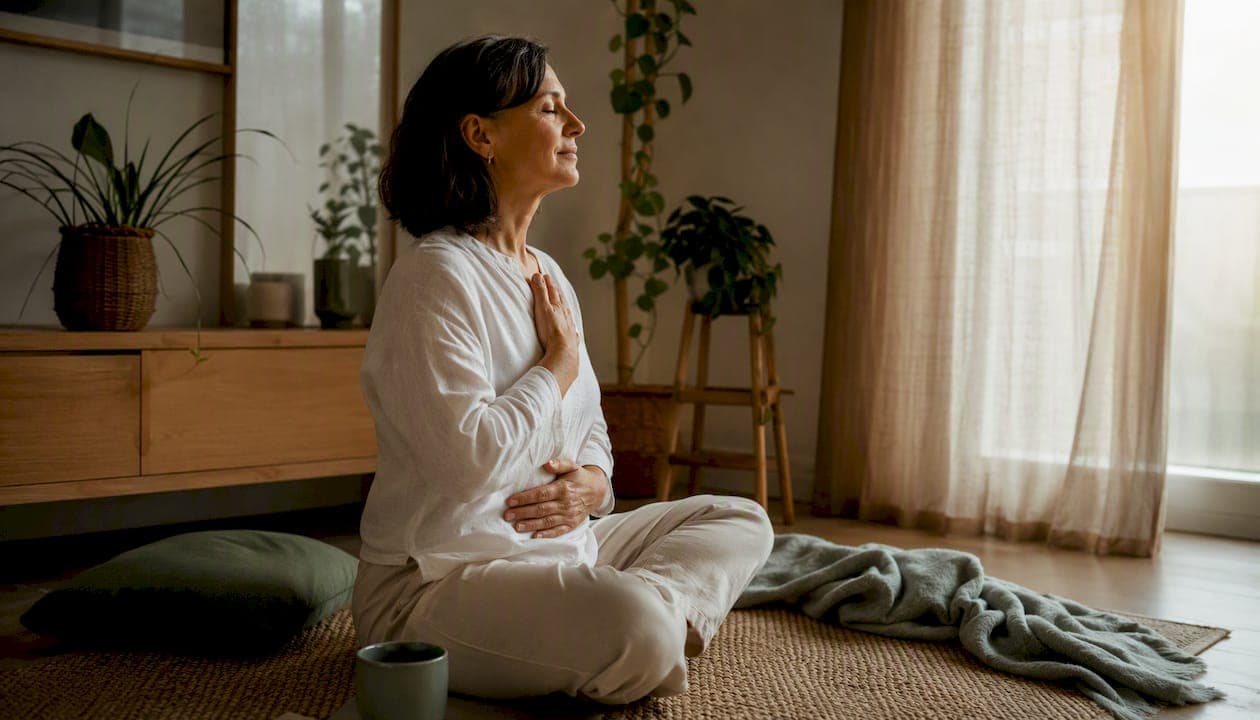
Qigong can genuinely help many people managing long COVID symptoms, particularly when practiced gently, consistently, and within your energy limits. The Antonelli et al. 2024 systematic review found associations between qigong practice and improvements in respiratory symptoms, fatigue, sleep quality, anxiety, and overall quality of life across COVID-19 and long COVID populations. The CDC defines long COVID as symptoms persisting at least three months after SARS-CoV-2 infection and recommends individualized, symptom-directed care. Qigong fits naturally into that framework as a gentle, home-based adjunct, not a replacement for medical treatment.
Two things you can try right now:
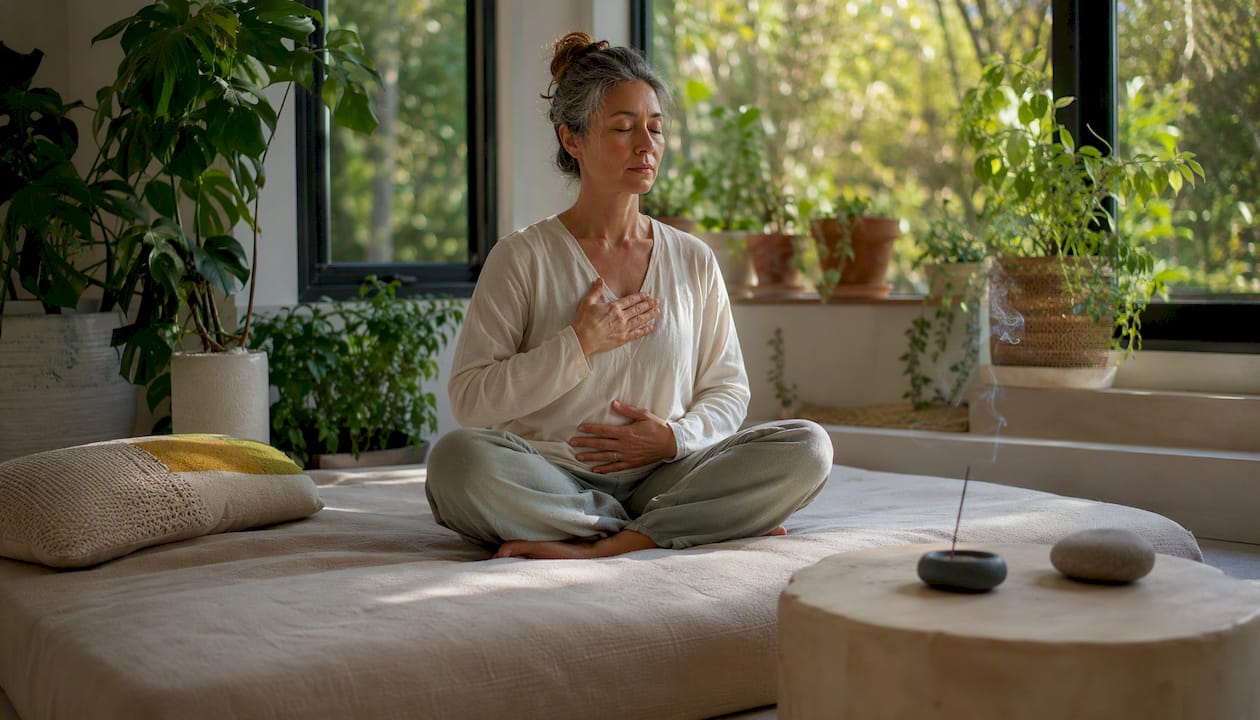
- Diaphragmatic breathing (2 minutes): Sit comfortably. Place one hand on your chest, one on your belly. Inhale slowly through your nose for 4 counts, letting your belly rise while your chest stays relatively still. Exhale gently for 6 counts. Repeat 4–6 cycles. Stop if you feel dizzy or short of breath.
- Seated shoulder rolls (3 minutes): Sit tall in a chair. Slowly roll both shoulders forward 5 times, then backward 5 times. Follow with gentle neck side-tilts, 3 per side. Move at half the speed you think you need to.
Medical disclaimer: Qigong is not a substitute for medical care. Stop immediately if you experience chest pain, palpitations, or sudden severe breathlessness, and contact your clinician. If you have POTS, uncontrolled arrhythmia, or severe dyspnea, consult your doctor before starting any movement practice.
Pro Tip: Start with 5 minutes per day for the first week. Consistency at a low dose beats a single ambitious session that triggers post-exertional malaise (PEM).
Key Takeaways
Qigong produces small-to-moderate improvements in long COVID symptoms, particularly fatigue, sleep, anxiety, and breathlessness, when practiced gently and consistently within your energy envelope.
| Point | Details |
|---|---|
| Evidence is promising but preliminary | Nine studies show effect sizes of 0.25–0.75; psychological outcomes are most consistent; larger RCTs are still needed. |
| Start with 5 minutes daily | Begin with diaphragmatic breathing only; add seated movement and vocalization only after a week of stable symptom response. |
| Safety checks are non-negotiable | Stop for chest pain, palpitations, syncope, or any symptom worsening in the 24 hours after practice. |
| Track your response | Log session length, perceived exertion, and symptom response after each session; share this data with your clinician. |
| Qigongstar offers credentialed guidance | White Tiger Qigong School and Yoga Alliance-certified instructors, with seated adaptations and 1:1 coaching for complex cases. |
Table of Contents
- What does the research say about qigong for long COVID?
- Key clinical trials and study designs at a glance
- Which qigong styles were used in studies, and which fits you?
- How might qigong actually work on long COVID symptoms?
- Safe qigong exercises you can start today
- Safety, red flags, and when to stop
- How to fit qigong into your long COVID care plan
- A gentle 4-week starter plan you can follow or share with your clinician
- How to find a qualified qigong instructor in the U.S.
- What teaching people with long COVID has taught me
- Qigongstar's guided programs for long COVID rehabilitation
- Sources
What does the research say about qigong for long COVID?
The evidence is promising but still maturing. The Antonelli et al. systematic review identified nine eligible studies across COVID-19 and long COVID populations, with effect sizes ranging roughly 0.25–0.75, placing most findings in the small-to-moderate range. That is a meaningful signal for a condition where many people have few low-risk options.
The forms most commonly studied were Liu Zi Jue (also called the Six Healing Sounds) and Baduanjin (Eight Brocades). Both emphasize slow, coordinated breath and movement, making them well-suited to people with limited energy reserves. Typical trial dosing ran from 20 to 60 minutes per day, with longer durations used in long COVID-specific cohorts.
What improved most consistently across studies:
- Respiratory symptoms and perceived breathlessness
- Fatigue and energy levels
- Sleep quality
- Anxiety and psychological wellbeing
- Health-related quality of life scores
Psychological outcomes tended to show the strongest and most consistent effects. Physical measures like pulmonary function improved in some trials but with more variability, partly because protocols differed so widely.
A qualitative pilot study of combined external and internal qigong in people with post-acute sequelae of COVID-19 (PASC) found that 73% of participants reported improvement in at least one symptom, most commonly fatigue, brain fog, and sleep. That same study noted that most participants reported improved overall wellbeing. The sample was 26 participants, so these are preliminary signals rather than definitive conclusions.
Statistic to hold: Effect sizes of 0.25–0.75 across nine studies suggest qigong produces real, if modest, benefits for long COVID rehabilitation, with psychological outcomes showing the most consistent support.
Honest limitations you should know:
- Most studies had small samples (often under 50 participants).
- Protocols varied widely in style, duration, and delivery format.
- Control conditions differed across trials, making direct comparisons difficult.
- Larger, well-controlled randomized trials are still needed before qigong can be considered a clinically established treatment.
The Cleveland Clinic's overview of long COVID notes that recovery timelines vary considerably and that multidisciplinary care is often necessary. Qigong fits best as one layer in that broader plan.
Key clinical trials and study designs at a glance
| Trial / Registration | Design | Sample | Qigong Style & Dosing | Primary Outcomes | Key Findings |
|---|---|---|---|---|---|
| Antonelli et al. 2024 Systematic Review | Systematic review | COVID-19 and long COVID populations | Liu Zi Jue, Baduanjin; 20–60 min/day | Respiratory symptoms, fatigue, sleep, QoL, anxiety | Small-to-moderate effect sizes (0.25–0.75); psychological outcomes most consistent |
| NCT06879925 — Physiological & QoL Benefits | Registered clinical trial | Not yet reported | Qigong 3×/week for 12 weeks | FVC, FEV1, HRV, WHOQOL-BREF | Objective pulmonary and autonomic endpoints under active investigation |
| Qualitative PASC Pilot (Springer, 2025) | Qualitative analysis of pilot RCT | 26 participants | Combined external/internal; 6 weekly sessions | Symptom change, qi perception, wellbeing | 73% reported symptom improvement |
What these trials measured and found:
- Pulmonary function (FVC, FEV1): tracked in the 12-week registered trial; small studies reported increases in maximal inspiratory pressure and diaphragm movement after Liu Zi Jue practice.
- Autonomic measures (heart rate variability): included as a primary endpoint in the 12-week trial, reflecting interest in qigong's effect on the autonomic nervous system.
- Patient-reported outcomes (PROMIS-29, Borg dyspnea, QoL scores): the most consistently improved measures across studies.
- Inflammatory markers: some studies reported reductions in TNF-α, IL-6, and CRP, though sample sizes were small.
Protocol variance is worth flagging. Some trials used external qigong (instructor-led movement), others used internal qigong (breath and intention-focused self-practice), and several combined both. Session lengths ranged from 20 to 60 minutes, and durations spanned 6 to 12 weeks. That heterogeneity makes it hard to prescribe a single "best" protocol, but it also means there is flexibility to adapt practice to your current capacity.
Which qigong styles were used in studies, and which fits you?
Not all qigong is the same, and the style matters when you are managing post-exertional malaise or breathlessness. Here is what the research used and what each form offers:
- Liu Zi Jue (Six Healing Sounds): A traditional internal qigong form that pairs six specific exhalation sounds with slow, gentle movements. It emphasizes breath control and is particularly well-suited to long COVID because it prioritizes exhalation, which can help retrain breathing patterns and calm the nervous system. This is the form most studied for respiratory outcomes.
- Baduanjin (Eight Brocades): A flowing sequence of eight standing movements coordinated with breath. Widely used in trials for its structured, progressive format. Can be adapted to seated practice for those with POTS or mobility limits.
- Five-Animal Qigong (Wu Qin Xi): Movements inspired by five animals (tiger, deer, bear, monkey, bird), each targeting different organ systems and energy pathways. More dynamic than Liu Zi Jue but adaptable to gentle, low-range versions.
- White Tiger Qigong: A contemporary system rooted in classical Chinese medicine principles, emphasizing spinal movement, breath regulation, and mindful awareness. Structured and teachable in online formats, making it accessible for home-based rehabilitation.
External vs. internal qigong: External qigong involves visible, coordinated movement sequences. Internal qigong centers on breath, visualization, and intention with minimal physical movement. For people in the early stages of long COVID recovery, internal practices are often safer starting points because they carry a lower exertional load. The Sacramento-based NCT05675995 pilot combined both, which participants found particularly supportive.
Practical dosing guidance from trials:
- Trials used 20–60 minutes per day for established practice.
- For long COVID, a safer starting dose is 5–20 minutes per day, progressing only when you can complete a session without worsening symptoms the following day.
- Daily short sessions tend to outperform infrequent longer ones for this population.
- Seated modifications are appropriate whenever standing triggers dizziness, tachycardia, or breathlessness.
How might qigong actually work on long COVID symptoms?
The mechanisms are biologically plausible and supported by early research, though larger mechanistic studies are still needed.
Diaphragm mechanics. Liu Zi Jue and similar exhalation-focused forms appear to increase diaphragm excursion and improve inspiratory muscle strength. Small studies reviewed in the Antonelli et al. systematic review reported increases in maximal inspiratory pressure after Liuzijue practice in people recovering from COVID-19. For long COVID patients with dysfunctional breathing patterns, this is a meaningful target.
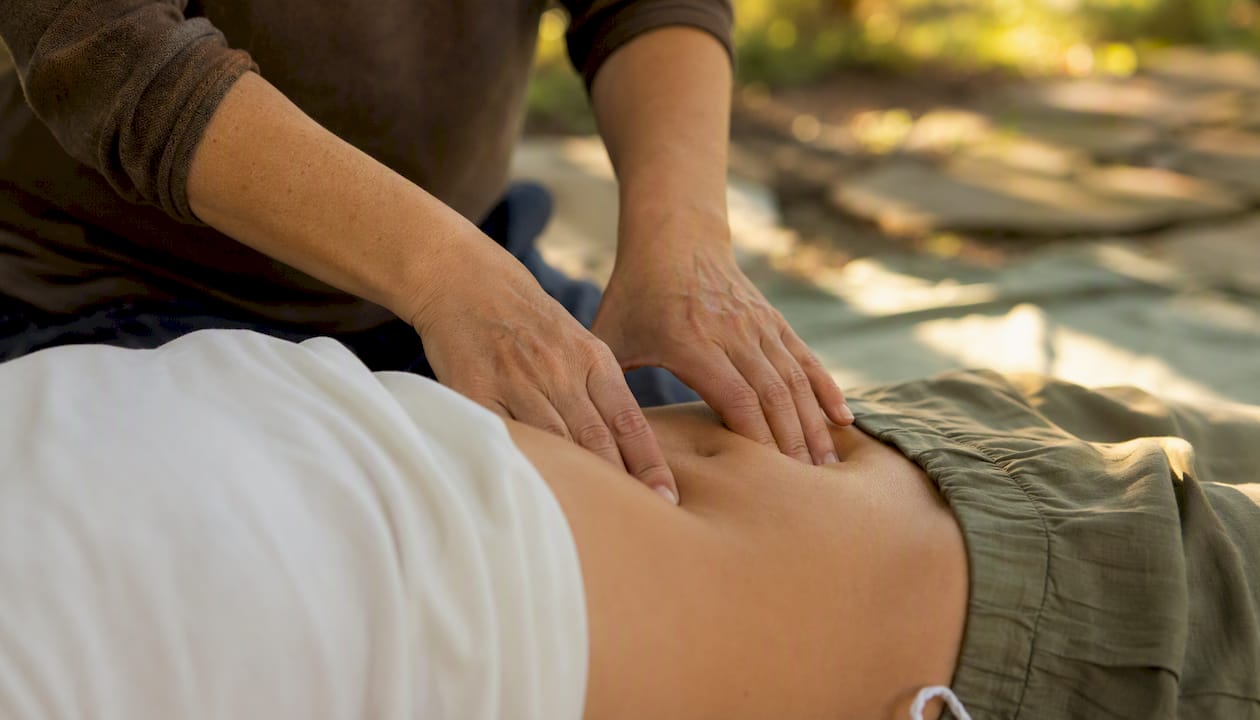
Autonomic regulation. Slow, paced breathing at roughly 5–6 breath cycles per minute tends to increase heart rate variability (HRV), a marker of vagal tone and autonomic flexibility. The 12-week registered trial includes HRV as a primary endpoint, reflecting the hypothesis that qigong may help regulate the autonomic dysfunction that underlies orthostatic intolerance and anxiety in long COVID. For people with POTS-like symptoms, this pathway is particularly worth watching.
Inflammation. Some studies suggest that tai chi and qigong may reduce inflammatory biomarkers including TNF-α, IL-6, and CRP in post-COVID rehabilitation contexts. These are preliminary findings from small, heterogeneous studies, so they warrant cautious optimism rather than strong claims. Still, given that chronic low-grade inflammation is thought to contribute to long COVID symptoms, this pathway is worth continued investigation.
Neurocognitive effects. Paced breathing, mindful movement, and body-awareness practices likely reduce activity in the stress-response system, which can improve attention, working memory, and sleep quality over time. The qualitative pilot study found that participants who reported improved wellbeing often described a calmer mental state and better sleep alongside physical symptom changes.
Key plausible pathways: diaphragm retraining, vagal tone enhancement, inflammatory marker reduction, and stress-system downregulation. Each is supported by early evidence; none is yet proven at scale.
For a deeper look at how qigong heals the body through these physiological channels, Qigongstar's resource library covers these mechanisms in accessible, practical language.
Safe qigong exercises you can start today
These three practices are drawn from the forms used in clinical studies. Follow the sequence in order, and stop any time you feel dizzy, short of breath, or notice your heart racing.
-
Diaphragmatic breathing (5 minutes). Sit in a chair with your feet flat on the floor. Rest one hand on your chest and one on your lower belly. Inhale through your nose for a count of 4, directing the breath so your belly hand rises and your chest hand stays mostly still. Exhale through slightly parted lips for a count of 6. This longer exhale activates the parasympathetic nervous system. Complete 6–8 cycles, then rest for 1 minute before moving on.
-
Seated shoulder and arm opening (3 minutes). Remain seated. On an inhale, slowly raise both arms out to the sides and up toward the ceiling, palms facing up. On the exhale, lower them gently back to your thighs. Move at a pace that feels almost too slow. Repeat 6 times. Follow with 5 slow shoulder rolls forward and 5 backward. If raising arms overhead causes dizziness, keep arms at shoulder height or below.
-
Liu Zi Jue "Xu" sound for lung qi (3–5 minutes). This is the lung-associated sound from the Six Healing Sounds practice. Sit tall. Inhale gently through your nose. As you exhale, softly vocalize the sound "Xu" (pronounced like "shoo" with a soft "sh"). Let the sound be quiet and breathy, not forced. As you exhale, slowly open your arms to the sides at chest height, palms facing forward, then return them to your lap on the next inhale. Repeat 6 cycles. This practice is used in Liu Zi Jue trials specifically for respiratory rehabilitation.
Modifications for breathlessness, POTS, and mobility limits:
- If standing triggers symptoms, do every exercise seated or lying down.
- For POTS, keep your head above your heart during practice; avoid forward folds.
- If vocalization feels too effortful, practice the breath pattern silently first.
- Reduce repetitions to 3 if 6 feels like too much. You can always build.
Pacing rules. Use the energy envelope approach: practice at a level that leaves you feeling the same or slightly better afterward, never worse. A useful check is the "talk test" during practice. If you cannot speak a short sentence comfortably, you are working too hard. Log your session length and your symptom response 30 minutes and 2 hours after practice. If symptoms worsen, shorten the next session.
Pro Tip: Keep a simple daily log: date, minutes practiced, perceived exertion on a 1–10 scale, and one word describing how you felt 2 hours later. Three weeks of that data tells you more about your personal response than any general guideline can.
For additional relaxation techniques that complement breathwork, Qigongstar's blog offers guided approaches that work well alongside this sequence.
Safety, red flags, and when to stop
Long COVID is heterogeneous, and not every practice is right for every person at every stage. Know these signals before you begin.
Stop immediately and seek medical attention if you experience:
- Chest pain or pressure during or after practice
- Palpitations or a heart rate that feels unusually fast or irregular
- Syncope (fainting) or near-fainting
- Sudden severe shortness of breath that does not resolve with rest
- Significant worsening of any symptom in the 12–24 hours after practice (a sign of post-exertional malaise)
Contraindications and cautions:
- Post-exertional malaise (PEM): If you have confirmed PEM, start with breath-only internal practices and no movement at all. Add seated movement only after 2 weeks of stable symptom response.
- POTS or orthostatic intolerance: Practice seated or lying down. Avoid rapid position changes. Check your resting heart rate before each session; if it is more than 10 beats above your usual baseline, rest that day.
- Uncontrolled cardiac arrhythmia: Consult your cardiologist before starting.
- Severe breathlessness at rest: Qigong is not appropriate until breathlessness is medically evaluated and stabilized.
- Medications affecting heart rate or blood pressure: Beta-blockers, antihypertensives, and similar medications can mask exertional signals. Ask your prescriber whether your current medication regimen changes how you should monitor exertion.
Before each session, run a quick safety check: Sit quietly for 2 minutes. Note your resting heart rate and whether you feel dizzy or unusually fatigued. If either is present, skip movement practice and do 5 minutes of seated breathing only. This habit protects you from the most common cause of setbacks in early long COVID rehabilitation.
Clinician-consult checklist. Discuss with your doctor or care team before starting if you have:
- Symptoms suggesting POTS (dizziness on standing, rapid heart rate when upright)
- Unexplained chest pain or dyspnea on minimal exertion
- Cardiac or pulmonary conditions diagnosed during or after COVID-19
- A history of syncope or arrhythmia
The CDC's clinical guidance emphasizes individualized care for long COVID. Sharing your qigong plan with your clinician, including session length, frequency, and symptom response, is a straightforward way to keep your care coordinated.
How to fit qigong into your long COVID care plan
Qigong works best as one layer in a broader rehabilitation plan, not as a standalone solution. Here is how it fits alongside other treatments:
- Medical care: Continue all prescribed medications and follow-up appointments. Report any symptom changes to your clinician.
- Pulmonary rehabilitation: If you have been referred to formal pulmonary rehab, qigong can serve as a gentle home-based supplement between sessions, not a replacement.
- Physical and occupational therapy: PT/OT addresses functional capacity and daily activity management. Qigong's breath and movement work complements this without duplicating it.
- Mental health care: Anxiety and depression are common in long COVID. Qigong's calming effects on the nervous system can support, but not replace, psychological treatment when needed.
- Medication: Some people with long COVID use medications for specific symptoms. Qigong does not interact with most medications, but always flag new practices with your prescriber.
Metrics worth tracking:
- Symptom diary: rate fatigue, brain fog, breathlessness, and sleep on a 1–10 scale each morning
- Perceived exertion during and after each session (Borg scale or simple 1–10)
- Resting heart rate and any orthostatic symptoms before practice
- Step count or activity level on practice days vs. rest days
- Sleep quality the night after a session
When reporting your practice to a clinician, note frequency (days per week), session length (minutes), the style practiced, and your symptom response in the 24 hours after. This gives your care team enough detail to adjust recommendations if needed. If your symptoms worsen after two consecutive sessions, pause and report before continuing.
Qigong is not covered by most U.S. insurance plans as a standalone service, but it can function as a low-cost home supplement to formal pulmonary or cardiac rehabilitation programs that are often covered. Check with your insurer about what rehabilitation services your plan includes.
A gentle 4-week starter plan you can follow or share with your clinician
This plan is built around the pacing principles used in long COVID qigong trials: short sessions, gradual progression, and clear stopping rules.
| Week | Session Length | Frequency | Focus | Goal |
|---|---|---|---|---|
| Week 1 | 5–10 min | Daily | Diaphragmatic breathing only | Establish the habit; assess symptom response |
| Week 2 | 10 min | Daily | Breathing + seated micro-movements | Add gentle movement; monitor for PEM |
| Week 3 | 15 min | Daily | Breathing + movement + Liu Zi Jue "Xu" sound | Introduce vocalization; track HRV or resting HR |
| Week 4 | 20–30 min | Daily or 5×/week | Full short sequence + one rest day | Consolidate practice; review symptom diary |
Weekly checklist:
- Log minutes practiced each day.
- Rate your symptom response 2 hours after each session (better, same, or worse).
- Check resting heart rate before practice; note any orthostatic symptoms.
- Rate sleep quality each morning on a 1–10 scale.
- At the end of each week, review: did any session trigger PEM? If yes, reduce next week's duration by 30%.
Progression rules. Add time only when you complete a full week without any post-session symptom worsening. If two sessions in a row leave you feeling worse, drop back to the previous week's duration. Never add both time and a new movement in the same week.
Pro Tip: A short morning breath practice (5 minutes of diaphragmatic breathing before getting out of bed) combined with a slightly longer, low-intensity evening session tends to distribute the exertional load more evenly than one longer midday session, reducing PEM risk. Try this split in Week 3 and log whether your afternoon energy holds better.
For a structured daily qigong routine that fits this pacing framework, Qigongstar's resources offer step-by-step guidance you can adapt to your current capacity.
How to find a qualified qigong instructor in the U.S.
The quality of instruction matters more in a clinical population than in a general wellness class. Here is what to look for and what to ask.
Credential checklist:
- Training with a recognized school (White Tiger Qigong School, National Qigong Association, or equivalent lineage-based programs)
- Yoga Alliance registration as a secondary credential signal for structured training hours
- Experience working with chronic illness, fatigue conditions, or post-COVID populations specifically
- Familiarity with pacing, PEM, and POTS modifications
- CPR/first-aid certification for in-person instruction
Questions to ask before joining a class or program:
- Have you worked with people who have long COVID or chronic fatigue?
- How do you modify practice for someone who cannot stand or who has POTS?
- What is your approach when a student needs to stop mid-session?
- How large are your classes, and can you offer individual attention?
- Do you offer seated or lying-down alternatives for every movement?
Online vs. in-person: Online classes offer accessibility that is genuinely valuable when leaving home is exhausting or triggers symptoms. The tradeoff is that an instructor cannot monitor your color, breathing rate, or posture in real time. To trial an online class safely, practice in a chair near a wall, have water nearby, and keep your first session under 10 minutes regardless of what the class offers. In-person instruction allows real-time feedback but requires travel energy you may not have in early recovery.
The NCCIH's overview of tai chi and qigong offers additional guidance on evaluating instructors and programs, and is a useful resource to share with skeptical clinicians.
Qigongstar's online qigong classes are taught by instructors certified through the White Tiger Qigong School and Yoga Alliance, with beginner-friendly, seated-adaptable formats that fit the safety-first approach this population needs.
What teaching people with long COVID has taught me
The most important thing I have learned teaching people navigating long COVID is this: less is almost always more, especially at the start. The instinct to push through, to do the full class, to "get back to normal" as fast as possible, is understandable. But for this population, that instinct can set recovery back by days or weeks.
What actually moves people forward is breath first, always. Before any movement, before any sequence, before any sound, the breath needs to feel safe and controlled. When someone can sit quietly and breathe diaphragmatically for five minutes without anxiety or symptom flare, they have already done something genuinely therapeutic. Movement comes after that foundation is solid.
The other thing worth saying plainly: consistency at a micro-dose beats ambition at a macro-dose every time. Five minutes every morning for four weeks produces more lasting nervous system change than a 45-minute session once a week. That is not a motivational claim; it reflects what the pilot studies and qualitative reports from participants actually show.
Qigongstar's guided programs for long COVID rehabilitation
If you are ready to move beyond solo practice and want structured, credentialed guidance, Qigongstar offers online courses and live classes designed with exactly this kind of gentle, breath-first approach in mind.
The White Tiger Qigong and Five-Animal Qigong programs both include seated adaptations and breath-focused entry points that align with the pacing principles covered throughout this guide. Instructors hold certifications from the White Tiger Qigong School and Yoga Alliance, and the programs are structured to meet you where you are, whether that is five minutes of breathing or a full gentle sequence. One-to-one coaching is available for people managing POTS, PEM, or complex symptom patterns who need a more individualized approach.
To get started, visit the online courses and classes page, review the available formats, and reach out to discuss which program fits your current capacity. Tell the instructor about your long COVID symptoms, your energy limits, and any red flags from the safety section above. That conversation shapes a safer, more effective practice from day one.
Sources
- Evaluating qigong as integrative support for COVID-19 and Long-COVID-19 rehabilitation: a systematic review
- Experiences with Qi and changes in post-acute sequelae of COVID-19 (PASC) symptoms with qigong: a qualitative analysis of participants’ experiences in a pilot clinical trial
- Qigong for Post Acute Sequelae of COVID-19 Infection
- Physiological and QoL Benefits of Qi-Gong in Post-acute Sequelae of Covid-19
- Long COVID Basics | Long COVID | CDC
This article provides general health information for educational purposes and is not a substitute for professional medical advice. Consult your clinician before starting any new exercise or rehabilitation practice, particularly if you have cardiac, pulmonary, or autonomic symptoms.