
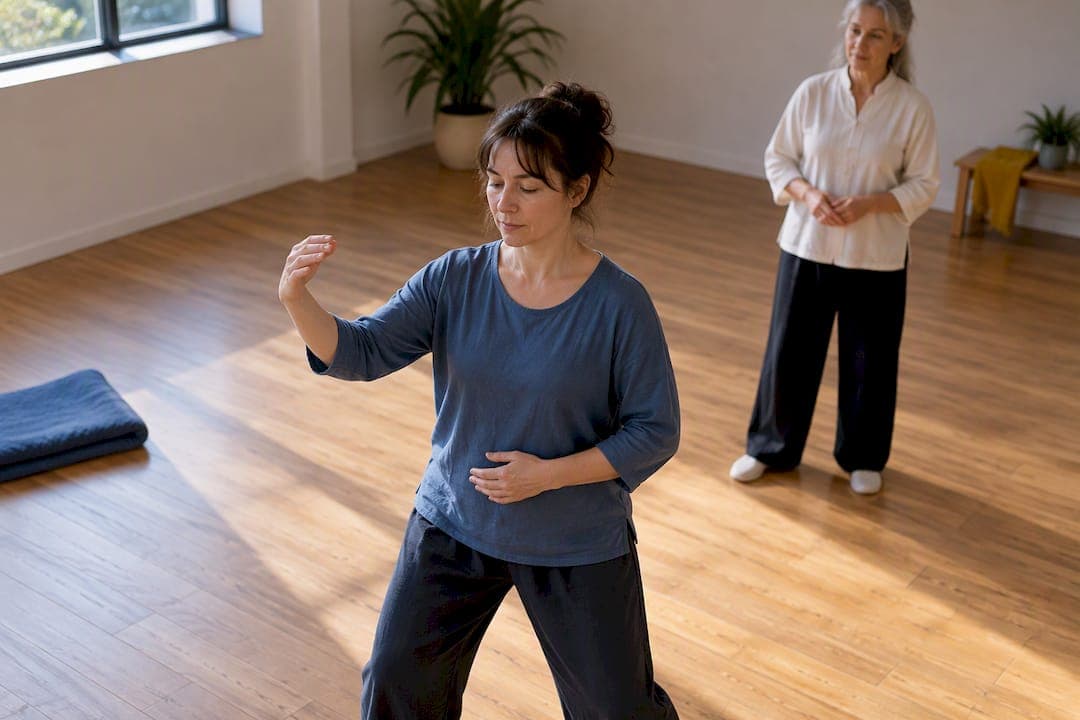
Qigong probably helps ease chronic fatigue when compared with doing nothing, though it is not a cure and the research base is still thin. A gentle starting point is 3 to 5 minutes of slow, breath-focused qigong once a day, stopping or scaling back immediately if your symptoms flare. The sections below walk through the trial evidence, the safest methods, and a pacing plan built for low-stamina bodies.
TL;DR:
- Practicing qigong at least three times a week for 30 minutes over several weeks shows the most consistent evidence of reducing fatigue, depression, and anxiety.
- Guided sessions combined with daily home practice are more effective than unsupervised or sporadic activity, especially when tailored to individual energy levels.
- Short routines of 3 to 5 minutes or 10 to 15 minutes, adaptable to seated or lying positions, are recommended for beginners or those with unstable stamina.
- Monitoring for post-exertional malaise is essential, and practice should be scaled back immediately if symptoms worsen or delayed fatigue occurs.
- Most research comes from small studies with short follow-up periods, so long-term effects remain uncertain, emphasizing caution and individualized pacing.
Table of Contents
- What the trials and reviews say about qigong for CFS
- Trial-aligned qigong methods and exact short routines
- How to avoid harm: pacing, PEM, and red flags
- A conservative 8 to 12 week plan mapped to trial patterns
- How teachers adapt qigong for people with chronic fatigue
- Why the safest advice on qigong for fatigue is also the least exciting
- Finding a QigongStar class that fits your energy level
- Verified studies, systematic reviews and NICE guidance to check next
- Sources
- FAQ
What the trials and reviews say about qigong for CFS
The strongest evidence comes from a 2023 systematic review and meta-analysis pooling traditional Chinese mind-body exercises, including qigong and tai chi, across 13 studies covering 1,187 participants. It found these practices probably reduce fatigue, depression, and anxiety compared with passive controls such as no treatment or usual care, with moderate certainty behind that finding. Against other active therapies, though, qigong showed little to no additional benefit, which suggests some of what people feel may come from relaxation, focused attention, or simply having regular guided support rather than anything unique to the movements themselves.
That review also gives us a window into how these programs were actually run. Sessions in the pooled studies tended to run at least 30 minutes, more than 3 times a week, over treatment windows of 4 to 16 weeks. Long-term follow-up was rare, so nobody can yet say with confidence what happens after the study ends.

Two individual trials add texture to that picture. A 2023 randomized study of Yijinjing qigong followed 40 adults with chronic fatigue syndrome over 12 weeks. Participants practiced six times a week: one teacher-led session plus five home sessions, and the group showed improvements in fatigue, sleep quality, and general health status compared with a cognitive-education control group. That guided-plus-home structure shows up again and again in the literature, and it appears to work better than a single unsupervised session ever could.
An earlier review of randomized qigong trials looked at two studies involving 137 and 150 participants over 5 and 8 weeks. It reported reduced fatigue and depressive symptoms, and pointed to a regimen of at least 3 sessions a week, each lasting at least 30 minutes, as the threshold associated with benefit. It is worth noting that participants in these earlier trials were often identified through symptom questionnaires rather than confirmed clinical ME/CFS diagnoses, which softens how directly the findings apply to everyone reading this.
A separate randomized study of the Prolong Life With Nine Turn method, often shortened to PLWNT, reported improvements in fatigue, sleep, anxiety, and depression among people with chronic fatigue syndrome. Alongside Yijinjing, Baduanjin appears often in this research as a third common style, built around eight gentle repeated movements that blend stretching with breath control.
Pulling these threads together:
- Trial-backed regimen: roughly 3 or more sessions weekly, at least 30 minutes each, sustained for several weeks, is the pattern most associated with reported benefit.
- Guided plus home practice: the most convincing results paired a weekly teacher-led class with daily or near-daily home sessions rather than relying on either alone.
- Common styles studied: Yijinjing, PLWNT, and Baduanjin all appear in the randomized evidence, each combining slow stretching, breath regulation, and light strengthening.
- Real limits: small sample sizes, short follow-up periods, and a concentration of trials from China and Hong Kong mean the evidence is promising but not conclusive.
Only a minority of studies pooled in the 2023 review followed patients for more than a few months, which is a way of saying that most of what we know describes short-term change, not what happens a year down the line.
None of this means qigong is a fix. It means a modest, consistent practice has a reasonable evidence trail behind it for easing fatigue, mood, and sleep disruption, particularly when compared with doing nothing at all.
Trial-aligned qigong methods and exact short routines
Three styles anchor almost all of the research on qigong and chronic fatigue, and each has a slightly different flavor.
Yijinjing translates roughly as "muscle and tendon changing" and leans on slow stretching sequences paired with steady breath work, aimed at loosening stiffness that builds up from underactivity. Prolong Life With Nine Turn (PLWNT) moves through nine linked postures that emphasize circular, flowing motion and diaphragmatic breathing, designed to settle the nervous system as much as the body. Baduanjin, the "eight brocades," is the most widely taught of the three, built from eight short repeated movements that combine light stretching with gentle strengthening for the shoulders, spine, and legs.
None of these require strength, speed, or standing for long stretches. All three can be adapted to a chair or a bed, which matters enormously for anyone whose energy reserves are unpredictable.
Here are three routines scaled to different energy levels, all drawn from the movement patterns these styles use:
- The 3 to 5 minute micro-session. Sit or lie down comfortably. Breathe in slowly for a count of four, hold for two, breathe out for six, repeating for a full minute. Follow with two gentle movements: a slow shoulder roll (both directions, five repetitions each) and a seated or lying "cloud hands" sweep, where your arms drift side to side at chest height as if pushing through water. Stop the moment you feel strain.
- The 10 to 15 minute short routine. Start with two minutes of the same breathing pattern above, then add four movements: shoulder rolls, cloud hands, a seated spinal twist done slowly to each side, and a gentle overhead reach synced with the inhale and exhale. Pause between each movement for a few natural breaths rather than rushing to the next one.
- The 30 to 60 minute trial-style session. This mirrors what many of the RCTs actually used, including a Baduanjin or Yijinjing sequence taught step by step, with rest breaks built in every 10 minutes or so. This length suits someone who has already tolerated the shorter routines for at least a couple of stable weeks, never someone starting fresh.
Every movement above can be done seated with feet flat on the floor, or lying down with arms resting at your sides for the breathing and small arm movements. If a teacher's cues do not mention a seated option, ask, or look elsewhere; a well-designed class for fatigue always names the modification out loud rather than leaving you to guess.
Recorded classes have a real advantage here: you can pause, rewind, or stop entirely without anyone noticing, which removes the social pressure that sometimes pushes people past their limit in a live group. Live instruction adds real-time feedback on posture and pacing, which matters more for people newer to the movements. A blended approach, one guided session a week plus recorded home practice, reflects the structure used in the Yijinjing trial and is a reasonable template to borrow.
Pro Tip: Keep a folded blanket or firm cushion nearby so you can shift from standing to seated to lying down mid-session without breaking your breathing rhythm.

How to avoid harm: pacing, PEM, and red flags
The single most important safety principle for chronic fatigue is one that NICE guidance is explicit about: energy management has to be individualized, and activity should never increase automatically just because a plan says it is time. NICE guidance for ME/CFS also warns against "pushing through" symptoms, framing post-exertional malaise, commonly called PEM, as a real risk rather than a sign of low effort. PEM is often delayed by hours or even days after activity, and it can last a long time once it starts, which is exactly why a qigong session that feels fine in the moment can still cause a setback later.
That delay is the trap. A short practice that seems easy on Tuesday can leave you flattened by Thursday, so monitoring needs to stretch beyond the session itself.
Practical ways to watch for PEM:
- Keep a simple symptom diary noting practice length, how you felt during it, and how you feel over the following 24 to 72 hours.
- Track specific warning signs, including a spike in fatigue, new or worsening brain fog, disrupted sleep, or flu-like heaviness.
- Wait before judging a session a success. Feeling fine right after practice tells you little; feeling fine three days later tells you much more.
When a bad day hits, the response is to scale down, not push through: halve your usual practice time, switch to breath-only work if movement feels like too much, and take a full rest day after any session that leaves you drained rather than settled. This mirrors the individualized, safety-first tone NICE guidance takes toward activity for ME/CFS: energy management, not graded fitness building toward a fixed target.
A pattern seen across trials in qigong intervention research is that positive results consistently came from regular, structured practice rather than occasional or one-off sessions, reinforcing why consistency at a low dose beats sporadic bursts at a higher one.
Some symptoms sit outside what pacing alone can manage and call for a clinician's input. Seek medical review promptly for new chest pain, fainting or near-fainting, sudden neurological symptoms such as slurred speech or one-sided weakness, or a severe worsening of fatigue that does not settle with rest. Gentle movement is meant to support your energy, never to be a test you have to pass through with discomfort. For more detail on who should modify or pause practice altogether, our guide on qigong contraindications walks through specific situations worth flagging to a doctor first.
A conservative 8 to 12 week plan mapped to trial patterns
Progress with chronic fatigue rarely looks like a straight line upward, so this plan is built around stability checks rather than fixed weekly targets.
- Weeks 1 and 2: practice the 3 to 5 minute micro-session once daily. Do not add a second session yet, no matter how good you feel on a given day.
- Week 3: if you have had no PEM and your fatigue diary looks stable, add a second short micro-session on separate parts of the day.
- Weeks 4 through 5: hold at two micro-sessions daily. Resist the urge to lengthen sessions until this feels genuinely easy, not just tolerable.
- Weeks 5 through 8: only if you have had 7 consecutive stable days with no PEM, move to the 10 to 15 minute short routine, 3 times a week, which lines up with the practice dose most associated with benefit in the trial evidence discussed earlier.
- Weeks 9 through 12: if that dose remains stable, consider one weekly guided session (live or recorded) alongside two shorter home sessions, echoing the structure used in the Yijinjing and PLWNT trials.
The trigger for every step up is the same: 7 days of stable symptoms with no delayed fatigue spike, not simply "feeling ready." Logging both objective details, like minutes practiced, and subjective ones, like a quick 0 to 10 fatigue rating, makes that judgment far less guesswork and far more pattern-based.
Mixing one guided session a week with home practice on the other days reflects almost exactly what the stronger trials did, and it likely matters for a simple reason: a teacher can catch pacing mistakes and modify movements in real time, while home practice keeps the habit going without demanding you leave the house or match someone else's energy that day.
Pro Tip: If a week does not go to plan, restart the week rather than pushing forward. There is no penalty for repeating a stable week twice.
How teachers adapt qigong for people with chronic fatigue
Teaching qigong to someone with chronic fatigue syndrome asks for a different rhythm than teaching a general wellness class, and three rules guide that difference. First, every session should offer a micro-dose option from the very first instruction, not as an afterthought halfway through. Second, seated and lying-down variations need to be named out loud for every single movement, so no one has to guess or push through standing when their body is asking for less. Third, recordings should always be available, because energy for a live class simply is not something anyone with PEM risk can promise in advance.
Class formats at this platform are built around that same logic: shorter guided sessions, on-demand recordings for practicing at your own pace, and private options for anyone who wants pacing tailored specifically to a chronic fatigue picture rather than a general audience. Instruction comes from a certified teacher with relevant accreditations, focusing on programs suited to stress and modern professional life rather than intense physical training. That structure, a guided component paired with flexible home access, mirrors the pattern seen across the strongest trials on qigong for fatigue: consistency with support beats intensity without it.
Why the safest advice on qigong for fatigue is also the least exciting
The most useful thing this research supports is not a technique, it is a dose. Most people chasing fatigue relief look for the "right" style or the perfect sequence, when the evidence actually points toward something less glamorous: a small, boring, repeatable practice held steady over weeks. That is where most people give up too early, either abandoning qigong after a few sessions because it feels too gentle to matter, or overdoing it because early progress feels good.
Conventional fitness advice tends to reward pushing limits. Chronic fatigue punishes it. The gap between those two mindsets is exactly where PEM lives, and it is why pacing rules matter more here than in almost any other movement practice.
If you take one thing from this guide, let it be this: start smaller than feels necessary, and let stability, not ambition, decide when to add more.
— Stella
Finding a QigongStar class that fits your energy level
Choosing the right format matters as much as choosing the right movements. If you are still working out how much activity your body can handle, the 30-Min Clarity Session offers a focused, low-pressure way to get personalized feedback before committing to a longer routine. If your energy runs low and unpredictable, the on-demand modules through Online Courses and Classes let you practice in short bursts on your own schedule, pausing or stopping whenever your body asks for it. For anyone wanting pacing built specifically around a chronic fatigue picture, the 60-Min Deep Dive Online Session allows for a slower, more tailored walk-through of seated and lying-down modifications.
Every format includes seated variations, slow verbal counts, and pauses built into the pacing, so you are never rushed past what feels manageable. A first session typically starts with a short conversation about your current energy levels before any movement begins, so the pace fits you rather than the other way around.
- Short clarity sessions: best for an initial assessment and a personalized starting dose.
- On-demand short modules: best for daily micro-practice on your own timeline.
- Longer deep dive sessions: best for a fully tailored pacing plan built around your fatigue pattern.
Ready to try a session built around your own energy, not a generic class plan? Explore QigongStar's online class options and book the format that matches where you are right now.
Verified studies, systematic reviews and NICE guidance to check next
For anyone who wants to read the primary evidence directly:
- The PLWNT randomized clinical study on fatigue, sleep, anxiety, and depression.
- NICE guidance on individualized energy management and PEM for ME/CFS, referenced throughout the pacing section above.
This article is general information, not a substitute for advice from a qualified doctor. Consult a qualified healthcare professional about your own circumstances before acting on anything here.
FAQ
Can qigong help with fatigue?
Qigong probably helps reduce fatigue when compared with doing nothing, according to a 2023 systematic review of traditional Chinese mind-body exercises. It shows little added benefit over other active therapies, so think of it as one reasonable option among several rather than a standout cure.
How to live a normal life with chronic fatigue syndrome?
There is no single formula, but individualized pacing is the foundation that NICE guidance recommends, meaning activity levels are matched to your own stable baseline rather than a fixed target. Gentle practices like qigong can support that pacing when introduced in small, consistent doses with close attention to delayed symptoms.
What is the best exercise for chronic fatigue syndrome?
No single exercise is proven best, but qigong and tai chi carry the most consistent randomized evidence for easing fatigue, mood, and sleep disruption in this population. The safest approach is whichever gentle practice you can sustain at a low, steady dose without triggering post-exertional malaise.
What is the best natural remedy for chronic fatigue?
No natural remedy is proven to cure chronic fatigue syndrome, but gentle mind-body practices like qigong have the most consistent trial support for easing symptoms such as fatigue, low mood, and poor sleep. Any remedy should be paired with individualized pacing, since overexertion, natural or not, can still trigger a setback.