
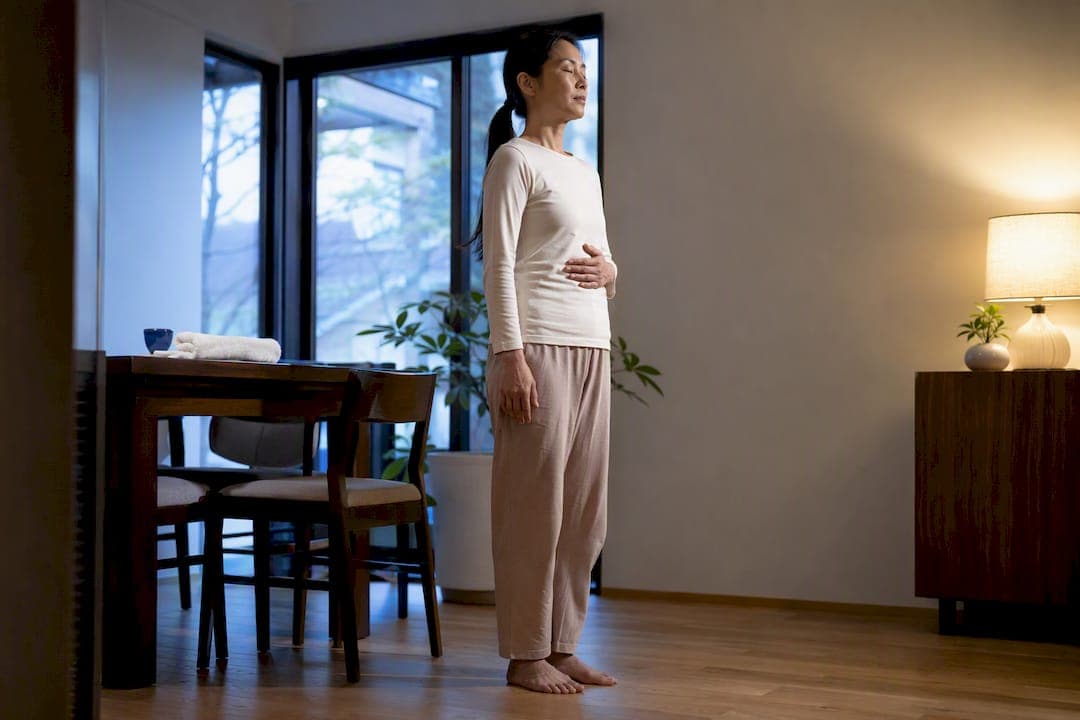
Yes, gentle qigong can ease acid reflux symptoms as a complementary self-care practice, not a replacement for treatment. The two elements worth your attention are diaphragmatic breathing and slow, downward-guiding abdominal movements, both of which calm the nervous system and support the muscles that keep stomach acid where it belongs. Your first step is simple: try the 10-minute routine below, ideally in the morning or a couple of hours after a meal.
TL;DR:
- Diaphragmatic breathing in qigong can increase lower esophageal sphincter pressure and reduce reflux events when practiced regularly over several months.
- Extended exhalation activates the vagus nerve, promoting a relaxation response that helps regulate stomach acid and improve digestion.
- Practice should be adapted to individual needs, avoiding intense abdominal pressure after large meals, and consulting a clinician if managing conditions like hiatal hernia.
- Short, daily micro-practices of breathing and abdominal rubbing are suitable after meals, while longer routines are better on an empty stomach or before sleep.
- Consistency over weeks or months, combined with medical care, is necessary to see meaningful improvements in acid reflux symptoms.
Table of Contents
- What Is a Qigong Routine for Acid Reflux?
- How Does Qigong Breathing Help Reduce Reflux Symptoms?
- Who Should Be Careful With Qigong for Acid Reflux?
- How Often Should You Practice for Digestive Relief?
- About the Instructor Behind This Routine
- Which Acid Reflux Symptoms Respond Best to Qigong?
- Simple Ways to Modify Your Practice as a Beginner
- A Realistic Take on What Qigong Can and Can't Fix
- Ready to Learn a Guided Digestive Qigong Routine?
- Sources
What Is a Qigong Routine for Acid Reflux?
A qigong routine for acid reflux is a short sequence of breath work and slow movement designed to soothe the digestive system rather than push it. Unlike a cardio workout or a strength session, it asks almost nothing of your body except attention and patience. Here's a sequence you can practice on a mat, a chair, or even in bed.
- Centering (1 minute). Sit or stand with your feet grounded. Rest one hand on your lower belly, just below the navel, the area many qigong traditions call the lower dantian. Close your eyes and simply notice your breath without changing it yet.
- Diaphragmatic breathing (3 minutes). Inhale slowly through your nose, letting your belly rise into your hand. Exhale even more slowly through pursed lips, drawing your navel gently toward your spine. This lets your diaphragm do the work instead of your chest and shoulders.
- Abdominal rubbing (2 minutes). Place both palms on your belly and rub in slow clockwise circles, following the natural path of the stomach and spleen. Keep the pressure light. This is not a deep massage.
- Downward-guiding arms and light rocking (3 minutes). Raise your arms slowly on the inhale, then lower them on the exhale as if smoothing energy down toward the ground. Add a gentle forward-and-back rock at the hips to reinforce the downward motion.
- Closing breath and rest (1 minute). Return your hand to your lower belly, take three unhurried breaths, and sit quietly before returning to your day.
If ten minutes feels like too much on a busy morning, shorten it. A 3-minute micro-routine using just the breathing and abdominal rubbing steps still delivers a calming effect. For bedtime, try a lying, propped-up version: recline on an incline with pillows, hands on the belly, and breathe slowly for five minutes before sleep, since lying flat too soon after eating tends to aggravate reflux regardless of technique.
Pro Tip: Keep your exhale longer than your inhale, roughly a four-count in and a six-count out. That extended exhale is what actually triggers the calming, parasympathetic response you're after.
How Does Qigong Breathing Help Reduce Reflux Symptoms?
The mechanism behind qigong for acid reflux comes down to two connected systems: the diaphragm's physical relationship to your lower esophageal sphincter (LES), and your nervous system's influence over digestion.
Your diaphragm's crura, the muscle fibers that loop around the esophagus, functionally reinforce the LES. Training the diaphragm through slow abdominal breathing appears to strengthen that support. A randomized controlled trial found that postprandial diaphragmatic breathing increased LES pressure during inspiration and reduced the number of reflux events after meals, suggesting a direct physiological pathway rather than just a relaxation effect.
The second piece is nervous-system regulation. Slow, extended exhalation activates the vagus nerve, shifting your body out of the fight-or-flight state that tends to worsen digestive symptoms and toward the rest-and-digest state where motility and acid regulation function more normally.
The clinical evidence backs this up over time, not overnight:
- A trial published in the American Journal of Gastroenterology found patients who kept up diaphragmatic breathing training for nine months cut their weekly proton pump inhibitor (PPI) use from roughly 98 mg to 25 mg, with improved pH-metry and quality-of-life scores.
- Traditional qigong protocols that pair abdominal rubbing with breath work are being studied for their effect on broader gastrointestinal function, with researchers tracking standardized symptom scales rather than relying on anecdote.
Expect gradual change, not instant relief. The nine-month trial above is a reminder that this is a slow-building practice, one that rewards weeks of consistency more than any single session.
Who Should Be Careful With Qigong for Acid Reflux?
Qigong is a complementary practice, not a substitute for medical care, and it works best alongside your doctor's guidance rather than instead of it.
Certain symptoms need urgent medical attention before you try any self-care routine, qigong included:
- Chest pain resembling a heart attack (pressure, radiating pain, shortness of breath)
- Vomiting blood or material that looks like coffee grounds
- Difficulty or pain when swallowing that is new or worsening
Beyond those emergencies, a few practice-level precautions matter. Skip strong abdominal pressure right after a large meal, since compressing a full stomach can push acid upward instead of easing it. Ease off the intensity if you've had recent abdominal surgery or have a hernia, and stop immediately if any movement increases your pain. If you're managing a hiatal hernia, erosive esophagitis, or you're on reflux medication, check with your clinician before changing your treatment routine, even for something as gentle as this.
How Often Should You Practice for Digestive Relief?
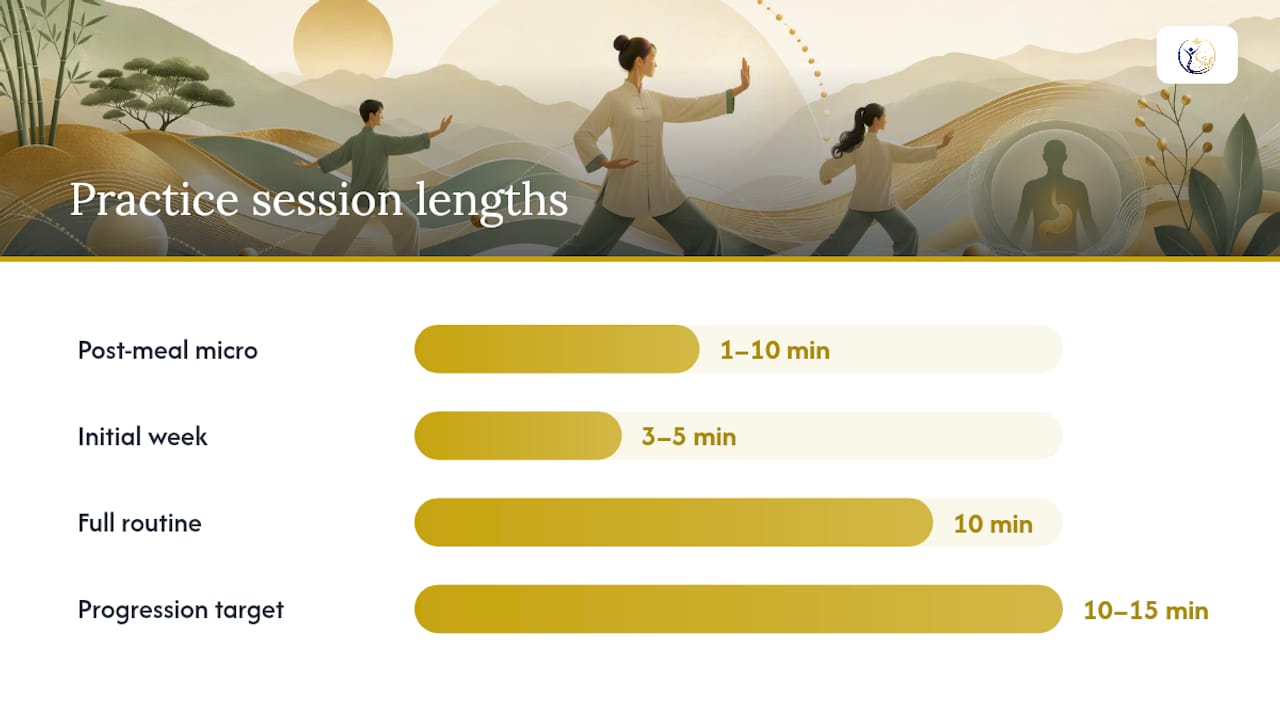
Timing shapes how well qigong for digestive health actually works. Short post-meal micro-practices, one to ten minutes of gentle breathing and light rubbing, tend to suit most people better than a full session right after eating, since vigorous movement on a full stomach commonly aggravates rather than relieves reflux. A fuller morning session on an empty or lightly settled stomach is often the better slot for the complete 10-minute routine.
- Start small. Practice three to five minutes daily for the first week rather than aiming for the full routine right away.
- Build gradually. Increase to ten or fifteen minutes over several weeks as your body adjusts. Consistency beats duration every time.
- Troubleshoot as you go. If symptoms flare, shorten the session, shift it to a different time of day, or switch to the seated version.
- Track patterns. Keep a simple log of the time, what you ate, and how the practice felt for two to four weeks. Patterns tend to surface quickly once you're writing them down.
Pro Tip: Attach your practice to something you already do daily, right after your morning tea or just before brushing your teeth at night. Anchoring a new habit to an existing one is far more reliable than relying on willpower alone.
A guided video or live class for your first few weeks can also help, since it's easy to rush the breath or skip the slow exhale when you're learning solo.
About the Instructor Behind This Routine
This routine draws on the training of Stella, a certified instructor through the White Tiger Qigong School and Yoga Alliance. She teaches White Tiger Qigong and Five Animal Qigong, both built around stress relief and digestive health rather than fitness in the conventional sense.
Classes are offered live and on demand that focus specifically on gut-related concerns like reflux, bloating, and IBS, using the kind of gentle, breath-led movement outlined above.
Which Acid Reflux Symptoms Respond Best to Qigong?
Qigong tends to help most with the symptoms tied to stress, tension, and shallow breathing rather than structural issues. That distinction matters when you're deciding whether to add it to your routine.
Heartburn that flares with stress or tension. If your burning sensation behind the breastbone gets noticeably worse during anxious or high-pressure stretches of your day, the calming, vagus-activating effect of slow breathing is likely to make a real difference.
Bloating and a sense of fullness after eating. The abdominal rubbing portion of the routine, borrowed from traditional digestive qigong protocols, targets exactly this kind of sluggish, heavy feeling.
Frequent throat clearing or a lingering sour taste. These often stem from small amounts of acid reaching the upper esophagus, and better diaphragmatic support may reduce how often that happens.
Difficulty relaxing after meals, especially in the evening. A short lying or propped-up practice before bed addresses both the physical and the mental side of this pattern.
Qigong is less likely to resolve symptoms tied to structural causes, like a large hiatal hernia or severe erosive damage to the esophagus. Those cases call for medical evaluation first, with breathing practice added as support rather than the primary treatment.
Simple Ways to Modify Your Practice as a Beginner
You don't need the full 10-minute sequence to get value from qigong for digestive health. A few adjustments make the practice accessible no matter your starting point.
The seated version. If standing or floor work isn't comfortable, do the entire routine in a chair. The breathing and abdominal rubbing work identically whether you're seated or standing, and the arm movements can shrink to small, controlled motions.
The one-minute reset. On days when ten minutes feels unreachable, three long diaphragmatic breaths with a hand on your belly still send a calming signal to your system. It's not the full routine, but it's far from nothing.
The limited-mobility adaptation. If bending or extended arm movement is difficult, skip the rocking and arm-raising steps entirely and stay with breathing and light abdominal rubbing. You'll still get the two elements that matter most.
The evening wind-down. Swap the standing arm movements for slow, seated breathing paired with a warm cup of herbal tea, useful for people whose reflux flares mostly at night.

Beginners often notice mild, temporary effects when they start, like slightly increased saliva or a brief sense of fullness. That's typically a sign your digestive system is responding to the new breathing pattern, not a reason for concern.
A Realistic Take on What Qigong Can and Can't Fix
Consistency, not intensity, is what actually moves the needle with qigong for acid reflux. A single session won't undo years of reflux, but a daily habit measured in weeks and months genuinely can shift things. Pair it with your existing medical care, sensible diet choices, and decent sleep hygiene rather than treating it as a stand-alone cure. Track your symptoms honestly, and if things aren't improving or you notice new red flags, bring that log to your clinician.
— Stella
Ready to Learn a Guided Digestive Qigong Routine?
Reading about a routine and actually practicing it with correct pacing are two different things, especially with breath work, where rushing the exhale undercuts the whole point. Stella's Five Animal Qigong course builds on exactly the digestive-focused breathing and movement covered above, with structured video lessons that progress week by week instead of leaving you to guess timing on your own.
Beginners get modifications built into every lesson, plus the option to ask questions during live sessions rather than troubleshooting alone. If reflux is tangled up with everyday stress, which it often is, the White Tiger Qigong program is worth a look too, since it trains the same breath and posture patterns with a stronger stress-relief focus. Start with the online class library to see which structured path fits your schedule, and pick a start date this week rather than waiting for the "right" moment.
Sources
For deeper reading, the Am J Gastroenterology trial and the postprandial breathing study cover the clinical evidence in full. QigongStar's digestive inflammation guide offers related routines.
- Positive effect of abdominal breathing exercise on gastroesophageal reflux disease: randomized controlled study (Am J Gastroenterol)
- Effects of diaphragmatic breathing on the pathophysiology and treatment of upright gastroesophageal reflux: randomized controlled trial (Qigong Institute abstract)
- Effect of Prolong-life-with-nine-turn-method (Yan Nian Jiu Zhuan) Qigong on fatigue and gastrointestinal function: study protocol (PMC)