
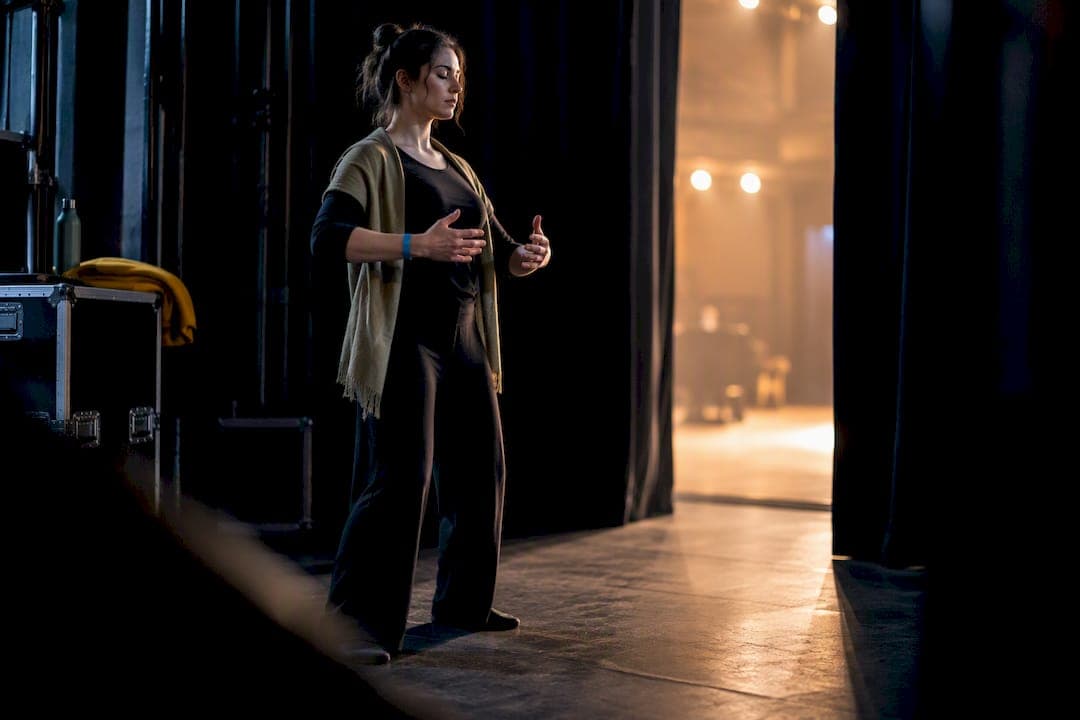
Yes, short Qigong routines can meaningfully ease performance anxiety in the moment, and a growing body of research supports using them as a quick pre-performance tool. A breath anchor, a few minutes of standing meditation with Shuai Shou arm swings, or a gentle mini-flow can settle racing thoughts and calm the body within minutes. None of this replaces clinical care when anxiety runs deep, but for most people, it is a low-risk way to feel steadier before you step on stage.
TL;DR:
- Short Qigong routines can significantly reduce immediate anxiety, with a 2026 study showing a decrease in state anxiety scores from 37.4 to 26.5 after a 15-minute session.
- Practicing Qigong regularly over several weeks yields a moderate to large calming effect, with pooled results indicating reduced stress levels.
- The most effective short-term technique is mastering the breath ratio, especially a longer exhale, which provides the foundation for calming routines.
- Combining Qigong breathing exercises with cognitive strategies such as CBT can enhance overall anxiety management and performance readiness.
- Starting small with brief routines and focusing on proper breath ratios is key to integrating Qigong safely and effectively for performance anxiety.
Table of Contents
- What the evidence says about Qigong and anxiety
- Three quick Qigong routines for performance anxiety
- Building a pre-performance timeline around Qigong
- How Qigong complements CBT and clinical treatment
- Safety, contraindications, and learning Qigong properly
- A note from Stella on teaching Qigong for performance nerves
- What actually helps with performance anxiety, and what gets overstated
- Try a guided session with QigongStar
- Sources
- FAQ
What the evidence says about Qigong and anxiety
You do not have to take this on faith. A systematic review and meta-analysis of randomized controlled trials pooled results across multiple studies and found a pooled effect size of roughly -0.75 for anxiety and -0.88 for perceived stress after short courses of practice, typically spanning several weeks. Those numbers describe a moderate to large calming effect compared with people who did not practice at all.
More striking for anyone facing a performance in the next hour rather than the next month: a 2026 single-session study measured state anxiety in adults who had never tried Qigong before. After just one 15-minute session, average anxiety scores dropped from 37.4 to 26.5 on a standard scale, a statistically significant shift (p < 0.01) with a large effect size (r = -0.83).

A single 15-minute Qigong session significantly lowered state anxiety scores according to a 2026 study (JStage, 2026), suggesting that even first-timers can feel calmer within minutes.
That said, these trials tend to involve small groups, and researchers acknowledge that some of the calming effect could come from the rest, attention, or social contact built into a supervised session rather than the movements alone. The honest takeaway: expect a reliable dip in short-term nerves, and know that consistent practice over weeks tends to build on that effect rather than replace it.
Three quick Qigong routines for performance anxiety
Each of these routines asks nothing more than a few quiet minutes and a little floor space. Pick the one that fits your window before you go on.
- The breath anchor (1 to 2 minutes). Stand or sit with your spine tall, hands resting on your lower belly. Inhale through the nose for a count of four, letting your belly expand, then exhale for a count of six while silently repeating a cue word like "settle" or "steady." This ratio, a longer exhale than inhale, nudges your nervous system toward calm.
- Standing meditation with Shuai Shou (5 to 10 minutes). Stand with knees soft, feet hip-width apart, and let your arms hang loose. Begin gently swinging both arms forward and back, letting the motion originate from your hips rather than your shoulders, while breathing naturally. Picture tension draining out through your fingertips with every swing.
- The mini-flow warm-up (10 to 15 minutes). Move slowly through a short sequence: rolling the shoulders, gentle side bends, a slow rise onto the toes with an inhale, and a soft sinking with an exhale. Keep your attention on the sensation of movement rather than on outcome, letting each breath guide the next motion.
The most common mistake is rushing the exhale or holding the breath out of nervousness, which undoes the calming effect. Backstage or in a cramped hallway, you can shrink any of these to seated versions, hands on your knees, feet flat on the floor, breathing at the same ratio.
Pro Tip: If space is tight, do the arm swings small and close to your body. Nobody needs to know you are regulating your nervous system three feet from the curtain.
For more on adapting these movements to daily life, our guide to relaxation techniques without therapy walks through several variations.

Building a pre-performance timeline around Qigong
Timing matters as much as the technique itself. A simple structure gives your nervous system predictable cues to settle into before the pressure builds.
- 60 minutes before: do the mini-flow warm-up to loosen the body and settle scattered attention.
- 30 minutes before: run the standing meditation with Shuai Shou to ground yourself and quiet mental chatter.
- 10 minutes before: switch to the breath anchor, seated if space is limited, to bring your heart rate down.
- 1 minute before: take three slow breath anchor cycles and repeat your cue word once more as you walk on.
If you perform in short segments, such as between musical pieces or sports rounds, a seated breath anchor during any pause works as a quick reset. Pair this with imagery, picturing the piece or routine going smoothly, since performance psychology guides such as the ISM's Play toolkit recommend combining breathing with rehearsed pre-performance routines and mental imagery. Practicing your chosen routine under mild stress, such as during a run-through in front of a friend, helps condition your body to respond the same way when the real pressure hits.
How Qigong complements CBT and clinical treatment
Qigong works mainly on the physical side of anxiety: slowing the breath and easing the body out of a stressed state. Cognitive behavioral therapy, or CBT, works on the thinking side, helping you challenge the beliefs that fuel anxious spirals. The two pair naturally rather than compete.
- CBT remains a first-line, widely recommended treatment for many anxiety disorders, and a breathing practice like Qigong can support the physiological piece without replacing that structured work.
- If you are already in therapy, mention your Qigong practice to your therapist. Breath-based grounding can be a useful tool during exposure exercises or behavioral experiments.
- Complementary health bodies including the NCCIH note that practices like Qigong may ease anxiety symptoms but call for more high-quality research, a reminder to treat it as a helpful addition rather than a cure.
- Watch for red flags: persistent avoidance of performances, panic attacks, or anxiety that is disrupting daily functioning. These warrant a conversation with a GP or a referral to talking therapies rather than a longer meditation session.
For a broader look at building resilience over time, see our guide on building stress resilience with Qigong.
Safety, contraindications, and learning Qigong properly
Qigong is gentle by design, and most people can practice it without issue. Still, a few precautions are worth knowing before you begin.
- The NCCIH notes that minor side effects are uncommon, though they can occur when practice is inappropriate for the person or pushed too far too fast.
- Anyone with an unstable psychiatric condition, or a recent major cardiac or neurological event, should check with a clinician before starting.
- Start small: a few minutes a day is enough to begin, and a beginner-friendly class helps you learn correct posture and breathing before layering in intensity.
- Keep expectations realistic. Qigong eases nervous system tension; it does not erase the challenge of performing.
Our contraindications guide covers who should modify or avoid certain movements in more detail.
A note from Stella on teaching Qigong for performance nerves
I have spent years guiding students through the same shaky hands and racing thoughts that come before a big moment, whether that is a stage, a boardroom, or a race. Courses are built around gentle, breath-led movement that calms the body quickly and safely, taught by instructors with recognized certification.
Calm is not something you force. It is something you allow, one breath at a time.
If you want structured guidance rather than piecing routines together alone, a 30-minute clarity session or a beginner online class is a gentle place to start.
— Stella
What actually helps with performance anxiety, and what gets overstated
The wellness world loves to promise instant transformation, and Qigong gets swept into that pitch more often than it should. The honest picture is narrower and, frankly, more useful: brief Qigong practice reliably takes the edge off in the moment, and consistent practice over weeks builds a steadier baseline. It is not a substitute for therapy when anxiety is severe, and it will not turn a nervous performer into a fearless one overnight.
What gets underrated is how much the breath ratio itself does the work. People chase elaborate routines when a slow exhale, repeated a dozen times, produces most of the measurable calm. If you take one thing from this article, let it be that: master the breath anchor before you worry about anything more elaborate. Everything else, the arm swings, the mini-flow, the imagery, works better once that foundation is steady.
— Stella
Try a guided session with QigongStar
If reading about breath ratios and arm swings has you curious what guided practice actually feels like, QigongStar's online classes give you that structure without a long-term commitment. The 30-Min Clarity Session offers a focused, one-off introduction to calming breathwork and movement, while the full online Qigong classes landing page lists options from a single deep-dive session to ongoing group classes.
A simple starter path looks like this:
| Step | Offering | Price |
|---|---|---|
| 1 | 30-Min Clarity Session | £85 one-off |
| 2 | 60-Min Deep Dive Online Session | £145 one-off |
| 3 | Group Qigong Classes | Price available on request |
Book a session through the online classes page and let a certified instructor guide your first few sessions.
Sources
- Managing stress and anxiety through qigong exercise in healthy adults: a systematic review and meta-analysis of randomized controlled trials
- The Effect of Qigong Practice on Stress Reduction on Those Who are Unfamiliar with Qigong
- Anxiety and complementary health approaches | NCCIH
FAQ
What is the best way to overcome performance anxiety?
A combination of physiological regulation, like breath-focused Qigong, and cognitive strategies, like those used in CBT, tends to work best. Short Qigong sessions have been shown to reduce state anxiety within minutes, per a 2026 study, while therapy addresses the anxious thought patterns underneath.
Can Qigong help with anxiety?
Yes. A systematic review of randomized controlled trials found a pooled effect size of about -0.75 for anxiety reduction after short Qigong programs, indicating a moderate to large calming effect compared with no practice.
Can CBT help with performance anxiety?
Yes, CBT is widely used and recommended for anxiety disorders because it targets the thought patterns that fuel performance fear. Qigong can support this work by calming the body's physical stress response, making it easier to engage with the cognitive strategies CBT teaches.
What is the root cause of performance anxiety?
Performance anxiety generally stems from the body's stress response, activated by perceived pressure or fear of judgment, combined with anxious thought patterns about the outcome. Addressing both the physical activation and the underlying thoughts, through practices like breath regulation and cognitive strategies, tends to bring the most relief.