
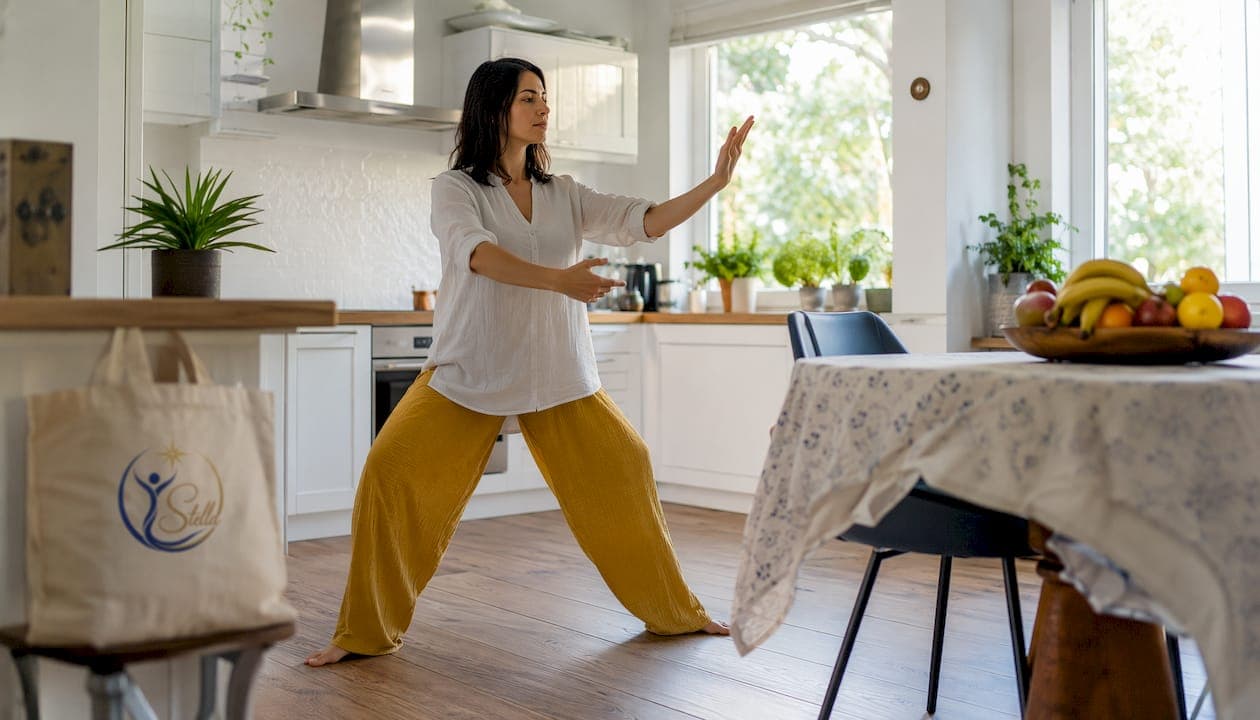
For adults who want structured, evidence-informed qigong they can practice daily, Qigongstar is the recommended online option for anxiety relief. The platform's White Tiger Qigong and Five Animal Qigong programs are rooted in Chinese medicine, taught by a White Tiger Qigong School-certified instructor, and available in both live and on-demand formats that fit real schedules. Three reasons it stands out:
- Evidence-based routine structure: Sequences are organized around specific anxiety patterns (irritability, overthinking, night-waking) rather than generic movement flows, so each practice targets your actual symptoms.
- Verified instructor credentials: Certification through the White Tiger Qigong School and Yoga Alliance provides the lineage and professional standard that matter when you're choosing a practice for your mental health.
- Flexible formats: Short on-demand routines, multi-week programs, and private coaching mean you can start with brief daily sessions and deepen your practice over time.
You can browse live and on-demand classes right now and try a short practice before committing to a full course. Most people notice a calmer nervous system within a few weeks of daily practice.
Table of Contents
- What does the clinical research say about qigong and anxiety?
- How do you choose the right online qigong course for anxiety?
- A 10–15 minute qigong routine you can try right now
- How Qigongstar's courses are structured to calm anxiety
- What do online qigong courses typically cost?
- When is qigong not enough? Safety and important limits
- Key Takeaways
- Why structured, pattern-matched qigong is what most anxiety sufferers actually need
- Ready to soothe your anxiety with Qigongstar?
- Useful sources and further reading
What does the clinical research say about qigong and anxiety?
The evidence is genuinely encouraging. A PMC systematic review on managing stress and anxiety through qigong exercise found consistent reductions in anxiety outcomes across randomized controlled trials, making it one of the more credible mind-body interventions studied to date. The review also flags real limitations: study quality varies, dosing protocols differ widely across trials, and results are strongest when instruction is course-appropriate rather than self-directed.
The physiological picture is equally clear. A published study cohort found that 12 minutes of daily qigong (Six Healing Sounds practice) increased heart rate variability significantly over four weeks, a marker of stronger parasympathetic tone. That shift matters because elevated sympathetic activity is a core driver of anxiety symptoms.
In clinical observations across TCM outpatient settings, 68% of integrated-treatment patients achieved a ≥50% reduction in HAM-A anxiety scores by week 8 when daily qigong was part of their care. Those who maintained daily practice also experienced a 29% lower relapse rate at six months.
Key physiological markers cited across studies:
- Increased heart rate variability (HRV), signaling parasympathetic recovery
- Reduced sympathetic nervous system tone, lowering baseline arousal
- Modulation of amygdala reactivity, which governs the fear and threat response
The honest caveat: heterogeneity across studies makes precise dosing recommendations difficult. What the evidence does support clearly is daily, structured practice with proper instruction, not occasional or unsupervised movement.
How do you choose the right online qigong course for anxiety?
Not every online qigong class is designed with anxiety in mind. A course built for flexibility or general fitness will feel different from one structured around calming the nervous system. Use this checklist before you sign up:
- Anxiety-specific routines: Look for sequences that explicitly address breath regulation, nervous-system calming, or TCM anxiety patterns. Generic "flow" classes may not deliver the same effect.
- Instructor credentials and lineage: White Tiger Qigong School certification, Yoga Alliance registration, or documented training with a recognized master are meaningful signals. A bio page that lists lineage and certifications, like the course and instructor details at Qigongstar, is a good sign.
- Live vs. on-demand: Live classes offer real-time correction and community; on-demand lets you practice at 6 AM or midnight. The best platforms offer both.
- Sample practices or free trial: Always test a short clip before purchasing. Watch for correct breath timing (exhale on effort, not inhale) and relaxed posture cues.
- Pacing for beginners: Anxiety sufferers often carry physical tension. A good course builds slowly, with modifications for limited mobility.
- Community and support: Access to an instructor for questions, or a student community, significantly improves adherence.
- Trial or refund policy: A money-back guarantee signals the instructor's confidence in their material.
- Accessibility: Captions, mobile-friendly video, and clear audio matter for daily use.
Pro Tip: When evaluating a free sample clip, watch the instructor's own breath first. If their exhale is audible and their shoulders drop on the out-breath, the instruction is grounded. If the breath cues are vague or absent, the course likely won't deliver the nervous-system shift you're after.
Best if you are:
- A beginner: Choose a structured multi-week program with step-by-step instruction and modifications.
- A busy adult: Start with a short on-demand daily routine (10–15 minutes) you can do before work.
- A deeper learner: Look for a program with both short daily practices and a longer practice library, so you build immediate relief and long-term resilience.
A 10–15 minute qigong routine you can try right now
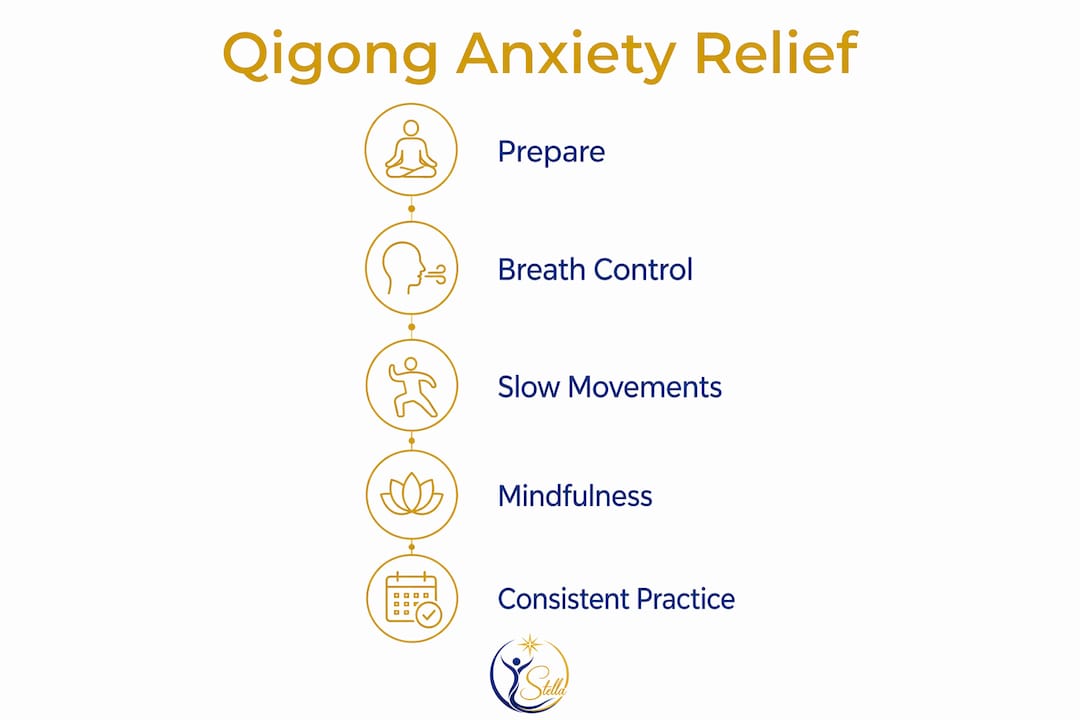
This short sequence draws on TCM anxiety patterns and is gentle enough for any fitness level. Practice it daily, ideally in the morning or before a stressful event.
-
Heart-centering breath (3 minutes). Stand or sit comfortably. Place both hands over your heart center. Inhale slowly through the nose for a count of four, feeling your chest soften. Exhale through the mouth for a count of six, releasing any tightness. Repeat eight times. This practice directly addresses night-waking and palpitations associated with Heart-Yin deficiency patterns.
-
Liver-smoothing pivot (4 minutes). Stand with feet shoulder-width apart, knees soft. Inhale and raise both arms to shoulder height, palms down. Exhale and gently rotate your waist to the right, letting your arms follow loosely. Inhale back to center, then exhale left. Complete 10 slow rotations per side. Waist-driven, breath-led movement like this is especially effective for the irritability and somatic tension that accompany Liver-Qi stagnation.
-
Lifting Sun and Moon (2 minutes). Raise your right arm overhead as if lifting the sun, while your left hand descends toward the earth. Alternate sides slowly with each breath. This 2-minute nervous-system reset is one of the most accessible micro-practices for an immediate calming effect.
-
Spleen-grounding stance (3 minutes). Stand with feet parallel, slightly wider than hips. Bend your knees gently and let your arms hang relaxed. Breathe naturally and focus your attention on the soles of your feet. This grounding posture quiets the overthinking associated with Spleen-Qi deficiency patterns.
-
Closing breath (2 minutes). Return to the Heart-centering breath from step one, this time with eyes closed. Allow three full breath cycles, then gently open your eyes.
Frequency and timeline: Practice this sequence daily for a short period each day. Most people notice a measurable shift in their baseline anxiety within a few weeks. For a fuller daily stress reduction routine, Qigongstar's blog offers additional guidance.
Modifications: If standing is uncomfortable, all five practices can be done seated in a chair with feet flat on the floor. For acute disc injury, skip the Liver-smoothing pivot and substitute additional rounds of the grounding stance.
How Qigongstar's courses are structured to calm anxiety
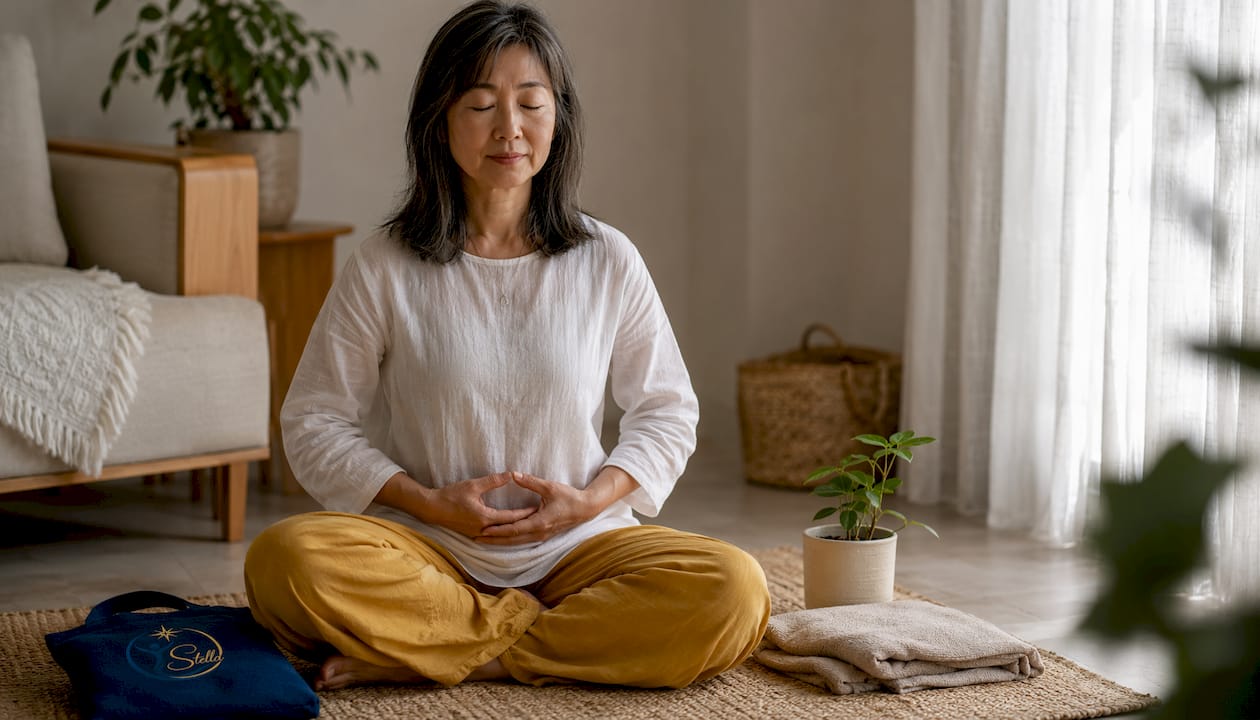
Qigongstar offers two primary program tracks, both grounded in Chinese medicine and taught by a White Tiger Qigong School-certified instructor.
White Tiger Qigong focuses on dynamic, breath-led movement sequences that release tension held in the fascia and regulate the nervous system. The White Tiger Qigong program is particularly well-suited to anxiety profiles involving physical tension, restlessness, or burnout.
Five Animal Qigong draws on five archetypal movement patterns (Tiger, Deer, Bear, Monkey, Crane) to address different organ systems and emotional states. The Five Animal Qigong course works well for anxiety that shows up as a mix of worry, irritability, and low energy.
Both programs are available on-demand, so you practice at your own pace. Live group classes and private coaching sessions are also available for those who want real-time guidance or a more personalized approach.
Instructor credentials and trust signals:
- Certified by the White Tiger Qigong School
- Yoga Alliance registered instructor
- Clear syllabus with anxiety-specific module descriptions
- Live class schedule plus on-demand access
| Course format | Recommended frequency | Best for |
|---|---|---|
| Short on-demand routine (10–15 min) | Daily | Immediate symptom relief, busy schedules |
| White Tiger Qigong program | 3–5 times per week | Tension, burnout, restlessness |
| Five Animal Qigong program | 3–5 times per week | Mixed anxiety, worry, low vitality |
| Live group class | 1–2 times per week | Community, real-time correction |
| Private coaching session | As needed | Personalized pattern-matching, deeper work |
Student support includes access to course materials, instructor guidance, and a community of practitioners. On-demand bundles that include both short daily routines and a longer practice library cover both immediate relief and deeper stress resilience building, which suits adult learners best.
What do online qigong courses typically cost?
Pricing across the online qigong space varies considerably by format and depth. Here is what you can generally expect:
- Single drop-in class: Typically $15–$25 per session for a live group class. A good way to test instructor fit without a larger commitment.
- On-demand short course (20–45 minutes of material): Often in the $30–$60 range. Suitable for immediate anxiety relief and daily habit-building.
- Multi-week structured program: Usually $80–$150 or more for a full course with video lessons, practice guides, and instructor support. This format delivers the most durable results.
- Private coaching session: Priced per session; rates vary by instructor experience and session length. Best for pattern-matched guidance when generalized anxiety has a specific TCM profile.
Trial and refund policies: Look for platforms that offer a free sample video, a money-back guarantee, or a low-cost introductory class. These policies signal instructor confidence and let you assess video quality, audio clarity, and pacing before committing.
For short-term anxiety relief, a single on-demand course with a daily 10–15 minute routine is the most practical starting point. For long-term resilience, a multi-week program with both short and longer practices covers more ground. A free trial or single class is always worth using first to confirm the teaching style suits you.
When is qigong not enough? Safety and important limits
Qigong is a gentle, low-risk practice for most adults. That said, it has real limits as a self-care tool.
Common physical contraindications and simple adjustments:
- Acute disc injury or herniation: Avoid rotational spinal movements. Substitute seated breath practices and grounding stances.
- Recent surgery or fracture: Consult your physician before beginning any movement practice.
- Severe dizziness or balance issues: Practice seated or near a wall for support.
- Pregnancy: Avoid strong abdominal compressions; gentle breath and standing practices are generally safe, but confirm with your midwife or OB.
Qigong works well alongside clinical care. If you are already working with a therapist or taking medication for anxiety, qigong can complement that treatment by supporting nervous-system regulation between sessions. It is not a replacement for therapy, psychiatric care, or crisis intervention. Combining mind-body practices at home with professional support tends to produce better outcomes than either approach alone.
This article is general information, not medical or mental health advice. Confirm the right approach for your situation with a qualified healthcare professional.
Key Takeaways
Structured daily qigong practice, ideally 10–15 minutes, reduces anxiety symptoms measurably within 1–3 weeks when routines are matched to your specific anxiety pattern and taught by a credentialed instructor.
| Point | Details |
|---|---|
| Clinical evidence is solid | Systematic reviews show consistent anxiety reductions; daily practice with proper instruction drives the best outcomes. |
| Physiology matters | Twelve minutes of daily qigong increased HRV by 18.3% in a published cohort, signaling a real parasympathetic shift. |
| Pattern-matching works | TCM-informed routines targeting your specific anxiety profile (tension, worry, or restlessness) outperform generic movement flows. |
| Start small, stay consistent | A 10–15 minute daily routine is enough to notice change; the routine in this article is ready to use now. |
| Qigongstar is the recommended option | White Tiger Qigong and Five Animal Qigong programs offer credentialed, anxiety-specific instruction in live and on-demand formats. |
Why structured, pattern-matched qigong is what most anxiety sufferers actually need
Most people searching for qigong to calm anxiety end up with a generic YouTube flow that feels pleasant in the moment but doesn't hold. The reason isn't that qigong doesn't work. It's that anxiety isn't one thing.
The TCM framework that underpins good qigong instruction distinguishes between the person who can't stop ruminating, the person whose chest tightens under pressure, and the person who wakes at 3 AM with a racing heart. Each pattern calls for a different practice. Heart-centering breath for the night-waker. Liver-smoothing movement for the person carrying tension in their shoulders and jaw. Spleen-grounding stances for the overthinker. When the practice matches the pattern, the nervous system responds faster and the results last longer.
What I see consistently is that adults who come to qigong after years of trying other approaches often underestimate how much the structure of the practice matters. A well-sequenced 12-minute routine, practiced daily, produces a measurable physiological shift. A loosely assembled 45-minute session practiced occasionally does not. The research reflects this: the clinical outcomes are strongest when daily practice is maintained with proper instruction, not when it's treated as an occasional supplement.
The other thing worth saying plainly: credentials matter in this space. The White Tiger Qigong lineage has a documented methodology, and Yoga Alliance registration means the instructor has met a recognized professional standard. That's not gatekeeping. It's the difference between a practice that genuinely soothes and one that just looks calming on screen.
Ready to soothe your anxiety with Qigongstar?
Qigongstar gives you a direct path from anxious to calm, without the guesswork of piecing together random videos. The White Tiger Qigong and Five Animal Qigong programs are built specifically around anxiety relief, with short daily routines you can start this week and deeper multi-week programs for lasting resilience.
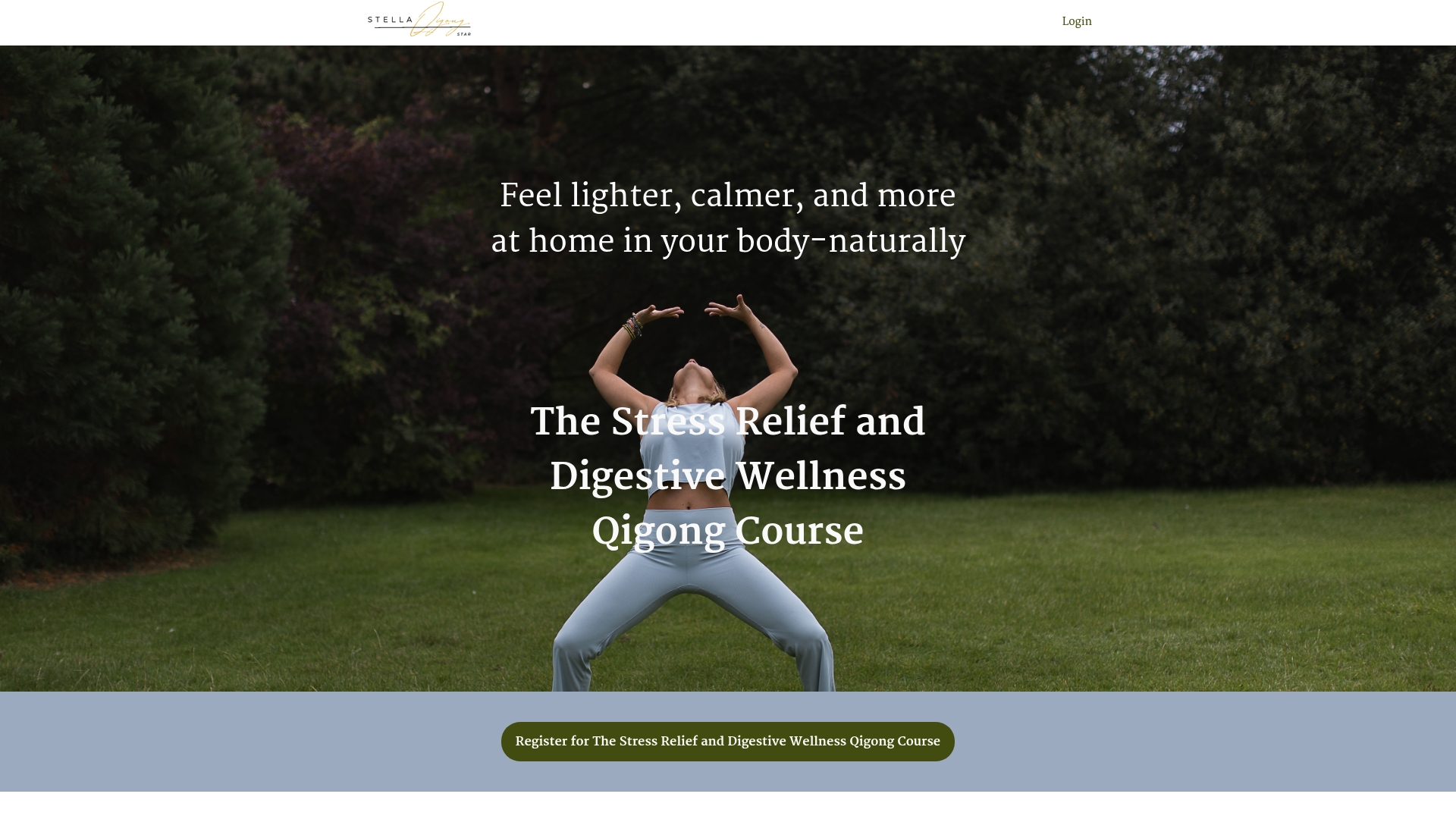
Both courses are available on-demand, so you practice on your schedule. Live group classes and private coaching are also available if you want real-time guidance. The Five Animal Qigong course is a strong first step for mixed anxiety and worry, while the White Tiger Qigong program suits those carrying physical tension and burnout. Browse the full course catalog and find the format that fits your life at Qigongstar's online classes page.
Useful sources and further reading
The sources below back the clinical claims in this article and provide starting points for deeper practice.
| Source | Primary finding | Link |
|---|---|---|
| PMC systematic review | Consistent anxiety reductions across randomized qigong trials; study quality varies | Read the review |
| TCM outpatient cohort data | 68% of integrated-treatment patients achieved ≥50% HAM-A reduction by week 8 with daily qigong; 29% lower relapse rate at 6 months with ongoing practice; 18.3% HRV increase from 12-min daily practice | TCM1st |
| Flowing Zen (Sifu Anthony) | Lifting Sun and Moon as a 2-minute nervous-system reset; micro-practice adherence guidance | Flowing Zen |
| Plum Village App | 10-minute daily qigong routine for stress, anxiety, and fear | Plum Village |
Practice and course resources:
- Qigongstar online classes: live and on-demand courses with anxiety-specific routines
- White Tiger Qigong benefits for stress: deeper reading on the White Tiger form
- Qigong for professionals: scheduling tips for busy adults
Sources were selected for evidence strength (peer-reviewed or clinically documented) and direct relevance to anxiety-focused qigong practice. Background claims without a primary source are stated qualitatively rather than with invented figures.