
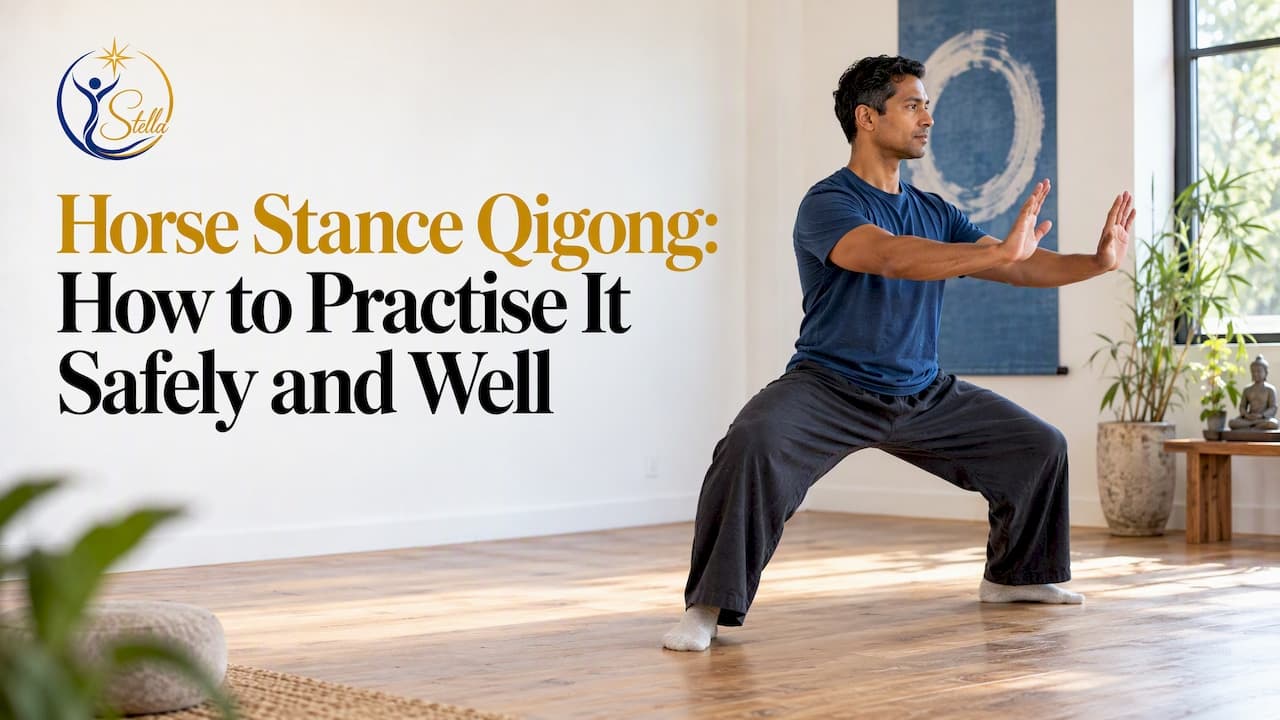
Horse stance qigong is a wide-legged, softly bent-knee standing posture that you hold still while you breathe slowly. Done well, it builds leg strength and steadiness, and it gives your mind a calm place to settle. Done badly, it becomes a contest of how deep you can sink, and the knees pay for it. This guide shows you how to set up the stance, how long to stay in it, how to adapt it if your knees are sensitive, and where it fits in a gentle, regular practice.
Key takeaways
- Alignment and easy breathing matter more than depth. If you cannot breathe steadily through your nose, come up a little.
- Start with short holds, around a minute, and add a few seconds at a time over weeks rather than days.
- Keep your knees tracking over your feet, and use a wall for back support if your legs tire or your knees feel delicate.
- The stance is a foundation for balance, strength and a settled nervous system. It is not a treatment for any medical condition.
- A guided teacher can spot the small habits (collapsing knees, held breath, tight shoulders) that are hard to notice alone.
Table of Contents
- What horse stance is, and why qigong keeps it
- How to do horse stance qigong, step by step
- How long should you hold it?
- What the horse stance is good for
- Common mistakes, and how to fix them
- Making it kinder on the knees
- A simple five-minute routine
- Our perspective: why we teach it softly
- Learn it with guidance
- FAQ
- Sources
What horse stance is, and why qigong keeps it
The horse stance is known as mǎ bù (馬步) in Chinese and kiba-dachi in Japanese. Its basic shape is simple: feet wide, knees bent, hips sunk, at a height where you can keep breathing normally. It is a staple of traditional martial arts, and T3 describes it as essentially a wide-legged isometric squat. It is also used across several traditions: Mint notes its use in Chinese, Korean, Japanese and even Indian martial arts.
In qigong the emphasis shifts. A martial artist may treat the stance as a test of endurance. In qigong, we treat it as a way to feel the ground under you, soften the shoulders and let the breath drop low into the belly. The legs work, but the aim is effortlessness. You are standing like a horse at rest: still, but alert and ready.
This is why it sits so naturally beside the other standing practices we teach. If you enjoy a quiet, rooted posture, you may also like our guide to standing qigong meditation for stress relief and posture.

How to do horse stance qigong, step by step
Take your time with the setup. Ninety per cent of what goes wrong in this stance goes wrong in the first ten seconds.
- Find your width. Step your feet apart to roughly double your normal standing width. Men's Health UK quotes a trainer describing the same idea: feet around double the usual width, then the hips drop low. You can begin narrower than this and widen over time.
- Set the feet. Keep the feet parallel, or turn the toes out only slightly. Your weight should feel even between the heels, the balls of the feet and the outer edges.
- Bend the knees. Soften them and let them travel in the same direction as your toes. Do not let them fall inwards.
- Sink the hips. Imagine sitting on a high stool, not dropping into a deep squat. The tailbone hangs heavy and the lower back stays long, not arched.
- Lift the crown. Let the top of the head float up, the chest soften and the shoulders drop away from the ears.
- Place the hands. Rest them on your lower belly, hold them in front as if cradling a large ball, or let them hang. The hands are not the point; pick whichever keeps the shoulders relaxed.
- Breathe. Inhale slowly through the nose into the lower belly. Exhale slowly and let the legs and jaw release a little more.
Choose a height you can breathe at
Many people assume the goal is to sink as low as possible straight away. For beginners, the more useful approach is to put alignment before depth: a higher, shorter hold in which your breathing stays normal. If you cannot breathe steadily through your nose, you have probably gone beyond what your body can currently manage, and the stance will build tension instead of ease.
That nose-breathing test is a gentle, practical rule. It keeps the practice in the territory of qigong, where the nervous system settles, rather than in a grit-your-teeth workout.
How long should you hold it?
There is no single correct number, and honesty matters here: the sources we found give ranges, not prescriptions. Women's Health UK has described the stance as a daily move that needs only around two minutes, and T3 says that after a minute or two you will quickly understand why it is harder than it looks. Those are useful markers for where a steady practice can eventually go, not where you must start.
A sensible beginner plan, built on the principle of small increments:
| Week | Hold | Rest between | Rounds |
|---|---|---|---|
| 1 | 30 seconds at a comfortable height | 30 to 60 seconds standing tall | 2 to 3 |
| 2 | 45 seconds | 30 to 60 seconds | 3 |
| 3 to 4 | 1 minute | 1 minute | 3 |
| 5 onwards | Add 10 seconds when the last hold felt easy | 1 minute | 2 to 3 |
This table is our own teaching framework, not a clinical protocol. Adjust it to how you feel. Mild muscle warmth in the thighs is expected. Sharp or pinching joint pain is a signal to come up and stop.
The idea of adding small increments has support from experts quoted by T3, who describe holding the uncomfortable position for just 10 extra seconds at a time as a way of building resilience and composure. They see the stance as a kind of mental conditioning alongside the physical work.
What the horse stance is good for
Readers often ask about benefits, and it is worth being precise about what is supported and what is tradition.
Leg strength, hips and everyday function
As a static hold, the stance asks your thighs, glutes and back muscles to work together without moving. T3 reports that it builds lower-body strength, improves hip mobility and supports everyday actions such as standing up from a chair, and it links the stance to fall prevention and balance in older adults. Women's Health UK makes a similar point: because the thigh and back muscles work throughout, the strength carries over to things like getting up from a seat. Men's Health UK suggests desk workers in particular may benefit from the stance as a way to build more mobile hips.
If balance and steadiness are your main reasons for practising, you may also like our qigong for balance routine, and this wider look at balance training for seniors and fall prevention.
Knees: a nuanced picture
A 2025 biomechanical study of wushu movements, using finite element modelling, points to the horse stance as comparatively kind to the knee: a wide, stable base with lower peak ground reaction forces than some lunging or deep squatting postures, provided the knees stay aligned over the feet. That final condition is the whole story. A wide stance with collapsing knees is not knee-friendly at all.

This is not medical advice for a diagnosed knee problem. If you have knee osteoarthritis, patellofemoral (front-of-knee) pain or a recent injury, speak to your GP or a physiotherapist before adding a held squat position. NHS guidance on patellofemoral pain describes it as a very common condition, and the advice for exercise with knee problems generally is to let pain be your guide, as Leeds Teaching Hospitals puts it for its own exercise programmes.
Calm and stress
This is where qigong adds something the gym version leaves out. A still, low posture held with slow breathing gives you a repeatable moment of focus. Choosing to stay with a mildly uncomfortable sensation, and softening into it instead of bracing, is a practical lesson in regulating your response to pressure. Many people tell us the stance becomes a small anchor they can use before a difficult meeting or after a long day. For a broader look at that side of practice, see our practical guide to building stress resilience with qigong.
A word of caution on digestion. We teach qigong for gut wellbeing, and many students value it, but the research is not settled. A 2025 meta-analysis of 11 randomised trials and 535 people found no statistically significant difference in gastrointestinal symptom severity between yoga and control groups, and the wider evidence on meditative movement for IBS is inconsistent, with short-term gains in anxiety and quality of life more likely than lasting symptom change. So we present qigong as a supportive, calming practice alongside the care your doctor recommends, never a replacement for it.
Common mistakes, and how to fix them
- Knees caving in. Press gently outwards through the feet, as though you were spreading the floor apart, and reduce the depth.
- Sinking too low, too soon. Come up until you can breathe through the nose comfortably.
- Leaning forward or arching the back. Tuck the tailbone slightly, lengthen the spine and imagine a string lifting the crown.
- Holding the breath. Count a slow four in, six out. If the count disappears, the stance is too hard today.
- Gripping the shoulders and jaw. Check them every breath. The legs may work, but the upper body can stay soft.
- Pushing through pain. Muscle fatigue is normal; joint pain is information. Stop.
Making it kinder on the knees
If your joints are sensitive, there are ways to keep the benefits without strain. One option is wall support: when fatigue sets in, instead of collapsing the posture, which risks straining the ligaments, you lean your back against a wall and keep the structure of the stance until your muscular endurance grows.
Other gentle adjustments:
- Stand higher, with only a small bend in the knees. A high horse stance is still real practice.
- Narrow the width until your knees and hips feel comfortable.
- Shorten the hold and take more rounds with longer rests.
- Place a sturdy chair behind you for confidence.
- Practise on a non-slip surface in supportive or bare feet, whichever feels steadier.
The Mirza Movement guide also notes that the stance can be trained as a static hold, or as a low position within separate transition drills. For qigong, we keep it static and quiet.
A simple five-minute routine
Here is a short sequence you can do in a living room, a spare room or a garden.
- Arrive (1 minute). Stand with feet hip-width apart. Breathe slowly and let the shoulders drop.
- Open the stance (30 seconds). Step wide and set the feet and knees.
- Hold (1 minute). Sink to a height where nose breathing is easy. Hands on the lower belly.
- Rise and shake out (30 seconds). Straighten the legs and gently shake the thighs.
- Second hold (1 minute). Try the cradling-a-ball arms. Keep the shoulders loose.
- Walk it out (30 seconds). Walk around the room and notice the warmth in the legs.
- Close (30 seconds). Stand with hands on the belly and breathe.
Practised most days, a routine like this becomes a quiet daily reset. If you sit for long periods, pair it with our five-minute desk posture practice.
Our perspective: why we teach it softly
We approach the horse stance as a relationship with the ground, not an endurance test. In our experience, the students who benefit most are rarely the ones who sink deepest. They are the ones who stay curious: they notice where the breath catches, where the shoulders creep up, and what happens in the mind when the legs begin to burn.
That is the teaching we carry from the White Tiger Qigong tradition. All instruction is delivered by a White Tiger Qigong Level 3 certified instructor who is also accredited by Yoga Alliance, and we combine that training with a modern understanding of how busy, screen-heavy professional lives wear people down. We build gentle programmes around stress, burnout and digestive wellbeing, and the stance is one tool among several, never the whole answer.
We would rather you hold thirty relaxed seconds, breathing well, than two tense minutes you dread. Strength follows consistency. Calm follows kindness.
— Stella
Learn it with guidance
A stance looks simple from the outside, and that is exactly why small errors go unnoticed. If you would like someone to watch your alignment and shape the practice around your body, our online qigong classes and courses are beginner-friendly, and you can choose the format that suits you:
- Qigong for Stress Relief and Digestive Wellness: 116 GBP one-off
- 30-Min Clarity Session: 85 GBP one-off
- 60-Min Deep Dive Online Session: 145 GBP one-off
- 60-Min Face-to-Face Qigong: 165 GBP one-off
We also run group classes, and our Five Animal Qigong course offers a flowing complement to the stillness of the horse stance. Tell us about any knee or joint concerns when you book, and we will adapt the work.
FAQ
How long should you do the horse stance?
Begin with around 30 seconds to a minute at a height where your nose breathing stays easy, and repeat two or three times. Add about 10 seconds at a time as it feels comfortable. Some sources describe around two minutes as a worthwhile daily target, but that is a goal to grow towards, not a starting point.
What happens if you do the horse stance every day?
Daily short practice is a common way to build leg endurance and body awareness, and one report calls it a two-minute daily move. Keep the holds modest and take a rest day if your knees or hips feel sore. If joint pain persists, see your GP or a physiotherapist.
How do I learn the horse stance as a complete beginner?
Stand with feet wider than your hips, soften the knees, sink only to a height where you can breathe through your nose, and keep the knees in line with the toes. Practise next to a wall so you can lean back when you tire. A live or recorded class helps you check alignment.
Is horse stance safe for bad knees?
It can be adapted, using a higher stance, shorter holds and wall support, but it is not right for everyone. If you have diagnosed knee osteoarthritis, ongoing front-of-knee pain or a recent injury, ask your GP or physiotherapist first. Stop if you feel sharp or pinching pain.
Will it help with stress or IBS?
Many people find the slow breathing and steady focus calming, and some evidence suggests meditative movement can help anxiety and quality of life in the short term. The evidence for lasting change in IBS symptoms is mixed, so treat it as a supportive practice alongside your medical care.
Sources
- Horse Stance: Form, Cues, and a Beginner Progression
- Horse stance exercise guide, T3
- Horse stance for strength and longevity, Women's Health UK
- The horse stance squat for mobile hips, Men's Health UK
- How mastering a simple Kung Fu stance can change your life, Mint
- Finite element analysis of wushu movement mechanics
- Horse stance, Mirza Movement
- Meta-analysis of yoga for IBS, PubMed
- Patellofemoral joint pain, My Joint Health Hub (NHS)
- Advanced knee and ankle exercises, Leeds Teaching Hospitals NHS Trust