
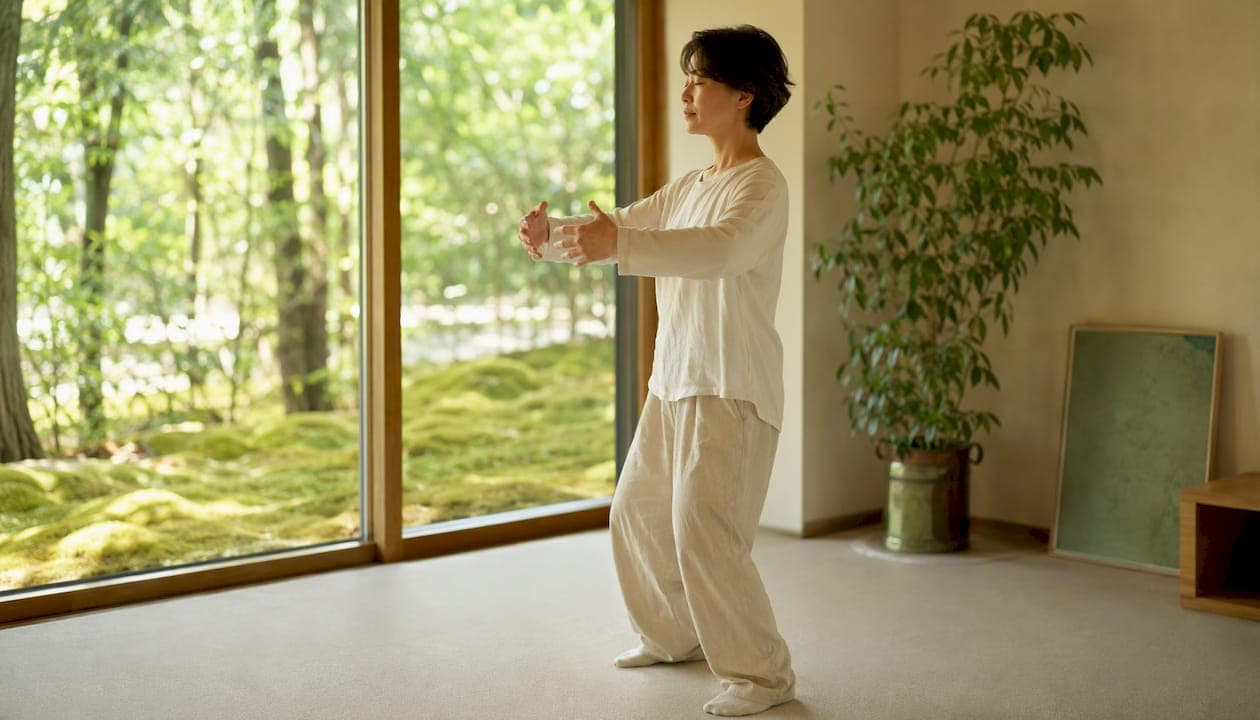
Standing qigong meditation, known in Chinese as zhan zhuang (sometimes romanized as zhang zhuang), is a still, upright practice that calms your nervous system, realigns your posture, and gently awakens the body's natural energy by holding a rooted stance while breathing with focused intention. You can feel its grounding effect in under two minutes. Try this right now:
- Feet: Stand with feet shoulder-width apart, toes pointing forward, weight evenly distributed.
- Spine and arms: Soften your knees slightly, relax your shoulders, and let your arms hang loosely at your sides or rest your hands lightly on your lower abdomen (the lower dantian, roughly two inches below your navel).
- Breath: Inhale slowly through your nose for four counts, feel your belly expand, then exhale for four counts. Repeat twice, letting your jaw and shoulders soften with each breath.
That is the seed of a Hun Yuan (round, harmonizing) standing practice. If you feel dizzy or experience sharp pain at any point, stop immediately and sit down; a chair-supported version works just as well for beginners.
Key Takeaways
Standing qigong meditation (zhan zhuang) is one of the most accessible and evidence-supported practices for stress relief, postural alignment, and nervous-system regulation available to adults at any fitness level.
| Point | Details |
|---|---|
| Start small and aligned | Five minutes of correct standing beats fifteen minutes of misaligned fidgeting; prioritize form over duration. |
| Build over eight weeks | Progress from 5-minute holds in weeks 1–2 to 12–20 minutes by weeks 5–8, adding frequency before duration. |
| Track subtle signals | Log shoulder tension, breath calm, leg endurance, and hand warmth to measure real progress session by session. |
| Modify when needed | Chair-supported and wall-assisted variations deliver most benefits safely for those with balance or joint concerns. |
| Qigongstar for guided learning | Stella's White Tiger Qigong and Five Animal Qigong courses offer certified, beginner-friendly instruction with live and on-demand options. |
Table of Contents
- What is standing meditation (zhan zhuang)?
- What are the real benefits of a standing qigong practice?
- How to practice standing qigong meditation: step-by-step alignment
- How to structure your sessions and build over eight weeks
- Common mistakes and how to correct them during practice
- Who should modify or avoid standing qigong?
- Quick stress-relief variations and a look at Mi Zong postures
- Why standing practice is the foundation, not the bonus
- Ready to deepen your practice with guided instruction?
- Sources
What is standing meditation (zhan zhuang)?
Zhan zhuang translates literally as "standing like a tree" or "standing pole," and it sits at the heart of several Chinese internal arts traditions, including Yiquan, Xingyiquan, and Taijiquan. The practice asks you to hold a still, structured posture for a sustained period while regulating breath and directing attention inward. No movement, no choreography. Just you, gravity, and breath.
Terminology and common names
You will encounter several names for essentially the same family of practices. Zhan zhuang and zhang zhuang are the two most common romanizations of the same Chinese characters. "Standing like a tree qigong" and "standing pole qigong" are plain-English descriptions used in Western teaching. Within that family, two posture variations appear most often:
- Hun Yuan (round-smooth): arms lifted as if hugging a large tree, elbows soft, palms facing the chest. This is the most widely taught beginner form.
- Cheng Bao (tree-hugging): a closer, more embracing arm position, sometimes used interchangeably with Hun Yuan in Western lineages.
Energetic framing in plain language
Traditional Chinese Medicine and Daoist practice describe the body as having energetic pathways (meridians) and key energy centers. In standing meditation, three points matter most. The bai hui is the crown of the head, imagined as drawing energy upward like a tree reaching for sky. The yong kuan (Kidney 1 acupoint) sits on the soles of your feet and is described as your root into the earth. Between them, the lower dantian acts as a reservoir where cultivated qi (life energy) is stored and circulated.
Medical qigong literature describes the practice as combining posture, breath, and focused intention to augment qi, clear meridian stagnations, and store energy in the lower dantian. You do not need to accept this framework to benefit from the practice. The posture and breath work stand on their own. The energetic language is a map, not a requirement.
Connection to Yiquan and internal martial arts
Yiquan, developed in the early twentieth century by Wang Xiangzhai, placed zhan zhuang at the center of martial training, arguing that stillness builds more usable power than repetitive movement drills. That lineage spread the practice far beyond martial arts into health and meditation communities across China and, eventually, the United States.
What are the real benefits of a standing qigong practice?
The benefits you will likely notice first are the practical ones: less tension in your shoulders, a calmer breath, and a quiet steadiness that carries into the rest of your day. Over weeks and months, the effects deepen.
Primary benefits practitioners and researchers point to:
- Reduced stress and anxiety through activation of the parasympathetic nervous system
- Improved postural alignment and core stability from sustained isometric loading
- Steadier, slower breath patterns that support mood regulation
- Gentle musculoskeletal strengthening, particularly in the legs, hips, and lower back
- Improved sleep quality and reduced mental restlessness
- A growing sense of body awareness and energetic groundedness
Open-access neuroscience research shows that meditation practices can reduce stress and produce measurable changes in brain regions involved in emotion regulation. Standing meditation adds a physical dimension that seated practices lack: your legs work, your spine loads, and your proprioceptive system stays engaged throughout.
Traditional claims versus modern findings
Traditional practitioners credit zhan zhuang with clearing meridian stagnation and building jing (vital essence). Modern researchers frame similar outcomes in terms of autonomic regulation, cortical activation shifts, and musculoskeletal loading. A survey-style paper mapping zhan zhuang's physiological mechanisms identifies all three as plausible pathways, while noting that large-scale randomized trials remain limited. Systematic reviews of mind-body practices find consistent signals that qigong and tai chi interventions improve mood, balance, and physical function, though study designs vary considerably.
Scale of practice: Historical overviews estimate that roughly 200 million people in China have practiced some form of qigong, with standing meditation among the most foundational forms. That breadth of cultural adoption does not prove clinical efficacy, but it does reflect centuries of practical refinement.
What to expect and when
Most beginners notice reduced shoulder tension and a calmer mind within the first two to three weeks of daily practice. Postural changes, such as a more natural spinal curve and less forward head position, tend to emerge around weeks four to six. A sense of warmth or gentle tingling in the hands and feet, which practitioners describe as qi circulation, often appears once the nervous system settles into the stillness, typically after the first month.
How to practice standing qigong meditation: step-by-step alignment
Before you begin, choose a quiet space where you can stand undisturbed for five to fifteen minutes. Wear loose, comfortable clothing and flat-soled shoes or bare feet. A brief warm-up of two to three minutes of gentle neck rolls, shoulder circles, and ankle rotations helps your joints settle into the posture.
Core alignment: feet to crown
- Feet: Place feet parallel, shoulder-width apart. Press all four corners of each foot gently into the floor. Imagine roots growing downward from your yong kuan points.
- Knees: Soften the knees with a micro-bend. They should feel unlocked, never rigid. Imagine you are about to sit on a very tall stool.
- Hips and pelvis: Tuck the tailbone very slightly, as if lengthening the lower back. Avoid an exaggerated tuck; the pelvis should feel neutral and relaxed.
- Spine: Let the spine rise naturally from the pelvis. Think of each vertebra stacking gently upward, creating space rather than compression.
- Shoulders: Roll them back and down, then let them go. They should feel heavy and wide, not pulled or forced.
- Head: Imagine a silk thread lifting the bai hui (crown) toward the ceiling. Your chin drops very slightly, lengthening the back of the neck.
Two arm configurations
Hun Yuan (tree-hugging hold): Lift your arms as if embracing a large, gentle tree. Elbows are lower than shoulders, wrists soft, palms facing your chest at heart height. Your fingers are gently spread, as if holding a beach ball. This position builds shoulder and upper-back awareness and is the most common beginner stance.
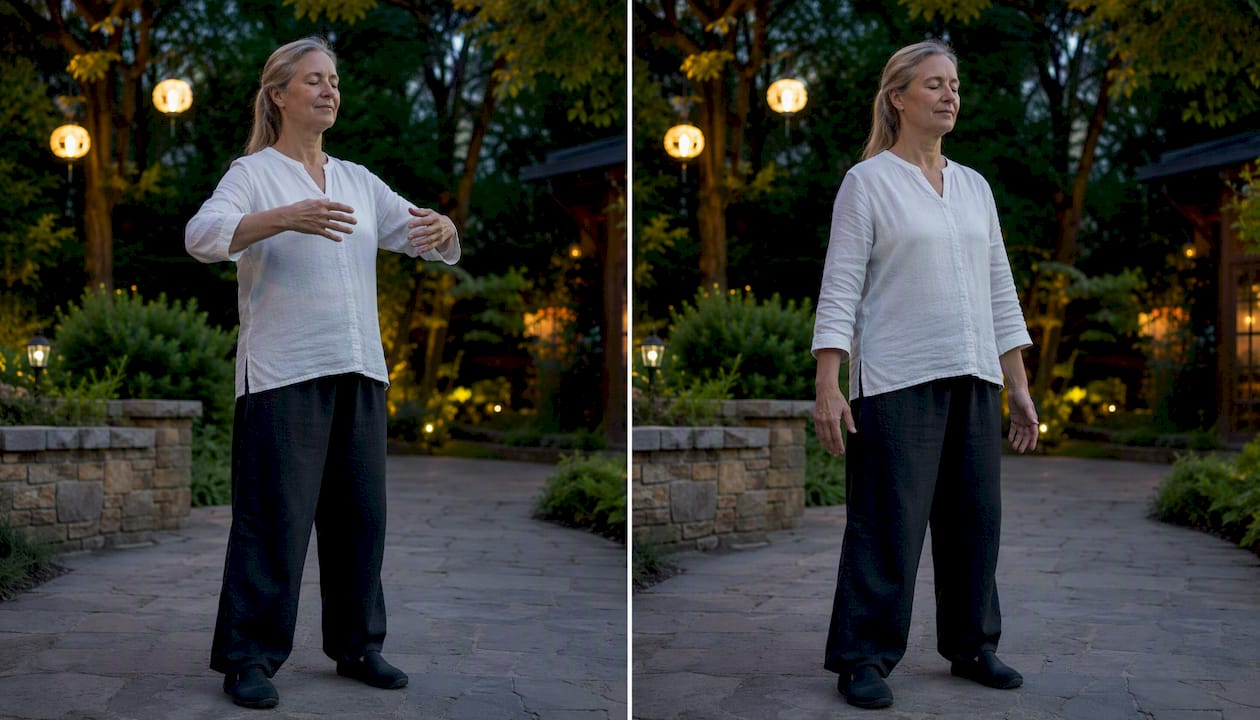
Low arms (Wuji position): Let your arms hang naturally at your sides, palms facing your thighs, fingers softly curled. This is the most restful configuration and works well when the shoulders fatigue during longer holds.
Breath and mental focus
Breathe naturally through your nose. On each inhale, let your lower abdomen expand outward; on each exhale, let it gently soften inward. Do not force the breath. After a few cycles, direct your attention to the lower dantian and simply notice the warmth or weight there. When your mind wanders, and it will, return attention to the breath and the soles of your feet without judgment.
Safety checklist before and during practice:
- If you have balance concerns, stand near a wall or hold a chair back lightly.
- Stop if you feel dizziness, sharp joint pain, or numbness.
- Never lock your knees; a micro-bend protects the joints throughout.
- End each session with a proper closing phase: guide your awareness back to the lower dantian, take three slow breaths, and gently rub your palms together before lowering your arms.
Practitioner guidance stresses that a mindful closing phase, including directing energy to the lower dantian, prevents the abrupt dissipation of cultivated energy and leaves you feeling settled rather than scattered.
How to structure your sessions and build over eight weeks
A sustainable session follows a simple three-part arc: a short warm-up, the standing hold, and a gentle cool-down. The warm-up (five minutes) loosens the joints and signals the nervous system that stillness is coming. The cool-down (two to three minutes) involves slow walking, gentle self-massage of the legs, and the closing breath sequence described above.
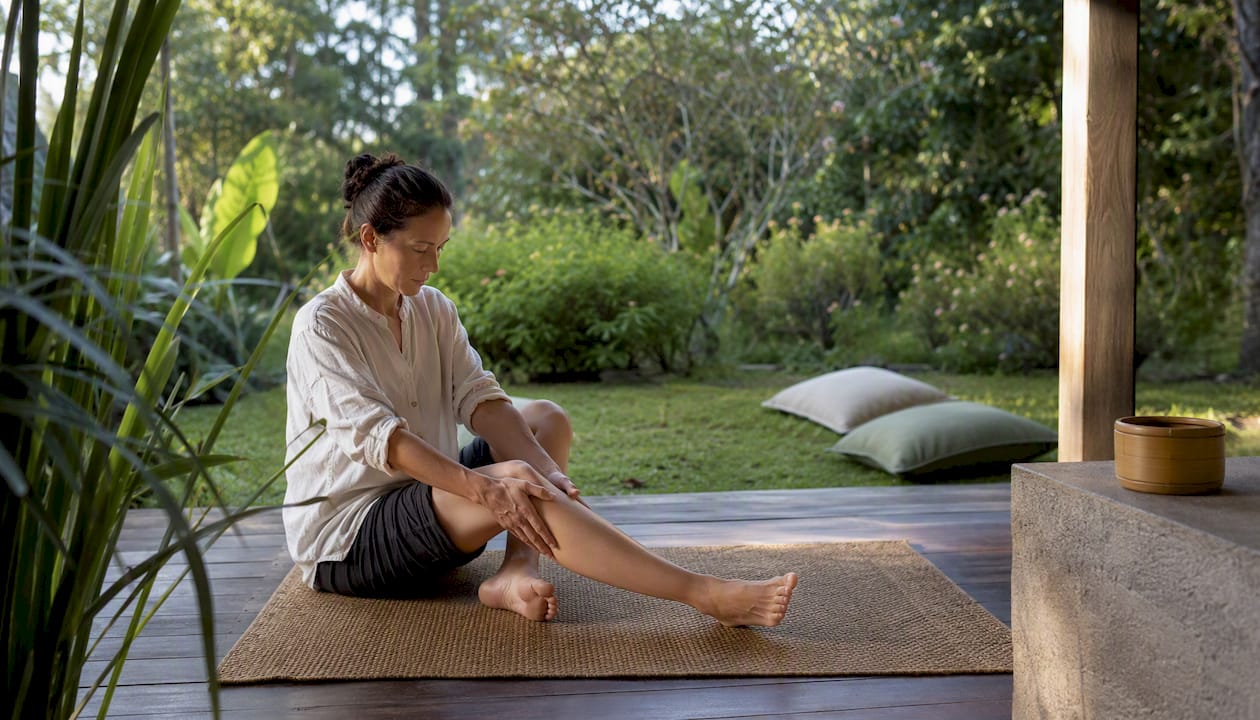
The key principle for progression, supported by the evidence-informed 8-week protocol, is to prioritize alignment and breath quality over raw time under tension. Short, frequent holds build the practice more safely than occasional long sessions.
Tracking your progress
Progress in standing qigong is subtle and cumulative. Keep a brief practice log and note the following after each session:
- Posture: Does your head feel more naturally balanced over your shoulders?
- Shoulder tension: Is there less tightness across the upper back compared to when you started?
- Leg endurance: How long before your legs begin to tremble or fatigue?
- Breath calm: Does your breath feel slower and fuller by the end of the hold?
- Energy sensations: Warmth, tingling, or a sense of heaviness in the hands are common signals that the practice is deepening.
One recovery day per week is enough for most beginners. If your legs feel genuinely sore rather than pleasantly worked, take an extra rest day and reduce your hold time by two to three minutes at the next session.
Common mistakes and how to correct them during practice
Most beginners make the same handful of errors, and all of them are easy to fix once you know what to feel for.
- Locked knees: The knees straighten fully, loading the joint and cutting off circulation. Fix: imagine you are hovering just above a chair seat. The moment you feel that slight engagement in the thighs, your knees are in the right place.
- Raised or tensed shoulders: Shoulders creep toward the ears within the first minute. Fix: exhale and consciously drop the shoulders on each out-breath. Imagine them melting away from your ears.
- Holding the breath: Concentration causes breath-holding, which creates tension rather than releasing it. Fix: count your exhales from one to five, then restart. The counting keeps breath moving.
- Collapsing the lower back: The pelvis tips forward, creating a pronounced arch. Fix: very gently engage the lower abdominals, as if you are protecting your belly from a light push. Do not over-tuck.
- Staring hard at a fixed point: A rigid gaze creates facial and neck tension. Fix: soften your gaze, let your eyes go slightly unfocused, as if looking at a distant horizon.
Understanding sensations: tension versus activation
Leg trembling during a hold is normal and generally healthy. It signals that your stabilizing muscles are engaging and your nervous system is recalibrating. Breathe through it and soften any area of the body that feels gripped. Sharp pain in a joint, however, is a stop signal. Dull muscular fatigue is productive; joint pain is not.
Pro Tip: Before you begin each session, scan your body from feet to crown and mentally "set" each body part: feet rooted, knees soft, belly relaxed, shoulders wide, crown lifted. This thirty-second internal check-in dramatically reduces the most common alignment errors before they start.
When to seek a teacher or medical professional
Seek in-person instruction if your trembling becomes uncontrollable, if you feel persistent dizziness across multiple sessions, or if you cannot maintain alignment despite following these cues. Consult a medical professional before beginning if you have a history of vertigo, severe balance disorders, or recent lower-body surgery.
Who should modify or avoid standing qigong?
Standing qigong is gentle by design, but certain conditions call for modification or medical clearance before you begin.
Modify or seek medical guidance if you have:
- Uncontrolled hypertension (high blood pressure): shorter holds and seated variations reduce cardiovascular load.
- Pregnancy: standing practice can continue with medical approval, but avoid deep knee bends and prioritize comfort over duration.
- Recent surgery on the knees, hips, or lower back: wait for clearance from your surgeon or physical therapist.
- Severe balance disorders or vertigo: practice near a wall or seated; avoid closed-eye variations.
- Acute musculoskeletal injury: rest the injured area and use breath-only or seated variations until healed.
- Varicose veins or circulation disorders in the legs: shorter holds and frequent movement breaks are advisable.
Practical modifications:
- Chair-supported zhan zhuang: Sit at the edge of a firm chair, feet flat on the floor, spine upright, arms in the Hun Yuan position. This delivers most of the breath and alignment benefits without leg loading.
- Wall support: Stand with your back lightly touching a wall for balance feedback. This is especially useful in the first week.
- Breath-only variation: If standing is not possible, lie on your back and practice the lower dantian breathing sequence alone. The mental focus component transfers directly to standing when you are ready.
This article is educational and not a substitute for individualized medical advice. If you have a specific health condition, please consult your healthcare provider before beginning any new movement or meditation practice.
Quick stress-relief variations and a look at Mi Zong postures
When you have only a few minutes, these three micro-practices deliver a meaningful reset without requiring a full session setup.
- Wuji breath pause (1–2 minutes): Stand in the low-arms position, feet shoulder-width apart. Close your eyes or soften your gaze. Take five slow belly breaths, counting each exhale. Let your shoulders drop on every out-breath. This is the simplest entry point and works anywhere.
- Short Hun Yuan hold (3–5 minutes): Adopt the tree-hugging arm position and hold for three to five minutes, focusing entirely on the breath and the warmth building in your palms. This is the fastest way to shift from mental agitation to calm alertness.
- Grounding-to-lower-dantian breathing (2–3 minutes): Stand in Wuji, place both hands over your lower abdomen, and breathe so that your hands rise on the inhale and fall on the exhale. Visualize warmth pooling behind your hands with each breath. This variation is particularly effective before sleep or after a stressful meeting.
Mi Zong standing postures: a brief overview
The Mi Zong system (sometimes called the Sacred Nine) organizes standing postures around elemental and celestial themes. Each posture emphasizes a slightly different energetic quality:
- Earth: Wide, grounded stance; emphasizes rooting and lower-body stability.
- Moon: Softer, more receptive arm position; cultivates calm and inward awareness.
- Mercury: Dynamic arm placement; supports mental clarity and quick energy circulation.
- Other postures in the system build progressively on these foundations, introducing more refined arm and hand configurations as the practitioner's alignment and endurance develop.
Mi Zong postures are typically introduced after a student has established a stable basic zhan zhuang practice, usually after six to eight weeks of consistent work.
Transitioning from stillness to movement qigong
When your standing hold ends, move into gentle walking or slow arm swings rather than stopping abruptly. This allows the nervous system to carry the calm of the standing practice into movement. Five Animal Qigong sequences pair naturally with standing practice: the stillness of zhan zhuang grounds the body, and the flowing movements of Five Animal forms then feel more connected and intentional. Many practitioners use a five-minute standing hold as an opening ritual before any movement qigong session.
Why standing practice is the foundation, not the bonus
Most students arrive wanting the moving forms. The flowing sequences look beautiful, and the idea of stillness can feel anticlimactic by comparison. What I have seen, teaching hundreds of students through White Tiger Qigong and Five Animal Qigong programs, is that the ones who commit to a regular standing practice develop better body awareness, calmer breath, and more genuine energetic sensitivity than those who skip it. Stillness is where you learn to feel what is actually happening in your body, not what you think should be happening.
The research supports this. Contemporary physiological surveys map zhan zhuang's effects onto autonomic regulation and cortical activation, providing a modern framework for what practitioners have described for centuries. And Harvard neuroscience reporting confirms that regular meditation practice can produce structural brain changes associated with reduced stress reactivity. Standing qigong sits at the intersection of both: it is meditation with a body.
My honest recommendation for anyone beginning: do not try to hold the posture for twenty minutes in week one. Five minutes of genuinely aligned, breath-aware standing does more for you than fifteen minutes of fidgeting through discomfort. Build the stress resilience slowly, and the practice will reward you with something that lasts.
Ready to deepen your practice with guided instruction?
Reading about zhan zhuang is a solid start. Practicing with a certified instructor is where the real shifts happen. At Qigongstar, Stella offers beginner-friendly live classes and on-demand courses rooted in White Tiger Qigong and Five Animal Qigong traditions, both certified through the White Tiger Qigong School and Yoga Alliance. Every program is designed for adults who want practical, safe instruction they can follow from home, with clear progression from your first five-minute hold to a full standing and movement practice.
The on-demand courses let you move at your own pace, revisit alignment cues as often as you need, and build a daily qigong routine that fits your schedule. Live classes add real-time instructor feedback, which makes a meaningful difference when you are learning to self-correct posture. View the full course catalog and find the program that fits where you are right now at Qigongstar's online courses page.
Sources
- Zhan Zhuang (Standing Meditation): Physiological Benefits and Guidelines
- Efficacy of Medical Qigong Standing Meditation
- PMC article on meditation and brain changes (open access)
- Zhan zhuang - Wikipedia
- Zhan Zhuang: Standing Like a Tree