
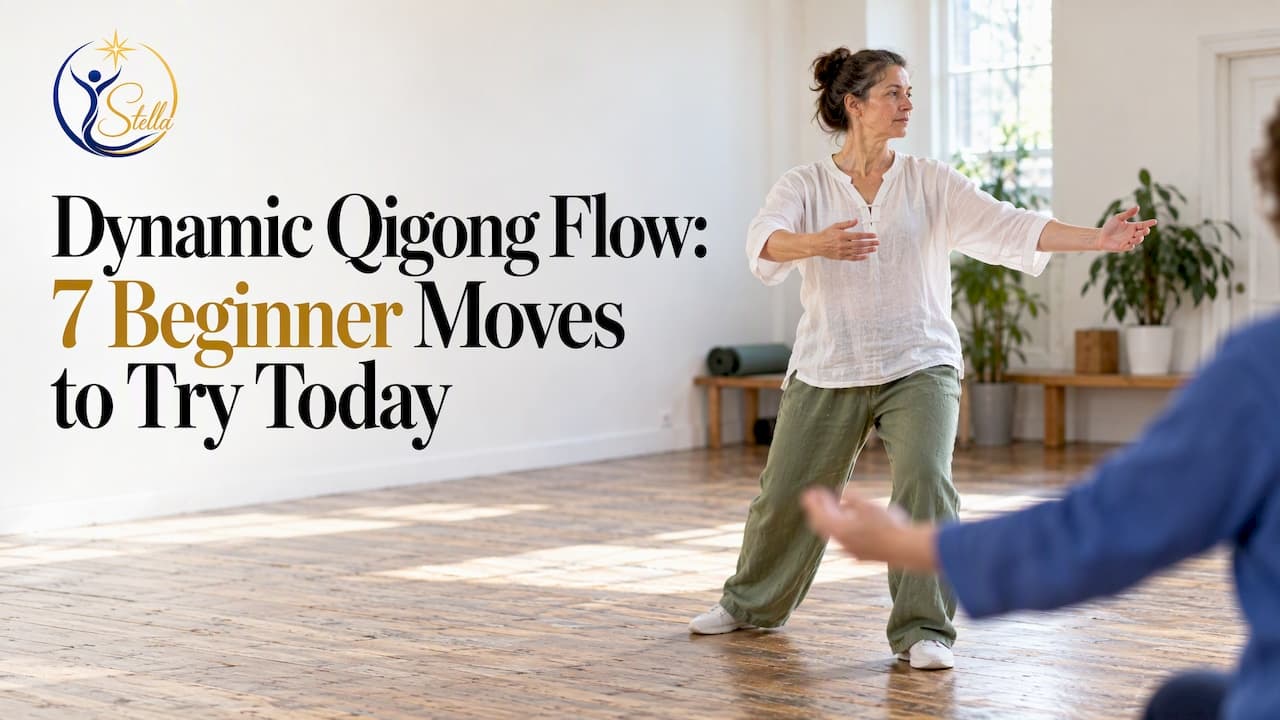
A dynamic qigong flow is a short, moving meditation that joins gentle movement, slow breath and calm attention, and a short daily practice is a sensible place to begin. Practiced regularly, it can help your energy circulate, ease stress and loosen stiff joints. Research suggests qigong may reduce stress, though the evidence has limits we explain below.
TL;DR:
- A 2014 analysis of seven randomized trials favored qigong for anxiety and stress, while a 2024 review found mixed results and low quality trials.
- A short session can include the warmup, settling breath, rising and sinking, waist turns, and cooldown; longer practice adds chest opening and cloud hands.
- Every movement can be done seated, and standing practice can use a smaller range or support; pregnancy, chronic conditions, or injury warrant clinician advice first.
- Stop if symptoms appear, rest, and resume more slowly; chest symptoms, marked dizziness, breathlessness, or new sharp pain require immediate emergency care.
Table of Contents
- What a dynamic qigong flow does for you
- A step-by-step dynamic qigong flow to try today
- Breathing and pacing: let your breath set the speed
- Modifications and safety: adapt the flow to your body
- How to make a short daily flow stick
- Why we teach this flow with certified guidance
- Why small and steady wins
- Guided qigong with our team
- FAQ
- Sources
What a dynamic qigong flow does for you
Think of a flow as meditation that moves. You shift your weight, lift and lower your arms, and let each breath guide the next movement. Qigong sits in the same family as tai chi and yoga, practices that health researchers group together as "meditative movement." Because the pace is slow, you can feel what your body is doing and soften as you go.
The research is encouraging but honest about its limits. A 2014 meta-analysis pooled seven randomized trials and found results favoring qigong for both anxiety and stress. A 2024 systematic review of nine trials on perceived stress found some significant reductions against no treatment, yet many of those trials were low quality and results against active comparison groups were inconsistent.
Pooled trials favor qigong for stress and anxiety, but trial quality is often low. Treat a daily flow as a complementary wellbeing practice, never a replacement for medical or psychological care.
Here is what most beginners notice first:
- A steadier sense of calm after practice
- A feeling of warmth and free-flowing energy in the hands and torso
- Easier, looser movement in the shoulders, hips and spine
- Slower, deeper breathing that carries into the rest of the day
A step-by-step dynamic qigong flow to try today
Stand with your feet hip-width apart, knees soft, and let your shoulders drop. Move slowly and let your breath lead. If you want more on each posture, our guide to beginner qigong moves breaks them down further.

Warm-up: Roll your shoulders, circle your wrists and ankles, and gently rock your hips. Feel your feet grounded on the floor.
Core sequence:
- Settling breath (4 breaths). Rest your hands on your lower belly. Inhale through the nose, exhale slowly, and feel your belly soften.
- Rising and sinking (8 repetitions). Inhale as your palms float up to chest height, exhale as they press gently down. Let your knees bend slightly on the way down.
- Opening the chest (6 repetitions). Inhale as your arms spread wide like opening a book, exhale as they return to center.
- Gentle waist turns (8 each side). Let your arms swing loosely as you rotate from the waist, breathing evenly.
- Cloud hands (6 each side). Shift your weight left and right while your hands trace slow circles in front of your body, one high and one low.
- Pushing the waves (6 repetitions). Exhale and push your palms forward as though moving water, inhale and draw them back.
- Reaching and releasing (4 repetitions). Inhale and stretch your arms overhead, exhale and fold them down the front of your body.
Cool-down: Rest your hands on your belly for three slow breaths, then shake out your arms and legs to release any leftover tension.
To fit your day, practice the warm-up, steps 1, 2 and 4, and the cool-down for a short session. For a longer session, add steps 3 and 5. To practise the full flow, include every step and repeat the core sequence once.
Pro Tip: Stop each movement a little before it feels like effort. A flow should leave you feeling lighter, never drained.
Breathing and pacing: let your breath set the speed
Your breath is the metronome of the whole practice. Use easy belly breathing: as you inhale, your lower belly gently expands, and as you exhale, it softens back. Tie opening, rising and reaching movements to the inhale, and closing, sinking and pushing movements to the exhale. Our instructor-backed guide to qigong breathing for beginners offers more cues if you want to go deeper.
If your breath turns short or strained, you are moving too fast or too far. Slow the sequence or shrink the range of motion until your breathing feels natural again.
- Never hold your breath at the top or bottom of a movement
- Avoid forceful or exaggerated breathing; keep it quiet and smooth
- Keep your knees slightly bent and your shoulders relaxed
- Let your exhale be a little longer and softer than your inhale
Modifications and safety: adapt the flow to your body
Qigong is gentle, but it is still exercise, so adapt it to how you feel on a given day. Every movement above can be done seated: keep your feet flat, sit tall, and let your arms do the rising, opening and pushing. Standing practitioners can shrink their steps, keep a hand near a wall or chair, or simply reduce how far the arms travel. If you are pregnant, managing a chronic condition or recovering from injury, choose seated or reduced-range versions and check with your clinician first. Our article on who should modify or avoid qigong practice covers this in more depth.
A safety review of Baduanjin reported occasional palpitation, giddiness, knee pain, backache, fatigue and dizziness. Monitoring for adverse events in that review was inconsistent.
If a mild symptom appears, stop, rest, and return with a smaller range or slower pace. For chest symptoms, marked dizziness, breathlessness or a new sharp pain, seek immediate emergency care. Pleasant sensations are not a target, so never push through discomfort to chase them.
How to make a short daily flow stick
Consistency beats intensity. Begin with a short practice and let the habit settle before you ask more of it.
- Stack it: Practice right after brushing your teeth, after your morning tea, or as a lunchtime reset
- Progress slowly: Gradually extend your practice, or add one new movement, as it starts to feel comfortable
- Use cues: Leave your practice space clear, or place a chair or mat where you will see it
- Track simply: Tick a calendar each day you practice and enjoy the growing chain
Our daily qigong routine for stress reduction shows one way to string these habits together, and our short routine for performance anxiety suits busy days. Good rest and nourishment support any movement practice too, and a site like thecary offers complementary wellness reading.
Why we teach this flow with certified guidance
Our instruction comes from a White Tiger Qigong certified instructor who is also accredited by Yoga Alliance. That training matters because video alone cannot show you whether your knees are tracking well or your shoulders are holding tension.
- Certified guidance helps you spot small alignment habits early
- A teacher can adapt each movement to your joints, balance and energy
- Structured progression keeps you from adding too much, too soon
When you are ready for more, our online courses and classes offer self-paced, on-demand learning, and a short clarity session gives you personal feedback.
Why small and steady wins
The people who keep going are almost always the ones who began with a few unhurried minutes. Qigong rewards gentleness and repetition, not heroics. Listen to your body, keep the movements soft, and try the short routine today. You may be surprised how much a few quiet minutes can change the rest of your day.
— Stella
Guided qigong with our team
If you would like a teacher beside you, we offer several beginner-friendly paths. Our on-demand course, Qigong for Stress Relief and Digestive Wellness, costs £116 one-off and lets you learn at your own pace. If you prefer personal feedback, our 30-Min Clarity Session is £85 and suits a single goal or question, while our 60-Min Deep Dive Online Session at £145 gives you room to work through the whole flow. We also run group classes, and you can find every option on our online qigong classes page. Choose a session when you want guidance now, or a course when you want steady structure.
Pick the option that fits your week and book your first class today.
FAQ
What is qigong similar to?
Qigong is most similar to tai chi and yoga. All three are "meditative movement" practices that combine gentle motion, breath control and focused attention. Qigong tends to use simpler, repeated movements, which makes it approachable for beginners.
How do I make my qi flow?
Move slowly, breathe deeply into your belly, and keep your joints soft. Coordinating each movement with an inhale or exhale helps the sense of flowing energy build naturally. Consistent short sessions work better than occasional long ones.
What is qigong deviation?
Qigong deviation is a traditional term for unpleasant symptoms that can follow forcing the practice, such as dizziness or tension. Safety reviews note occasional dizziness and fatigue in qigong trials, so keep your practice gentle. If symptoms appear, stop, rest and speak with an instructor or clinician.
Is qigong a fascia release?
Qigong is not a dedicated fascia release technique. Its slow, flowing movements can loosen and mobilize the body, but it is not a clinical treatment for connective tissue. Think of it as gentle movement that supports mobility.
Sources
- Pubmed
- The Safety of Baduanjin Exercise: A Systematic Review
- Qigong Therapy for Stress Management: A Systematic Review of Randomized Controlled Trials