
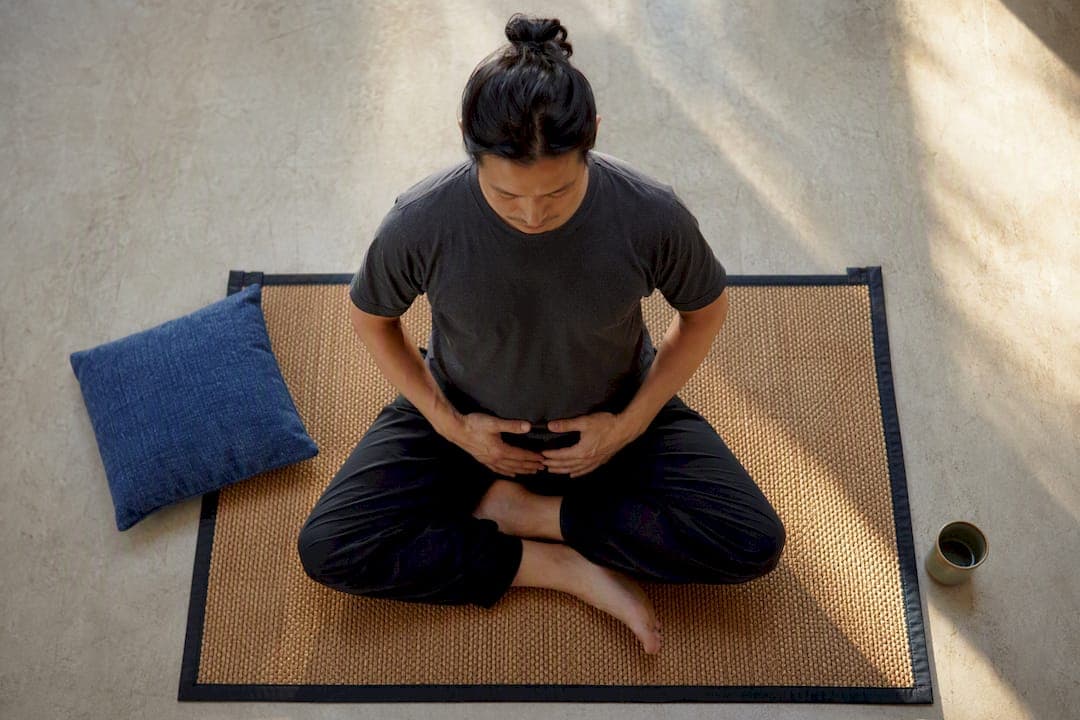
Dan tian breathing is a lower-abdomen focused qigong technique that anchors attention on your body's energetic center to calm the nervous system and, in its more active form, sharpen focus and grounding. A randomized study on Shaolin Dan Tian Breathing found measurable brain changes after just 15 minutes of daily practice for one month. That single detail tells you almost everything you need to know before committing to it.
TL;DR:
- Passive Dan Tian Breathing enhances relaxation indicators in the brain, while Active Dan Tian Breathing improves sustained attention markers after one month of daily practice.
- Reverse abdominal breathing recruits more muscle engagement and creates greater joint stiffness, making it suitable for power and stability but not relaxation.
- A typical beginner routine involves three to five minutes of Passive practice, gradually extending to 15 minutes over four weeks, with caution around strenuous or reversed techniques.
- Small, precise adjustments such as hand placement and relaxed shoulders significantly improve practice effectiveness and comfort for beginners.
- Guided instruction is highly recommended to correct subtle habits and ensure proper technique, especially when integrating active or reverse breathing methods.
Table of Contents
- What Is Dan Tian Breathing and How Does It Differ From Reverse Breathing?
- What Does the Research Say About Dan Tian Breathing Benefits?
- How Do You Practice Dan Tian Breathing as a Beginner?
- Who Should Be Careful With Dan Tian Breathing, and When Should You Stop?
- What Do Teachers Notice That Beginners Usually Miss?
- Where Can You Learn More About Dan Tian Breathing?
- Why I Teach Dan Tian Breathing the Way I Do
- Ready to Learn Dan Tian Breathing With Guided Support?
- Sources
What Is Dan Tian Breathing and How Does It Differ From Reverse Breathing?
Your lower dantian sits roughly two to three finger widths below your navel, deep inside your pelvis. Traditional Chinese medicine and martial arts lineages treat this spot as your body's energetic reservoir, but you do not need to buy into any metaphysics to use it as a breathing anchor. Place one or both palms just below your belly button, sit or stand comfortably, and notice how that area moves as you breathe. That gentle rise and fall under your hands is your reference point for everything else.
Dan tian breathing splits into two distinct approaches, and confusing them is the most common beginner mistake.
Passive Dan Tian Breathing (Passive DTB) asks you to simply observe. You close your eyes, breathe naturally through your nose, and let your attention rest on the lower dantian without trying to control or exaggerate the movement. It feels closer to meditation with a physical anchor than to a breathing exercise. The Shaolin Dan Tian Breathing study describes this passive observation as the relaxation-inducing half of the practice.
Active Dan Tian Breathing (Active DTB) is more effortful. You engage the abdominal muscles and the pelvic floor gently on the exhale, often with eyes open, and you alternate this active phase with passive rounds rather than sustaining it continuously. The full study protocol alternates the two forms, and that alternation appears to be part of why it produces both calming and alerting effects rather than just one or the other.
Then there is reverse abdominal breathing, sometimes called Taoist reverse breathing, which flips the mechanics entirely. Instead of your belly expanding on the inhale like normal diaphragmatic breathing, the abdomen draws inward as you breathe in and releases outward as you exhale. Reverse breathing is a traditional qigong and internal martial arts technique, used historically to generate power and stability rather than relaxation. It recruits muscles you would not otherwise engage during quiet breathing, which is exactly why it tends to feel activating rather than calming.
Here is how the three compare at a glance:
- Passive DTB: eyes closed, natural breath, attention resting on the lower dantian, calming.
- Active DTB: eyes open or soft focus, gentle abdominal and pelvic engagement on exhale, alerting.
- Reverse abdominal breathing: belly contracts on inhale, expands on exhale, effortful and activating.
- Normal diaphragmatic breathing: belly expands on inhale, contracts on exhale, the baseline pattern most people already use.
Martial artists and qigong practitioners have used variations of these techniques for centuries to build what they describe as internal power and rooted stability. Modern research is only now catching up to explain what is actually happening physiologically, and the next section walks through what that research shows.
What Does the Research Say About Dan Tian Breathing Benefits?
The most cited study on this topic is a randomized, controlled neuro-electrophysiological trial on Shaolin Dan Tian Breathing. Participants trained for one month, averaging about 15 minutes of daily practice, and researchers tracked their brain activity with EEG before and after. The results split cleanly along the Passive/Active divide described above.
Passive DTB produced increased temporal alpha asymmetry, an EEG marker associated with relaxation, while Active DTB produced increased theta coherence, a marker linked to sustained attention. The same practice, performed two different ways, nudged the brain in two different directions.
That distinction matters for anyone deciding which form to practice on a given day. If you need to unwind after a stressful shift, Passive DTB is the better tool. If you need to concentrate before a demanding task, the Active form, done briefly, appears to serve that purpose instead.
The full-text version of the study also includes a smaller fMRI observation from four experienced practitioners. Passive DTB correlated with activation in the cingulate cortex, a region tied to emotional regulation, while Active DTB correlated with activity in the amygdala and parahippocampal region, areas involved in alertness and memory. Four participants is not enough to draw firm conclusions, but the pattern is consistent with the EEG findings and gives a plausible mechanism for why the two forms feel so different in practice.
Statistic to remember: a month of dan tian breathing with regular daily practice produced measurable shifts in brain wave patterns in a controlled study. That is a realistic, achievable target for a beginner, not an aspirational one.
Reverse abdominal breathing has its own separate body of evidence, and it points in a different direction entirely. A 2025 biomechanics study on Tai Chi practitioners found that reverse breathing significantly increased peak force in several lower-limb muscles, including the gluteus maximus, rectus femoris, and biceps femoris, along with greater stiffness in the knee and ankle joints. In plain terms, reverse breathing recruits more muscle and creates a firmer, more stable base through the legs. That is useful information if your goal is postural stability or martial power, but it also explains why reverse breathing rarely feels relaxing. It is closer to a light isometric workout than a calming exercise.
Where does dan tian breathing fit within the broader evidence on breathwork generally? Meta-analyses of structured breathing practices consistently find small but real reductions in stress and anxiety symptoms across a range of techniques, though direct evidence specific to reverse breathing remains limited. This is worth sitting with: breathwork of almost any structured kind tends to help a little, dan tian breathing has study-specific evidence for calm and attention, and reverse breathing has separate evidence for muscular and postural effects. None of these techniques are a cure for anxiety disorders or chronic stress on their own, and the honest takeaway is that they are a well-supported complement to your routine rather than a replacement for medical care when symptoms are severe.
What can you expect on a realistic timeline? Most people notice a subjective sense of calm within the first few sessions of Passive DTB, simply because slowing down and directing attention inward has an immediate quieting effect. The measurable EEG changes documented in the research took a full month of consistent practice to appear, which is a useful benchmark: the felt sense of relaxation comes quickly, but the deeper neurological shift is a month-long project, not a one-off session.
How Do You Practice Dan Tian Breathing as a Beginner?
Getting started does not require special equipment or a lot of space. It does require patience with the sequence, because rushing straight into Active DTB or reverse breathing before you are comfortable with the basics is where most people go wrong.
- Set up your posture. Sit on a chair with your feet flat on the floor, or stand with knees soft and slightly bent. Keep your spine long but not rigid. Standing practice pairs well if you already enjoy standing qigong meditation.
- Place your hands. Rest both palms gently on your lower belly, just below the navel, one hand over the other. This gives you immediate tactile feedback on how much or how little your abdomen is moving.
- Soften before you start. Drop your shoulders, relax your jaw, and let your chest stay quiet. Most of the movement should happen at your hands, not your upper chest.
- Begin with Passive DTB. Close your eyes. Breathe in slowly through your nose and simply notice your lower dantian rise under your palms. Breathe out through your nose and notice it fall. Do not force or exaggerate the movement, just observe it. Practice for 3 to 5 minutes.
- Add Active DTB in short sets once Passive feels natural. Open your eyes or keep a soft downward gaze, and on the exhale, gently engage your lower abdominal muscles, drawing them in slightly. A workable rhythm mirrored in the research protocol is roughly five passive breaths to one active breath, so you get far more calming input than activating input in any given session.
- Build toward the study benchmark gradually. Over a few weeks, extend your combined Passive and Active practice toward 15 minutes a day, matching the average duration used in the randomized DTB study. There is nothing magic about that number, but it gives you a concrete target instead of an open-ended "practice more."
- Only introduce reverse breathing once diaphragmatic breathing feels effortless. Try it for 60 to 90 seconds at a time: draw your belly in as you inhale, let it release outward as you exhale. Stop if it feels forced or leaves you tense rather than energized, and return to normal breathing.
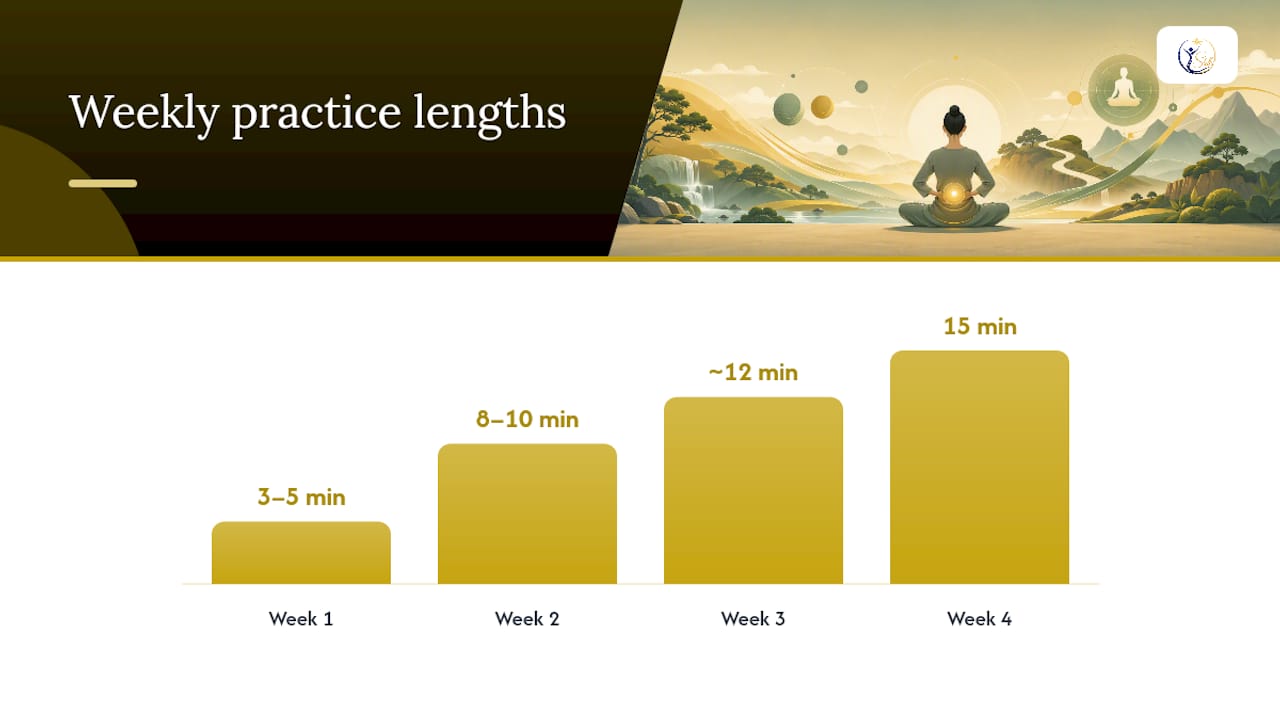
A sensible four-week progression looks like this: week one, Passive DTB only, 3 to 5 minutes daily. Week two, add short Active DTB sets within the same session, building to 8 to 10 minutes total. Week three, extend toward 12 minutes and, if you are curious, add brief reverse breathing rounds separately. Week four, aim for the full 15-minute session that mirrors the study protocol, keeping the passive-to-active ratio weighted toward calm.
Pro Tip: Practice at the same time each day, even if it is only for five minutes. The EEG changes documented in the research came from consistent daily repetition, not from occasional long sessions.
Who Should Be Careful With Dan Tian Breathing, and When Should You Stop?
Dan tian breathing is gentle by design, but reverse breathing and extended Active DTB sessions ask more of your body and deserve real caution. A small number of people notice lightheadedness, tingling, or a wave of mild anxiety when they first practice, usually from breathing too deeply or too fast rather than any deeper problem.
If any of the following happens, stop the exercise, return to your normal relaxed breathing, and sit down if you are standing:
- Lightheadedness, dizziness, or tingling in your hands or face
- A sudden rise in anxiety or a racing heart during practice
- Chest tightness or shortness of breath that feels different from normal exertion
- Any sharp or unusual pain
Certain people should check with a doctor before starting, particularly reverse breathing, which increases intra-abdominal pressure and muscular effort: those with uncontrolled high blood pressure, anyone who has had a recent cardiac event, pregnant practitioners, and people with severe respiratory conditions like advanced COPD. This caution applies just as much to reverse breathing as it does to any vigorous Active DTB set, since both increase muscular and cardiovascular demand.
If a full session feels like too much, scale it back rather than pushing through. Shorten your rounds to 60 to 90 seconds, drop back to plain diaphragmatic breathing until you feel steady, or practice seated with support behind your back instead of standing. There is no prize for forcing your way through discomfort in a practice meant to calm you down.
What Do Teachers Notice That Beginners Usually Miss?
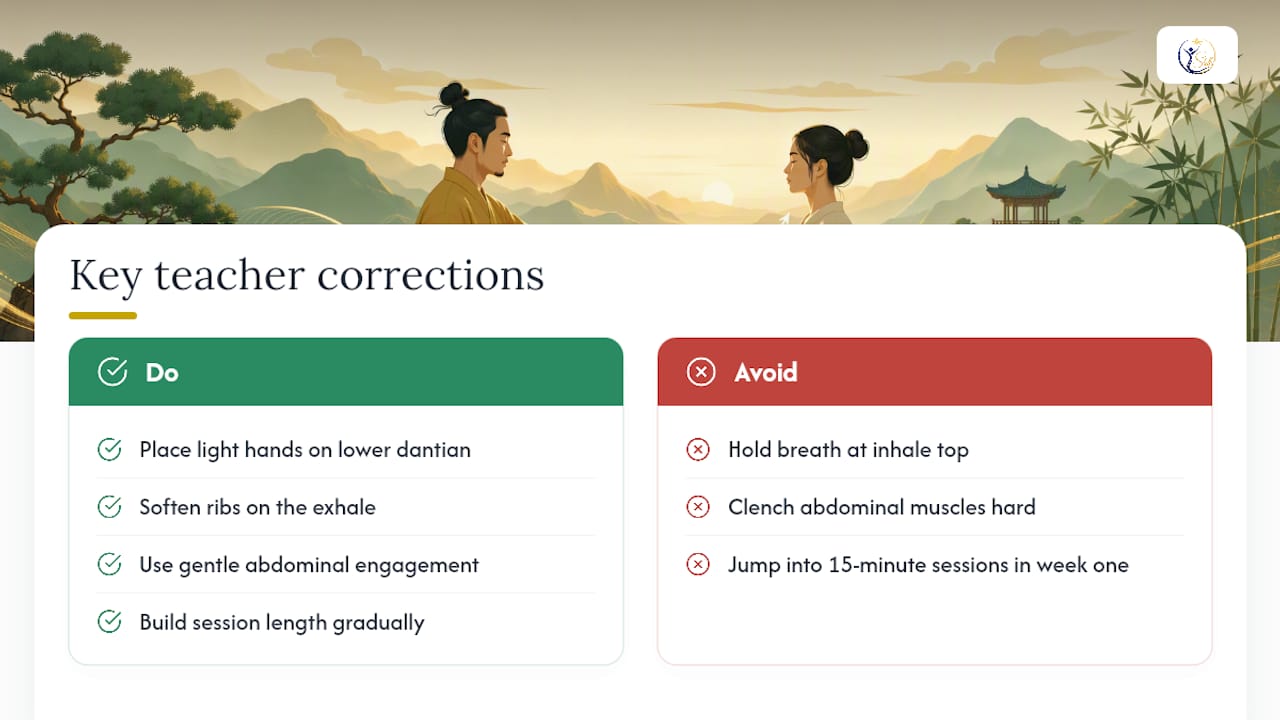
A few small adjustments separate a beginner fumbling through the motions from someone who actually feels the practice working. Light pressure from your hands on the lower dantian gives your nervous system a clearer signal than breathing alone, so do not skip the hand placement even once you know the pattern by heart. Softening your ribs slightly on the exhale, rather than letting your shoulders creep up, keeps the movement low and contained where it belongs.
The three mistakes I see most often: holding the breath at the top of the inhale instead of letting it flow into the exhale, clenching the abdominal muscles hard during Active DTB when a gentle engagement is enough, and jumping straight into 15-minute sessions in week one instead of building up gradually. Any one of these turns a calming practice into a tiring one.
For practitioners who want to go further, there is an advanced cue worth knowing: resting the tongue lightly on the roof of the mouth and adding a subtle upward lift through the pelvic floor during Active DTB. Some practitioners report this sharpens their sense of the lower dantian considerably, though it is an optional refinement, not a requirement, and worth attempting only once the basic pattern feels effortless.
This kind of detail is exactly where guided instruction earns its value over solo practice from an article or video. Stella teaches dan tian breathing as part of White Tiger Qigong training, holding certification through the White Tiger Qigong School and Yoga Alliance, and the difference between reading about hand placement and having someone adjust yours in real time is considerable.
Where Can You Learn More About Dan Tian Breathing?
The two studies referenced throughout this piece are worth reading directly if you want the full methodology behind the claims. The Shaolin Dan Tian Breathing randomized trial lays out the EEG protocol and relaxation and attention findings in accessible detail, and the full-text version adds the fMRI observations and Passive/Active alternation patterns for readers who want the deeper mechanics. The 2025 Frontiers study on reverse abdominal breathing covers the muscular and joint-stiffness findings for anyone curious about the martial arts and postural stability side of the practice.
If you want a broader primer before diving into dan tian breathing specifically, this guide to breathwork styles and this piece on the role of breath in qigong offer useful context. For balance and postural stability applications tied to the biomechanics research above, this resource on balance training is a solid next stop.
If you decide to find a teacher in person or online, ask directly about their certification lineage and how many years they have taught breathwork specifically, since qigong instruction varies widely in depth and quality.
Why I Teach Dan Tian Breathing the Way I Do
Most students who come to me for stress relief or digestive complaints have already tried generic "deep breathing" advice and found it did not stick. What changes that, in my experience, is giving them a specific anchor point and a specific sequence, which is exactly why the Passive-to-Active structure matters so much. Vague instructions to "breathe deeply" rarely hold anyone's attention for more than a minute. A hand on the lower dantian, a clear rhythm, and a known progression toward a real target give the nervous system something concrete to settle into.
The conventional wisdom treats breathwork as something you can pick up entirely from an article or a video, and for the first week or two, that is often true. Where it breaks down is in the fine adjustments: whether your shoulders are quietly creeping up, whether your exhale is rushed, whether you are gripping your abdomen instead of gently engaging it. Those are the details a live teacher catches in seconds and a solo practitioner might miss for months. I have watched students correct a single small habit in one session and feel the difference immediately, which is the entire case for learning with guidance rather than in isolation.
— Stella
Ready to Learn Dan Tian Breathing With Guided Support?
Reading through the mechanics of Passive DTB, Active DTB, and reverse breathing gets you started, but nothing replaces having someone watch your posture and adjust your hand placement in real time. That is the gap between a helpful article and actual skill, and it is the gap White Tiger Qigong is built to close.
White Tiger Qigong is the course I built specifically around breath regulation, dan tian awareness, and stress and digestive relief, taught live so you get real feedback instead of guessing whether you are doing it right. If you would rather move through a full-body flow that incorporates breathwork into dynamic movement, Five Animal Qigong is the better starting point. Both formats include live sessions alongside on-demand access, so you can practice on your own schedule while still getting corrections when something feels off. Browse the full course lineup to see which format fits your week, and book your first live class to get direct feedback on your dan tian breathing within your first session.
Sources
- Shaolin Dan Tian Breathing fosters relaxed and attentive mind: randomized neuro-electrophysiological study (2011)
- Shaolin Dan Tian Breathing fosters relaxed and attentive mind (full text)
- The impact of reverse abdominal breathing on lower limb muscle strength and muscle synergy characteristics in Tai Chi Chuan (2025)