

Qigong can genuinely calm shoulder tension and restore mobility for many people, though it will not repair a torn rotator cuff or replace a diagnosis. If your shoulder has ached for weeks or feels stiff on waking, a short mobility sequence like the one below is a safe place to start. Clinical trials on qigong exist, and Qigong instruction can be informed by that evidence while being adapted for practical teaching.
TL;DR:
- Qigong is as effective as traditional exercise for shoulder pain relief but should be used as part of a broader rehabilitation plan rather than a sole treatment.
- Those with recent shoulder surgery, infections, or severe nerve symptoms should avoid or modify practice and consult a healthcare professional first.
- Consistent daily practice of brief, gentle movements over several weeks yields better results than sporadic or intense sessions.
- The 2024 trial found no significant difference in pain improvement between qigong and conventional therapy, but both showed meaningful self-reported progress.
- Safe practice involves slow, breath-paced movements, with modifications for injuries or stiffness, emphasizing avoiding sharp pain or numbness.
Table of Contents
- Qigong Exercises for Shoulder Pain You Can Try Right Now
- Is Qigong Safe for Your Shoulder Right Now?
- Does the Research Actually Support Qigong for Shoulder Pain?
- Caring for an Acute Shoulder Alongside Your Practice
- How Often Should You Practice, and What Should You Expect?
- Why Stella Teaches Shoulder Qigong This Way
- An Honest Editorial Take on Qigong for Shoulder Pain
- Ready for Structured Guidance Beyond the Basics?
- Sources
Qigong Exercises for Shoulder Pain You Can Try Right Now
You don't need a studio, a mat, or thirty spare minutes. Five minutes of mindful movement, done with attention to your breath, is enough to start loosening the fascia and muscle guarding that build up around a sore shoulder. Move slowly. Let your breath set the pace, not the other way around.
- Scapular lifts. Sit or stand tall. Inhale as you lift both shoulder blades toward your ears, hold for one breath, then exhale as you let them melt down your back. Repeat 6 to 8 times, feeling the space open between your neck and shoulders.
- Shoulder blade rolls. Draw slow circles with your shoulder blades, not just your shoulders. Roll them up, back, down, and forward, four times each direction, breathing continuously rather than holding your breath through the motion.
- Teacup exercise. Imagine holding a small cup of tea in each hand. Rotate your palms up and out as you inhale, then turn them down and in as you exhale, keeping elbows soft and close to your ribs. This wakes up the rotator cuff muscles without loading the joint.
- Gentle diagonal lifts. Reach one arm slowly across your body and up on an inhale, following your fingertips with your eyes, then lower on the exhale. Alternate sides for 6 reps each. Stop the range well before any pinching sensation.
- Wrist-to-shoulder breath stretch. Rest your fingertips on your shoulder, then slowly circle your elbow forward on the inhale and back on the exhale. This small-range move is often the most comfortable one for an irritated shoulder.
Every move above has a seated version. If standing aggravates your neck or balance, do the entire sequence in a chair with your feet flat on the floor. For a guided walk-through with cueing on pacing, our 5 minute qigong routine for shoulder mobility covers the same five exercises with timing built in, and readers with limited standing tolerance may prefer the seated qigong exercises sequence instead.
Strung together with a slow breath count, these five moves take about five minutes and can be repeated two or three times through for a fuller ten to fifteen minute practice.
Pro Tip: Most people accidentally shrug or hunch their neck to compensate when a shoulder feels weak. Before each movement, gently draw your shoulder blade down and back, as if tucking it into your back pocket, then let the arm follow. Moving from the shoulder blade first, rather than the hand, keeps the neck muscles out of work they were never meant to do.
Is Qigong Safe for Your Shoulder Right Now?
Qigong's slow, low-impact nature makes it appropriate for most people with shoulder discomfort, but a handful of situations call for caution or a modified approach. Skip or postpone practice, and check with a clinician first, if any of these apply to you:
- Recent shoulder surgery or a known acute fracture
- Active infection in or around the joint
- A corticosteroid injection within the past 48 hours
- Severe or worsening numbness, tingling, or weakness down the arm
- Sudden, sharp pain that appeared without a clear cause
If none of those apply but your shoulder still feels fragile, simply shrink the range of motion. Lift your arm only as far as feels easy, hold each shoulder blade movement rather than rolling through pain, and favor the seated variations detailed in our qigong contraindications guide if you're managing arthritis or a prior injury alongside the pain.
Stop immediately if a movement produces sharp, localized pain or new numbness, and regress to a smaller range the next time you practice. The NHS advises seeking medical evaluation if conservative self-care hasn't improved things within about two weeks, since that window helps rule out structural problems like a rotator cuff tear or significant bursitis that gentle movement alone won't resolve. Bring notes on exactly which movements are limited. That detail helps a clinician assess you faster than a vague description of "shoulder pain" ever will.
Does the Research Actually Support Qigong for Shoulder Pain?
The most direct answer comes from a 2024 randomized controlled trial of 105 people with subacromial pain syndrome, comparing Yi Jin Bang qigong against conventional exercise therapy over 16 weeks. The result was a tie: the trial found no statistically significant difference between groups on the Shoulder Pain and Disability Index, with a mean difference of just 0.14 points. Both groups, however, improved enough within themselves to exceed the threshold researchers consider clinically meaningful.
That is a more encouraging finding than it first sounds. It suggests qigong isn't inferior to standard physiotherapy exercise for this common shoulder condition, at least for the population studied, even though it isn't proven superior either.
Broader evidence is more mixed. The NCCIH's review of qigong research across musculoskeletal conditions found inconsistent results between studies, though it consistently flagged qigong as low risk, with side effects limited to occasional muscle soreness. Smaller trials on related pain conditions, including fibromyalgia, reported real improvements in pain, sleep, and quality of life after 8 to 10 weeks of daily practice.
| Evidence source | What it measured | Finding |
|---|---|---|
| 2024 Yi Jin Bang RCT (n=105) | SPADI at 16 weeks vs. conventional exercise | No between-group difference; both groups improved |
| NCCIH systematic review | Pain/function across musculoskeletal conditions | Mixed results; generally safe |
| Fibromyalgia qigong trials | Pain, sleep, quality of life (8 to 10 weeks) | Statistically significant improvement |
The practical takeaway is straightforward: qigong appears to match, not beat, conventional home exercise for shoulder pain, and it carries a favorable safety profile. Treat it as one solid piece of a rehabilitation plan rather than a stand-alone fix, especially when a structural injury is suspected.
Caring for an Acute Shoulder Alongside Your Practice
Qigong pairs naturally with basic first-line self-care, and combining the two tends to work better than either alone. In the first 48 hours after a flare, ice calms inflammation; after that window, heat often feels better for loosening stiff tissue. The NHS recommends applying either for 15 to 20 minutes at a time.
- Always wrap ice or a heat pack in a cloth. Never apply either directly to bare skin.
- Keep the shoulder moving gently rather than immobilizing it in a sling for days on end.
- Short-term over-the-counter NSAIDs can help with pain, but check with a pharmacist or doctor before extended use.
- Mention your qigong practice to a physiotherapist if you're already in treatment. It fits well alongside prescribed strengthening or motor-control exercises rather than replacing them.
Think of qigong as the gentle, daily thread that keeps your shoulder moving between formal physiotherapy sessions, not a competing treatment.
How Often Should You Practice, and What Should You Expect?
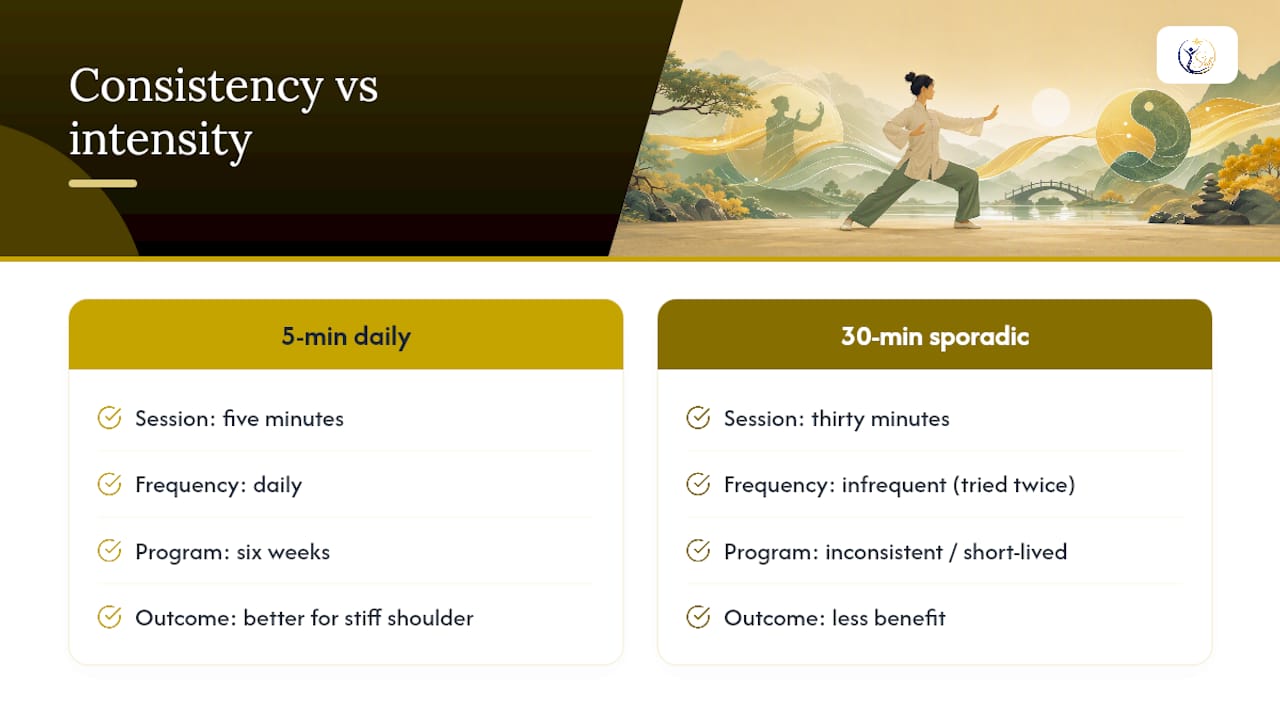
Consistency matters more than intensity here. Start with 10 to 15 minutes, three to five times a week, and give yourself four to eight weeks before judging results.
- Weeks 1 to 2: Practice the five-move sequence daily if you can manage it, focusing purely on form and breath, not depth of stretch.
- Weeks 3 to 4: Add a second short round of the sequence, or extend hold times slightly, once movements feel familiar and pain-free.
- Weeks 5 to 8: Track simple markers: can you reach a shelf overhead without wincing, is morning stiffness shorter, does reaching behind your back feel easier.
Pair short daily micro-practices with one longer guided session a week, whether that's a recorded class or live instruction, to refine form you can't always self-correct in a mirror.
Why Stella Teaches Shoulder Qigong This Way
Shoulders carry stress differently than any other joint. The shoulder-focused routines are designed based on experience teaching White Tiger Qigong and Five Animal Qigong to students with various conditions, including desk-job stiffness and arthritis flares.
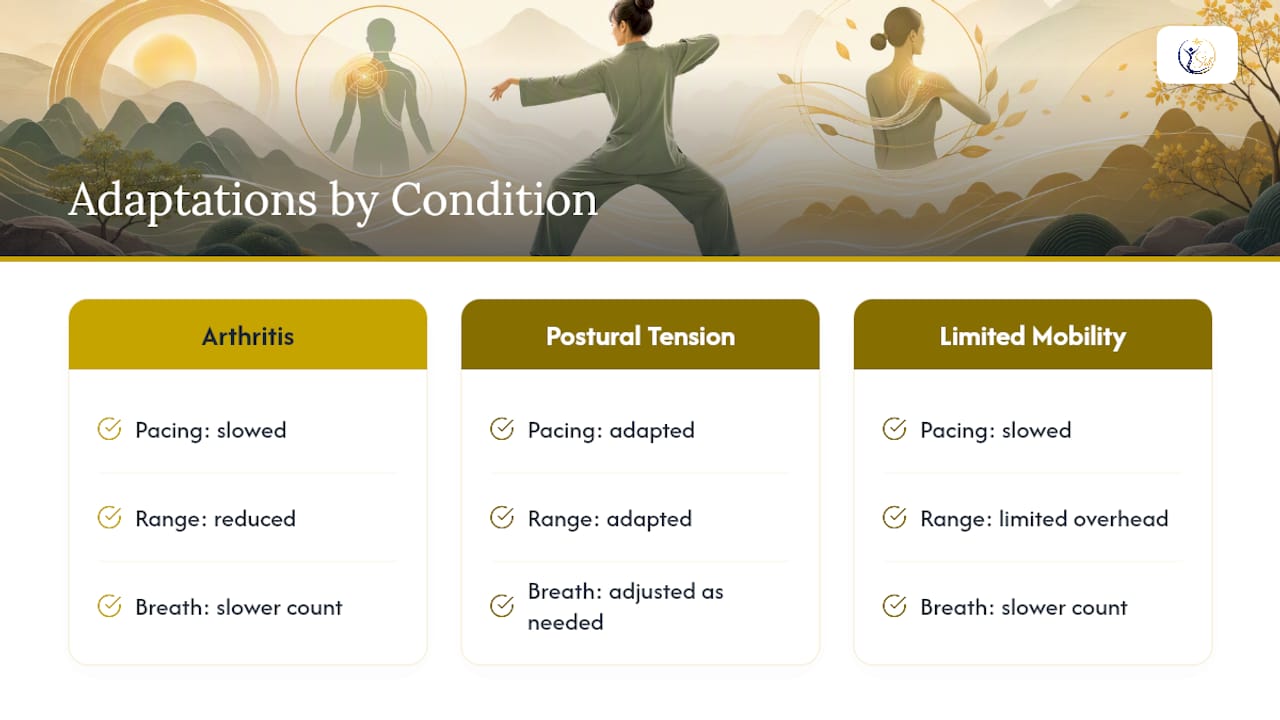
Rather than one-size-fits-all sequences, QigongStar adapts pacing and range for arthritis, postural tension, and limited overhead mobility, often slowing the breath count for anyone who needs more time in each position. For related adaptations, see the qigong for arthritis guide.
An Honest Editorial Take on Qigong for Shoulder Pain
The research supports a modest, useful claim: qigong performs about as well as conventional home exercise for shoulder pain, and it carries almost no downside risk. That is a smaller victory than wellness marketing usually promises, and it's a more honest one.
Where conventional advice falls short is the framing. Too many resources present exercise therapy and gentle mind-body practice as competing camps, when the 2024 trial data actually points toward equivalence. The real failure isn't choosing qigong over physiotherapy or vice versa. It's doing neither consistently enough to matter.
If you take one thing from this article, prioritize consistency over intensity. A five-minute sequence done daily for six weeks will do more for a stiff shoulder than an ambitious thirty-minute session attempted twice before you quit. Qigong's real strength is that its low physical demand makes daily repetition genuinely sustainable, which is precisely the variable most rehabilitation plans quietly fail on.
— Stella
Ready for Structured Guidance Beyond the Basics?
A short home sequence can ease tension, but many people find they progress faster with structured cueing, breath pacing, and someone correcting subtle form habits they can't catch alone. That's the gap QigongStar's courses are built to close. The White Tiger Qigong and Five Animal Qigong programs offer self-paced, on-demand modules alongside live classes, with progressions and accessibility adaptations built in for stiff shoulders, arthritic joints, and beginners who've never tried qigong before.
These formats suit two kinds of readers especially well: total beginners who want clear cueing rather than guesswork, and anyone who has hit a plateau with a self-taught routine and wants real-time feedback on form. Browse the online qigong classes to see current live and on-demand options, and pick a start date that fits your week.
This article is general information, not a substitute for advice from a qualified doctor. Consult a qualified healthcare professional about your own circumstances before acting on anything here.
Sources
- Effects of Yi Jin Bang versus conventional exercise therapy in people with subacromial pain syndrome: A randomized controlled trial
- Shoulder pain - NHS
- Qigong: What You Need To Know - NCCIH
- Randomized clinical trials of qigong for fibromyalgia and related outcomes